
量子加密

Search documents
真正的未来,由青年定义 | 创业邦2026「新青年创投榜」调研启动!
创业邦· 2026-03-13 04:11
Core Insights - The article highlights the emergence of young entrepreneurs and investors in the hard technology sector, emphasizing their role in addressing complex problems and driving innovation [2][3]. Group 1: Young Entrepreneurs - Peter Steinberger, an Austrian developer, created PSPDFKit, a PDF rendering tool, which has become a crucial component in thousands of applications globally [2]. - The "35 Under 35 Entrepreneur Pioneers" list by Chuangyebang has consistently recognized that true innovation often occurs in quiet persistence rather than in the spotlight [2]. - By 2025, the average funding for the 30 young entrepreneurs listed reached nearly 400 million, with all having completed at least two rounds of financing, indicating a robust entrepreneurial ecosystem [2]. Group 2: Young Investors - The "40 Under 40 Investors" list features investors with an average age of 37.5 years, with 60% holding partner-level positions, showcasing a young and dynamic investment landscape [3]. - A significant 72.5% of these investors focus on early-stage projects, while 82.5% invest in growth-stage companies, reflecting a commitment to nurturing innovation from the ground up [3]. - Over the past three years, their exit cases have yielded an average return of 11.7 times, underscoring the value of long-term engagement and professional judgment in investment [3]. Group 3: Emerging Trends - The article identifies key areas of innovation led by young entrepreneurs and investors, including AI applications, humanoid robots, automotive chips, commercial aerospace, controllable nuclear fusion, synthetic biology, 6G communication, solid-state batteries, quantum encryption, and brain-computer interfaces [3]. - These sectors are characterized by a shift away from concept financing towards building real barriers through products, technology, and customer trust [3].


共筑能源安全新屏障!齐鲁石化与淄博移动开展深度合作
Qi Lu Wan Bao· 2026-02-11 02:29
Core Viewpoint - The collaboration between Qilu Petrochemical and Shandong Mobile Zibo aims to innovate the application of quantum encryption technology in the energy and chemical industry, enhancing industry security and development through technological self-reliance [1][2] Group 1: Collaboration and Technology Integration - The partnership focuses on deep integration and shared mission, with Shandong Mobile providing tailored security upgrade solutions for Qilu Petrochemical [2] - The quantum encryption system supports secure transmission of various content types, including text, images, and videos, with features like self-destruct messages and sensitive word control [1] - The system enables secure storage and transmission of large files and documents, incorporating permission levels and watermark tracing mechanisms [1] Group 2: Application in Energy Production - Quantum encryption technology is applied in production scheduling, supply chain collaboration, and remote equipment maintenance, significantly reducing risks of data leakage and cyberattacks [2] - The system enhances production safety reliability by establishing trusted data transmission channels for critical facilities like refining units and oil and gas pipelines [2] Group 3: Strategic Importance and Future Directions - The collaboration exemplifies the response of energy and communication sectors to national strategies and the push for digital transformation in the industry [2] - The partnership aims to strengthen information and production safety barriers in the energy sector while fostering new productive forces and high-quality development paths [2] - Future efforts will focus on advancing strategic cooperation and integrating cutting-edge technologies like quantum computing and artificial intelligence [2]

三箭齐发”!成都锦江区大步迈入“量子时代
Zhong Guo Fa Zhan Wang· 2026-01-29 03:24
Core Insights - The first quantum technology industry fund in Sichuan Province has been established in Chengdu's Jinjiang District, marking a significant step in the development of the quantum technology ecosystem [1][2] - The fund, with a scale of 1 billion yuan, aims to cultivate the quantum industry chain and enhance the competitiveness of the region's quantum technology sector [2] - A comprehensive plan for the "Quantum Corridor" and ten major quantum technology application scenarios has been released, outlining the spatial framework and implementation paths for industry development [5][6] Group 1: Fund Establishment and Strategic Goals - The quantum technology industry fund is a collaboration between Chengdu Xingjin Industrial Investment Co., Ltd. and the Sichuan Industrial Fund, focusing on project investment and innovation in the quantum sector [2] - The establishment of this fund fills a gap in the province's quantum technology funding landscape and aims to create a win-win situation for government, funds, and industry [2][3] Group 2: Quantum Corridor and Application Scenarios - The "Quantum Corridor" will be developed along a 4-kilometer stretch in the Chengdu metropolitan area, integrating research, manufacturing, and application [5] - The ten application scenarios include key areas such as energy and finance, aiming to transition quantum technology from research to practical applications in daily life [6] Group 3: Industry Collaboration and Development - Jinjiang District is actively collaborating with top institutions like the University of Science and Technology of China to enhance its quantum technology capabilities [3] - Six leading companies, including Tianfu Quantum Technology Co., Ltd., have signed agreements to establish a presence in the Quantum Technology Building, which will serve as a core engine for the Quantum Corridor [7][8]

三星手机GPU,位列榜首
半导体行业观察· 2026-01-23 01:37
Core Viewpoint - Samsung's Exynos 2600 processor, featuring the new Xclipse 960 GPU developed in collaboration with AMD, claims to deliver double the GPU performance compared to its predecessor, the Exynos 2500 [1][7]. Performance Metrics - In the Geekbench 6 OpenCL test, the Xclipse 960 GPU scored 24,964 points, making it the fastest processor in the Android benchmark list, surpassing the Honor Magic8 Pro with Snapdragon 8 Elite Gen 5 by over 1,000 points [2]. - The Xclipse 960 outperformed the Snapdragon X Elite in the same OpenCL test, scoring 21.8% higher than the Snapdragon X Elite, which scored 20,492 points [6]. Technical Specifications - The Exynos 2600 is manufactured using Samsung's 2nm GAA process and features a 10-core CPU based on the Arm v9.3 architecture, including one main core at 3.8 GHz, three high-performance cores at 3.25 GHz, and six energy-efficient cores at 2.75 GHz [7]. - The new chip offers a 39% performance improvement over the Exynos 2500 and enhanced energy efficiency [7]. AI and Gaming Enhancements - The Exynos 2600 introduces a new NPU, claiming a 113% improvement in AI performance compared to the previous generation [9]. - The GPU's ray tracing performance has improved by 50%, and its computational performance has doubled compared to the Exynos 2500 [9]. Imaging and Cooling Technology - The image signal processor (ISP) includes an AI-based visual perception system capable of supporting camera sensors up to 320MP and features deep learning video noise reduction for better low-light video capture [9]. - The Exynos 2600 employs a new heat path barrier (HPB) technology to enhance thermal management, potentially reducing temperatures by up to 30% [6][9]. Market Deployment - Samsung plans to use the Exynos 2600 in upcoming flagship models like the Galaxy S26 and Galaxy S26+, although there are conflicting reports about its availability in global markets [11].

a16z 趋势洞察:2026 年,隐私将成加密行业的关键护城河
Xin Lang Cai Jing· 2026-01-11 12:03
Group 1 - Privacy is becoming a crucial competitive advantage in the blockchain space, as existing blockchains have significant shortcomings in privacy features [2][3] - The concept of "privacy network effects" is introduced, where privacy not only enhances security but also creates a lock-in effect for users, making them less likely to switch chains [2][3] - The transition between private and public chains poses risks of identity exposure, making privacy a core requirement for most real-world applications [2][3] Group 2 - The emergence of new chains with privacy features could lead to a "winner-takes-all" dynamic, where a few privacy-focused chains dominate the market due to user loyalty [3] - The need for decentralized communication tools is emphasized, as reliance on centralized servers poses risks of government intervention and data breaches [5][6] - The concept of "Secrets-as-a-Service" is proposed, which aims to integrate privacy as a fundamental infrastructure rather than an afterthought, ensuring data access control and client-side encryption [8][9] Group 3 - The DeFi sector is urged to shift from heuristic security practices to a principle-based approach, focusing on enforcing key security attributes through code [11] - The evolution from "Code is Law" to "Spec is Law" reflects a need for systems to automatically enforce security properties, potentially preventing attacks before they occur [11] - AI-assisted tools are being developed to help create specifications and invariants, streamlining the process of ensuring security in DeFi applications [11]

苏州科达:公司是国内重要的音视频基础软硬件产品、行业数字化解决方案及综合服务提供商
Zheng Quan Ri Bao Wang· 2025-12-12 12:46
Core Viewpoint - Suzhou Keda is a significant provider of audio and video foundational hardware and software products, industry digital solutions, and comprehensive services in China [1] Group 1: Company Overview - The company focuses on audio and video applications, offering quantum encryption-based video conferencing products and solutions to meet high communication security demands from certain clients [1] - Suzhou Keda aims to provide high-quality products and solutions tailored to the actual needs of different clients and various application scenarios [1] Group 2: Mission and Vision - The company is committed to empowering industry clients through video technology, aligning with its mission to enhance industry capabilities [1]

苏州科达(603660):把握AI+机遇,积极拓展海外市场
Soochow Securities· 2025-11-28 07:20
Investment Rating - The report maintains a "Buy" rating for Suzhou Keda (603660) [1] Core Views - The company is seizing opportunities in AI and actively expanding its overseas market presence, particularly in line with the "Belt and Road" initiative [8] - The company has launched a series of public safety products powered by its self-developed "Kaidan Large Model," enhancing its smart security capabilities [8] - The company is also advancing its quantum-encrypted video conferencing products, catering to high-security communication needs [8] - Despite short-term pressure on earnings due to fluctuations in downstream customer demand, the company is expected to recover its performance with the support of AI, international expansion, and domestic production acceleration [8] Financial Forecasts and Valuation - Total revenue is projected to decline from 1,816 million RMB in 2023 to 1,331 million RMB in 2024, before gradually increasing to 1,853 million RMB by 2027 [1] - The net profit attributable to the parent company is expected to turn positive in 2025, reaching 7.79 million RMB, and further increasing to 108.07 million RMB by 2027 [1] - The latest diluted EPS is forecasted to be negative in 2023 and 2024, but is expected to reach 0.19 RMB by 2027 [1] - The report adjusts the EPS estimates for 2025-2026 down to 0.01 RMB and 0.07 RMB, respectively, while introducing a new estimate of 0.19 RMB for 2027 [8]
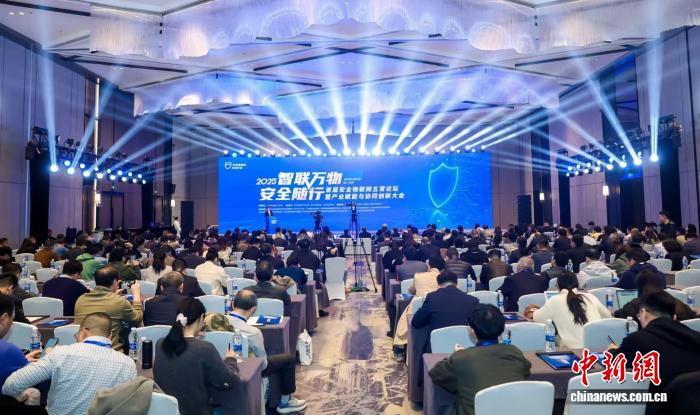
首届安全物联网五常论坛在杭州举办 共筑物联安全底座
Zhong Guo Xin Wen Wang· 2025-11-28 06:36
Core Insights - The development of "Safe IoT" is becoming a critical foundation for the advancement of the digital era, emphasizing the importance of security in the Internet of Things (IoT) [1][4] Group 1: Event Overview - The first "Safe IoT" forum was held in Hangzhou, Zhejiang, focusing on the collaboration of government, industry, academia, and research to enhance urban resilience and high-quality industry development [1] - The forum aims to solidify the foundation for building a "Safe China" through discussions on the empowerment of safe IoT technologies [1] Group 2: Technological Advancements - The advancement of cutting-edge technologies such as artificial intelligence and quantum encryption is providing strong support for IoT security [1] - Safe IoT technologies are rapidly being implemented in various fields, including environmental monitoring, infrastructure safety, and risk prevention in agriculture and industry, showcasing vast application potential [1] Group 3: Industry Impact - In the construction sector, safe IoT technologies are proving to be valuable, with China's self-developed NPR-DDA software system enhancing the resilience of construction projects [4] - In water conservancy, a highly coordinated intelligent water management system utilizing digital twin and AI technologies can significantly improve disaster simulation, risk warning, and operational optimization [4] Group 4: Regional Development - Zhejiang province is actively promoting the integration of "City Brain" and safe IoT, with a notable concentration of AI core industry enterprises in the region [4] - In Yuhang District, there are 154 core AI enterprises, with projected revenue of 95.58 billion yuan in 2024, reflecting a year-on-year growth of 27.6%, accounting for approximately 27% of Hangzhou's total [4] Group 5: Philosophical Approach - The importance of trust and credit in data and device interactions is emphasized as a prerequisite for all applications in the interconnected world [5] - The integration of "safety genes" and "integrity genes" into urban development and industrial systems is advocated to contribute to the construction of a "Safe China" and the modernization of the nation [5]
神州信息:已与汇丰中国、三菱银行等标杆客户达成合作
Mei Ri Jing Ji Xin Wen· 2025-11-24 00:57
Core Viewpoint - The company is leveraging its membership in BIAN and participation in ISO 20022 standards to enhance its influence in international financial technology regulations, aiming to convert this influence into competitive advantages in the market [1] Group 1: Company Initiatives - The company has successfully joined BIAN, an international banking architecture organization, and is actively promoting the transformation of banking architecture and service functions [1] - The company has established partnerships with benchmark clients such as HSBC China and Mitsubishi Bank, gaining valuable experience in expanding its overseas customer market [1] Group 2: Future Plans - The company plans to focus on emerging markets in Southeast Asia and the Middle East for further expansion of its overseas business [1] - There are ongoing efforts to develop standards in areas such as digital currency cross-border payments and quantum encryption, with potential updates on international cooperation [1]

十五运会深圳赛区场馆将实现100%使用绿电
Zhong Guo Jing Ji Wang· 2025-11-18 12:17
Core Insights - The Southern Power Grid has sponsored the use of 70 million kilowatt-hours of green electricity for the Shenzhen competition venues of the 15th National Games, achieving 100% green electricity usage during the event and reducing carbon emissions by approximately 50,000 tons, equivalent to planting 2.7 million trees [1] - The Shenzhen Power Supply Bureau has established the first zero-carbon smart science popularization base in the country, showcasing various energy-saving and carbon-reduction technologies [1][2] - The green electricity supplied during the event primarily comes from solar energy in Yunnan and Guangxi, with a significant increase in green certificate transactions in Shenzhen, reflecting a growing commitment to sustainable energy [2] Group 1: Green Energy Initiatives - The Southern Power Grid has procured 70,000 green certificates to support the event, ensuring all venues utilize green electricity [1] - The Shenzhen Power Supply Bureau's initiatives include a zero-carbon substation and a science popularization base to educate the public on green energy [1][2] - In the first three quarters of the year, green certificate transactions in Shenzhen reached 14.182 billion kilowatt-hours, a year-on-year increase of 38.1% [2] Group 2: Technological Innovations in Power Supply - The Shenzhen Power Supply Bureau has implemented a "full electric Hong + quantum communication" smart power supply guarantee system, integrating advanced technologies for real-time monitoring of power supply conditions [2][3] - The deployment of the electric Hong system across 2,000 monitoring terminals allows for effective data communication and real-time anomaly detection in power supply facilities [3] - A quantum encryption network has been established to enhance the security of data transmission between the command center and event venues, providing a robust defense against potential cyber threats [4]