
债券投资策略

Search documents
债券周策略:资金有波动,债券策略怎么看
2025-05-19 15:20
Summary of Conference Call Notes Industry Overview - The conference call primarily discusses the bond market and monetary policy strategies in the context of the current economic environment, particularly focusing on the implications of interest rate changes and credit strategies. Key Points and Arguments Monetary Policy and Market Conditions - The central bank's monetary policy operations indicate a focus on stable growth, but uncertainties surrounding US-China tariff negotiations require ongoing attention. The logic of systematically converging the funding center remains to be validated, with unexpected cuts in reserve requirements and interest rates reflecting the current stable growth approach [1][2][3] - The bond market has not strongly anticipated the dual cuts, with bond yields not significantly declining. The probability of a systematic elevation of the funding center is low, especially if the 7-day funding rate remains around 1.55% [1][2][3] Interest Rate Dynamics - Short-term interest rates face challenges in declining, with potential fluctuations leaning towards strength. The pricing of long-term rates is not favorable, but capital gains can be pursued if funding conditions loosen. The lower limit for the 10-year government bond yield is estimated to be around 1.6% [3][9] - The current market logic is bullish, suggesting that immediate short-selling is not advisable. Continuous analysis of future trends is necessary, as increased risk appetite or better-than-expected domestic demand data could lead to bond price declines [3][10][11] Credit Strategy Recommendations - It is recommended to continue holding 2-3 year ordinary credit bonds as a base position, as there are still opportunities for interest rate arbitrage. Attention should be paid to government issuance terms and potential short-term fluctuations around tax periods and month-end [5][6] - For 4-5 year secondary capital bonds, the current value is less favorable compared to shorter maturities. It is suggested to wait for tighter funding conditions before purchasing, treating this position with a trading mindset [6][7] - For bonds with maturities of 4-5 years and perpetual bonds, it is advised to hold from a coupon perspective, with a focus on high-yield points or individual bonds, such as 6-8 year secondary capital bonds, while also considering liquid credit bonds to build a high-coupon base [8] Investment Portfolio Construction - The construction of investment portfolios should consider three aspects: aggressive strategies for capital gains, stable strategies for consistent returns, and interest rate-focused strategies. Recommendations include a mix of 2-3 year credit bonds, long-term local government bonds, and liquid high-rated credit bonds [12] - For capital gains, strategies should involve betting on funding loosening, with options to buy the most active bonds or select those with the best value [13] Market Dynamics and Future Considerations - The spread between the 20-year and 30-year special government bonds remains around zero due to liquidity preferences and market dynamics favoring local government bonds over long-term special government bonds [17][18] - The impact of newly issued government bonds on existing main bonds' liquidity and value is expected to be minimal, as the new issues are relatively small in scale [19][20] Specific Investment Suggestions - For trading, it is advisable to consider the 30-year special government bond and the newly issued 10-year bonds from the National Development Bank. Short-term floating rate bonds are also highlighted for their potential value post-LPR adjustments [21][22] Other Important Insights - The current market environment suggests a preference for active trading strategies, with a focus on liquidity and interest rate dynamics. Continuous monitoring of market conditions and timely adjustments to strategies are essential for optimizing returns [14][15][16]
年内吸金近800亿元,债券型ETF迎阶段性爆发
Sou Hu Cai Jing· 2025-05-16 08:41
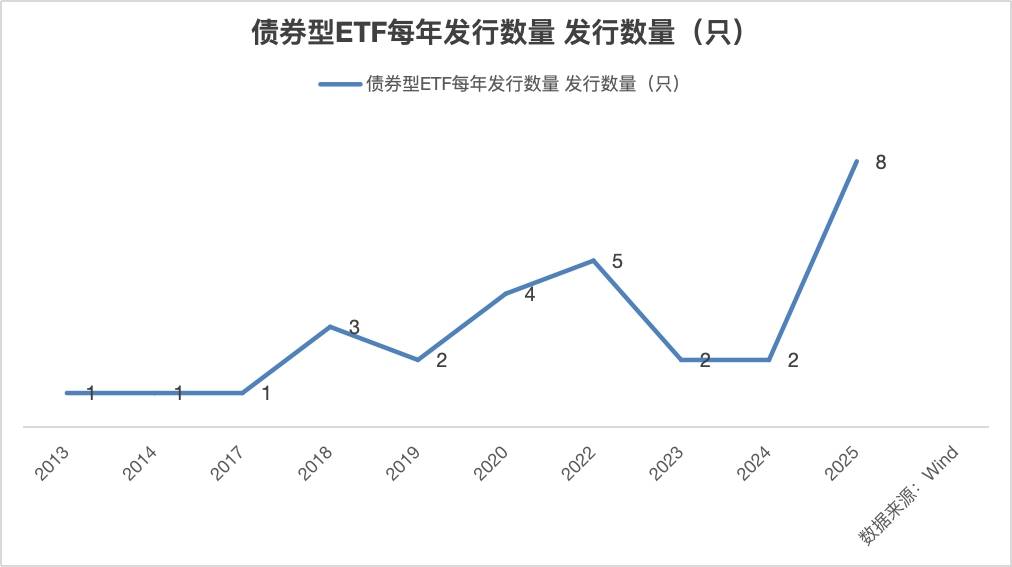
Core Viewpoint - The bond ETF market has experienced significant growth in 2023, with total assets surpassing 250 billion yuan for the first time, reaching 259.9 billion yuan as of May 15, marking an increase of 79.9 billion yuan since the end of last year [1][3]. Group 1: Market Growth and New Products - The bond ETF market has seen a record issuance of 8 new products in January 2023, compared to a maximum of 5 in previous years [1][3]. - The newly launched bond ETFs have collectively raised 21.71 billion yuan, with their total scale exceeding 43.45 billion yuan by May 15, reflecting a growth of over 100% since their inception [3][4]. - Existing bond ETFs have also attracted significant investment, with the Pengyang 30-Year Treasury ETF and the Haifutong Short-Term Bond ETF growing by 11.62 billion yuan and 10.70 billion yuan respectively in 2023 [3][5]. Group 2: Market Drivers and Investor Sentiment - The growth in bond ETFs is attributed to multiple factors, including a declining deposit interest rate and a continued loose monetary policy, which have drawn market attention [6][7]. - Bond ETFs are favored for their clear risk-return characteristics, transparency of underlying assets, and stable positions, catering to diverse investor needs [6]. - The flexibility and liquidity of bond ETFs, along with low investment thresholds and T+0 trading mechanisms, make them an efficient investment tool for risk-averse investors [6]. Group 3: Future Outlook and Strategies - The bond market's future performance is expected to be influenced by tariff negotiations and domestic macroeconomic policies, with potential short-term pressures on market sentiment [6][7]. - Despite the challenges, the overall monetary policy remains accommodative, limiting the upward risk for bond yields, as the economy is still in a weak recovery phase [7]. - A diversified bond investment strategy is anticipated to become mainstream, incorporating various asset types such as industrial bonds, convertible bonds, and overseas bonds to enhance overall expected returns [8].

固收策略报告:追涨性价比-20250505
SINOLINK SECURITIES· 2025-05-05 11:46
Group 1: Market Overview - The bond market experienced unexpected volatility leading up to the May Day holiday, with the 10-year minus 1-year government bond yield spread narrowing to a new low of 16 basis points, and the 10-year government bond yield dropping to 1.62% [3][11] - The rapid decline in yields was driven by three catalysts: easing liquidity around the holiday, market anticipation of the April PMI readings, and active trading of 30-year government bonds [11][3] - The discussion among investors shifted from concerns about holding bonds over the holiday to whether to chase rising yields [11][3] Group 2: Credit Bond Market Analysis - The performance of credit bonds has been weaker compared to government bonds, with adjustments in credit bonds generally more pronounced than in interest rate bonds, raising questions about their value proposition [25][55] - Factors contributing to the cautious outlook on credit bonds include weak trading sentiment, insufficient duration chasing, low turnover rates, and a flattening yield curve [25][55][31] - The average yield on key credit bonds has shown a balanced contribution from coupon income and capital gains, but as absolute yields approach lower levels, coupon contributions are expected to decline [25][37] Group 3: Bank Subordinated Debt - Bank subordinated debt, often referred to as a "yield amplifier," has shown conservative market behavior, with yields on 4-year AAA- subordinated bonds dropping to 1.95% [4][49] - The lack of aggressive participation from institutional investors in the subordinated debt market has been noted, particularly as yields fell below 2.5% [4][49] - The correlation between insurance net purchases and subordinated debt performance has weakened, indicating a shift in investment strategies [52][49] Group 4: Investment Strategies - The report suggests that maintaining a larger allocation to short- to medium-term bonds is a relatively stable strategy, especially for accounts with unstable liabilities [55] - For accounts with stable liabilities, extending the duration of city investment bonds to 3-5 years is recommended to mitigate potential scarcity in credit bond issuance later in the year [55] - The overall strategy should focus on high liquidity assets to reduce exposure to liquidity risks, particularly in the context of a flattening yield curve [31][55]
债市剧烈波动,基金经理“排兵布阵”
Zhong Guo Ji Jin Bao· 2025-04-27 08:23
Group 1 - The core viewpoint of the articles highlights the significant adjustments made by fixed-income fund managers in response to the volatility in the bond market during the first quarter, emphasizing the need for a shift in investment strategies to focus on absolute returns and risk control [1][4][6] Group 2 - In the first quarter, there was an increase in the allocation of interest rate bonds and a decrease in credit bonds among actively managed fixed-income funds, with the proportion of interest rate bonds rising from 41.54% to 42.86% and credit bonds falling from 54.63% to 53.12% [2][3] - The shift towards interest rate bonds is attributed to the structural preference in the issuance market and the desire for better liquidity amid significant market fluctuations [2][3] Group 3 - Fund managers are advised to adopt a non-linear thinking approach in bond investment strategies, focusing on enhancing asset liquidity and adjusting the duration of asset holdings to better navigate market volatility [4][5] - There is a strong demand for stable, short- to medium-term bonds with secure coupon values, while certain convertible bonds and exchangeable bonds are seen as having good investment potential [5][6] Group 4 - The second quarter is expected to witness a peak in government project bond issuance, with anticipated supportive monetary policies, including potential rate cuts and the resumption of government bond purchases by the central bank [6] - The overall sentiment in the market is positive, with expectations of a more accommodative monetary policy to support economic stability and growth [6]