
关税不确定性

Search documents
黄金ETF持仓量报告解读(2025-9-3)金价大涨 创近三年最高水平
Sou Hu Cai Jing· 2025-09-03 03:46
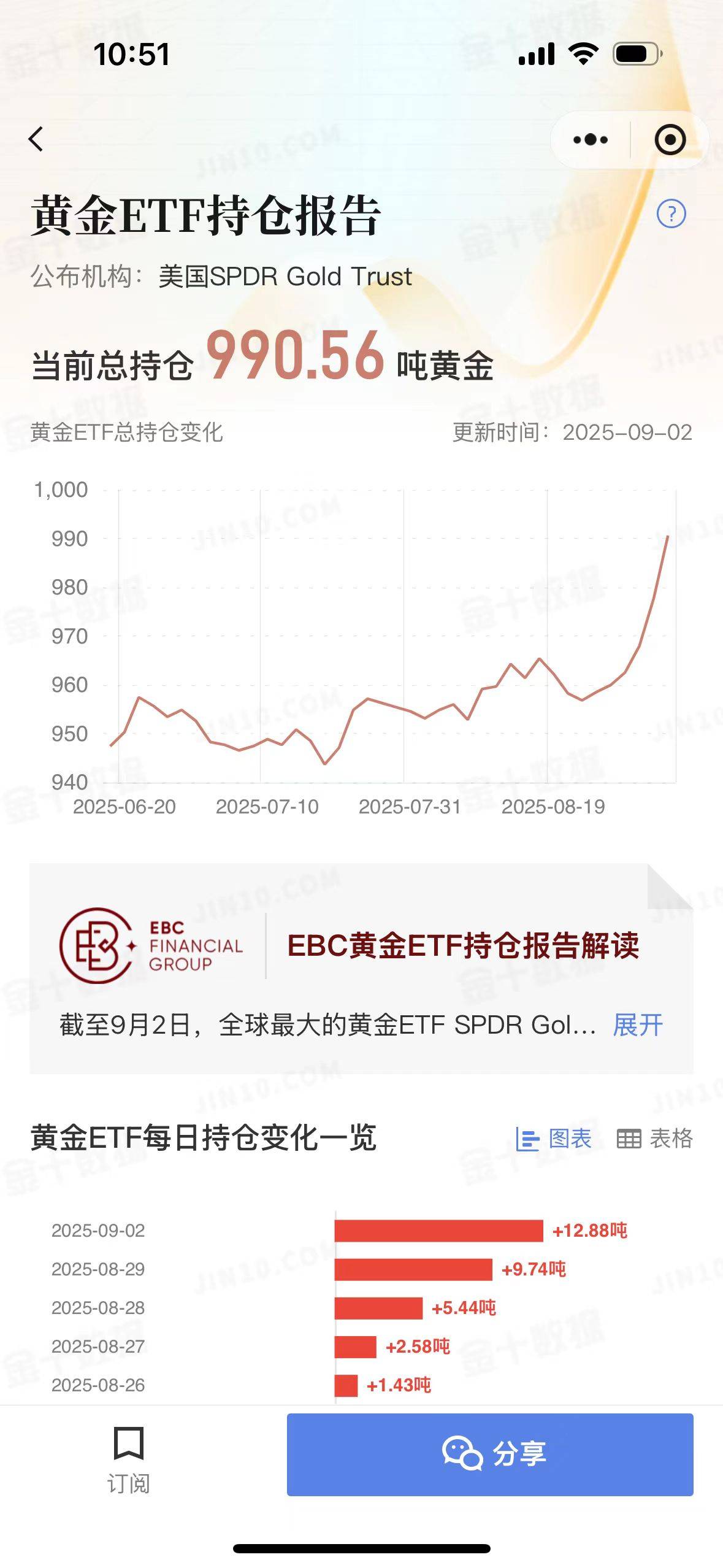
Core Viewpoint - The SPDR Gold Trust, the world's largest gold ETF, reported a significant increase in holdings to 990.56 tons, marking the highest level since August 2022, driven by rising gold prices and favorable market conditions [6]. Group 1: Gold ETF Holdings - As of September 2, the SPDR Gold Trust's holdings rose by 12.88 tons from the previous trading day [6]. - The current total holdings of 990.56 tons represent a substantial increase, reflecting growing investor interest in gold [6]. Group 2: Gold Price Movement - On September 2, spot gold prices surged past $3,500 per ounce, reaching a peak of $3,540.04, and closing at $3,533.35, an increase of $57.04 or 1.64% [6]. - Analysts expect continued increases in gold ETF holdings in the coming week due to the ongoing rise in gold prices [6]. Group 3: Market Drivers - The recent surge in gold prices is attributed to a weakening dollar and expectations of interest rate cuts by the Federal Reserve, particularly following political events affecting the Fed's independence [6]. - UBS forecasts four consecutive rate cuts in the upcoming Federal Reserve meetings, further supporting gold prices [6][7]. Group 4: Technical Analysis - Technical indicators suggest strong potential for gold price increases, with a bullish crossover observed in moving averages [7]. - Short-term resistance is identified at $3,550, with potential challenges to $3,600 and even $4,000 if upward momentum continues [7].

降息预期及贸易局势助推金价 伦敦金矿股走强
Sou Hu Cai Jing· 2025-09-01 09:21
Group 1 - The core viewpoint of the article highlights that gold sector stocks listed in London are rising due to increasing gold prices driven by expectations of U.S. interest rate cuts and uncertainties surrounding tariffs [1] - Gold prices are approaching historical highs, influenced by the upcoming U.S. economic reports including the Federal Reserve's Beige Book, non-farm payroll report, job vacancies, labor turnover survey, and ADP report [1] - Specific stock performances include Hochschild Mining's share price increasing by 5%, Alien Metals rising by 3.85%, and Fresnillo up by 1.6% [1]
建信期货集运指数日报-20250828
Jian Xin Qi Huo· 2025-08-28 01:28
Report Information - Report Title: Container Shipping Index Daily Report [1] - Date: August 28, 2025 [2] - Research Team: Macro Financial Team [4] - Researchers: He Zhuoqiao, Huang Wenxin, Nie Jiayi [3] Industry Investment Rating - Not provided Core Viewpoints - This week, the SCFIS dropped below 2000 points, marking six consecutive weeks of decline. However, the downward trend of online quotes has stabilized. Some shipping companies have announced price increases for September, indicating a willingness to support prices. Considering the uncertainty of tariffs and the high level of supply during the off - season, demand is unlikely to improve significantly this year, and freight rates may show a more pronounced off - season pattern. The short - term decline in futures may narrow, but in the long run, it may still show a downward trend. It is recommended to short the October contract on rallies [8]. Summary by Directory 1. Market Review and Operation Suggestions - **Market Situation**: The SCFIS has fallen below 2000 points for six consecutive weeks, but the decline of online quotes has stabilized. Some shipping companies' September freight rates are higher than those at the end of August, showing a willingness to support prices. Demand is hard to improve significantly due to tariff uncertainties, and supply is at a relatively high level during the off - season. The current main October contract has a deep discount, and the decline in spot freight rates has slowed down, so the short - term decline in futures may narrow. In the long run, it may still decline [8]. - **Operation Suggestion**: Short the October contract on rallies [8]. 2. Industry News - **Overall Market**: From August 18th to 22nd, the China export container shipping market was basically stable, but the supply - demand fundamentals were weak. Most route freight rates declined, and the comprehensive index continued to adjust [9]. - **European Routes**: In August, the eurozone's composite PMI rose to 51.1, better than expected. However, due to US tariff policies, foreign orders in the eurozone's manufacturing industry declined for the second consecutive month. On August 22nd, the freight rate from Shanghai Port to European basic ports was $1668/TEU, a decrease of 8.4% from the previous period [9]. - **Mediterranean Routes**: The market situation was similar to that of European routes, and the spot booking price continued to fall. On August 22nd, the freight rate from Shanghai Port to Mediterranean basic ports was $2225/TEU, a decrease of 2.4% from the previous period [9]. - **North American Routes**: As of the week ending August 16th, the number of initial and continued unemployment claims in the US increased, indicating a cooling labor market. The freight rates from Shanghai Port to the US West and East basic ports on August 22nd were $1644/FEU and $2613/FEU respectively, down 6.5% and 3.9% from the previous period [10]. - **Tariff News**: Trump announced a "major" tariff investigation on imported furniture in the US, which will be completed within 50 days. New tariffs on imported furniture may further impact the industry that has already been affected by other tariffs [10]. - **Geopolitical News**: Israeli Prime Minister Netanyahu approved the plan to capture Gaza City, and the Israeli army is deploying troops. Trump expressed full support for Israel's military goal [10]. 3. Data Overview - **Container Shipping Spot Prices** - **European Routes**: On August 25th, the SCFIS for European basic ports was 1990.2 points, a decrease of 8.7% from August 18th [12]. - **US West Routes**: On August 25th, the SCFIS for US West basic ports was 1041.38 points, a decrease of 5.9% from August 18th [12]. - **Container Shipping Index (European Line) Futures Market** - Provided the trading data of container shipping European line futures on August 27th, including contract information such as EC2510, EC2512, etc., covering opening price, closing price, settlement price, change, change rate, trading volume, open interest, and open interest change [6]. - **Shipping - Related Data Charts** - Included charts of European container ship capacity, global container ship orders, Shanghai - European basic port freight rates, and Shanghai - Rotterdam spot freight rates [17][20]
纬创美国设厂 按表操课
Jing Ji Ri Bao· 2025-08-27 23:45
Core Viewpoint - Wistron (3231) Chairman Lin Hsien-Ming stated that the company's U.S. factory layout is proceeding as planned, without acceleration or slowdown, amidst the uncertainty surrounding U.S. tariffs [1] Group 1: U.S. Operations - Wistron is maintaining its U.S. factory plans, with production sites in Dallas and El Paso, Texas, and an existing factory in Mexico, indicating a strategic presence in the Americas [1] - The company has a factory in California that is positioned close to customers, allowing for product validation before shipping to the U.S. [1] Group 2: Tariff Concerns - The uncertainty regarding the semiconductor 232 clause is acknowledged, with Lin expressing concern over potential special treatment for the EU by the U.S. government [1] - Lin emphasized that the decision-making process regarding tariffs is still evolving, and there is no need for excessive panic, as Taiwanese companies have the capability to adapt quickly [1] Group 3: European Operations - Wistron already has operations in Europe, specifically in the Czech Republic, where the factory primarily handles final manufacturing and delivery, with the core technology not being based there [2] - The company recognizes the limitations of resources in Taiwan, particularly regarding the substantial power requirements for AI [2]
黄金ETF持仓量报告解读(2025-8-27)老特施压美联储 影响黄金走势
Sou Hu Cai Jing· 2025-08-27 06:01
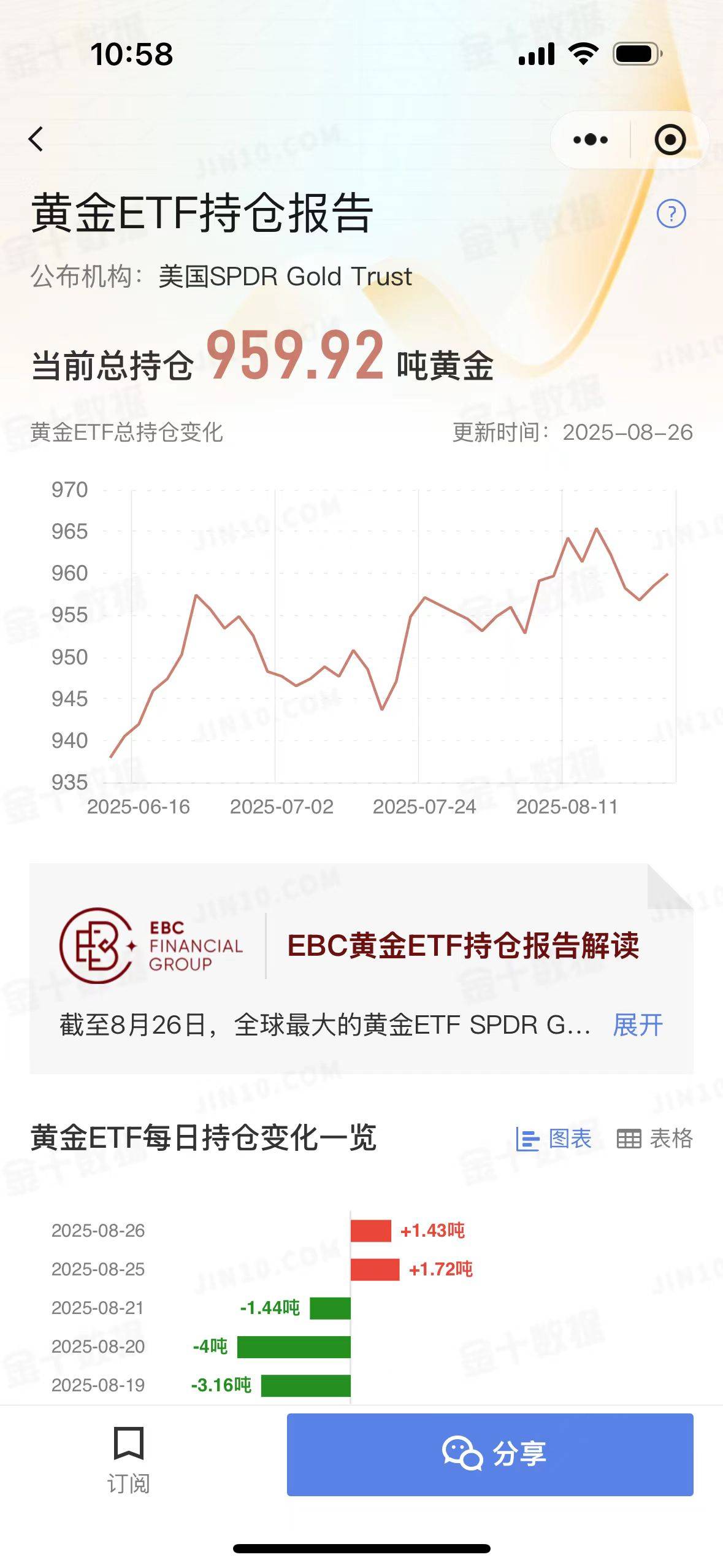
Group 1 - The current total holdings of the world's largest gold ETF, SPDR Gold Trust, stand at 959.92 tons, with an increase of 1.43 tons from the previous trading day [5] - On August 26, spot gold surged, reaching a peak of $3393.67 per ounce, closing near this high at $3393.62, marking an increase of $28.02 or 0.83% [5] - The increase in gold ETF holdings marks the second consecutive day of growth, indicating a rising interest in gold as a safe-haven asset amid market uncertainties [5] Group 2 - Recent comments from former President Trump regarding the dismissal of Federal Reserve Governor Lisa Cook have raised concerns about the independence of the Fed, contributing to the rise in gold prices [6] - Analysts are focusing on the upcoming Personal Consumption Expenditures (PCE) price index data, which is expected to provide insights into the Fed's interest rate decisions [6] - Technical analysis suggests a bullish outlook for gold, with potential resistance levels at $3438 and $3450, while key support is identified at $3350 [6]
建信期货国债日报-20250826
Jian Xin Qi Huo· 2025-08-26 02:59
1. Report Information - Report Title: Treasury Bond Daily Report [1] - Date: August 26, 2025 [2] - Researchers: He Zhuoqiao, Huang Wenxin, Nie Jiayi [3] 2. Industry Investment Rating - Not provided in the report. 3. Core Viewpoints - Long - term, the bullish foundation of the bond market remains unchanged as the Politburo meeting in July maintained the "moderately loose" stance on monetary policy, and there is high uncertainty in tariffs with the risk of a post - rush - export decline. Short - term, the stock - bond seesaw effect has strengthened since late June, and the bullish equity market has pressured the bond market. The marginal weakening of July's fundamental data still shows short - term resilience, making it difficult to trigger a significant increase in easing sentiment. The short - term bond market rebound is unlikely to form a trend. Currently, the stock - bond seesaw has slightly weakened, the central bank is actively supporting the capital market, and short - term bond varieties are more resilient [11][12]. 4. Summary by Directory 4.1 Market Review and Operation Suggestions - **Market Performance**: A - shares reached new highs, but the bond market was slightly desensitized. The Shanghai real - estate policy met expectations with limited impact on the bond market. After continuous adjustments, the bond market's protection cushion thickened, and with the central bank's active support and rising overseas easing expectations, treasury bond futures rebounded across the board [8]. - **Interest Rate Bonds**: The yields of major inter - bank interest rate bonds across all maturities declined, with the long - end yields dropping more, about 3bp. By 16:30, the yield of the 10 - year treasury bond active bond 250011 was 1.7640%, down 2.1bp [9]. - **Funding Market**: The central bank actively supported the capital market, and the inter - bank capital market loosened. There were 2665 billion yuan of reverse repurchases due, and the central bank conducted 2884 billion yuan of reverse repurchase operations and injected 6000 billion yuan of MLF. The inter - bank capital sentiment index declined, short - term capital interest rates fluctuated, the overnight weighted average of inter - bank deposits fell 6.2bp to 1.35%, the 7 - day rate rose 5.4bp to 1.52%, and the medium - and long - term capital remained stable [10]. 4.2 Industry News - A personal consumer loan discount policy will be launched on September 1, which is expected to accelerate institutions' expansion into consumption scenarios. Market rumors about restrictions on bond trading methods for small and medium - sized institutions were not confirmed by industry insiders. The traditional "Golden September and Silver October" real - estate sales season is approaching, and policies have achieved positive results in promoting the real - estate market [13]. - Fed Chairman Powell's speech at the Jackson Hole central bank meeting increased market bets on a September interest - rate cut [14]. 4.3 Data Overview - **Treasury Bond Futures**: Information on trading data, cross - maturity spreads, cross - variety spreads, and price trends of treasury bond futures was provided [6][17][21]. - **Money Market**: Data on inter - bank repurchase rates, SHIBOR term structure, and trends were presented [28][33]. - **Derivatives Market**: Information on Shibor3M and FR007 interest - rate swap fixing curves was given [38].
建信期货国债日报-20250822
Jian Xin Qi Huo· 2025-08-22 01:47
Report Information - Report Title: Treasury Bond Daily Report [1] - Date: August 22, 2025 [2] - Researchers: He Zhuoqiao, Huang Wenxin, Nie Jiayi [3] Industry Investment Rating - Not provided in the report Core Viewpoints - Long - term, the Politburo meeting in July indicated that the "moderately loose" monetary policy orientation remains unchanged, and the high uncertainty of tariffs means there's a risk of a post - export - rush decline, so the bull - market foundation for bonds remains intact [10] - Short - term, the stock - bond seesaw effect has strengthened since late June. The bullish equity market has pressured the bond market, and the marginal weakening but still resilient July fundamental data can't significantly boost the loose sentiment, so the short - term bond market rebound can't form a trend [10] - Amid the tax - period disturbance this week, the central bank actively provided funds. Short - term bond varieties are more resilient due to the stable funding environment, so the strategy of going long on short - term and short on long - term bonds to steepen the yield curve is maintained [11] Summary by Directory 1. Market Review and Operation Suggestions - **Market Performance**: The stock - bond seesaw continued. The decline of the stock market in the afternoon boosted the overall recovery of treasury bond futures. The yields of major term interest - rate bonds in the inter - bank market declined across the board, with the long - end yields falling by 1 - 2bp. By 16:30, the yield of the 10 - year treasury bond active bond 250011 was reported at 1.7655%, down 1.45bp [8] - **Funding Market**: The central bank actively supported the funding market, and the inter - bank funding market became looser. There were 1287 billion yuan of reverse repurchases due today, and the central bank conducted 2530 billion yuan of reverse repurchase operations, achieving a net injection of 1243 billion yuan. The short - term funding rates declined across the board, while the medium - and long - term funds were stable [9] 2. Industry News - The deputy governor of the People's Bank of China stated that policies will be strengthened to stimulate the vitality of the movable - property financing market, which helps small and medium - sized enterprises solve financing problems and promotes the diversified development of the financial market [12] - The central bank's Q2 monetary policy report proposed to implement a moderately loose monetary policy, keep liquidity abundant, and use monetary policy tools to support various economic sectors [13] 3. Data Overview - **Treasury Bond Futures Market**: The report presents data on treasury bond futures trading on August 22, including contract prices, trading volumes, open interests, and changes. It also mentions the inter - delivery spreads and inter - variety spreads of treasury bond futures [6][14] - **Money Market**: The central bank's reverse repurchase operations and the changes in short - term and medium - long - term funding rates are provided, such as the decline in overnight and 7 - day weighted rates in the inter - bank market [9] - **Derivatives Market**: Information on the Shibor3M and FR007 interest - rate swap fixing curves is provided [37]
美联储,重大宣布
Zheng Quan Shi Bao· 2025-08-16 13:17
Core Points - The Federal Reserve has officially closed the "Novel Activities Supervision Program," which was designed to regulate banks' activities in the cryptocurrency and fintech sectors, and will now integrate this oversight into standard banking regulations [1][2] - The closure of the program follows a deeper understanding of the risks associated with cryptocurrency activities, particularly after the collapse of three banks closely tied to the crypto industry [2][3] - The recent actions by the Federal Reserve signal a trend of increasing acceptance of the cryptocurrency industry by U.S. regulators, moving away from previous stringent requirements [4] Regulatory Changes - The "Novel Activities Supervision Program" was established to enhance oversight of banks' involvement in digital assets and blockchain technology, focusing on areas such as crypto asset custody and stablecoin issuance [3] - The latest regulatory changes simplify compliance processes for banks engaging in cryptocurrency activities, while core regulatory principles like anti-money laundering and consumer protection remain unchanged [3] Market Sentiment - Financial markets are highly anticipating a potential interest rate cut by the Federal Reserve, with a 92% probability of a 25 basis point reduction in September [6][7] - Recent inflation data has created uncertainty among Federal Reserve officials regarding the timing and extent of future rate cuts, with some officials suggesting a cautious approach [6][7]
“黄金引力效应”+供应缺口拉动 汇丰上调2025-27年白银价格预测
智通财经网· 2025-08-13 01:10
Group 1 - HSBC analysts have raised their silver price forecasts for 2025, 2026, and 2027, citing strong gold prices and safe-haven demand due to geopolitical and economic uncertainties [1] - The new average silver price forecast for 2025 is $35.14 per ounce, up from $30.28; for 2026, it is $33.96, up from $26.95; and for 2027, it is $31.79, up from $28.30 [1] - Despite a 31% increase in silver prices this year, HSBC notes that this rise is more related to the correlation between silver and gold rather than intrinsic fundamentals [1] Group 2 - HSBC predicts that silver mine production will continue to grow at a moderate pace, with supply-demand models forecasting a silver deficit of 206 million ounces in 2025, 126 million ounces in 2026, and 167 million ounces in 2024 [1] - The weakening US dollar is seen as beneficial for silver prices, while ongoing discussions about Federal Reserve rate cuts and central bank policies may impact future price trends [1] Group 3 - On Tuesday, gold futures prices slightly declined while silver futures prices saw a slight increase as investors reacted to the latest US economic data [2] - The US consumer price index rose 2.7% year-on-year in July, supporting expectations for a rate cut in September [2] - Optimism surrounding the upcoming summit between President Trump and President Putin regarding the resolution of the Russia-Ukraine conflict has limited the upward momentum in prices [2]

WTO:“对等关税”预计将在下半年 及2026年令美国进口承压
Sou Hu Cai Jing· 2025-08-10 16:28
Core Viewpoint - The WTO predicts a 0.9% growth in global merchandise trade by 2025, an improvement from the previous forecast of -0.2%, but still below the pre-tariff increase estimate of 2.7% [1] Trade Growth Factors - Asian economies are expected to be the largest positive contributors to global merchandise trade growth in 2025, although their contribution in 2026 will be lower than previously forecasted [2] - North America is projected to have a negative impact on global trade growth in 2025 and 2026, but the negative effect this year will be less than previously estimated due to higher-than-expected early imports in the first quarter [2] - European contributions to trade growth have shifted from moderate positive to slightly negative for 2025, with energy-exporting economies also expected to see reduced positive contributions due to falling oil prices [2] Import and Export Trends - Europe’s exports and imports are projected to grow by -0.9% and 0.4% respectively, slightly weaker than the April forecast, while North American exports are expected to improve slightly to -4.2% [3] Tariff Impact on Trade - The WTO explains that the previous forecast of a 0.2% contraction in trade for 2025 was based on measures in effect as of April 14, including the suspension of "reciprocal tariffs" by the U.S. [4] - Following agreements between the U.S. and countries like the UK, the annual forecast was adjusted to 0.3%, but higher tariffs on steel and aluminum products brought the forecast back down to 0.1% [4] - The higher tariffs effective from August 7 are expected to increasingly pressure trade, although this will be offset by the positive effects of early procurement and inventory accumulation [4] Overall Trade Forecast - The WTO's improved forecast of 0.9% growth for 2025 is attributed to two positive factors and one negative factor: a significant increase in U.S. imports by 11% year-on-year due to early procurement and inventory buildup, and a more optimistic global macroeconomic outlook compared to April [5][6] - The early procurement is the main contributor to the updated forecast, with similar patterns observed in other countries due to concerns over retaliatory measures [6] - The recent tariff adjustments are expected to have an overall negative impact on global trade prospects, with the higher "reciprocal tariffs" expected to exert increasing pressure on U.S. imports and suppress exports from trade partners [6]