市场操纵

Search documents
一周亏损60亿!一场期货引发的破产“惨案”!
Sou Hu Cai Jing· 2025-09-14 09:41
Core Insights - The collapse of Amaranth hedge fund was primarily due to a massive bet on natural gas futures by star trader Brian Hunter, resulting in a loss of approximately $6 billion in a week, which was 65% of the fund's assets [1][5][6] Group 1: Fund Background and Strategy - Amaranth hedge fund was established in 2000 by Nickolas Maounis, initially focusing on bond arbitrage with stable performance [2] - From 2004 onwards, the fund shifted its strategy to invest heavily in the energy market, with total assets reaching $9.5 billion by August 2006, half of which was allocated to energy [2] - Brian Hunter was promoted to co-head of the energy department in 2005, showcasing exceptional trading skills that generated over $1 billion in profits for the fund that year [3] Group 2: Fatal Betting Strategy - In August 2006, Amaranth held natural gas contracts predicting a widening price spread between winter and summer contracts, with a spread of $2.6 per million BTU [4] - By September 20, the price of the contracts fell significantly, leading to substantial losses for the fund as the anticipated price spread narrowed to $0.6 [4] Group 3: Rapid Decline and Impact - On September 14, 2006, Amaranth reported a loss of $560 million, which accelerated into a series of extreme losses, culminating in a single-day loss of nearly $2 billion on September 15 [5] - By September 20, the fund was forced to sell its energy positions at a significant discount, resulting in investors losing two-thirds of their investments [6][7] Group 4: Regulatory and Risk Management Issues - Following the collapse, regulatory bodies filed lawsuits against Hunter and Amaranth for market manipulation, with fines totaling $259 million for the fund and $30 million for Hunter [9] - The failure of Amaranth highlighted critical risk management deficiencies, emphasizing the need for better oversight and risk assessment practices within hedge funds [10]
纳斯达克收紧中国公司上市规则,最低融资门槛提至2500万美元
Guan Cha Zhe Wang· 2025-09-05 10:08
Core Viewpoint - Nasdaq is tightening its listing rules for Chinese companies, requiring a minimum fundraising amount of $25 million for IPOs, in response to criticisms regarding fraud and market manipulation associated with smaller Chinese firms [1][2]. Group 1: New Listing Regulations - Nasdaq will raise the minimum fundraising threshold for IPOs of companies primarily operating in mainland China, Hong Kong, and Macau to $25 million [1]. - The proposed changes also include increasing the minimum market capitalization requirement for future listings to $15 million and expediting delisting procedures for companies that no longer meet listing standards [1]. - All changes are subject to approval by the U.S. Securities and Exchange Commission (SEC) [1]. Group 2: Background and Rationale - Since 2020, numerous Chinese companies have gone public on Nasdaq, often raising amounts of $15 million or less, leading to significant price volatility [1]. - Nasdaq identified a new emerging pattern related to potential stock manipulation, where promoters linked to major shareholders sell stocks to new investors, artificially inflating prices before insiders sell off their shares [1]. - Since August 2022, nearly 70% of the cases reported by Nasdaq to the SEC or the Financial Industry Regulatory Authority (FINRA) involved trading of Chinese companies, despite these companies representing less than 10% of Nasdaq's total listings [1][2]. Group 3: Market Sentiment - The tightening of Nasdaq's listing standards reflects a broader regulatory commitment to protect investors and maintain market order, especially in light of concerns raised by Wall Street veterans and investor advocates [2]. - There is a growing sentiment among brokerages and trading firms that Nasdaq's previous listing standards were too lenient, allowing questionable companies, particularly from overseas jurisdictions, to list [2].
纳斯达克拟改小型IPO上市规则,中企赴美受影响?
Sou Hu Cai Jing· 2025-09-05 01:13
Core Viewpoint - The proposed changes to Nasdaq's IPO listing standards will significantly raise the entry barriers for companies, particularly affecting Chinese firms seeking to go public in the U.S. market [3][4][13]. Summary by Relevant Sections Proposed Changes - Nasdaq has proposed three main changes to its IPO listing standards: 1. Minimum public holding market value for companies choosing to list based on net profit will increase to $15 million from the current $5 million [3]. 2. Companies with listing deficiencies and a market value below $5 million will face accelerated delisting processes [3]. 3. A minimum fundraising requirement of $25 million will be set for new companies primarily operating in China [3][4]. Impact on Chinese Companies - The new rules will raise the listing threshold for many small and medium-sized Chinese enterprises, making it more challenging for them to meet the new standards [4]. - The increased delisting risk due to accelerated processes will affect existing Chinese companies with low market values or other listing deficiencies [4]. Market Reactions - Some companies may consider shifting their IPO plans to other markets, particularly the Hong Kong market, which has seen a surge in IPO activity and recently revised its own IPO rules [4][5]. - Nasdaq's adjustments are seen as a response to potential market manipulation and a move to enhance investor protection and market integrity [5][6]. Regulatory Context - The proposed changes are part of Nasdaq's ongoing efforts to improve market quality and competitiveness amid a challenging global capital market environment [7]. - If approved by the SEC, the new requirements will be implemented immediately, with a 30-day grace period for companies already in the IPO process [7].

“股神”特朗普又放话了:今天美股涨的很好,未来会有更多这样的日子
美股IPO· 2025-08-05 03:49
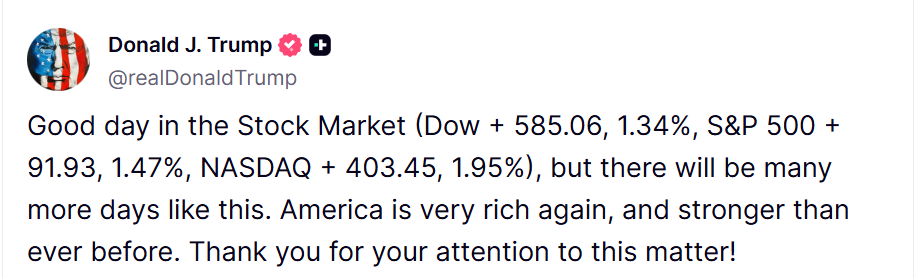
Group 1 - Trump's public statements on the stock market are not new, as he previously suggested it was a good time to buy before announcing a tariff pause, leading to a 9.5% increase in the S&P 500 [4][5] - On August 4, after the market closed, Trump posted on "Truth Social" that the stock market performed well, with the Dow Jones up 585.06 points (1.34%), S&P 500 up 91.93 points (1.47%), and Nasdaq up 403.45 points (1.95%) [3] - Trump's actions have raised concerns about market manipulation, with experts warning that he may be signaling he can manipulate the market without consequences [4][6] Group 2 - The "buy now" message from Trump on April 9 was followed by a significant market rally, recovering approximately $4 trillion in market value, which was 70% of the losses from the previous four trading days [5] - Trump's use of the signature "DJT" in his posts has drawn attention, as it is both his initials and the stock ticker for Trump Media and Technology Group, the parent company of "Truth Social" [6] - Despite Trump Media's significant losses of $400 million last year, the stock surged by 22.67% on the day of Trump's post, indicating a strong market reaction to his statements [6]


“股神”特朗普又放话了:今天美股涨的很好,未来会有更多这样的日子
Hua Er Jie Jian Wen· 2025-08-05 00:31
Group 1 - Trump's recent social media post indicated a strong performance in the stock market, with the Dow Jones up 585.06 points (1.34%), S&P 500 up 91.93 points (1.47%), and Nasdaq up 403.45 points (1.95%) [1] - In April, prior to announcing a 90-day suspension of tariffs, Trump suggested on social media that it was a good time to buy, leading to a 9.5% increase in the S&P 500, recovering approximately $4 trillion in market value, which represented 70% of the losses from the previous four trading days [2][3] - Trump's use of the signature "DJT" in his posts has drawn attention, as it is both his initials and the stock ticker for Trump Media and Technology Group, the parent company of the social media platform he uses [4] Group 2 - Experts have raised concerns about potential market manipulation due to Trump's social media activity, suggesting that his posts could imply he can manipulate the market without consequences [2][4] - The increase in Trump Media's stock price by 22.67% on the day of the April post, despite the company reporting a $400 million loss the previous year, indicates a significant market reaction to his statements [4]
香港证监会与廉署采取联合行动打击涉嫌市场操纵及贪污行为拘上市公司两前高层
news flash· 2025-07-25 08:07
Core Viewpoint - The Hong Kong Securities and Futures Commission (SFC) and the Independent Commission Against Corruption (ICAC) have launched a joint operation named "Leverage" to combat market manipulation and corruption involving a listed company and its former executives [1] Group 1: Joint Operation Details - The operation was initiated on July 23, 2025, targeting a sophisticated criminal group suspected of manipulating the shares of a listed company through corrupt practices [1] - Arrested individuals are accused of conspiring to use documents containing false information, including internal documents and announcements from the listed company [1] Group 2: Financial Implications - The suspects allegedly claimed that the listed company had reached a share subscription agreement with a mainland enterprise and was developing a joint project, involving funds exceeding 20 million Hong Kong dollars [1] - The involved listed company has had its trading suspended since March 2025 and has been ordered to be liquidated by the court [1]
公司快评︱股价大涨250%三次停牌核查!重大财务造假的*ST广道终将是沙上城堡
Mei Ri Jing Ji Xin Wen· 2025-07-17 05:52
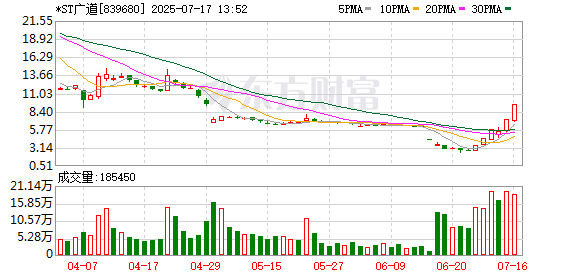
Group 1 - The stock price of *ST Guangdao surged by 251% from June 25 to July 16, reaching a market value of 630 million yuan, despite being a "quasi-delisting stock" facing severe legal issues [2][3] - The company is under investigation by the China Securities Regulatory Commission (CSRC) for systematic fraud, including falsifying contracts and financial documents, which has led to multiple reports containing false information from 2018 to 2024 [3] - Regulatory authorities have imposed trading restrictions on accounts involved in market manipulation, reaffirming a zero-tolerance stance against such activities [2][3] Group 2 - The recent trading activities surrounding *ST Guangdao reflect a broader issue of market speculation and disregard for regulatory boundaries, highlighting the need for stricter enforcement of delisting rules [3] - The company's last trading day before suspension saw another 30% increase in stock price, illustrating the absurdity of the market's behavior amidst ongoing fraud allegations [3] - Investors are advised to remain cautious and avoid engaging with companies involved in financial deception, as the risks associated with such investments can lead to significant losses [4]
“美股代币化”推出两周:炒作严重,追踪亚马逊代币的价格是股价的4倍!
Hua Er Jie Jian Wen· 2025-07-16 00:50
Core Viewpoint - Blockchain technology is attempting to disrupt traditional stock markets, but the reality is more complex than the ideal scenario [1] Group 1: Tokenized Stocks - The launch of tokenized stocks has not gone smoothly, with significant price deviations from the underlying stocks since their introduction two weeks ago [2] - Tokenized stocks, referred to as "xStocks," were launched by Backed Finance in collaboration with Kraken and Bybit, targeting non-U.S. customers [5] - The price performance of tokenized stocks has been chaotic, with instances of extreme price surges, such as the AAPLX token reaching $236.72, a 12% premium over the actual stock price [3] Group 2: Regulatory Scrutiny - Robinhood is facing scrutiny from European regulators after launching a token that allows investors to bet on OpenAI without the company's permission [2] - The Bank of Lithuania has contacted Robinhood for explanations regarding the marketing of these tokens, which are linked to companies that are not publicly listed [5] - Concerns have been raised that tokenized stocks could become a means to circumvent regulations, as traditional stock markets have mechanisms to monitor and investigate suspicious activities [5] Group 3: Market Manipulation Concerns - Industry insiders worry that tokenized stocks create opportunities for insider trading and market manipulation, which are difficult to detect [2] - Backed Finance claims that public blockchain transactions are more transparent than traditional finance, potentially aiding in the monitoring of illegal activities [6] - However, other industry participants express concerns that trading tokenized stocks on anonymous platforms could lead to increased illegal activities, with one CEO describing it as a "Pandora's box" [6]



Jane Street按照印度监管机构要求,向托管账户存入5.64亿美元
news flash· 2025-07-14 03:29
Core Viewpoint - Jane Street Group LLC has deposited 48.4 billion rupees into a custodial account to comply with the order from the Indian securities market regulator, SEBI, and does not plan to resume trading in the Indian derivatives market [1] Group 1 - The Securities and Exchange Board of India (SEBI) has temporarily banned Jane Street from entering the local market due to allegations of index manipulation [1] - SEBI has required Jane Street to deposit "illegal gains" into a custodial account at a local bank [1]
遭印度监管指控市场操纵,量化巨头发内部信否认
第一财经· 2025-07-08 23:44
Core Viewpoint - The conflict between Jane Street and the Securities and Exchange Board of India (SEBI) has escalated, with Jane Street denying all allegations of market manipulation and asserting that its trading practices are legitimate and beneficial to market liquidity [1][3]. Group 1: Allegations and Responses - SEBI issued a temporary ban on Jane Street, accusing the firm of "malicious market manipulation" and freezing its funds amounting to 48.4 billion rupees (approximately 4 billion yuan) in India [1]. - Jane Street refuted SEBI's claims, stating that its trading activities are based on standard arbitrage and hedging strategies aimed at ensuring price consistency across financial instruments [1][3]. - The firm highlighted a specific trading incident on January 17, 2024, where it engaged in index arbitrage to correct significant price discrepancies between the BANKNIFTY index in the stock and options markets [3][5]. Group 2: Trading Practices and Market Impact - Jane Street emphasized that its role as a liquidity provider is crucial for the health of the Indian derivatives market, arguing that without such participants, there would be no economic connection between the derivatives market and the underlying economy [3]. - The company defended its practices regarding the "extended closing price manipulation" accusation, explaining that its risk management strategies are standard globally and not intended to manipulate the market [5]. Group 3: Communication and Legal Actions - Jane Street criticized SEBI for claiming a lack of cooperation, asserting that it has been responsive and transparent since SEBI's request for trading information in August 2024 [7]. - The firm expressed disappointment over SEBI's failure to engage in dialogue despite multiple attempts to communicate, stating that it is preparing a formal response to the allegations and will utilize all available legal means to protect its interests [7][6].