
集体自卫权

Search documents
视频丨日本有识之士:高市错误言论损害日中关系 冲击日本经济
Yang Shi Xin Wen Ke Hu Duan· 2025-11-21 06:02
Group 1 - The remarks made by Japanese Prime Minister Sanae Takaichi have severely damaged Japan-China relations, causing significant impact on the Japanese economy [1][3] - Takaichi's comments disregard the core principles of the normalization of Japan-China diplomatic relations, leading to confusion within Japan's economic sector [3] - Japan's economy heavily relies on its relationship with China, which is its largest trading partner, and any deterioration in this relationship could have profound effects on Japanese society [3] Group 2 - Takaichi's intention to amend the "Three Non-Nuclear Principles" is viewed as a serious escalation compared to former Prime Minister Shinzo Abe's push for new security laws in 2015, which already violated the constitution [5] - Legal scholars in Japan have previously indicated that the new security laws breached constitutional limits, particularly Article 9, allowing Japan to exercise "collective self-defense," which was widely regarded as unconstitutional [7] - The current situation surrounding Takaichi's statements and actions is considered dangerous and serious, extending beyond mere errors [7]

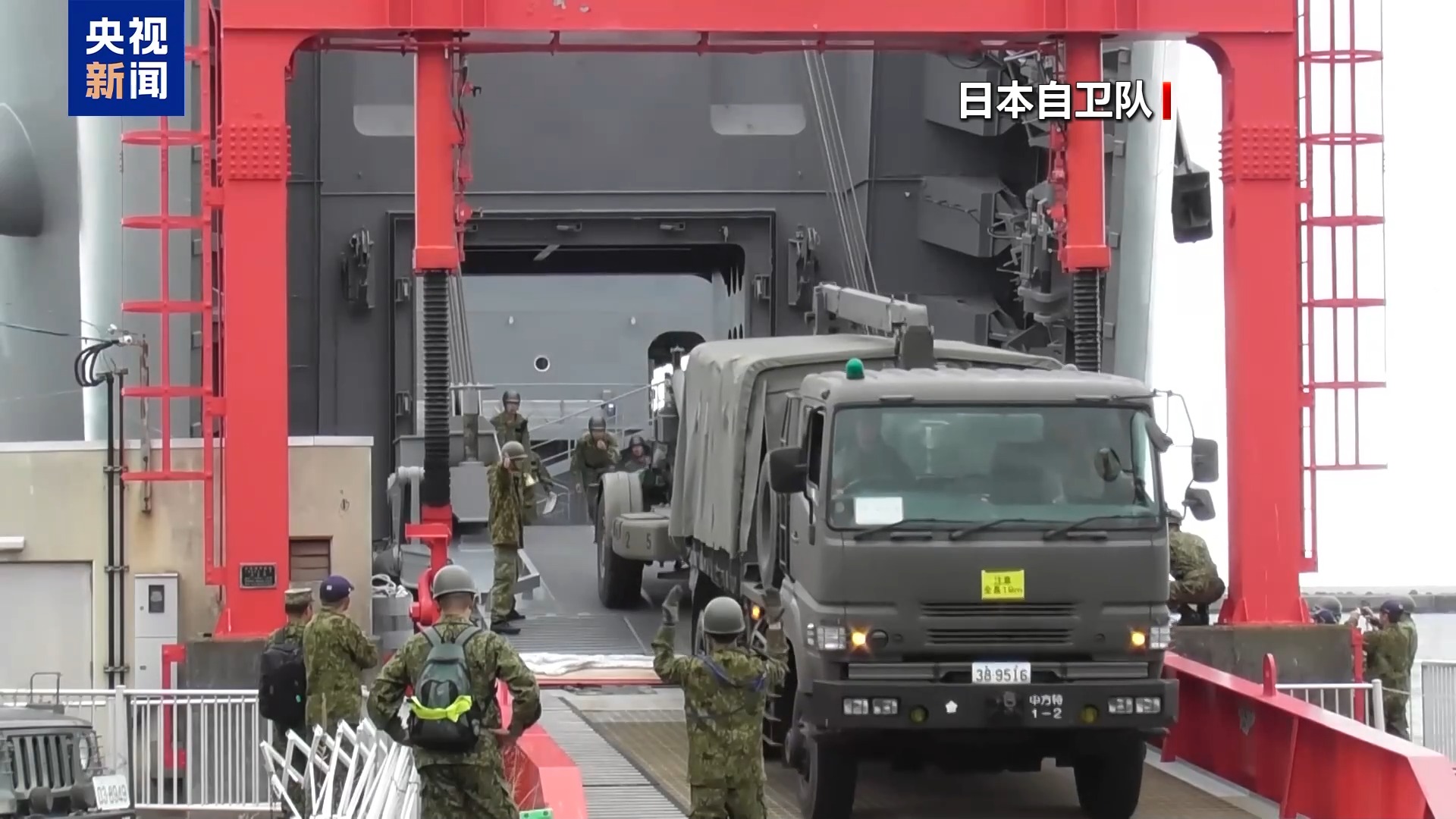
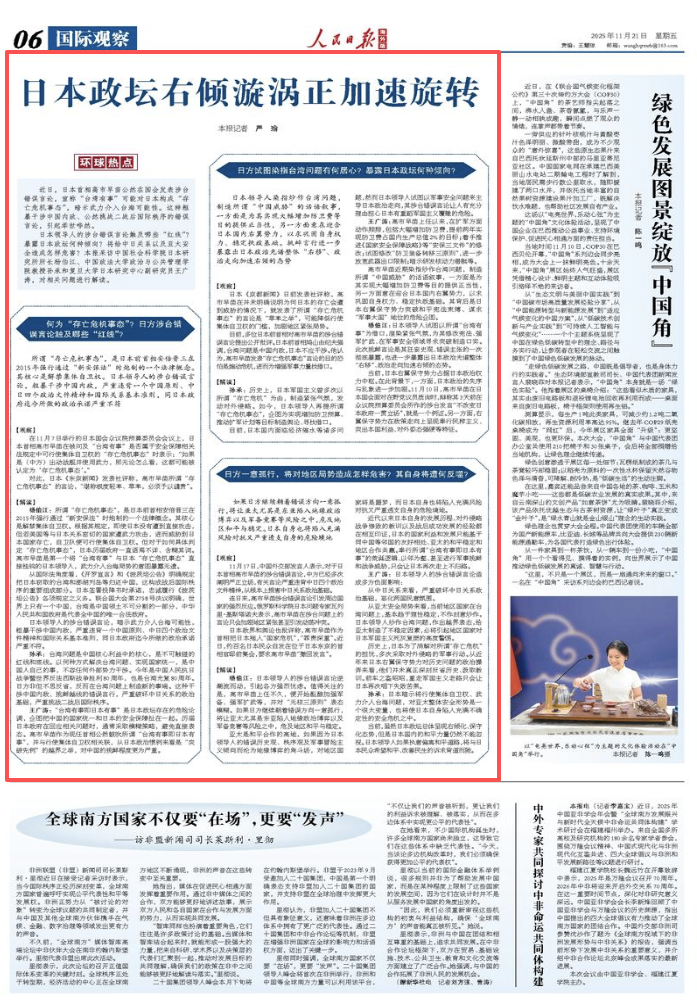
日本政坛右倾漩涡正加速旋转(环球热点)
Ren Min Ri Bao Hai Wai Ban· 2025-11-20 22:56
Core Viewpoint - Japanese Prime Minister Fumio Kishida's recent remarks in the National Diet regarding Taiwan have sparked global outrage, suggesting that a "crisis" in Taiwan could pose an existential threat to Japan, indicating a potential for military intervention in the Taiwan Strait [1][2][3] Group 1: Definition and Implications of "Existential Crisis" - The term "existential crisis" was introduced by former Prime Minister Shinzo Abe in 2015 through the "New Security Law," which allows for collective self-defense even if Japan is not directly attacked [2][3] - Kishida's comments directly link the situation in Taiwan to Japan's security framework, marking a significant shift in Japan's political stance and raising concerns about military involvement in Taiwan [3][4] Group 2: Political Trends in Japan - The remarks reflect a broader trend of rightward shift in Japanese politics, with Kishida's government attempting to justify increased defense spending and military expansion under the guise of a "China threat" narrative [5][6][7] - Historical parallels are drawn to Japan's militaristic past, with concerns that such rhetoric could lead to a resurgence of militarism and aggressive foreign policy [7][8] Group 3: Regional and International Reactions - Kishida's statements have drawn criticism from various quarters, including former Japanese leaders and international observers, who warn that such rhetoric could destabilize the region and provoke military tensions [9][10] - The Chinese government has firmly rejected these comments, emphasizing that Taiwan is a core interest and any external interference is unacceptable [9][10][11] Group 4: Potential Consequences - Continued provocative statements from Japan could lead to increased geopolitical tensions in the Asia-Pacific region, potentially igniting an arms race and undermining regional stability [9][10][11] - The domestic political landscape in Japan may also be affected, as public sentiment could shift against militaristic policies, contrasting with the government's current trajectory [11][12]
外交部:如日方拒不撤回涉台错误言论 中方将不得不采取严厉坚决的反制措施
Xin Lang Cai Jing· 2025-11-20 15:23
Group 1 - The core viewpoint of the article emphasizes that Japanese Prime Minister Fumio Kishida's remarks regarding Taiwan have fundamentally harmed the political foundation of China-Japan relations, provoking strong public outrage in China [1] - The Chinese government has issued a stern warning to Japan, urging it to retract its erroneous statements and to cease creating incidents related to China, indicating that failure to do so will result in severe countermeasures from China [1] - The spokesperson highlighted that Japan's historical use of the concept of "survival crisis" as a pretext for military aggression is a dangerous precedent that must not be repeated, referencing past events such as the Mukden Incident and the Pacific War [3] Group 2 - The article mentions that China has suspended imports of Japanese seafood due to Japan's failure to provide promised technical materials ensuring product safety, which is a prerequisite for such exports [3] - The spokesperson noted that the current political climate, exacerbated by Kishida's controversial statements, has led to a lack of market for Japanese seafood in China, regardless of its quality [3]
国际社会必须高度警惕、坚决阻击任何复活军国主义的图谋
Ren Min Ri Bao· 2025-11-19 22:20
Core Points - The spokesperson of the Ministry of Foreign Affairs, Mao Ning, emphasized that Japan's use of "existential crisis" and "self-defense" as justifications for external aggression is a common tactic of militarism [1][2] - Mao Ning highlighted that Japan's historical actions, such as the invasion of Northeast China in 1931 and the declaration of the "Greater East Asia Co-Prosperity Sphere," were framed as matters of national survival, leading to significant military conflicts [2] Summary by Sections - **Japan's Militaristic Tactics** - Japan has historically invoked "existential crisis" to justify military aggression, as seen in events like the Mukden Incident in 1931 and the Pacific War [2] - The international community must remain vigilant against any resurgence of militarism from Japan [2] - **Legal and Historical Context** - The concept of "collective self-defense" was established under the UN Charter to maintain international security and prevent the resurgence of fascism [1] - Post-World War II, Japan was restricted from exercising this right, as outlined in the Potsdam Declaration and its own constitution, which commits to renouncing war and military threats [1]
外交部:国际社会必须高度警惕、坚决阻击任何复活军国主义的图谋
Xin Hua She· 2025-11-19 13:30
Core Viewpoint - The spokesperson of the Ministry of Foreign Affairs, Mao Ning, emphasized that Japan's invocation of "survival crisis" and "self-defense" as justifications for foreign aggression is a tactic commonly used by Japanese militarism, urging the international community to remain vigilant against any attempts to revive militarism and to collectively maintain post-war international order and world peace [1][2]. Group 1 - Mao Ning highlighted that the concept of "collective self-defense" as defined by the UN Charter was created to maintain collective security and prevent the resurgence of fascist forces, and Japan has been restricted from exercising this right post-World War II [1]. - The Potsdam Declaration explicitly prohibits Japan from rearming, and Japan's constitution commits to "forever renouncing war" and the use of force to resolve international disputes, establishing a principle of "defensive defense" [1]. - Historical examples were cited, such as Japan's invasion of Northeast China in 1931 under the pretext of a "survival threat," and the declaration of the "Greater East Asia Co-Prosperity Sphere" as a battle for Japan's survival, which led to widespread aggression across Asia [2]. Group 2 - Mao Ning warned that the alarm has been sounded and that the tragedies of the past must not be repeated, calling for the international community to be highly alert and to decisively counter any attempts to revive militarism [2]. - The statement coincides with the 80th anniversary of the victory in the Chinese People's Anti-Japanese War and the global anti-fascist war, reinforcing the need for collective action to safeguard world peace [2].
中方:日本毫无资格要求成为安理会常任理事国
Ren Min Ri Bao· 2025-11-19 08:47
Core Viewpoint - The Chinese representative to the UN, Ambassador Fu Cong, criticized Japanese Prime Minister Fumio Kishida's provocative remarks regarding Taiwan, asserting that such statements threaten China's sovereignty and violate international principles [1][2]. Group 1: China's Position on Taiwan - Fu Cong emphasized that Taiwan is an inseparable part of China and that Japan's interference in China's internal affairs is dangerous and erroneous [1]. - The remarks made by Kishida are seen as a challenge to international justice and a violation of the post-war international order [1][2]. - Fu Cong warned Japan against playing with fire on the Taiwan issue, stating that any military intervention would be considered an act of aggression [2]. Group 2: Historical Context and Implications - The statement referenced Japan's militaristic history, noting that similar justifications for "survival crises" were used to initiate invasions, such as the 1931 Mukden Incident [2]. - Fu Cong questioned Japan's commitment to peace, given Kishida's advocacy for abolishing the constitutional clause that renounces war [2]. - The international community is urged to scrutinize Japan's ability to uphold its promises of peace and justice in light of its historical actions [2].
中方:以所谓“存亡危机”发动对外侵略是日本军国主义惯用伎俩
Zhong Guo Xin Wen Wang· 2025-11-19 08:11
Core Viewpoint - The Chinese government criticizes Japan's potential military intervention in the Taiwan Strait, linking it to historical patterns of Japanese militarism and aggression under the guise of "self-defense" and "survival crisis" [1][2]. Group 1: Historical Context - Japan has historically used the concept of "survival crisis" to justify military aggression, such as the invasion of Northeast China in 1931 and the broader conflicts during World War II [2]. - The notion of "self-defense" has been manipulated by Japan to initiate conflicts, as seen in the lead-up to the Pacific War [2]. Group 2: Legal Framework - The Chinese government emphasizes that Japan's post-World War II constitution prohibits the use of military force for resolving international disputes and mandates a principle of self-defense [1]. - The United Nations Charter's provision for "collective self-defense" was established to maintain international security and prevent the resurgence of fascism, which Japan is seen as violating by considering military actions in the Taiwan Strait [1].
中方暂停进口日本水产品!
证券时报· 2025-11-19 08:07
Core Viewpoint - China has suspended the import of Japanese seafood due to Japan's failure to provide promised technical materials ensuring product safety, which is a prerequisite for such exports [2][3]. Group 1: Diplomatic Relations - The recent remarks by Japanese Prime Minister Kishi Nobuo linking Taiwan issues to Japan's survival crisis have provoked strong public outrage in China, indicating a potential market rejection of Japanese seafood even if exports were allowed [2][3]. - The spokesperson emphasized that Japan's historical use of "self-defense" as a pretext for military aggression raises concerns about the revival of militarism, which must be vigilantly opposed by the international community [3]. Group 2: Historical Context - Historical precedents show that Japan has previously invoked "survival threats" to justify military actions, such as the invasion of Manchuria in 1931 and the broader conflicts during World War II [3]. - The spokesperson called for heightened vigilance against any attempts to revive militarism, especially in light of the 80th anniversary of the victory in the Anti-Japanese War and the global anti-fascist struggle [3]. Group 3: Future Implications - The spokesperson warned that if Japan does not retract its controversial statements regarding Taiwan, China will have to take severe countermeasures, with all consequences falling on Japan [3].
外交部:国际社会必须高度警惕,坚决阻击任何复活军国主义的图谋
Huan Qiu Wang· 2025-11-19 07:40
Core Viewpoint - The statement by Japan's former Prime Minister Sanna Takagi linking "Taiwan's situation" to Japan's "survival crisis" raises concerns about Japan potentially exercising collective self-defense, which could lead to military intervention in the Taiwan Strait, violating China's bottom line [1][2]. Group 1 - The Chinese Foreign Ministry spokesperson, Mao Ning, emphasized that the concept of "collective self-defense" as defined by the UN Charter was created to maintain international security and prevent the resurgence of fascism, and Japan has been restricted from exercising this right post-World War II [1]. - Historical context was provided, highlighting that Japan's past justifications for military aggression, such as the 1931 invasion of Northeast China under the guise of "survival crisis," reflect a pattern of militaristic behavior [1]. - Mao Ning warned against the revival of militarism, urging the international community to remain vigilant and prevent any attempts to undermine the post-war international order [2].
外交部回应高市涉台谬论触犯中方底线:警钟已经敲响 悲剧不能重演
Yang Shi Xin Wen· 2025-11-19 07:38
Core Viewpoint - The spokesperson of the Ministry of Foreign Affairs, Mao Ning, emphasized that Japan's potential military intervention in the Taiwan Strait, under the guise of "collective self-defense," violates China's bottom line and recalls historical precedents of Japanese militarism [1][2]. Group 1 - Mao Ning highlighted that the concept of "collective self-defense" was established to maintain international security and prevent the resurgence of fascism, and Japan has been historically restricted from exercising this right post-World War II [1]. - The Potsdam Declaration explicitly prohibited Japan from rearming, and Japan's constitution commits to renouncing war and the use of force to resolve international disputes, establishing a principle of "defensive defense" [1]. - Historical examples were cited where Japan invoked "survival crisis" as a pretext for military aggression, including the 1931 invasion of Northeast China and the justification for the Pacific War [1]. Group 2 - Mao Ning warned that the international community must remain vigilant to prevent the resurgence of militarism, especially in light of the 80th anniversary of the victory in the Chinese People's Anti-Japanese War and the global anti-fascist war [2].