
跨境支付

Search documents
超2500只个股上涨
第一财经· 2025-08-21 03:48
Core Viewpoint - The A-share market shows positive momentum with significant gains in digital currency concept stocks, while other sectors like liquid cooling servers experience declines [3][4][23]. Market Performance - As of the midday close, the Shanghai Composite Index rose by 0.35%, the Shenzhen Component Index increased by 0.45%, and the ChiNext Index gained 0.21% [3]. - The total trading volume in the Shanghai and Shenzhen markets reached 1.57 trillion yuan, with over 2,500 stocks rising [4][5]. - The market has seen a continuous trading volume exceeding 1.5 trillion yuan for 26 consecutive trading days [5]. Sector Highlights - Digital currency concept stocks experienced a surge, with companies like New Morning Technology hitting the daily limit of 20% [23]. - The combustible ice sector saw a significant rise, with Shenke Co. increasing by over 5% following breakthroughs in large-scale utilization [6]. - Oil and gas stocks also performed well, with Junyou Co. reaching the daily limit [8]. Notable Stocks - ZTE Corporation's A-shares surged over 7%, with trading volume exceeding 14 billion yuan [11][19]. - Cambrian's stock price reached a new high, with a market capitalization surpassing 440 billion yuan [17][18]. Other Market Movements - The agricultural sector, particularly planting and forestry, saw short-term gains, with Kangnong Seed rising over 10% [13]. - Liquid cooling server stocks faced volatility, with Jintian Co. hitting the daily limit down [14].




稳定币、数字货币概念领涨,稳定币含量最高的金融科技ETF华夏(516100)异动走强
Sou Hu Cai Jing· 2025-08-21 02:01
Group 1 - The three major indices opened higher on August 21, with stablecoins and digital currency concepts leading the gains, and the financial technology index showing significant movement [1] - The financial technology ETF Huaxia (516100) experienced a strong performance, rising by 1.5%, with its holdings in stablecoin-related stocks such as Xinchen Technology hitting the daily limit up [1] - Over the past three days, the financial technology ETF Huaxia (516100) has seen a cumulative net subscription amount of 153.93 million yuan [1] Group 2 - The financial technology ETF Huaxia (516100) closely tracks the CSI Financial Technology Theme Index, covering software development, internet finance, and the digital currency industry chain [2] - The ETF includes major stocks such as Tonghuashun, Dongfang Caifu, Runhe Software, and Hengsheng Electronics, as well as popular stablecoin stocks, with a stablecoin content of 22.59%, ranking first in the market [2] - This ETF allows investors to easily access popular concepts such as stablecoins, digital currencies, and cross-border payments [2]
A股早评:三大指数高开,沪指涨0.12%续创10年新高,跨境支付概念活跃!天融信涨停,中油资本、四方精创涨超9%,中银证券涨5%
Ge Long Hui· 2025-08-21 01:59
Market Overview - The A-share market opened with all three major indices rising, with the Shanghai Composite Index up by 0.12%, continuing to reach a 10-year high [1] - The Shenzhen Component Index increased by 0.33%, while the ChiNext Index rose by 0.28% [1] Sector Performance - The cross-border payment concept saw significant gains, with Tianrongxin hitting the daily limit, and Zhongyou Capital and Sifang Jingchuang both rising over 9% [1] - Brokerage stocks experienced a broad rally, with Zhongyin Securities increasing by over 5%, and Hatou Securities and Dongxing Securities both rising over 3% [1] - The photovoltaic equipment sector faced adjustments, with Huamin Co. dropping over 4% and Yamaton falling over 3% [1] - The rare earth permanent magnet concept initially declined, with Jintian Co. falling over 8% and Dongfang Zirconium dropping over 5% [1]


移卡(09923) - 2025 H1 - 电话会议演示
2025-08-21 01:30
2025 First Half Investor Presentation A u g 2 0 2 5 Legal Disclaimer 2 • This document has been prepared by YEAHKA LIMITED (the "Company" or "us") for a limited number of recipients and for information purposes only and not for public dissemination. You and your directors, officers, employees, agents and affiliates must hold this document and any oral information provided in connection with this document in strict confidence and may not communicate, reproduce, distribute or disclose it to any other person, ...
大智慧:公司未开展“稳定币”“虚拟资产交易”“跨境支付”等相关业务
3 6 Ke· 2025-08-19 11:36
Core Viewpoint - Dazhihui announced that its stock price has deviated significantly, with a cumulative increase of over 20% in closing prices over three consecutive trading days [1] Group 1: Stock Performance - The company's stock trading has shown an abnormal fluctuation, with a cumulative increase in closing price deviation exceeding 20% over three trading days [1] Group 2: Business Operations - The company conducted a self-examination and confirmed that it does not possess qualifications related to "stablecoins," "virtual asset trading," or "cross-border payments," and has not engaged in any related business [1] - The company has not identified any other significant factors that could impact its stock trading price, including media reports, market rumors, or trending market concepts that require clarification [1]

大智慧:公司未开展“跨境支付”等相关业务
Zheng Quan Shi Bao Wang· 2025-08-19 10:44
Core Viewpoint - Dazhihui (601519) announced on August 19 that its stock price has experienced an abnormal fluctuation, with a cumulative increase of over 20% in the closing price deviation over three consecutive trading days [1] Group 1: Stock Performance - The company's stock price has shown a significant increase, with a cumulative deviation of over 20% in the closing price over three trading days [1] - The market is currently focused on "virtual asset trading" and "cross-border payments," which may have influenced the stock's performance [1] Group 2: Company Operations - Following a self-examination, the company confirmed that it does not possess relevant qualifications and has not engaged in related businesses [1] - The company has not identified any other factors that could significantly impact its stock price, including media reports, market rumors, or trending concepts [1]
大智慧(601519.SH):未开展“稳定币”、“虚拟资产交易”、“跨境支付”等相关业务
Ge Long Hui A P P· 2025-08-19 10:44
Core Viewpoint - The company, Dazhihui (601519.SH), has announced that it currently does not possess qualifications related to "stablecoins," "virtual asset trading," or "cross-border payments," despite the high market interest in these areas [1] Group 1 - The company conducted a self-inspection and confirmed it has not engaged in any related business activities [1] - The company did not identify any other significant factors that could impact its stock trading price, which require clarification or response to media reports, market rumors, or trending concepts [1]
龙虎榜 | 资金疯狂买入!作手新一1.17亿加仓中油资本,沪股通抛售华胜天成
Sou Hu Cai Jing· 2025-08-19 10:30
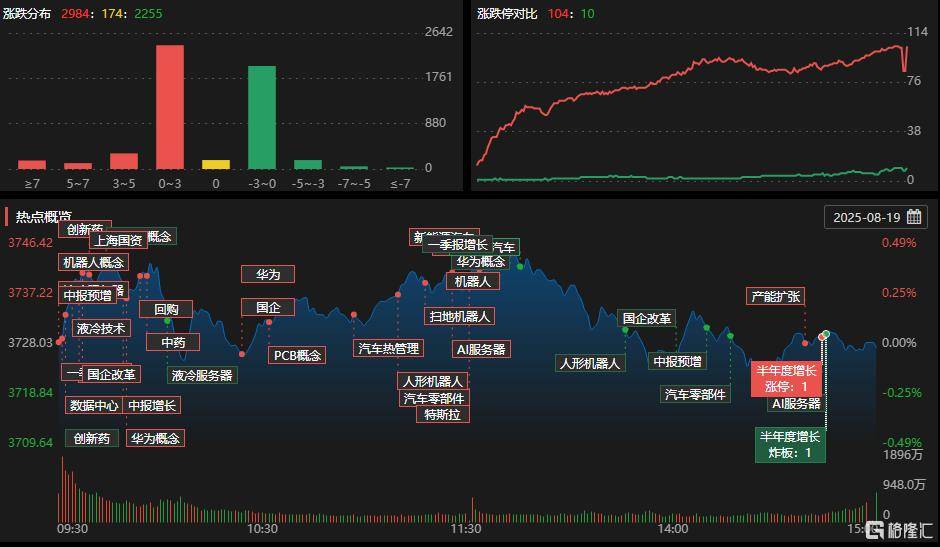
Market Overview - On August 19, major A-share indices experienced fluctuations, with the Shanghai Composite Index down by 0.02%, Shenzhen Component Index down by 0.12%, and ChiNext Index down by 0.17%. The North Star 50 Index rose by 1.27%, reaching a new historical high. The total trading volume for the day was 2.64 trillion yuan, with over 2,900 stocks rising [1]. - The market focus was on sectors such as liquor, Huawei HiSilicon, CPO, and humanoid robots [1]. Stock Performance - A total of 85 stocks hit the daily limit up, with 26 stocks on consecutive limit up boards. The limit up rate was 71% (excluding ST and delisted stocks) [3]. - Notable stocks included: - Da Yuan Pump Industry, which fell to the limit down after six consecutive limit ups, reducing the market's consecutive limit up height to four for Ji Min Health [3]. - Guo Ji Jing Gong, which achieved seven limit ups in 12 days, driven by the robot and commercial aerospace concepts [3]. Key Stocks and Trading Data - **宜安科技 (Yian Technology)**: Closed at 16.98 yuan, with a limit up of 20.00% and a trading volume of 28.39 billion yuan. Institutional net buying was 522.84 million yuan [12]. - **广东建科 (Guangdong Construction Science)**: Closed at 44.36 yuan, with a limit up of 19.99% and a trading volume of 19.03 billion yuan. Institutional net buying was 86.48 million yuan [15]. - **中油资本 (China Oil Capital)**: Closed at 9.72 yuan, with a rise of 9.96% and a trading volume of 56.10 billion yuan. Institutional net selling was 120 million yuan [10]. Institutional Trading - The top three net buying stocks on the daily leaderboard were: - 中油资本 (China Oil Capital): 265 million yuan - 宜安科技 (Yian Technology): 207 million yuan - 卧龙电驱 (Wolong Electric Drive): 199 million yuan [6]. - The top three net selling stocks were: - 影石创新 (Yingshi Innovation): 418 million yuan - 航天科技 (Aerospace Science and Technology): 284 million yuan - 华胜天成 (Hua Sheng Tian Cheng): 192 million yuan [6]. Sector Highlights - The market saw significant interest in sectors related to humanoid robots and innovative pharmaceuticals, with stocks like 宜安科技 (Yian Technology) and 申联生物 (Shenlian Bio) showing strong performance [12][15]. - The focus on digital currency and cross-border payment solutions was highlighted by 中油资本 (China Oil Capital), which is leveraging its state-owned enterprise advantages [12].

义支付上半年跨境收款超25亿美元
Zheng Quan Ri Bao Zhi Sheng· 2025-08-18 16:09
Core Insights - Zhejiang China Commodity City Group Co., Ltd. reported strong growth in its third-party payment institution, YiPay, with a profit exceeding 40 million yuan, a year-on-year increase of over 50% [1] - YiPay's cross-border payment volume surpassed 2.5 billion USD in the first half of the year, reflecting a growth of over 47% [1] - YiPay operates in over 170 countries and regions, supporting more than 26 mainstream currencies [1] Group 1: Company Performance - YiPay's business performance is attributed to the global trade hub effect of Yiwu, digital upgrades, and favorable policies [1] - The company has opened cross-border accounts for over 20,000 merchants, leveraging the market procurement trade advantages [1] - YiPay is actively involved in the new round of international trade comprehensive reforms, with five tasks related to its operations efficiently progressing [1] Group 2: Global Expansion and Strategy - YiPay is accelerating its global expansion by applying for financial licenses such as MSO and TCSP in Hong Kong [2] - The company has enhanced its banking partnerships, launching USD direct collection and cross-border RMB allocation upgrades [2] - YiPay has introduced preferential policies for cross-border payments for U.S. export enterprises, indicating a strategic shift from a payment tool to a comprehensive cross-border service provider [2]

这张支付牌照正式易主,跨境支付服务商谋合规
Bei Jing Shang Bao· 2025-08-18 10:53
北京商报讯(记者 岳品瑜 董晗萱)一笔买方来自跨境支付机构的支付牌照交易获批。8月18日,北京商报记者注意到,人民银行官网更新了非银行支付机构 重大事项变更许可信息,同意传化支付有限公司(以下简称"传化支付")主要股东由传化物流集团有限公司变更为上海寻汇信息科技有限公司(以下简 称"上海寻汇")。 | | | | | 同意传化支付有限公司 东由传化物流集团有限 | | --- | --- | --- | --- | --- | | | 传化支付有限公 | 银许准予决字 | 中国人民银行准予行 | | | 65 | 可 | 〔2025〕 第66号 | 政许可决定书 | 更为上海寻汇信息科技 | | | | | | 司,实际控制人由自然 | | | | | | 巨变更为自然人MEN | 上海寻汇是跨境支付品牌寻汇SUNRATE(以下简称"寻汇")在中国境内的运营主体,后者全球业务总部位于新加坡,目前已在香港、雅加达、东京、伦敦 和上海等地设有办事处。其对于传化支付的收购事项于今年4月开始,根据公告,上海寻汇以3.15亿元的价格拿下了这张支付牌照。 正如公司自身评价,跨境支付服务商持续谋求支付牌照,一方面是基于国内 ...
