可燃冰

Search documents
万联晨会-20260327
Wanlian Securities· 2026-03-27 01:26
Core Insights - The A-share market experienced a decline on Thursday, with the Shanghai Composite Index falling by 1.09%, the Shenzhen Component Index down by 1.41%, and the ChiNext Index decreasing by 1.34%. The total trading volume in the Shanghai and Shenzhen markets was 19,434.53 billion [2][7] - In terms of industry performance, coal, oil and petrochemicals, and banking sectors led the gains, while the computer, non-bank financial, and telecommunications sectors faced declines. Concept sectors such as combustible ice, sodium-ion batteries, and Tianjin Free Trade Zone saw increases, whereas military restructuring concepts, HJT batteries, and newly listed tech stocks declined [2][7] - The Hong Kong market also saw declines, with the Hang Seng Index dropping by 1.89% and the Hang Seng Tech Index falling by 3.28%. Internationally, all three major U.S. indices closed lower, with the Dow Jones down by 1.01%, the S&P 500 down by 1.74%, and the Nasdaq down by 2.38% [2][7] Important News - On March 26, 2026, the State Administration for Market Regulation held its first enterprise fair competition symposium, focusing on "regulating corporate competition behavior and building a healthy competitive ecosystem for enterprises going abroad." The meeting involved discussions with leaders from companies such as China Minmetals, China State Construction, CATL, and BYD. The Deputy Director emphasized the need for strengthened antitrust enforcement, corporate compliance guidance, and support for enterprises to explore international markets and achieve high-quality development [3][8]
“十五五”小众能源十大看点:分布式天然气、生物质能、地热供暖……
Zhong Guo Dian Li Bao· 2025-12-11 06:23
Core Viewpoint - Niche energy sources in China, including distributed natural gas, biomass energy, geothermal energy, and ocean energy, are gaining strategic importance in the context of the "dual carbon" goals and the critical period of the 14th Five-Year Plan, potentially becoming significant supplements to mainstream energy sources and supporting energy security and ecological protection [1] Group 1: Distributed Natural Gas - Distributed natural gas can provide multi-energy supply with a comprehensive energy utilization rate exceeding 70%, but its development is constrained by high costs and dependence on external sources [3] - The cost of gas-electricity integration ranges from 0.59 to 0.72 yuan per kilowatt-hour, significantly higher than mainstream energy sources [3] - Policy incentives, such as the revised "Natural Gas Utilization Management Measures" and the peak production plan for gas peak-shaving power stations, are expected to drive the growth of distributed natural gas [3] Group 2: Biomass Energy - Biomass energy, derived from organic waste, has a low utilization rate of 11.8% in China, but is expected to accelerate development due to renewable energy replacement actions [5] - By the end of 2024, biomass power generation capacity is projected to reach 45.99 million kilowatts, with an annual generation exceeding 208.3 billion kilowatt-hours [5] - The development of biomass energy should focus on integrating it into renewable energy strategies and expanding applications in hydrogen production and cellulose ethanol [5] Group 3: Biomass Power Generation - Biomass power generation includes agricultural, forestry, and waste biomass, with installed capacities of 17.09 million kilowatts, 27.38 million kilowatts, and 2.52 million kilowatts respectively by 2024 [7] - The sector faces challenges such as subsidy reductions, unstable fuel supply chains, and low efficiency [7] - Solutions include promoting new technologies, standardizing operations, and exploring new profit models [7] Group 4: Biomass Co-firing - Biomass co-firing is identified as a key method for reducing carbon emissions in coal power plants, with projects demonstrating significant CO2 reduction [10] - The annual biomass resource generation in China exceeds 9 billion tons, and a 60% recovery rate could meet energy needs [10] - The integration of biomass energy with carbon capture technology is recognized as a core path to carbon neutrality [10] Group 5: Geothermal Heating - Geothermal heating is positioned as a crucial clean heating solution for northern cities, with a projected heating area of nearly 900 million square meters by 2025 [12] - Currently, 95% of heating relies on fossil fuels, contributing to significant carbon emissions [12] - Geothermal energy can be integrated with other renewable sources to create demonstration projects that reduce dependency on single resources [12] Group 6: Geothermal Power Generation - China's geothermal power generation capacity is currently only 61.47 megawatts, ranking 19th globally [14] - The development is hindered by economic factors, resource concentration in less developed areas, and inadequate policies [14] - To catch up, efforts should focus on technology breakthroughs, cost reduction, and policy improvements [14] Group 7: Hot Dry Rock Power Generation - Hot dry rock resources in China are substantial, with a potential to meet energy needs for 4,000 years [16] - The technology is still in the early stages of commercialization, facing challenges in extraction and cost [16] - If breakthroughs are achieved during the 14th Five-Year Plan, hot dry rock power could become a disruptive energy source [16] Group 8: Ocean Energy - Ocean energy, including tidal and wave energy, has a potential development capacity of 650 million kilowatts [18] - Recent advancements have positioned China as a leader in ocean energy technology [18] - The sector is still in the demonstration phase, with high costs and technical challenges to overcome [18] Group 9: Integrated Development - The integration of ocean energy with other sectors, such as desalination and offshore oil and gas platforms, is being promoted [21] - Successful pilot projects have demonstrated the potential for cost reduction and resource efficiency [21] - The focus during the 14th Five-Year Plan should be on developing large-scale demonstration projects to drive industry growth [21] Group 10: Combustible Ice - Combustible ice resources in the South China Sea are equivalent to 65 billion tons of oil, with potential for over 130 years of supply [23] - The main challenges include high extraction costs and ecological protection [23] - A technological breakthrough in extraction could significantly enhance the prospects for combustible ice as a marine energy source [23]
可燃冰板块11月24日跌2.06%,中国石油领跌,主力资金净流出4.52亿元
Sou Hu Cai Jing· 2025-11-24 09:25
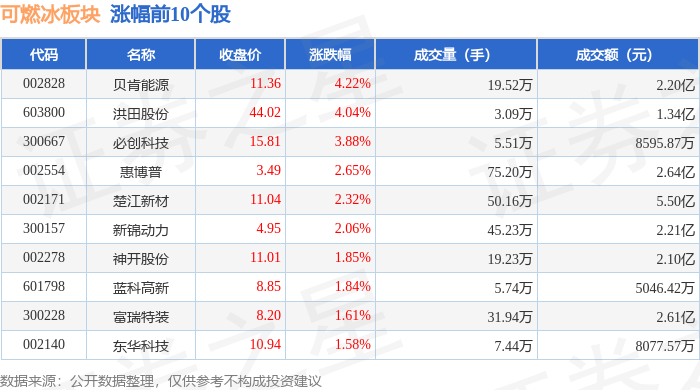
Core Viewpoint - The combustible ice sector experienced a decline of 2.06% on November 24, with China National Petroleum Corporation leading the drop, while the Shanghai Composite Index rose by 0.05% and the Shenzhen Component Index increased by 0.37% [1] Group 1: Market Performance - The closing price of China National Petroleum was 9.78, down by 2.49%, with a trading volume of 2.428 million shares and a transaction value of 2.383 billion yuan [2] - The closing price of China Petroleum & Chemical Corporation was 5.84, down by 2.18%, with a trading volume of 1.9947 million shares and a transaction value of 1.171 billion yuan [2] - The combustible ice sector saw a net outflow of 450 million yuan from main funds, while retail investors contributed a net inflow of 388 million yuan [2] Group 2: Individual Stock Performance - Beiken Energy (002828) closed at 11.36, up by 4.22%, with a trading volume of 195,200 shares and a transaction value of 220 million yuan [1] - Hongtian Co., Ltd. (603800) closed at 44.02, up by 4.04%, with a trading volume of 30,900 shares and a transaction value of 134 million yuan [1] - Huibo Yin (002554) closed at 3.49, up by 2.65%, with a trading volume of 752,000 shares and a transaction value of 264 million yuan [1] Group 3: Fund Flow Analysis - Huibo Yin (002554) had a main fund net outflow of 36.17 million yuan, with a retail net inflow of 61.32 million yuan [3] - The main fund net inflow for Beiken Energy (002828) was 7.16 million yuan, while retail investors had a net inflow of 0.75 million yuan [3] - The main fund net inflow for Donghua Technology (002140) was 4.88 million yuan, with a retail net outflow of 1.02 million yuan [3]



中经评论:深海采火照未来
Jing Ji Ri Bao· 2025-11-20 00:20
Core Insights - The main focus of the article is on the significance of methane hydrate, also known as "combustible ice," which was used to ignite the main torch at the 15th National Games, highlighting its potential as a future energy source [1][4]. Group 1: Characteristics of Combustible Ice - Combustible ice is a solid crystalline substance formed from natural gas and water molecules under high pressure and low temperature, capable of releasing a large volume of natural gas when ignited [1][2]. - The energy density of combustible ice is extremely high, with 1 cubic meter capable of releasing approximately 160 to 180 cubic meters of natural gas, equivalent to compressing natural gas over a hundred times [1][2]. Group 2: Resource Potential - Global reserves of combustible ice are estimated to be more than twice the total known reserves of coal, oil, and natural gas combined, indicating a significant opportunity for those who can commercialize its extraction [2][4]. - The combustion of combustible ice produces minimal dust and significantly lower carbon dioxide emissions compared to coal, positioning it as a cleaner fossil fuel alternative [2]. Group 3: Challenges in Extraction - The extraction of combustible ice is challenging due to its location in deep-sea sediments or permafrost, where high pressure and low temperatures pose technical difficulties and risks of destabilizing the geological structure [3]. - High extraction costs and environmental risks, such as potential methane leaks, complicate the path to commercial viability [3][5]. Group 4: Strategic Importance for China - The successful extraction and utilization of combustible ice could enhance China's energy security by reducing dependence on foreign oil and gas, effectively discovering a vast "gas reservoir" in its own territory [4]. - Combustible ice is seen as a crucial bridge in transitioning from traditional to renewable energy sources, providing stable base-load energy to support the grid during periods of low renewable energy generation [4]. - The development of deep-sea combustible ice extraction could lead to the creation of a large high-tech industrial chain, boosting China's marine technology and economic growth [4]. Group 5: Future Outlook - Despite the successful ignition of combustible ice, significant challenges remain in achieving large-scale commercial extraction, requiring ongoing advancements in technology, cost management, and environmental risk assessment [5].
靠科技创新培育新动能(评论员观察)
Ren Min Ri Bao· 2025-11-11 22:40
Group 1 - The "14th Five-Year Plan" has achieved significant results, emphasizing the importance of independent innovation and self-reliance for strategic advantage [3] - The marine equipment industry in China holds 54.4% of the global effective patent volume, showcasing its technological advancements and innovation capabilities [2] - The "Dream" deep-sea drilling vessel, designed and built by over 150 units, demonstrates the effectiveness of collaborative efforts in advancing marine technology [3] Group 2 - In the first three quarters of this year, China's new orders, completed orders, and hand-held orders for marine vessels continued to lead globally, with marine engineering equipment delivery and hand-held order amounts increasing by 13.6% and 7.0% year-on-year, respectively [4] - The transformation of scientific and technological achievements into practical applications is crucial for economic and social development, highlighting the need for reform to stimulate innovation [4] - The emphasis on technology modernization as a foundation for achieving high-quality development aligns with the goal of building a strong technological nation [4]
国民经济发展“蓝色支撑”稳中有进——访自然资源部海洋战略规划与经济司负责人
Xin Hua She· 2025-11-03 17:04
Core Insights - China's marine economy continues to show robust growth, with marine GDP reaching 7.9 trillion yuan, a year-on-year increase of 5.6%, outpacing the national GDP growth by 0.4 percentage points [2][7] - The country leads globally in marine product output and shipbuilding, with new ship orders accounting for 63.5% of the world market [1][4] Marine Economy Development - The marine production value has provided a solid "blue support" for national economic development, with significant advancements in marine aquaculture and energy sectors [2][3] - Marine product output increased by 4.8%, with marine aquaculture rising by 5.7% [2] Marine Energy Sector - Offshore wind power generation and new grid-connected capacity saw year-on-year increases of 3.7% and 42.1%, respectively [3] - Significant breakthroughs in oil and gas exploration were reported, with marine crude oil and natural gas production increasing by 3.0% and 17.7% [2] Shipbuilding Industry - The shipbuilding industry remains stable, with completed ship volumes and orders increasing by 6.7% and 25.7%, respectively [4] - China's marine engineering equipment continues to dominate the international market, holding 60.0% of new orders and 50.8% of delivered orders [4] Technological Advancements - The country is advancing in marine technology, with the launch of the first trusted data space in the marine sector and the introduction of AI applications [5] - New green ship orders have reached a 70.6% share of the international market, highlighting a commitment to reducing emissions in the shipping industry [5] Investment and Resource Management - The area approved for marine use and islands increased by 19.2%, with investments exceeding 641.9 billion yuan, supporting major projects [7] - A significant proportion of marine enterprises reported growth in revenue, profit, and workforce, indicating a positive trend in the marine economy [7]
权威访谈|国民经济发展“蓝色支撑”稳中有进——访自然资源部海洋战略规划与经济司负责人
Xin Hua Wang· 2025-11-03 16:44
Core Insights - China's marine economy shows robust growth, with marine GDP reaching 7.9 trillion yuan, a year-on-year increase of 5.6%, outpacing the national GDP growth by 0.4 percentage points [2] - The marine fishery sector continues to thrive, with marine product output increasing by 4.8%, and marine aquaculture output rising by 5.7% [2] - The offshore wind power sector is advancing, with offshore wind power generation increasing by 3.7% and new grid-connected capacity rising by 42.1% [3] Marine Economy Development - The marine economy provides a solid "blue support" for national economic development, with significant contributions from fisheries and energy sectors [2] - The construction of "blue granaries" is progressing, enhancing energy extraction from the ocean [2] - Oil and gas production from marine sources has seen increases of 3.0% for crude oil and 17.7% for natural gas [2] Marine Engineering and Manufacturing - China's shipbuilding industry remains strong, with ship completion and order volumes increasing by 6.7% and 25.7% respectively [4] - New orders, completed ships, and hand-held orders account for 63.5%, 47.3%, and 58.6% of the global market share, respectively [4] - The marine engineering sector continues to lead globally, with new orders and delivery amounts holding 60.0% and 50.8% of the international market [4] Technological Advancements - Significant advancements in deep-sea exploration and marine technology have been achieved, including successful trials of new equipment in extreme environments [4] - The first trustworthy data space in the marine sector has been launched, and various AI innovations are being integrated into marine applications [5] - The share of new green ship orders in the international market has reached 70.6%, indicating a strong push towards sustainable shipping practices [5] Investment and Resource Management - The area approved for marine and island use has increased by 19.2%, with investments exceeding 641.9 billion yuan, supporting major projects [6] - A majority of marine enterprises reported growth in revenue, profit, and workforce, indicating a positive trend in the marine economy [6] - Continuous innovation and investment in R&D are being observed in the marine sector, with significant increases in funding and personnel [6]
从深海取火到机器人之舞:一场照见湾区科技未来的火炬传递
Nan Fang Du Shi Bao· 2025-11-02 16:05
Group 1: Core Concept - The event of the torch relay symbolizes the integration of sports spirit, technology, and civilization, showcasing the strong synergy between Guangdong's industry and technology [4] Group 2: Deep Sea Energy - The flame used in the torch relay originates from combustible ice, a key resource for global energy transition, with Guangdong's research team successfully developing in-situ ignition technology [5][6] - Combustible ice has an energy density approximately 10 times that of coal and 2 to 5 times that of natural gas, producing significantly less pollution compared to traditional energy sources [6] - China's total reserves of combustible ice are estimated at 800 billion tons of oil equivalent, with the South China Sea being the core area, accounting for about 80% of the total reserves [6] Group 3: Technological Innovations - The torch relay featured the world's first 5G-A humanoid robot, "Kua Fu," which successfully completed a segment of the relay, marking a significant milestone in the application of robotics in national events [9][10] - The Guangdong region is home to over 100,000 robot-related enterprises, with industrial robot exports from the Greater Bay Area accounting for 32.3% of the national total [12] - The event also included the use of a driverless car for the torch relay, highlighting the advancements in autonomous vehicle technology in Guangdong [12] Group 4: Innovation and Development - The Guangdong-Hong Kong-Macao Greater Bay Area has emerged as a leading innovation cluster, with a research and development expenditure intensity of 3.6% and approximately 77,000 high-tech enterprises [13][15] - The Shenzhen-Hong Kong-Guangzhou innovation cluster has ranked first in the global innovation index, surpassing the Tokyo-Yokohama cluster, reflecting the region's strengths in international patent applications and research output [15]


A股开盘速递 | A股红盘震荡!苹果概念股拉升 煤炭、大消费板块回调
智通财经网· 2025-10-21 01:48
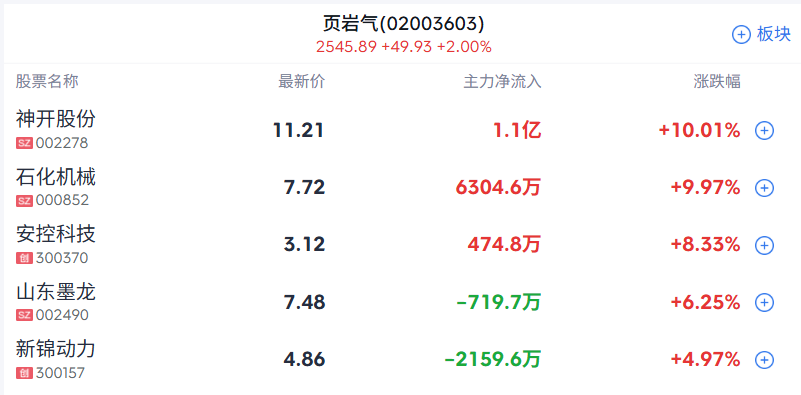
Core Viewpoint - The A-share market showed mixed performance with the Shanghai Composite Index up by 0.27%, the Shenzhen Component Index up by 0.43%, and the ChiNext Index up by 0.19% as of 9:32 AM on October 21. The market sentiment is approaching a neutral level, making expectations for a strong index rise unrealistic, with range-bound fluctuations expected to be the main market characteristic [1][6]. Group 1: Market Performance - The energy sector, particularly shale gas and combustible ice, saw a resurgence, with companies like ShenKong Co. and Petrochemical Machinery hitting the daily limit up [2][3]. - The construction machinery sector also performed well, with JianShe Machinery reaching the daily limit up [1]. - Conversely, coal and gas stocks experienced a pullback, while consumer sectors such as food and beverages weakened [1]. Group 2: Institutional Insights - CITIC Securities noted a continuation of volume contraction and style rotation, indicating a market consolidation phase following the overheated trading in the computing power sector [4]. - China Galaxy highlighted a shift in market style due to external trade uncertainties and previous gains in certain sectors, suggesting a cautious sentiment among investors [5]. - Dongfang Securities emphasized that the market is likely to remain in a range-bound state, with a focus on balanced allocation and attention to sectors like semiconductor equipment and AI [7]. Group 3: Energy Sector Insights - China's natural gas production has increased significantly from 30 billion cubic meters in 2000 to an expected 240 billion cubic meters in 2024, positioning the country as the fourth-largest producer globally [2]. - The development of unconventional gas resources, particularly coalbed methane, is seen as a new opportunity in the energy sector [2].
新华社:深海逐梦,燃“冰”成炬!1500米深海采集的全运火种点燃
Xin Hua She· 2025-10-17 05:54
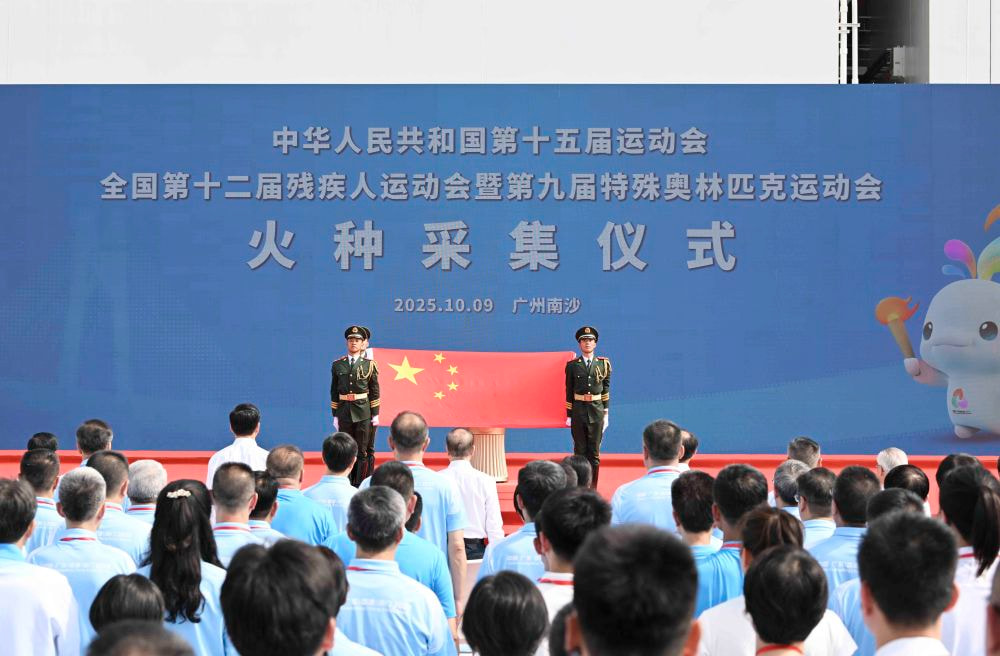
Core Points - The 15th National Games and the 12th National Paralympic Games, along with the 9th Special Olympics, held a torch collection ceremony in Guangzhou, showcasing a significant event in China's sports history [1] Group 1: Torch Collection Process - The "source fire" for this event was ignited using deep-sea combustible ice for the first time, utilizing China's independently developed "Haimai" ROV (4500-meter deep-sea remote-operated vehicle) [4] - The collection took place in the "Haimai Cold Spring Area" of the South China Sea, at a depth of over 1500 meters, where methane gas was collected and synthesized into combustible ice on-site [4][23] - The ignition of the combustible ice was achieved using solar energy through a special device, demonstrating a remarkable technological feat [4][19] Group 2: Technological Innovations - The entire process of collection, transportation, ignition, and recovery was completed in a super-deep-sea environment by the "Haimai" ROV [6] - This event marked the first time in international sports history that solar energy was used to drive deep-sea equipment for the precise ignition of combustible ice to obtain a green "source fire" [23] - A high-definition camera system was employed to provide real-time broadcasting of the entire collection process, enhancing transparency and engagement [23] Group 3: Environmental Considerations - The collection process fully integrated green and low-carbon concepts, utilizing a photovoltaic tracking system to transmit electrical energy to the equipment operating at over 1500 meters underwater [19] - The event symbolizes the fusion of marine technology and sports spirit, reflecting the vitality and dreams of a new era [26]