
关联交易

Search documents
江西正邦科技股份有限公司第八届董事会第七次临时会议决议公告
Shang Hai Zheng Quan Bao· 2025-12-09 19:48
江西正邦科技股份有限公司 登录新浪财经APP 搜索【信披】查看更多考评等级 证券代码:002157 证券简称:正邦科技 公告编号:2025一072 二、董事会会议审议情况 1、会议以3票同意,3票回避,0票反对,0票弃权,审议通过了《关于2026年度日常关联交易预计的议 案》; 关联董事鲍洪星、华涛、华磊在交易对手方的控股股东江西双胞胎控股有限公司担任董事、高管等职 务,回避了表决。 第八届董事会第七次临时会议决议公告 本公司及董事会全体成员保证信息披露内容的真实、准确和完整,没有虚假记载、误导性陈述或重大遗 漏。 一、董事会会议召开情况 1、江西正邦科技股份有限公司(以下简称"公司")第八届董事会第七次临时会议(以下简称"本次会 议")通知于2025年12月6日以电子邮件和专人送达方式发出。 2、本次会议于2025年12月9日在公司会议室以现场及通讯表决的方式召开。 3、本次会议应参加董事6名,实际参加董事6名,全体董事均亲自出席会议。符合《中华人民共和国公 司法》的规定和《公司章程》的要求。 4、本次会议由董事长鲍洪星先生主持,公司高级管理人员列席了本次会议。 5、本次董事会会议的召开符合有关法律、行政法 ...

北京清新环境技术股份有限公司第六届董事会第二十八次会议决议公告
Shang Hai Zheng Quan Bao· 2025-12-09 19:44
Group 1 - The company held its 28th meeting of the sixth board of directors on December 8, 2025, where several key resolutions were passed, including changes to the registered capital and amendments to the company's articles of association [2][3][28] - The company completed the repurchase and cancellation of 9,121,500 restricted shares, reducing the total number of shares to 1,415,267,079 and the registered capital to 1,415,267,079 yuan [3][28] - The company will no longer have a supervisory board; the audit committee of the board will assume the relevant powers previously held by the supervisory board [3][29] Group 2 - The company proposed to revise the "Rules for Shareholders' Meetings," changing its name to "Rules for Shareholder Meetings," which still requires approval from the shareholders' meeting [7][8][9] - The board also approved the revision of the "Rules for Board Meetings," which will also need to be submitted for shareholder approval [11][12][13] - The independent director system was revised to include a new chapter on the annual report work procedures for independent directors, detailing their responsibilities during the annual report preparation process [14][15][16] Group 3 - The company plans to publicly bid for 100% equity of Meishan Guorun Jinxiang Drainage Co., Ltd., which is owned by its wholly-owned subsidiary, Sichuan Development Guorun Water Investment Co., Ltd. [22][34] - The bidding price for the equity is set at 56.2 million yuan, which aligns with the assessed value of the company [34][61] - The acquisition aims to enhance the company's market share in the water service sector and improve operational efficiency [22][68][70] Group 4 - The company will hold its fourth extraordinary general meeting of shareholders on December 25, 2025, to discuss the resolutions passed by the board [25][76] - The meeting will allow shareholders to vote both in person and online, ensuring compliance with relevant regulations [78][81] - The company emphasizes that the resolutions discussed will significantly impact minority investors, and separate counting of votes will be conducted for them [81]

烽火通信科技股份有限公司关于归还暂时补充流动资金的募集资金的公告
Shang Hai Zheng Quan Bao· 2025-12-09 19:18
证券代码:600498 证券简称:烽火通信 公告编号:2025-077 烽火通信科技股份有限公司关于归还暂时补充流动资金的募集资金的公告 本公司董事会及全体董事保证本公告内容不存在任何虚假记载、误导性陈述或者重大遗漏,并对其内容 的真实性、准确性和完整性承担个别及连带责任。 一、募集资金暂时补充流动资金情况 烽火通信科技股份有限公司(以下简称"公司")于2024年12月11日召开第九届董事会第五次临时会议, 审议通过了《关于使用部分闲置募集资金暂时补充流动资金的议案》,同意将部分闲置募集资金不超过 2.7亿元(含2.7亿元)人民币暂时补充流动资金,使用期限不超过12个月(自公司董事会审议批准之日 起计算),在有效期内上述额度可以滚动循环使用,并将根据工程进度提前安排归还募集资金,确保募 集资金投资项目的正常运行。具体内容详见上海证券交易所网站(www.sse.com.cn)及2024年12月12日 《中国证券报》《上海证券报》和《证券时报》披露的《烽火通信科技股份有限公司关于使用部分闲置 募集资金暂时补充流动资金的公告》(公告编号:2024-070)。 二、募集资金归还情况 根据公司募集资金投资项目的建设进度 ...

莱茵生物停牌筹划控制权变更 交易对手方拟注入关联资产
Shang Hai Zheng Quan Bao· 2025-12-09 18:53
Group 1 - The company announced a suspension of trading due to a planned change in control and the issuance of shares to acquire assets [1] - The controlling shareholder, Qin Benjun, is negotiating to transfer part of his shares and relinquish voting rights, with agreements signed with major counterparties [1][2] - The transaction will result in Beijing Jinkangpu becoming a subsidiary of the company, included in the consolidated financial statements, and is expected to be an affiliated transaction [2] Group 2 - Guangzhou Defu Nutrition, the acquiring party, was established on December 2, 2025, and has a capital contribution of 1.35 billion yuan, with a significant majority from Guangzhou Defu Investment Management [2] - Beijing Jinkangpu, the target of the acquisition, specializes in food nutrition fortifiers and has been operational since 2004, serving various sectors including infant food and health supplements [2] - The company focuses on the production and operation of natural health products, with expertise in over 300 standardized plant extraction technologies and a range of products including monk fruit and stevia extracts [3] Group 3 - In the first three quarters of the year, the company reported revenue of 1.272 billion yuan, an increase of 8.73%, while net profit attributable to shareholders decreased by 30.73% to 70.3953 million yuan [3] - The transaction is expected to enhance the company's capabilities in product formulation and core competitiveness in the food and health supplement sectors, leveraging synergies between the two entities [3] - The collaboration aims to ensure a supply of natural raw materials and enhance global marketing capabilities, fostering a mutually beneficial development model [3]

瑞安地产16.5万/㎡卖豪宅给CEO家属,市价约30万/㎡
2 1 Shi Ji Jing Ji Bao Dao· 2025-12-09 13:45
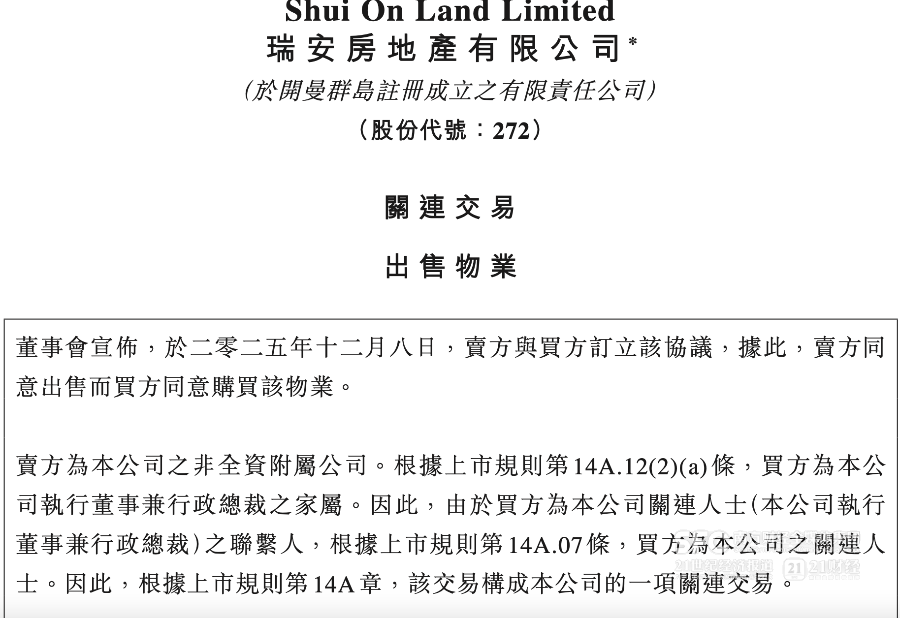
12月8日,瑞安房地产公告一则关联交易:旗下附属公司出售一套物业给公司执行董事兼行政总裁王颖家属,售价为3050.3566万 元(约为3356.1万元港元)。公告披露,该物业净资产(即成本)约为2514.18万元(约为2766.1万元港元),交易完成后,瑞安 房地产预计获利约为536.1766万元(约为589.9万元港元)。 记者丨唐韶葵 编辑丨张伟贤 前述地址对应的项目即为翠湖天地第五期,一共244套房源,分别在2020年6月、2021年10月开售,均价16.5万元/平方米。 (瑞安房地产公告。图片来源:港交所官网) 换言之,瑞安房地产出售这套物业的毛利率约为17.58%。 公告还披露了该套物业所在地址为上海市黄浦区淮海中路街道118街坊地块,该地块为太平桥项目的主要组成部分之一,总建面 约为7.8万平方米。 瑞安房地产在公告里说明,该套物业是按政府相关部门审核的价格出售,也就是预售证上的价格。这表明售价既没上涨也没下 调。瑞安房地产表示,交易资金将用作集团一般运营资金。 (翠湖天地第5期,唐韶葵/摄) 据一名豪宅销售经纪人发布的信息,翠湖天地5期前不久成交了一套高区359平方米的房源,成交单价约30万元/ ...


莱茵生物明日起停牌 筹划控制权变更及购买资产事项
Zhong Guo Jing Ji Wang· 2025-12-09 13:40
秦本军先生及公司已与本次交易的主要交易对方广州德福营养、德福金康普控股有限合伙企业、厦 门德福金普投资合伙企业(有限合伙)分别签署了《控制权变更意向协议》《发行股份购买资产并募集 配套资金意向协议》,协议约定秦本军先生通过协议转让方式将其所持有的部分公司股份转让给广州德 福营养,并签署《表决权放弃协议》,自愿放弃其所持公司部分股份的表决权。同时公司拟向德福金康 普控股有限合伙企业和厦门德福金普投资合伙企业(有限合伙)发行股份购买其合计持有的北京金康普 80%股权,以及向广州德福营养发行股份募集配套资金。 交易标的相关股权的最终交易价格,以公司聘请的符合证券法规定的评估机构出具的评估报告结果 为定价依据,由交易各方协商确定。上述协议仅为交易各方就本次交易达成的初步意向,本次交易的具 体方案将由交易各方另行签署正式协议予以约定。 因上述交易尚处于筹划阶段,有关事项存在不确定性,为保证信息披露的公平,维护投资者利益, 避免对公司股票交易造成重大影响,根据《深圳证券交易所上市公司自律监管指引第6号—停复牌》等 有关规定,经公司申请,公司股票(证券简称:莱茵生物,证券代码:002166)自2025年12月10日(星 期 ...
宁夏建材:关于与中国建材集团财务有限公司签署金融服务协议暨关联交易的公告
Zheng Quan Ri Bao· 2025-12-09 12:10
Group 1 - The core point of the article is that Ningxia Building Materials has signed a financial service agreement with China National Building Material Group Financial Co., Ltd. to provide various financial services for the years 2026, 2027, and 2028 [2] - The agreement includes services such as deposits, comprehensive credit, settlement, and other financial services approved by the National Financial Regulatory Administration [2] - This transaction is classified as a related party transaction due to both companies being under the actual control of China National Building Material Group Co., Ltd. [2]

风光股份(301100.SZ):拟收购三石博涛51%股份
Ge Long Hui A P P· 2025-12-09 11:12
格隆汇12月9日丨风光股份(301100.SZ)公布,公司拟收购营口市风光实业发展有限公司(简称"风光实 业")控股子公司宁夏三石博涛科技股份有限公司51%股份(简称"三石博涛"),收购价格520万元。风 光实业持有20%公司股份,根据《深圳证券交易所创业板股票上市规则》中的相关规定,其与公司之间 发生的交易形成关联交易。 ...
中国船舶:拟与中船财务续签2026年金融服务协议
Xin Lang Cai Jing· 2025-12-09 10:56
Group 1 - The company plans to renew the financial services agreement with China Shipbuilding Finance for the year 2026, which constitutes a related party transaction and requires shareholder approval [1] - The agreement will be valid for one year, with a maximum daily deposit balance of 170 billion yuan, a loan limit of 33 billion yuan, a total annual credit limit of 80 billion yuan, and an annual foreign exchange transaction limit of 17.5 billion USD [1] - China Shipbuilding Finance will provide financial services including deposits, settlement, and loans, with deposit rates ranging from 0.06% to 3.70% and loan rates from 1.60% to 3.40% [1] Group 2 - This initiative aims to provide financial support, reduce costs, and lower risks for the company [1]

精工科技:公司与湖北裕创签署销售合同,合同金额为7.29亿元
Xin Lang Cai Jing· 2025-12-09 10:35
Core Viewpoint - The company has won a bid for a project with Hubei Yuchuang Carbon Fiber Co., Ltd., with a contract amount of 729 million yuan, which constitutes a related party transaction due to the involvement of the company's vice president [1] Group 1 - The company announced on December 4, 2025, that it has won the bid for the high-performance carbon fiber production base project in Wuhan [1] - The contract amount for the project is 729 million yuan, which includes the provision of two 5,000-ton PAN-based carbon fiber precursor production lines and one 3,000-ton carbon fiber production line [1] - The vice president of the company, Mr. Ni Jianxun, serves as a director at Hubei Yuchuang, making this transaction a related party transaction [1]
