
医疗器械

Search documents
生物医药ETF(512290)涨超1.4%,政策红利与估值修复驱动板块走强
Sou Hu Cai Jing· 2025-08-19 03:17
Group 1 - The pharmaceutical and biotechnology industry has shown strong performance recently, with the CITIC Pharmaceutical Index rising by 3.0%, outperforming the CSI 300 Index by 0.7 percentage points, and a year-to-date cumulative increase of 25.5%, demonstrating the sector's resilience [1] - The National Healthcare Security Administration released the "Interim Measures for the Management of Disease-Specific Payment," clarifying the DRG/DIP payment framework and emphasizing transparency in total budget, optimization of technical standards, and reasonable calculation of payment standards, signaling support for medical institutions to use new drugs and technologies [1] - Key mid-term focuses in the industry include innovative drugs (especially those with strong commercialization capabilities like BioPharma and cutting-edge technologies such as gene therapy), medical devices that are experiencing policy turning points, and companies with better-than-expected interim performance [1] Group 2 - The innovative + recovery + policy framework constitutes the three main lines for the medium to long-term outlook, with the sector's valuation still at historically low levels, highlighting its investment value [1] - The Biopharmaceutical ETF (512290) tracks the CS Biopharmaceutical Index (930726), which selects listed companies involved in biotechnology and healthcare from the Shanghai and Shenzhen markets, covering various sub-sectors such as innovative drug development, medical devices, and healthcare services [1] - Investors without stock accounts can consider the Guotai CSI Biopharmaceutical ETF Connect A (006756) and Guotai CSI Biopharmaceutical ETF Connect C (006757) [1]
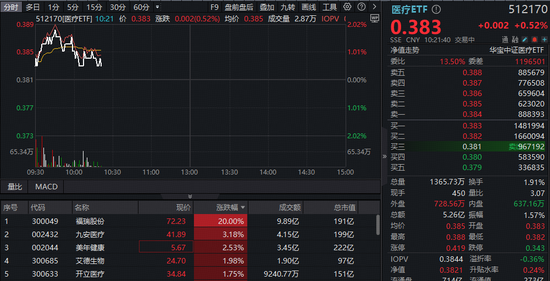
医疗、制药活跃!医疗ETF(512170)年内新高,福瑞股份20CM两连板!创新药续涨,场内唯一药ETF上市新高
Xin Lang Ji Jin· 2025-08-19 02:31
Group 1 - The core viewpoint of the news highlights the active performance of the medical device sector, with significant gains in related stocks and ETFs, particularly driven by the approval of a new drug for treating metabolic dysfunction-associated fatty liver disease [1] - The medical ETF (512170) opened high and reached a peak increase of 1.84%, achieving a new annual high with trading volume surpassing 500 million yuan [1] - The approval of Wegovy by the FDA for treating patients with MASH is expected to accelerate the market for diagnostic equipment, benefiting companies like Furuya Co., which is positioned as a key player in this segment [1] Group 2 - The innovative drug sector continues to show strong performance, with companies like Ganli Pharmaceutical hitting the daily limit, and the pharmaceutical ETF (562050) reaching a new high since its launch [2] - The National Medical Insurance Administration has announced a list of 121 drugs, including high-priced innovative drugs, seeking new payment methods through commercial insurance [4] - The estimated market size for innovative drugs and devices in China is projected to reach approximately 1.62 trillion yuan in 2024, with expectations to exceed 1 trillion yuan by 2035 [4] Group 3 - Recent institutional insights suggest that the pharmaceutical sector, particularly innovative drugs, is viewed positively, while the medical device sector is also gaining attention as a low-position opportunity [5] - Investment strategies are recommended to focus on the largest medical ETF (512170) and its linked funds, emphasizing a mix of medical devices and services, alongside leading pharmaceutical companies [5]


春立医疗涨2.12%,成交额1342.28万元,主力资金净流入79.41万元
Xin Lang Cai Jing· 2025-08-19 01:59
Group 1 - The core viewpoint of the news is that Spring Medical has shown significant stock performance, with an 88.85% increase in stock price year-to-date, despite a recent decline of 3.99% over the last five trading days [1] - As of August 19, the stock price of Spring Medical is 24.08 CNY per share, with a market capitalization of 9.236 billion CNY and a trading volume of 13.42 million CNY [1] - The company primarily engages in the research, production, and sales of orthopedic medical devices, focusing on joint prosthetics and spinal implants, with 99.92% of its revenue coming from medical device products [1][2] Group 2 - As of March 31, the company reported a revenue of 230 million CNY for Q1 2025, representing a year-on-year growth of 3.60%, and a net profit of 58.07 million CNY, which is a 5.20% increase compared to the previous year [2] - The company has distributed a total of 359 million CNY in dividends since its A-share listing, with 309 million CNY distributed over the past three years [3] - The number of shareholders increased by 7.48% to 7,182 as of March 31, while the average number of circulating shares per person decreased by 6.99% to 11,063 shares [2]

超研股份涨2.16%,成交额2.40亿元,近5日主力净流入-8228.55万
Xin Lang Cai Jing· 2025-08-18 08:47
Core Viewpoint - The company, Shantou Ultrasonic Instrument Research Institute Co., Ltd., is experiencing growth in the pet economy and medical device sectors, benefiting from the depreciation of the RMB and its recent listing as a new stock under the registration system [2][3]. Company Overview - Shantou Ultrasonic Instrument Research Institute Co., Ltd. specializes in the research, development, production, and sales of medical imaging equipment and industrial non-destructive testing equipment [3][7]. - The company was established on November 15, 1982, and was listed on January 22, 2025 [7]. - The main business revenue composition includes: medical ultrasound 50.32%, industrial ultrasound 19.04%, X-ray 16.30%, accessories 12.52%, and others 1.82% [7]. Financial Performance - For the period from January to March 2025, the company achieved operating revenue of 98.43 million, representing a year-on-year growth of 28.69%, and a net profit attributable to the parent company of 39.32 million, with a year-on-year increase of 47.70% [8]. - As of March 31, 2025, the company had a total of 26,800 shareholders, a decrease of 46.67% from the previous period, with an average of 2,047 circulating shares per person, an increase of 87.50% [8]. Market Activity - On August 18, the company's stock rose by 2.16%, with a trading volume of 240 million and a turnover rate of 14.56%, bringing the total market capitalization to 12.177 billion [1]. - The stock has seen a net outflow of 17.76 million from major investors today, with a continuous three-day trend of being reduced by major funds [4][5]. Product and Technology Development - The company showcased its innovative veterinary medical imaging achievements at the 97th WVC annual conference, focusing on pet, equine, and livestock health care [2]. - The company has developed a "Hongyun" system for portable ultrasound and DR devices that utilizes 5G networks for remote image transmission and interaction, enhancing the development of portable devices [2][3].
爱博医疗上周获融资净买入1720.87万元,居两市第470位
Sou Hu Cai Jing· 2025-08-17 23:51
8月18日,沪深两融数据显示,爱博医疗上周累计获融资净买入额1720.87万元,居两市第470位,上周 融资买入额2.51亿元,偿还额2.33亿元。 天眼查商业履历信息显示,爱博诺德(北京)医疗科技股份有限公司,成立于2010年,位于北京市,是一 家以从事医药制造业为主的企业。企业注册资本19340.3175万人民币,实缴资本18954.4528万人民币。 公司法定代表人为解江冰。 通过天眼查大数据分析,爱博诺德(北京)医疗科技股份有限公司共对外投资了20家企业,参与招投标项 目222次,知识产权方面有商标信息717条,专利信息165条,此外企业还拥有行政许可93个。 来源:金融界 爱博医疗所属概念板块包括:医疗器械、北京板块、专精特新、沪股通、上证380、融资融券、机构重 仓、医疗器械概念。 资金流方面,爱博医疗近5日主力资金流出1.18亿元,区间跌幅6.39%;近10日主力资金流出2.13亿元, 区间跌幅6.2%。 ...

奕瑞科技上周获融资净买入1649.77万元,居两市第484位
Sou Hu Cai Jing· 2025-08-17 23:51
资金流方面,奕瑞科技近5日主力资金流入5380.92万元,区间涨幅3.42%;近10日主力资金流入5315.54 万元,区间涨幅2.18%。 通过天眼查大数据分析,奕瑞电子科技集团股份有限公司共对外投资了16家企业,参与招投标项目69 次,知识产权方面有商标信息28条,专利信息414条,此外企业还拥有行政许可83个。 天眼查商业履历信息显示,奕瑞电子科技集团股份有限公司,成立于2011年,位于上海市,是一家以从 事专用设备制造业为主的企业。企业注册资本14306.2824万人民币,实缴资本4891.3043万人民币。公司 法定代表人为Tieer Gu。 来源:金融界 8月18日,沪深两融数据显示,奕瑞科技上周累计获融资净买入额1649.77万元,居两市第484位,上周 融资买入额9209.05万元,偿还额7559.28万元。 奕瑞科技所属概念板块包括:医疗器械、上海板块、专精特新、沪股通、上证380、中证500、融资融 券、机构重仓、基金重仓、转债标的、体外诊断、精准医疗、医疗器械概念、国家安防。 ...

福元医药股价震荡下行 半年度业绩说明会即将召开
Jin Rong Jie· 2025-08-15 16:53
Group 1 - The stock price of Fuyuan Pharmaceutical closed at 31.67 yuan on August 15, 2025, down 0.66% from the previous trading day [1] - The stock experienced significant volatility, with a high of 32.60 yuan and a low of 30.48 yuan, resulting in an amplitude of 6.65% [1] - The total trading volume for the day was 200,306 hands, with a transaction amount of 628 million yuan [1] Group 2 - Fuyuan Pharmaceutical is primarily engaged in chemical pharmaceuticals and medical devices, covering multiple therapeutic areas including cardiovascular, digestive, and anti-infection [1] - The company is headquartered in Beijing and is one of the stocks included in the Shanghai-Hong Kong Stock Connect [1] - A half-year performance briefing is scheduled for August 22, 2025, where the chairman and general manager will interact with investors online [1] Group 3 - On August 15, 2025, the net outflow of main funds was 36.41 million yuan, accounting for 0.24% of the circulating market value [1] - Over the past five trading days, the cumulative net inflow of main funds was 61.33 million yuan, representing 0.4% of the circulating market value [1]

春立医疗涨1.89%,成交额6580.26万元,近5日主力净流入299.88万
Xin Lang Cai Jing· 2025-08-15 08:28
Core Viewpoint - Spring Medical, a leading domestic orthopedic medical device manufacturer, focuses on the research, production, and sales of implantable orthopedic medical devices, including dental metal and invisible orthodontics, and is currently in the design and inspection phase for a customized porous tantalum dental implant product [2][3]. Company Overview - Spring Medical is located in Tongzhou District, Beijing, and was established on February 12, 1998, with its listing date on December 30, 2021. The company specializes in implantable orthopedic medical devices, with main products including joint prosthetics and spinal implants [7][8]. - The company's primary products cover hip, knee, shoulder, and elbow joints, as well as a full range of spinal internal fixation systems [5][8]. Financial Performance - For the period from January to March 2025, Spring Medical achieved operating revenue of 230 million yuan, representing a year-on-year growth of 3.60%, and a net profit attributable to shareholders of 58.07 million yuan, up 5.20% year-on-year [8][9]. - Since its A-share listing, Spring Medical has distributed a total of 359 million yuan in dividends, with 309 million yuan distributed over the past three years [9]. Market Position and Recognition - The company has been recognized as a "specialized, refined, distinctive, and innovative" small giant enterprise, which is the highest honor for small and medium-sized enterprises in China, indicating strong innovation capabilities and high market share [3]. - Spring Medical's products are exported to various regions, including Asia, South America, Africa, Oceania, and Europe, with its main business revenue composition being 99.92% from medical device products [8]. Technical Analysis - The average trading cost of the stock is 19.38 yuan, with recent signs of accumulation, although the accumulation strength is not strong. The current stock price is between resistance at 25.91 yuan and support at 22.60 yuan, suggesting potential for range trading [6].
春立医疗跌6.94%,成交额9282.19万元,近5日主力净流入106.63万
Xin Lang Cai Jing· 2025-08-14 09:40
Core Viewpoint - Spring Medical experienced a decline of 6.94% on August 14, with a trading volume of 92.82 million yuan and a total market capitalization of 8.949 billion yuan [1] Company Overview - Spring Medical is a leading domestic manufacturer of orthopedic medical devices, focusing on the research, production, and sales of implantable orthopedic medical devices, including oral metal and invisible orthodontics, as well as oral implants and restorations [2][5] - The company has developed a customized porous tantalum dental implant product, which is currently in the design and inspection phase [2] - The main products include joint prosthetics covering hip, knee, shoulder, and elbow joints, as well as a full range of spinal implant products [2][5] Industry Position - The company has been recognized as a "specialized, refined, distinctive, and innovative" small giant enterprise, which is a prestigious title in the evaluation of small and medium-sized enterprises in China, indicating strong innovation capabilities and high market share [3] - Spring Medical is located in Tongzhou District, Beijing, and was established on February 12, 1998, with its public listing on December 30, 2021 [7] Financial Performance - For the period from January to March 2025, Spring Medical achieved operating revenue of 230 million yuan, representing a year-on-year growth of 3.60%, and a net profit attributable to shareholders of 58.071 million yuan, up 5.20% year-on-year [8][9] - The company has distributed a total of 359 million yuan in dividends since its A-share listing, with 309 million yuan distributed over the past three years [9] Shareholder Structure - As of March 31, 2025, the number of shareholders for Spring Medical was 7,182, an increase of 7.48% from the previous period, with an average of 11,063 shares held per person, a decrease of 6.99% [8][9] - Major shareholders include Zhonggeng Small Cap Value Stock and Hong Kong Central Clearing Limited, with notable changes in their holdings [9]
华人健康跌3.97%,成交额2.32亿元,后市是否有机会?
Xin Lang Cai Jing· 2025-08-14 09:40
Core Viewpoint - The company, Anhui Huaren Health Pharmaceutical Co., Ltd., is experiencing fluctuations in stock performance and is actively engaging in various e-commerce platforms and innovative technologies to enhance its business operations and growth potential [1][2][3]. Company Overview - Anhui Huaren Health Pharmaceutical Co., Ltd. was established on June 29, 2001, and is located in Hefei, Anhui Province. The company primarily engages in pharmaceutical agency, retail, and terminal procurement [7]. - The main revenue composition includes: 80.25% from Chinese and Western medicine, 4.62% from health products, 4.23% from other goods, 4.00% from medical devices, 3.28% from traditional Chinese medicine pieces, 1.89% from specialty raw materials, and 1.72% from other supplementary products [7]. Financial Performance - For the period from January to March 2025, the company achieved a revenue of 1.267 billion yuan, representing a year-on-year growth of 14.71%. The net profit attributable to the parent company was 61.22 million yuan, reflecting a year-on-year increase of 28.15% [8]. - The company has distributed a total of 80.02 million yuan in dividends since its A-share listing [9]. Market Position and Shareholder Structure - As of March 31, 2025, the number of shareholders reached 18,000, an increase of 9.39% from the previous period. The average circulating shares per person decreased by 8.58% to 8,309 shares [8]. - Alibaba Health, a subsidiary of Alibaba, holds a 7.51% stake in the company, making it the second-largest shareholder [3]. Strategic Initiatives - The company is expanding its presence on major domestic e-commerce platforms, including JD.com, Pinduoduo, and Meituan, in addition to Alibaba's Tmall and Ele.me [2]. - The company is focusing on the integration of artificial intelligence (AI) technologies to enhance operational efficiency and customer experience, including AI medical consultations and customer service applications [2][3]. Technical Analysis - The average trading cost of the stock is 15.03 yuan, with the current stock price approaching a resistance level of 14.53 yuan. A breakthrough of this resistance could signal a potential upward trend [6].