
稳定币

Search documents
美联储巴尔呼吁加强稳定币监管以防系统性风险
Sou Hu Cai Jing· 2025-10-16 13:31
Core Viewpoint - The Federal Reserve Governor Barr emphasizes the need for more specific regulatory measures to ensure the safe operation of stablecoins [1] Group 1: Regulatory Framework - Barr welcomes the recently passed "Genius Act," which establishes a regulatory framework for stablecoins, including the types of assets required to support their issuance [1] - The act mandates that stablecoins must be backed by highly liquid assets, such as U.S. Treasury securities [1] Group 2: Market Confidence - Barr points out that regulatory agencies still need to address legal loopholes to enhance market confidence in stablecoins [1] - The aim is to protect households, businesses, and the entire financial system from potential shocks like "runs" or other instability events [1]
稳定币--更像是“代币化基金”?
Hua Er Jie Jian Wen· 2025-10-16 09:51
Core Insights - The recent cryptocurrency sell-off has highlighted the instability of stablecoins, particularly USDe, which briefly lost its peg to the dollar during market turmoil [1][2] - USDe's underlying mechanism has come under scrutiny, with concerns about its ability to maintain stability in extreme market conditions [1][4] - The incident has raised calls for caution regarding stablecoins as regulatory pressures increase [1][5] Group 1: Market Dynamics - A significant sell-off led to the liquidation of $19 billion in leveraged positions, causing volatility in altcoins and a drop in USDe to $0.65 on Binance [2] - Binance acknowledged operational issues affecting multiple tokens, including USDe, and compensated affected users with approximately $283 million [2] Group 2: USDe's Mechanism - USDe operates more like a tokenized hedge fund, generating returns through staking Ethereum and hedging crypto derivatives, unlike Circle and Tether, which resemble tokenized money market funds [3][4] - USDe's market capitalization has grown to $14 billion, with a reported yield exceeding 20% last year and a 12% annual yield offered to users last month [3] Group 3: Stability Concerns - S&P Global Ratings has assessed USDe's ability to maintain its peg as "weak," citing its reliance on a functioning cryptocurrency exchange ecosystem [4] - The recent sell-off has raised valid concerns about potential systemic risks in the crypto industry, particularly regarding the perception of USDe as a simple 1:1 stable asset [5]
G20风控机构警示加密监管存重大缺口 呼吁全球一致监管与协调
智通财经网· 2025-10-16 09:20
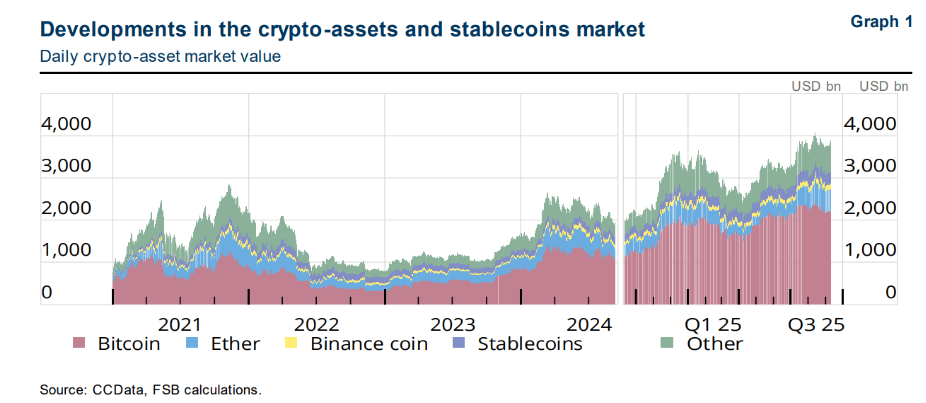
Core Insights - The Financial Stability Board (FSB) warns of significant regulatory gaps in the oversight of rapidly growing stablecoins and high-volatility cryptocurrencies, which could pose potential risks to global financial stability [1][4] - The global cryptocurrency market has doubled in value over the past year to $4 trillion, raising concerns about increasing financial risks [1][4] Regulatory Gaps - The FSB highlights a lack of comprehensive regulatory frameworks for stablecoins, which are often pegged to the US dollar, despite their growing use among traders [4][5] - The stablecoin market has grown nearly 75% in the past year, reaching just under $290 billion, driven by the expansion of stablecoin applications in the US [4][5] Global Coordination - The FSB's review covered 29 jurisdictions, including the US, EU, Hong Kong, and the UK, but noted that the US only participated in the assessment of stablecoins [5] - The FSB emphasizes the need for better global regulatory cooperation and consistency, as cryptocurrencies can easily cross borders [5][7] Market Dynamics - Stablecoins are designed to maintain a stable value, typically pegged 1:1 to the US dollar, and their usage has surged, particularly in cross-border financial services [6] - Despite the current limited risk, the FSB's report outlines eight recommendations for jurisdictions to implement comprehensive and globally consistent regulatory frameworks [7]

中美一场暗战打响了
Hu Xiu· 2025-10-14 22:44
Group 1 - Major global economies are attempting to curb the spread of US stablecoins, with a consortium of nine European banks announcing plans to launch a euro-denominated stablecoin to create an alternative to the US-dominated market [1][2] - The rapid response from Europe follows the passage of the US stablecoin bill, with concerns that widespread use of US stablecoins in the Eurozone could undermine the European Central Bank's control over monetary policy [2][3] - A significant statistic indicates that all top ten stablecoins in the global stablecoin system are backed by the US dollar [2] Group 2 - China has also taken swift action by launching the Digital Renminbi International Operation Center in Shanghai, along with cross-border digital payment and blockchain service platforms [4][5] - The internationalization of the renminbi has been primarily driven by trade and cooperation along the Belt and Road Initiative, but progress has been slow due to traditional settlement system inertia and capital controls [5][6] - The dominance of US stablecoins in the digital finance space highlights the competitive landscape for financial rules, with China needing to actively participate to avoid being sidelined [6][10] Group 3 - The article discusses the historical context of the US dollar's dominance, which was established through the Bretton Woods system and further solidified by the petrodollar system [8][9] - Currently, over 90% of global crypto trading volume relies on stablecoins, predominantly pegged to the US dollar, reinforcing the dollar's role as a universal currency [9][10] - The potential risks of relying heavily on the US dollar for China include systemic impacts if the dollar system restricts access to financial resources [11][12] Group 4 - The article emphasizes the urgency for China to promote the internationalization of the renminbi, particularly through the central bank-issued digital renminbi, as a means to enhance financial security [12][18] - The digital renminbi is positioned as a sovereign digital currency that does not rely on external assets, unlike private stablecoins, which could lead to increased financial risks [16][18] - The digital renminbi can facilitate faster and cheaper cross-border payments, addressing inefficiencies in traditional payment systems [18][19] Group 5 - Trust and compliance challenges are highlighted as significant barriers to the global acceptance of the digital renminbi, particularly regarding privacy and regulatory frameworks [21][22] - The article points out that the depth and liquidity of China's bond market are still insufficient compared to the US, which affects international confidence in holding renminbi assets [22][23] - To become a reserve currency, the digital renminbi must address issues related to asset security, exit mechanisms, and institutional transparency [23][24] Group 6 - The article suggests strategic scenarios for the digital renminbi's breakthrough, such as energy trade and regional payment corridors, to reduce reliance on the US dollar [26][27] - The overall conclusion is that the digital renminbi's path to becoming an international reserve currency will require overcoming significant challenges related to trust, liquidity, and regulatory alignment [26][27]
加密货币,如何看待?
Sou Hu Cai Jing· 2025-10-14 15:51
Core Viewpoint - Cryptocurrency, particularly stablecoins, is profoundly impacting and reshaping the global financial, trade, and economic systems, becoming a systemic variable that influences macroeconomics, international balance of payments, monetary policy, and financial stability [2] Group 1: Characteristics and Types of Cryptocurrency - Cryptocurrency is a digital asset based on blockchain technology, secured by cryptographic algorithms, and maintained by a decentralized network, enabling peer-to-peer value transfer without reliance on central banks [4] - Key characteristics include decentralization, cryptographic security, limited or algorithmic issuance, and transparency, with all transaction records available on the blockchain [4][5] - Major types of cryptocurrencies include public chain coins (e.g., Bitcoin, Ethereum), stablecoins (e.g., USDT, USDC), central bank digital currencies (CBDCs), exchange platform tokens, and privacy coins [5] Group 2: Impact on Global Economy - Cryptocurrency affects financial stability by exhibiting high volatility and correlation with traditional assets, potentially leading to systemic risks [8] - It transforms international trade by enabling low-cost, efficient cross-border transactions, significantly reducing fees and time compared to traditional banking [8][9] - Capital flow is influenced as cryptocurrencies allow rapid movement of funds across borders, potentially bypassing currency controls [9] - The emergence of a cashless economy is accelerated by cryptocurrencies and CBDCs, reshaping global energy and computing trade [9] Group 3: Regulatory and Governance Challenges - The global landscape is entering a "rules competition" era, with regulatory arbitrage becoming more pronounced as different regions adopt varying compliance standards [10] - Anti-money laundering pressures are increasing, necessitating the extension of regulations to stablecoins and decentralized finance (DeFi) [10] - The introduction of cryptocurrencies poses significant challenges to existing international economic governance, particularly in finance, trade, and capital flow [10] Group 4: Opportunities and Challenges for China - Opportunities for China include promoting the internationalization of the Renminbi, enhancing cross-border payment efficiency, and leveraging blockchain technology for digital currency development [12] - Challenges include risks to financial stability and monetary sovereignty, potential capital flow issues, and the need for a robust regulatory framework to address the evolving landscape of stablecoins [13]
X @Yuyue
Yuyue· 2025-10-14 15:11
Risk Control & Systemic Issues - Binance's internal risk control system has significant issues, particularly regarding the management of circulating loans for assets like USDe, WBETH, and BNSOL [1] - The de-pegging of WBETH and BNSOL, assets that should be redeemable 1:1, highlights flaws in Binance's risk management [1] - The market's reliance on Binance's pricing creates systemic risk, as other exchanges and market makers are overly confident in Binance's stability [1] - The lack of immediate action or a post-incident report by Binance following the liquidations is unreasonable [1] Binance's Responsibility & Accountability - Binance should be held accountable for the volatility caused by assets that rely on its reputation, such as WBETH and BNSOL [1] - The issues leading to the liquidations should have been addressed six months prior, suggesting a failure to learn from past events like the FDUSD incident [1] - The author questions whether temporary control or suspension of trading for abnormal assets could have mitigated losses during the liquidation event [1] Market Impact & Solutions - The market impact of Binance's issues is greater than historical de-pegging events like USDC during the Silicon Valley Bank collapse [1] - The industry needs better solutions to address the current situation, rather than engaging in meaningless emotional venting [2] - Individual users should learn from this event, improve their risk management, and protect their capital [2]
中国机构是迪拜金融中心发展的关键力量
Guo Ji Jin Rong Bao· 2025-10-14 10:54
Core Insights - Dubai has officially become one of the top four global fintech centers according to the latest Global Financial Centers Index (GFCI), being the only leading financial center in the MEASA region [1] - The Dubai International Financial Centre (DIFC) plays a crucial role in this achievement, housing over 8,000 companies and 48,000 professionals [1] - DIFC's CEO, Arif Amiri, emphasizes that artificial intelligence (AI) will fundamentally reshape the financial industry beyond mere automation, impacting risk assessment, customer service, and product design [1][5] Group 1: DIFC's Role and Growth - DIFC is the most favored hub for Chinese financial institutions in the UAE, with major firms like China International Capital Corporation, Bank of China, and Industrial and Commercial Bank of China establishing branches to access high-growth markets [2] - The D33 economic agenda aims to double Dubai's economy by 2033, with DIFC positioned as a core engine to drive growth and attract global capital [2] - DIFC has become a comprehensive financial center, serving both local and global economies, and is pivotal in the evolution of the global financial landscape [2] Group 2: Technological Advancements and AI Integration - DIFC has attracted over 180 AI companies through the Dubai AI Park, integrating AI into various financial services, enhancing processes from risk management to customer interaction [3] - The DIFC Innovation Center has gathered over 1,500 fintech and innovation firms, supported by initiatives like low-cost licensing and mentorship programs [3] - By August 2025, AI, fintech, and innovation startups in DIFC are projected to have raised over $4.2 billion in total funding, showcasing significant growth in the sector [3] Group 3: Collaboration with Chinese Institutions - Chinese institutions are key players in DIFC's development, with major banks establishing a presence to leverage Dubai's strategic position as a gateway to the MEASA region, which encompasses 3.7 billion people and a GDP of approximately $10.5 trillion [6] - The independent legal and regulatory framework based on English common law provides transparency and predictability, making DIFC attractive for Chinese tech and AI companies [6] - The collaboration between Dubai and China has expanded beyond traditional finance into innovation, technology, and green finance, aligning with both countries' long-term development strategies [7] Group 4: Regulatory Framework and Digital Assets - DIFC has introduced the world's first Digital Assets Law, providing a clear regulatory framework for digital assets, including stablecoins, ensuring a secure and transparent environment for institutions [8] - The Dubai Financial Services Authority (DFSA) has established comprehensive regulations covering digital assets, including anti-money laundering and consumer protection measures [8] - DIFC's commitment to innovation and responsible governance positions it as a trusted jurisdiction for the development and implementation of digital assets [8]



香港立法会秘书处建议在香港发展离岸人民币稳定币
Huan Qiu Wang· 2025-10-14 01:09
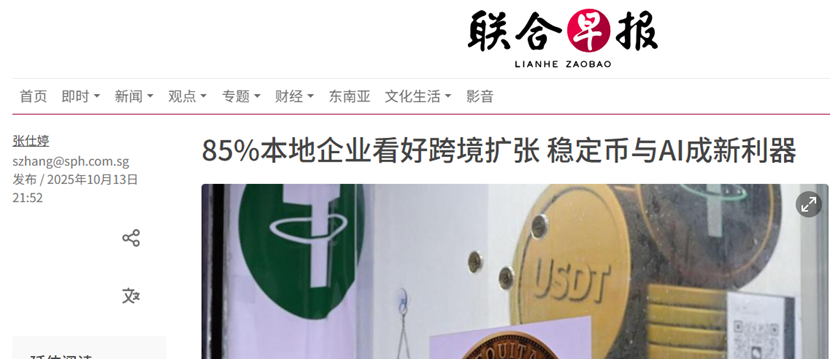
Core Insights - The Financial Stability Board (FSB) is focusing on enhancing global policy responses to emerging threats from the increasing use of private finance and stablecoins [1] - There is a significant gap in addressing financial stability risks, with few countries or regions establishing comprehensive regulatory frameworks for global stablecoins [1] - Hong Kong is exploring the development of offshore RMB stablecoins and aims to act as a "testing ground" for stablecoins and digital assets [1] - A recent survey indicates that nearly 20% of local businesses have already adopted or are using stablecoins, with 62% planning to do so within two years, surpassing the average of 46% from four other surveyed countries [1] - Over 80% of local businesses are either using or planning to introduce stablecoin payments [1] Industry Developments - Stablecoins are recognized for their "fast, low-cost, and programmable" characteristics, making them an effective solution for cross-border payment challenges [3] - The remittance market, valued at nearly $1 trillion, incurs an average fee of 6.4% (approximately $64 billion) annually, while stablecoin transfers can cost just a few cents and are nearly instantaneous [3]
X @Yuyue
Yuyue· 2025-10-13 12:42
Stablecoin & DeFi Platform Analysis - FalconStable's $FF stablecoin demonstrates resilience post-"black swan" event, with user confidence seemingly maintained despite fee structures [1] - The market expresses concerns regarding potential issues with Market Makers (MM), but DWF's involvement with FF suggests stability [1] - FalconStable launched Miles Season 2 with NFT incentives, requiring 1,000 $FF staked for potential NFT whitelist access [1] TVL & Trading Volume - FalconStable experienced a TVL increase of several hundred million, accompanied by billions in overall token trading volume [1] Airdrop & User Sentiment - Pendle's airdrop, in collaboration with Yap2FLY and Kaito, was distributed based on badge ownership [1] - Users express mixed feelings, with some criticizing FalconStable despite profitability, highlighting the importance of expectation management [1]
华检医疗(01931.HK)收购美国物业及设立美国附属公司ETHK BANK于美国推进稳定币及知识产权证券化新征程
Ge Long Hui· 2025-10-13 10:32
Core Viewpoint - The company has completed the acquisition of a property in Irvine, California, for $4.365 million, and established a wholly-owned subsidiary, ETHK BANK, to enhance its operations in the North American market, focusing on stablecoin and intellectual property securitization [1][2]. Group 1: Property Acquisition - The acquired property, located at 9840 Irvine Center Drive, spans approximately 4,960 square feet and includes a two-story office building of about 9,920 square feet, designed for both office and research purposes [2]. - This property will serve as the company's strategic headquarters in the U.S., supporting the development of stablecoin public chain technology and intellectual property securitization, creating a hub for connecting global innovative assets with capital markets [2]. Group 2: ETHK BANK - ETHK BANK will act as the global operational platform for the company's stablecoin and intellectual property securitization business, managing core business directions including stablecoin licensing and compliance framework establishment [3]. - The company is pursuing a federal payment stablecoin issuer license under the U.S. GENIUS Act and plans to apply for a national trust bank license to create a compliant operational system [3]. - The company is developing an innovative stablecoin architecture that supports the generation of stablecoins pegged to the U.S. dollar through real-world asset collateral, aiming to provide a transparent and sustainable digital asset yield solution [3]. Group 3: Key Project Cooperation - The company has signed a strategic cooperation agreement with Transcenta Holding Limited for the tokenization of innovative drug pipeline assets valued at approximately $1.5 billion, with ETHK BANK leading the initiative [5]. - This project focuses on cutting-edge research in cancer treatment, providing a transparent and professional channel for global investors to access medical assets [5]. Group 4: Future Outlook - The acquisition of the U.S. property and the establishment of ETHK BANK signify the company's strategic upgrade towards becoming a global leader in stablecoin and high-tech intellectual property capital operations [6]. - The company aims to integrate on-chain financial infrastructure with the real economy, aligning with global digital economy trends and potentially opening new growth pathways [6]. - The board believes these initiatives reflect the company's core philosophy of transforming knowledge into capital, ensuring long-term stable returns for shareholders through compliant capital operations and innovative practices [6].