
AI医疗

Search documents
“蚂蚁阿福”强势出圈 AI医疗产业商业化加速
Zhong Guo Zheng Quan Bao· 2025-12-23 22:01
● 本报记者 葛瑶 "健康大小事,阿福帮你讲明白。"电梯间、商场大屏、微博开屏,这款名为"蚂蚁阿福"的AI医疗应用近 期突然闯入大众视野,一夜之间,阿福无处不在。随着产品的强势推广,二级市场AI医疗板块闻风而 动,相关概念股迎来一波上涨。业内人士认为,随着"蚂蚁阿福"等现象级产品持续推出,AI医疗行业商 业化加速,相关板块指数仍处于底部区域,当前投资性价比较高。 概念股闻风而动 蚂蚁集团于12月15日宣布,旗下AI健康应用AQ品牌全面升级为"蚂蚁阿福",并发布App新版本,重点 升级健康陪伴、健康问答、健康服务三大核心功能。官方数据显示,目前"蚂蚁阿福"月活用户已突破 1500万,跻身国内前五大AI应用行列。 "蚂蚁阿福"的热度迅速传导到二级市场。在产品发布后,AI医疗主题指数连续三个交易日上涨。数据显 示,截至12月23日,该指数成分股华康洁净(301235)累计涨幅超34%,嘉和美康涨超14%,楚天科技 (300358)涨超8%。 光大证券研报称,此次产品迭代的核心价值在于商业模式的创新。通过"AI陪伴"模式,"蚂蚁阿福"将传 统的低频就医场景转化为高频健康管理需求,不仅重塑了患者流量入口,更深度地依托蚂 ...
“蚂蚁阿福”强势出圈AI医疗产业商业化加速
Zhong Guo Zheng Quan Bao· 2025-12-23 20:18
● 本报记者 葛瑶 "健康大小事,阿福帮你讲明白。"电梯间、商场大屏、微博开屏,这款名为"蚂蚁阿福"的AI医疗应用近 期突然闯入大众视野,一夜之间,阿福无处不在。随着产品的强势推广,二级市场AI医疗板块闻风而 动,相关概念股迎来一波上涨。业内人士认为,随着"蚂蚁阿福"等现象级产品持续推出,AI医疗行业商 业化加速,相关板块指数仍处于底部区域,当前投资性价比较高。 概念股闻风而动 蚂蚁集团于12月15日宣布,旗下AI健康应用AQ品牌全面升级为"蚂蚁阿福",并发布App新版本,重点 升级健康陪伴、健康问答、健康服务三大核心功能。官方数据显示,目前"蚂蚁阿福"月活用户已突破 1500万,跻身国内前五大AI应用行列。 "蚂蚁阿福"的热度迅速传导到二级市场。在产品发布后,Wind AI医疗主题指数连续三个交易日上涨。 Wind数据显示,截至12月23日,该指数成分股华康洁净累计涨幅超34%,嘉和美康涨超14%,楚天科技 涨超8%。 贺菊颖认为,AI医疗在提升医疗器械功能、检查检验结果的解读、辅助临床医生决策、健康管理等多 个领域的应用价值较大,是医疗企业和医院必须重视的创新方向和竞争趋势。企业有望借助AI进一步 提高产 ...
德生科技:就医无感支付平台获全国一等奖
Sou Hu Cai Jing· 2025-12-23 12:57
Core Viewpoint - Desheng Technology has successfully implemented its "no-sense payment platform" in all top-tier hospitals in Guangzhou, showcasing its strength in various application scenarios, particularly in AI healthcare [1] Group 1: Company Developments - The company has collaborated with China UnionPay and Guangzhou Medical Insurance to develop the "no-sense payment platform," which has recently won the first prize at the 2025 National Smart Medical Insurance Competition [1] - Desheng Technology is focusing on building a digital foundation for hospitals, utilizing AI algorithms to enhance service efficiency in medical institutions [1] Group 2: AI Healthcare Applications - The company plans to expand its AI healthcare applications by linking more B-end resources to create an AI healthcare ecosystem, with new application scenarios such as commercial insurance claims and chronic disease management [1]
创业慧康:数据合规流通赋能AI医疗
Sou Hu Cai Jing· 2025-12-23 12:57
以上内容为证券之星据公开信息整理,由AI算法生成(网信算备310104345710301240019号),不构成 投资建议。 投资者提问:尊敬的董秘您好!据悉公司被列入"中国数谷"数据要素"改革沙盒"第二批试点企业,可在 监管沙盒内合规开展数据要素流通与增值应用。公司手握近500家医院的合规脱敏大数据,并在"慧康- 启真"大模型上已把AI辅助诊断的准确率提升42%。请问:1.这些高质量数据是否已向互联网医疗平台 开放接口?2.后续有无计划与蚂蚁"阿福"等具备亿级C端流量的互联网生态合作,联合推出AI导诊/慢病 管理产品,以快速 创业慧康回复:尊敬的投资者,您好!感谢您的关注。公司作为"中国数谷"数据要素改革试点企业,始 终将数据合规与安全置于首位,业务开展严格遵循"数据可用不可见"及"原始数据不出域"原则,通过大 模型及数据可信空间提供AI辅助与增值服务,不涉及向第三方直接开放原始数据接口。在生态合作方 面,公司秉持开放共赢理念,对与包括具备流量优势的互联网平台在内的各类伙伴合作持积极态度,致 力于共同赋能医疗机构以更好地服务C端患者;如有达到披露标准的重大合作进展,公司将严格履行信 披义务,请以指定媒体公告 ...

“蚂蚁阿福”+诊断政策支持,AI医疗蓄势待发
NORTHEAST SECURITIES· 2025-12-23 07:47
Investment Rating - The report assigns an "Outperform" rating for the industry, indicating that the industry index is expected to exceed market benchmarks in the next six months [5]. Core Insights - The recent upgrade of Ant Group's AI health assistant to "Antifufu" focuses on health Q&A, companionship, and services, indicating a strong push in AI healthcare applications [2]. - The National Healthcare Security Administration has included "AI-assisted diagnosis" in the pricing structure for pathological diagnosis, which is expected to enhance the application of AI in medical diagnostics [3]. - Antifufu has achieved a remarkable 83.4% monthly active user growth rate, making it the leading health application in the AI native application sector in China [2]. - The integration of AI solutions into healthcare services is expected to create a comprehensive ecosystem, enhancing user engagement and service delivery [2]. Summary by Sections Industry Overview - The AI health application sector is rapidly evolving, with Antifufu being a key player, leveraging a large user base and partnerships to enhance service offerings [2]. - The report highlights the significant growth potential in AI-assisted diagnostics, driven by recent policy support and technological advancements [3]. Market Data - The industry comprises 336 constituent stocks with a total market capitalization of 45,834 billion, and a circulating market value of 25,851 billion [7]. - The overall revenue of constituent stocks stands at 12,390 billion, with a net profit of 154 billion, indicating a robust financial landscape [7].
ETF盘中资讯 | 联影医疗、爱尔眼科等龙头齐跌,最大医疗ETF(512170)盘中再失年线,场内高频溢价,“抄底”资金出动?
Sou Hu Cai Jing· 2025-12-23 03:40
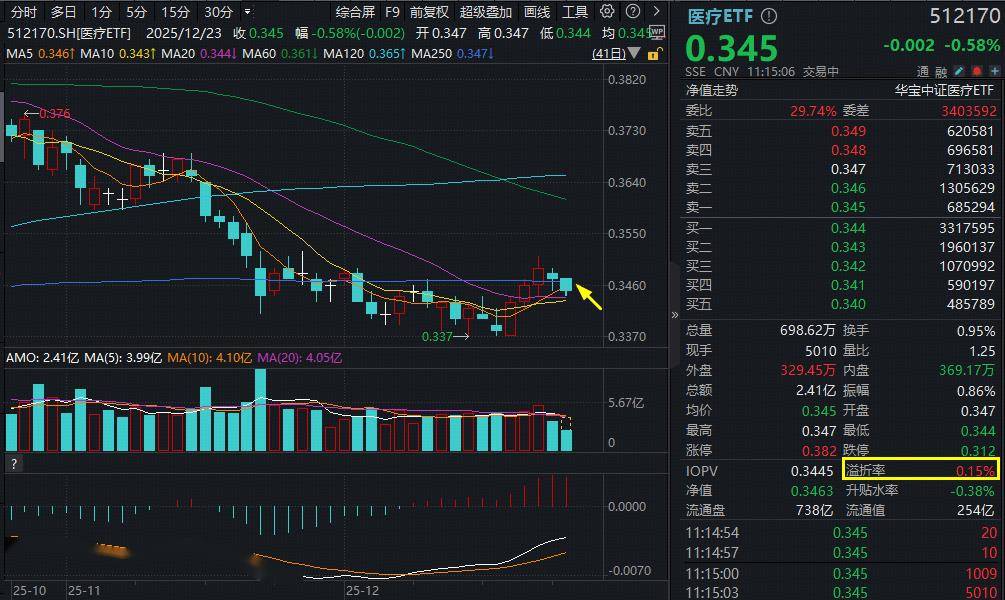
Core Viewpoint - The healthcare sector is currently underperforming, with the largest healthcare ETF (512170) experiencing fluctuations below the annual line, indicating potential accumulation of funds near this level [1]. Group 1: Market Performance - On December 23, the healthcare ETF (512170) recorded a net subscription of over 98.88 million yuan in a single day [1]. - The ETF closed at 0.345, down 0.58% from the previous day, with a trading range between 0.344 and 0.347 [2]. - Major component stocks in the ETF, such as Weining Health, fell over 2%, while other leading stocks like United Imaging, Aier Eye Hospital, and Aimeike also declined by more than 1% [1]. Group 2: Industry Insights - According to Zhongtai Securities, policy disturbances in the medical device industry are gradually clearing, with domestic demand recovering and export logic being realized, particularly in high-value consumables and medical equipment [2]. - Zhao Securities highlighted that by 2026, the medical device sector is expected to benefit from improved hospital demand, inventory optimization, and increased exports, with ongoing positive trends in bidding data for equipment [3]. - The medical ETF (512170) passively tracks the CSI Medical Index, which includes top-weighted stocks such as WuXi AppTec, Mindray Medical, United Imaging, Aier Eye Hospital, and others [3].


联影医疗、爱尔眼科等龙头齐跌,最大医疗ETF(512170)盘中再失年线,场内高频溢价,“抄底”资金出动?
Xin Lang Cai Jing· 2025-12-23 03:23
Group 1 - The medical sector is currently underperforming, with the largest medical ETF (512170) experiencing continued fluctuations below the annual line, indicating potential accumulation of funds near this level, as evidenced by a net subscription of over 98.88 million yuan on the previous day [1][5] - Major AI medical concept stocks, such as Weining Health, have seen declines exceeding 2%, with leading stocks like United Imaging, Aier Eye Hospital, and Aimeike also dropping over 1% [1][5] Group 2 - Zhongtai Securities notes that policy disturbances in the medical device industry are gradually clearing, with domestic demand recovering and export logic being realized, leading to a turning point for high-value consumables and medical equipment, while IVD and low-value consumables are expected to show marginal improvements [3][8] - According to招商证券, the medical device sector should focus on the improvement of in-hospital demand leading to inventory optimization and increased exports by 2026, with ongoing positive trends in equipment bidding data likely to enhance channel inventory [3][8] - The medical ETF (512170) and its linked funds passively track the CSI Medical Index, which includes top-weighted stocks such as WuXi AppTec, Mindray, United Imaging, Aier Eye Hospital, and others [3][8] Group 3 - Investment options in the medical sector include various ETFs, such as the Hong Kong Stock Innovation Drug ETF (520880) and the A-share Medical ETF (512170), with the latter being the largest in the market with a scale of 25.3 billion yuan [4][9] - The A-share medical ETF has a CXO content exceeding 25%, while the Hong Kong medical ETF has a CXO content over 37%, indicating a diverse investment landscape [4][9]
【光大研究每日速递】20251223
光大证券研究· 2025-12-22 23:05
Group 1: Fund Market Overview - Financial and real estate themed funds performed well, while TMT themed funds saw a net value decline [5] - A total of 40 new funds were established in the domestic market, with a combined issuance of 18.321 billion units [5] - Stock ETFs experienced significant inflows, particularly in large-cap broad-based ETFs, Hong Kong stock ETFs, and TMT themed ETFs [5] Group 2: Real Estate Market Insights - From January to November 2025, the transaction area of residential land in 100 cities decreased by 15.1% year-on-year, totaling 221 million square meters [5] - The average transaction floor price increased by 9.4% year-on-year to 6,295 yuan per square meter, with first-tier cities seeing a 29.5% increase [5] Group 3: Steel Industry Analysis - The price gap between hot-rolled and rebar steel is at its lowest level in six years [6] - High furnace capacity utilization rates have been below last year's levels for three consecutive weeks [6] - The price of tungsten concentrate reached a new high since 2012, while the capacity utilization rate for electrolytic aluminum hit a historical high [6] Group 4: Oil and Gas Sector Performance - China National Offshore Oil Corporation (CNOOC) received an "AA" rating in ESG, ranking 10th among 527 companies in the petrochemical sector [7] - The company has improved its board independence and risk management, actively addressing climate change and implementing carbon reduction measures [7] Group 5: Public Utilities Sector Update - In November, electricity generation increased by 2.7% year-on-year, with marginal improvements in the growth rates of nuclear, photovoltaic, and wind power [8] - The SW public utilities sector index fell by 0.59%, ranking 25th among 31 SW primary sectors [8] Group 6: Pharmaceutical and AI Integration - Ant Group rebranded its AI health application to "Ant Ai Fu," which saw a surge in downloads shortly after launch [8] - The product iteration transforms low-frequency medical visits into high-frequency health management, creating a digital closed loop from consultation to insurance claims [8] Group 7: Automotive Industry Developments - Botai Carlink, established in 2009, went public in September 2025, ranking third in China's passenger car intelligent cockpit domain control suppliers with a market share of 7.3% [8] - In the first five months of 2025, the company ranked second in the new energy passenger car cockpit domain control market with a market share of 13.11% [8]

【医药生物】AI医疗激活“医药险”全链路闭环,建议关注相关投资机会——医药生物行业跨市场周报(20251221)(吴佳青)
光大证券研究· 2025-12-22 23:05
Market Overview - Last week, the A-share pharmaceutical and biotechnology index fell by 0.14%, underperforming the CSI 300 index by 0.14 percentage points, while outperforming the ChiNext index by 1.39 percentage points, ranking 22nd among 31 sub-industries [4] - The Hong Kong Hang Seng Healthcare Index also declined by 1.77%, outperforming the Hang Seng Index by 0.19 percentage points [4] R&D Progress - Last week, SSGJ-608 NDA application from 3SBio was newly undertaken; the 24-valent pneumococcal polysaccharide conjugate vaccine from CanSino and SYH2069 from CSPC were also newly undertaken for clinical application [5] - Hengrui Medicine's 9531 is in Phase III clinical trials; HRS-7249 is in Phase II clinical trials; and CanSino's CM383 is in Phase I clinical trials [5] Investment Insights - The recent rebranding of Ant Group's AI health application "AQ" to "Antifufu" has led to a surge in downloads, reaching the top 3 in the Apple App Store and surpassing 15 million monthly active users, making it the leading AI health management app in China [6] - Antifufu integrates over 500 national-level academicians and renowned doctors into its "AI avatar" service, transforming scarce expert resources into 24/7 accessible services [6] - This product iteration shifts the traditional low-frequency medical visits into high-frequency health management, creating a digital closed loop from consultation, medication purchase to insurance claims, thus enhancing the "medical + pharmaceutical + insurance" integration [6] Future Investment Strategy - With the changing macroeconomic and policy landscape, future investments in the pharmaceutical sector should increasingly focus on the intrinsic clinical value of pharmaceuticals, addressing clinical needs of patients [7] - Both domestic medical insurance policies and global expansion strategies are placing higher premiums on clinical value [7]

吉因加科技冲刺港股IPO
Shen Zhen Shang Bao· 2025-12-22 18:29
Core Viewpoint - The company, GeneTech (Shaoxing) Co., Ltd., is seeking to list on the Hong Kong Stock Exchange, despite experiencing significant financial losses in recent years, particularly in 2024 and 2025 [1][2]. Group 1: Company Overview - GeneTech is a leading precision medicine company in China, integrating AI capabilities into the biomarker value chain [1]. - The company has developed a multi-omics platform that combines foundational models with intelligent AI, enabling a full-chain capability from biomarker discovery to commercialization [1]. - GeneTech offers three main solutions: precision diagnostics, drug development empowerment, and clinical research and translation [1]. Group 2: Business Performance - GeneTech's revenue has fluctuated significantly in recent years, with reported revenues of 1.815 billion yuan in 2022, 473 million yuan in 2023, 557 million yuan in 2024, and 285 million yuan in the first half of 2025 [2]. - The company's net profit has shown a downward trend, with figures of 372 million yuan in 2022, 54.127 million yuan in 2023, and losses of 424 million yuan and 414 million yuan in the first halves of 2024 and 2025, respectively [2]. - As of June 2025, GeneTech has served over 1,000 hospitals, including 30 of China's top 100 hospitals, and has established partnerships with over 200 pharmaceutical companies and 500 clinical research institutions [1].