
产学研协同

Search documents
深港穗创新军团破浪而出!揭秘大湾区“全球夺冠”的密码
Nan Fang Du Shi Bao· 2025-09-05 09:07
Core Insights - The "Shenzhen-Hong Kong-Guangzhou" innovation cluster has ranked first in the "2025 Global Innovation Index" released by the World Intellectual Property Organization, surpassing the long-time leader "Tokyo-Yokohama" cluster for the first time after six consecutive years on the list [2][3]. Group 1: Innovation Cluster Performance - The "Shenzhen-Hong Kong-Guangzhou" cluster accounts for 9% of global PCT patent applications and 2.4% of publications, with a notable 2.9% share in risk capital transactions, exceeding Tokyo-Yokohama's 0.7% [2]. - From 2019 to 2023, the top 100 global clusters attracted nearly 169,000 risk capital transactions, highlighting the unique advantages of the Greater Bay Area in funding support and technology transformation [2]. Group 2: Policy and Financial Support - The rise of the "Shenzhen-Hong Kong-Guangzhou" cluster is supported by top-level design and policy coordination, including the implementation of the "Guangdong Province Science and Technology Innovation Regulations" in 2024 [4]. - Guangdong has introduced a comprehensive service system for technology finance, including venture capital, technology credit, and technology insurance, with 13 new science and technology enterprises and companies listed on the Growth Enterprise Market in 2024 [4]. Group 3: Collaborative Mechanisms - The collaboration between academia, industry, and research is maturing, with Hong Kong focusing on basic research, Shenzhen excelling in technology transfer and advanced manufacturing, and Guangzhou leveraging its hub function and talent incubation [5]. - The establishment of high-value patent cultivation centers and the significant number of PCT international patent applications position Guangdong among the global leaders in innovation [5][6]. Group 4: Overall Innovation Capability - Guangdong has maintained the top position in regional innovation capability for eight consecutive years, with leading metrics in R&D expenditure, high-value invention patents, and the number of high-tech enterprises [6]. - The region has built 10 major national scientific and technological infrastructures, with 30 universities and 242 disciplines ranked in the top 1% globally according to ESI [6].
江门“双创园”累计吸引创业项目209个
Nan Fang Du Shi Bao· 2025-09-05 02:33
Core Insights - The "Double Innovation Park" in Jiangmen serves as a key base for youth innovation and entrepreneurship in the Guangdong-Hong Kong-Macao Greater Bay Area, attracting 209 entrepreneurial projects, including 112 from Hong Kong and Macao, and creating over 2,000 jobs [1][4][6] Group 1: Talent Attraction and Support - The park has attracted 183 individuals from Hong Kong and Macao, along with 156 PhD and high-level talents, contributing to a significant employment boost [1] - Jiangmen's policies, such as the "15 Measures to Stabilize Employment," have provided over 55 million yuan in financial relief to projects through rent exemptions and government subsidies [4][6] - A national postdoctoral innovation demonstration center has been established in the park, linking 128 research stations and providing over 80 government service channels [6] Group 2: Innovation and Collaboration - The park promotes collaboration between academia and industry, partnering with 50 universities and research platforms to facilitate shared research resources and technology transfer [7] - A total of 702 patents have been obtained by projects within the park, and they have won 73 awards in various innovation and entrepreneurship competitions [7] - The park focuses on integrating advanced industries such as artificial intelligence and robotics, with 80% of projects in these sectors [9] Group 3: Resource Integration and Ecosystem Development - The park aims to create a comprehensive incubation system by integrating resources from government, enterprises, and investment institutions, providing support for patent applications and project acceleration [10] - A full lifecycle incubation service is offered to Hong Kong and Macao youth, including career planning and market expansion support [12] - Various networking and exchange activities are organized to help entrepreneurs connect and establish a community in Jiangmen [12]


“锰”力全开:全产业链布局撬动百亿产值新未来
鑫椤锂电· 2025-09-02 03:12
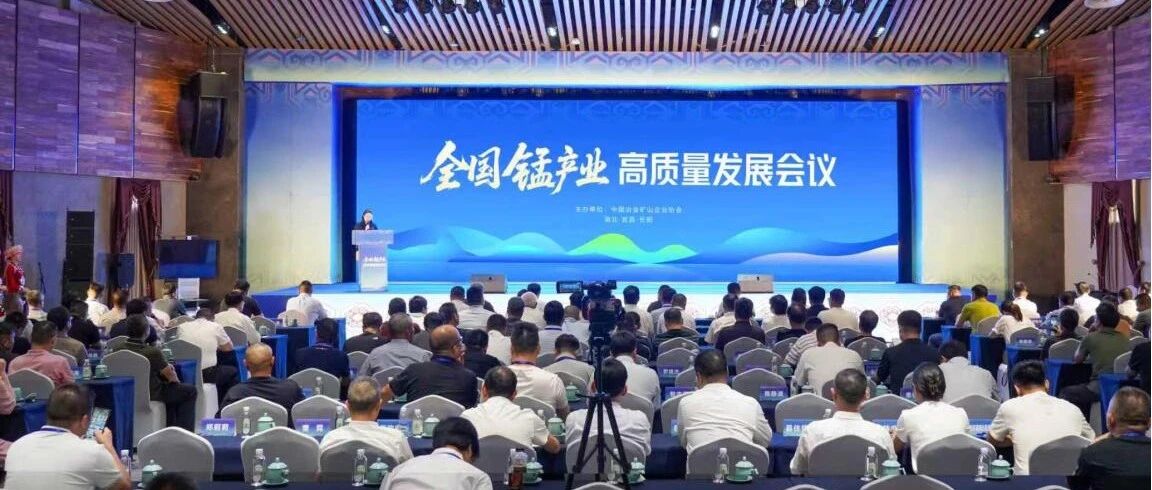
Core Viewpoint - The article emphasizes the urgent need for the manganese industry to overcome resource bottlenecks, accelerate technological innovation, and build a green circular industrial system in response to profound changes in the energy sector and intense competition in the materials industry [1][11]. Group 1: Industry Insights - The National Manganese Industry High-Quality Development Conference was held on August 28, focusing on the future direction of the manganese industry [1]. - Longyang County is recognized as a significant manganese resource area in China, highlighting its importance in the national manganese industry landscape [3]. - The future development of manganese mining in China will focus on breakthroughs in low-grade ore utilization and exploration in potential areas such as Xiangdong, Chuanxi, and Hebei over the next 10-15 years [3]. Group 2: Technological Developments - Manganese-based cathode materials are identified as a crucial direction for future battery development, necessitating collaboration between industry, academia, and research to expand their application in power and energy storage batteries [3]. - The advantages of manganese-based materials include safety, low-temperature performance, and high cost-effectiveness, making them a new trend in the power battery industry [4]. - The global first manganese-based semi-solid-state battery was launched by SAIC on August 5, 2025, showcasing the potential of manganese-based batteries in various applications [4]. Group 3: Environmental Solutions - The treatment of manganese slag, a solid waste from electrolytic manganese production, poses a significant challenge for sustainable development in the manganese industry [7]. - A comprehensive solution for harmless treatment of manganese slag includes multiple processes such as multi-stage countercurrent washing and chemical stabilization techniques [7]. Group 4: Collaborative Discussions - A roundtable discussion featured industry leaders discussing breakthroughs in technological bottlenecks and market trends, fostering a consensus on development strategies [9]. - The conference served as a high-level platform for industry professionals to exchange ideas, igniting enthusiasm for technological innovation and resource optimization [11]. Group 5: Future Outlook - The successful conclusion of the conference marks a new development stage for the manganese-based new energy industry, with leading companies like Anhui Boshik High-Tech setting benchmarks for enhancing battery performance and expanding application fields [11]. - As technologies mature and commercialization accelerates, manganese-based batteries are expected to play a significant role in the green energy revolution, particularly in new energy vehicles and energy storage systems [11].
鹤岗:以科技创新激活石墨资源 打造战略新兴产业高地
Sou Hu Cai Jing· 2025-08-27 14:22
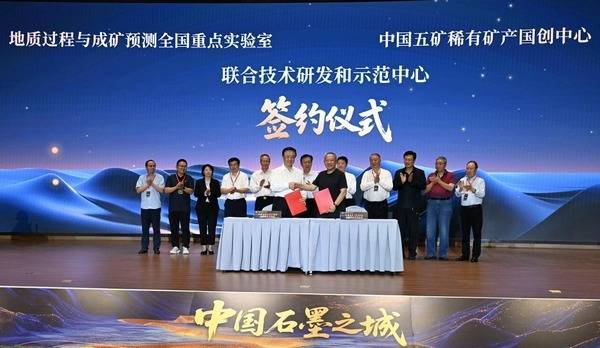
Core Viewpoint - The conference held in Hegang, Heilongjiang, focused on transforming China's advantageous mineral resources, particularly graphite, into strategic emerging industries through high-quality development and collaboration among various stakeholders [1][5][8]. Group 1: Industry Development - The "China Graphite City" was officially named in Luobei County, which is home to the world's largest single crystalline graphite mine, the Yunshan Graphite Mine [3]. - The conference emphasized the importance of resource endowment and the transformation of resource advantages into industrial strengths, highlighting the role of leading companies like China Minmetals in this process [5]. - Hegang has established a comprehensive "1+N" graphite new materials industry development system, focusing on natural graphite resources and extending into various applications such as new energy materials and graphene [7]. Group 2: Technological Innovation - A joint technology research and demonstration center was established, marking a new phase of deep integration between production, education, and research in the graphite industry [5][7]. - The focus is on overcoming "bottleneck" technologies and achieving full-chain domestic production from raw materials to end products, with several high-end graphite products already launched [5][7]. Group 3: Environmental and Economic Goals - Hegang aims to create a national-level zero-carbon park, promoting the synergy between industrial development and ecological protection [8]. - The city is positioning itself to adapt to international green trade rules while enhancing its energy structure and supporting regional coordinated development [8].
瞄准产业新赛道 成都邀请长三角企业家品“投资盖碗茶”
Sou Hu Cai Jing· 2025-08-27 08:00
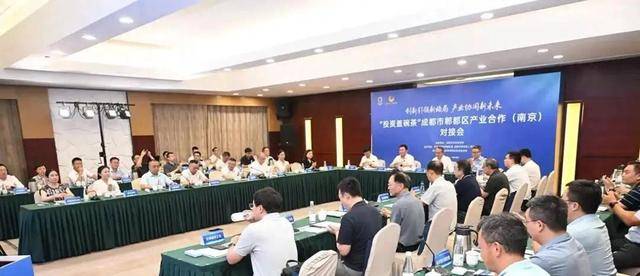
Core Insights - The event titled "Investment Gaiwan Tea" aimed to enhance collaboration between Chengdu and the Yangtze River Delta region, focusing on electronic information and intelligent technology sectors [1][3] Group 1: Event Overview - The "Investment Gaiwan Tea" industry matchmaking event was held on August 26, organized by Chengdu's Investment Promotion Bureau and the alumni association of the University of Electronic Science and Technology in Nanjing [1] - The event facilitated a platform for communication and collaboration, allowing participants to discuss opportunities in emerging industries such as electronic information and intelligent technology [1][3] Group 2: Regional Development and Industry Focus - Chengdu is actively promoting the enhancement of its characteristic advantageous industries and scaling up strategic emerging industries, with Pidu District identified as a key area for electronic information, green hydrogen, and green food sectors [3] - Pidu District aims to rank 82nd in the 2025 China Top 100 Districts by CAICT, showcasing its growth potential [3] Group 3: Policy and Support Mechanisms - The district presented a "policy package" and "industry roadmap" to highlight its differential advantages in industrial chain layout, special policy support, and production factor guarantees [3] - Successful case studies from leading companies like Huawei and BOE were shared to illustrate the construction of a complete electronic information industry chain [3][4] Group 4: Business Engagement and Future Plans - Entrepreneurs engaged in one-on-one discussions with the Pidu District investment team, addressing their investment layouts and technical cooperation needs [4] - Pidu District plans to leverage research and talent resources from 21 universities, including the University of Electronic Science and Technology and Southwest Jiaotong University, to support technology and talent for enterprises [4]
科学仪器:量子科技突破的关键支撑——访中国科学院院士俞大鹏
仪器信息网· 2025-08-25 04:07
Core Viewpoint - Quantum technology is not an abstract concept; it heavily relies on advanced scientific instruments for development, as emphasized by Professor Yu Dapeng, a leading figure in China's quantum technology field [4][6]. Group 1: Current State of Quantum Technology - China's quantum technology is experiencing differentiated development across three main areas: quantum communication, quantum computing, and quantum precision measurement [7]. - In quantum communication, China has transitioned from a follower to a leader, exemplified by the "Mozi" quantum satellite [7]. - The quantum computing sector has seen China achieve a "catching up" status, with significant advancements in superconducting and photonic quantum computing [7]. - However, in quantum precision measurement, China still lags behind the U.S. due to high precision requirements for scientific instruments [7][8]. Group 2: Challenges in Scientific Instrumentation - The development of quantum technology is constrained by the lack of advanced scientific instruments, which are crucial for breakthroughs [8]. - Key challenges in the autonomous development of scientific instruments include a weak industrial foundation, market environment issues, external technology blockades, and user perception problems [9]. - The reliance on imported high-end equipment poses risks, including high costs and supply chain vulnerabilities [8][9]. Group 3: Solutions for Innovation - Professor Yu proposes a "three-in-one" innovation system to address these challenges, focusing on talent cultivation, policy support, and optimizing the innovation ecosystem [9]. - The need for a talent cultivation system that produces professionals skilled in both quantum physics and engineering is emphasized [9]. - Establishing special funds for high-end instrument development and improving government procurement policies for domestic products are recommended [9]. Group 4: Innovations at Shenzhen International Quantum Research Institute - The Shenzhen International Quantum Research Institute has made significant strides in quantum technology, achieving national laboratory standards within five years [12]. - The institute focuses on solid-state quantum computing and has successfully developed domestic scientific instruments, including dilution refrigerators [12][13]. - Future plans include tackling high-end equipment such as transmission electron microscope aberration correctors and multi-beam lithography machines, which are vital for quantum research and semiconductor industries [13][14]. Group 5: Future Outlook and Talent Development - Quantum technology is viewed as a critical area for national competition, with confidence in achieving breakthroughs supported by government initiatives [14]. - The relationship between scientific instruments and quantum technology is highlighted as mutually beneficial, where advancements in one area drive progress in the other [14]. - Innovative approaches to talent development are suggested, including reforming evaluation systems and fostering interdisciplinary education [14].

2025年中国超硬材料行业政策发展分析—政策驱动“产学研”是解决卡脖子的关键要素
Qian Zhan Wang· 2025-08-22 05:09
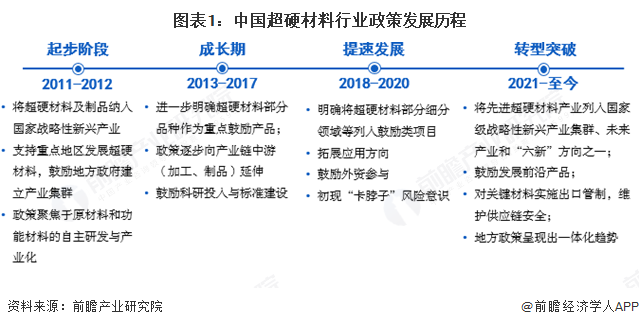
Core Viewpoint - The new export control policy in 2024 marks a new stage of technological protection for the industry, shifting the policy focus from scale expansion to the construction of an innovation ecosystem through collaboration between industry, academia, and research [1]. Policy Evolution and Development Planning - The development of superhard materials in China can be divided into four stages: initiation, growth, accelerated development, and transformation breakthrough. The initiation phase began with the inclusion of superhard materials in the national strategic emerging industries during the "12th Five-Year Plan" in 2012. The growth phase was marked by the clear distinction of superhard materials in "Made in China 2025," which emphasized the need to overcome high-performance diamond and cubic boron nitride (CBN) preparation technologies. The accelerated development phase saw the emergence of "bottleneck" risk awareness from 2018 to 2020, leading to multiple regulations and guidelines that clarified the project's status and encouraged development. Since the "14th Five-Year Plan" in 2021, the industry has entered a transformation breakthrough phase, aiming to overcome high-end production technology challenges with the help of the existing upstream supply chain [2][3]. Differentiated Development Pattern Led by Henan - Henan Province has prioritized the development of the superhard materials industry, implementing policies such as "Six New Breakthroughs in Manufacturing" and "High-end Materials Cluster Construction Action Plan." The province focuses on high-end products like gem-grade and functional diamonds, supporting enterprises in increasing technological innovation and R&D investment. Comprehensive measures, including the establishment of national and provincial innovation platforms, collaboration among leading enterprises, and financial subsidies, are enhancing the overall industry chain cooperation level. Henan aims to transition from "quantity leading" to "quality leading" and "high-end application breakthroughs," solidifying its core position in the superhard materials industry both nationally and globally [5]. Industry Development Goals and Strategies - By 2025, the goal is to form a trillion-level industry chain and establish the world's largest superhard materials R&D and production base, cultivating a national-level industry cluster and striving for an internationally leading industry chain. The industry is expected to upgrade from traditional manufacturing to high-end, intelligent, and green production, promoting vertical extension (from raw materials to end products) and horizontal expansion (cross-industry integration with 5G, chips, medical, and biological fields) [6]. Innovation-Driven Strategy Upgrade - In recent years, Henan has emphasized technological innovation and high-end breakthroughs in the superhard materials industry, focusing on composite superhard materials, high-end diamond products, and polycrystalline diamond composites. The province is increasing policy and financial support, promoting technological breakthroughs and the transformation of results. Additionally, Henan is facilitating deep integration of superhard materials with high-value industries such as chip manufacturing, 5G communication, and biomedical fields, enhancing the innovation ecosystem and strengthening intellectual property protection and standard system construction [7]. Funding-Driven Market Ecosystem Integration - In response to rapid global technological advancements and the trend of high-quality industrial development, Henan's superhard materials industry policy will further deepen towards intelligent manufacturing, digital transformation, and green low-carbon directions. Future focus areas include intelligent equipment and automation production, cross-industry applications of superhard materials in new energy, semiconductors, and healthcare, as well as the promotion of green low-carbon processes. The policy is expected to strongly promote international cooperation and standardization, supporting leading enterprises in participating in international rule-making and integrating into the "Belt and Road" industrial network [9]. Policy Support Trends - The policy content is shifting from broad industry scale support to precise technological breakthroughs and support for high-end segments of the industry chain, emphasizing the construction of an industrial ecosystem. The government-led industry support is gradually integrating market mechanisms, encouraging social capital participation in the construction of the innovation ecosystem. Future policies will highlight the deep integration of intelligent manufacturing, digital transformation, and low-carbon green manufacturing with the superhard materials industry, promoting cross-industry innovation with cutting-edge technologies [10].


活力中国 | 从中国制造到中国“智”造 民族品牌布局全球乘风出海启新程
Cai Fu Zai Xian· 2025-08-18 10:07
Core Insights - The prevalence of malocclusion in China is reported at 74%, leading to a growing demand for orthodontic treatments as public health awareness increases [1] - Zhengya Dental Technology (Shanghai) Co., Ltd. has made significant advancements in invisible orthodontics, breaking foreign technological monopolies through independent research and development [1][7] - The collaboration between Zhengya and Professor Shen Gang's team has established a comprehensive innovation system that transitions China from following to leading in the field of invisible orthodontics [1][4] Group 1: Technological Innovations - Shen Gang's innovative classification system for malocclusion focuses on facial shape, addressing the unique characteristics of Chinese patients, which has evolved from merely adopting foreign solutions to localized innovations [2][3] - The GS jaw position reconstruction technology integrates advanced digital technologies and algorithms, enhancing treatment efficiency and patient comfort by optimizing overall facial shape rather than just aligning teeth [3][4] - As of August 2025, the GS technology has received 64 domestic and 59 international patents, creating a technological "moat" for Zhengya [3] Group 2: Production and Market Expansion - Zhengya's automated manufacturing base in Jiaxing, covering 100,000 square meters, is set to produce over 20 million invisible aligners annually, supporting local production for the European market with a facility in Madrid [6] - The company has successfully entered 57 countries and regions with its brand Smartee, establishing subsidiaries in key markets, thus shifting from product output to standard-setting in the global orthodontic landscape [7] - Zhengya has accumulated 729 domestic and international patents by August 2025, showcasing its strength in technological innovation and ongoing research and development capabilities [7]
序轮科技:以创新之力突破垄断 撬动国产半导体封装材料新格局
Jing Ji Wang· 2025-08-18 09:37
Core Insights - The company, Xulun Technology, has developed a new material, UV release film, which is crucial for semiconductor packaging, breaking foreign monopolies in technology [1][2] - The company has established a comprehensive product innovation system covering all aspects from basic resin research to mass production, achieving a precision control of adhesive layer thickness to within 1 micron [2] - The domestic packaging market accounts for over 60% of the global market, and the company aims to meet domestic demand while expanding its market potential [3][4] Company Overview - Xulun Technology, originally founded in 1997, relocated to Zhenjiang Economic Development Zone in 2022, establishing a 10,000 square meter semiconductor tape factory [1] - The company has a production capacity of 10 million square meters of UV film annually, positioning itself as a leading manufacturer in the domestic wafer grinding and cutting tape sector [1] Market Context - The semiconductor packaging materials sector has been dominated by Japanese companies, with imported products holding a market share of 70%, indicating significant room for domestic players [2] - The company's innovative materials are also expected to find applications in consumer electronics, enhancing production efficiency compared to traditional methods [2]
我省召开2025年企业科技特派员再出征大会
Liao Ning Ri Bao· 2025-08-06 01:03
Core Points - The conference held on August 5 announced the list of outstanding enterprise technology commissioners for 2024 and the re-deployment of 1,034 new technology commissioners [1] - In the past year, 1,003 technology commissioners served 955 enterprises across 22 key industrial clusters, addressing 1,546 innovation needs related to technology breakthroughs, process optimization, talent training, and technology finance [1] - The technology commissioners established 186 technology innovation platforms and over 40 talent bases, helping to recruit 2,542 urgently needed talents for enterprises [1] - They assisted in securing 140 million yuan in technology loans, alleviating the financial pressure on enterprises for innovation [1] - A total of 91 enterprises completed technology achievement transformations, with a conversion amount of 12 million yuan, accelerating the transformation of innovative results into productive forces [1] Government and Policy Support - The government is urged to continue providing platforms, strengthen collaborative mechanisms, improve the precision selection system, and optimize the service guarantee environment to foster innovation [1] - The emphasis is on creating a fertile ground for innovation and ensuring the stability and sustainability of special actions [1] Role of Technology Commissioners - Technology commissioners are encouraged to continue their efforts as "problem solvers," "seed planters," "talent cultivators," and "think tanks," contributing to the collaborative advancement of industry, academia, and research [1]