市场风险

Search documents
【策略】牛市四阶段演绎特征——解密牛市系列之二(张宇生/郭磊)
光大证券研究· 2025-08-09 00:04
Group 1 - The article outlines the four stages of a bull market, which typically include "rapid rise - consolidation - upward oscillation - bull market peak" [4] - Historical bull markets since 2000 have followed this pattern, with the "rapid rise - consolidation" phase occurring before a full bull market, while structural bull markets experience this phase during the market progression [4] - In the peak phase of a full bull market, market trading is more active, with higher average turnover rates compared to the consolidation phase of a structural bull market [4] Group 2 - The transition to the rapid rise phase is driven by prior deep adjustments and improved expectations, while the consolidation phase is influenced by fundamental repair delays and profit-taking pressures [5] - Major policy signals or favorable policies typically precede the rapid rise phase, as seen in historical examples like the 2003 stock reform signals and 2016 supply-side structural reform [5] - The upward oscillation and peak phases are driven by a combination of improved fundamentals, liquidity easing, and industry trends, with specific historical periods demonstrating these effects [5] Group 3 - The onset of the upward oscillation phase is often marked by a positive year-on-year growth rate in the net profit of non-financial oil and petrochemical sectors [6] - During this phase, the Shanghai Composite Index typically shows an upward trend for more than 50% of the trading days, with maximum drawdowns generally remaining below 10% [6] - The market's performance in the first 120 trading days after the onset of the upward oscillation phase is crucial for determining future trends [7] Group 4 - The current market may have entered the upward oscillation phase, characterized by a strong performance in the Shanghai Composite Index since September 2024, following the "rapid rise - consolidation - upward oscillation" pattern [8] - The market's strength has not yet shown the expected "narrow oscillation" in the 60-80 trading days following the onset of the upward oscillation phase, indicating a potential formation of a peak [8] - Future market performance will depend on whether the Shanghai Composite Index can break through the recent peak formed since April 8; failure to do so may lead to a period of relative consolidation until the peak phase begins [8]


商业银行市场风险管理要求迎来细化
Jin Rong Shi Bao· 2025-08-08 07:59
Core Viewpoint - The Financial Regulatory Authority has revised the "Guidelines for Market Risk Management of Commercial Banks" to enhance capital supervision and standardize business operations, thereby improving market risk management levels in commercial banks [1][2]. Group 1: Definition and Scope of Market Risk - Market risk is defined as the risk of loss due to adverse changes in market prices (interest rates, exchange rates, stock prices, and commodity prices) affecting both on-balance and off-balance sheet activities of commercial banks [2][4]. - The revised guidelines clarify that market risk no longer includes interest rate risk related to the banking book, focusing instead on the fluctuations in market prices that impact bank profits and losses [4]. Group 2: New Requirements and Enhancements - The new regulations require banks to manage market risk through a comprehensive process, detailing requirements for risk identification, measurement, monitoring, control, and reporting [1][3]. - The guidelines aim to enhance banks' operational resilience by improving their understanding of the relationship between market risk and banking book interest rate risk, optimizing governance structures, and integrating the implementation of capital management with market risk management [3]. Group 3: Responsibilities and Governance - The responsibilities of the board of directors, supervisory board, and senior management regarding market risk management are clearly defined, emphasizing the need for a risk culture aligned with market risk management requirements [5][6]. - The guidelines specify that business units are the direct bearers and managers of market risk, while a dedicated department must be established to oversee market risk management policies and procedures [6].
银行理财有哪些常见风险?
Sou Hu Cai Jing· 2025-08-05 17:18
Core Viewpoint - Bank wealth management serves as a common investment method, providing investors with opportunities to participate in financial markets and achieve asset preservation and appreciation. However, understanding the common risks associated with bank wealth management is crucial for investors [1] Market Risk - Market risk is a significant risk faced by bank wealth management products, influenced by changes in financial markets such as interest rates, exchange rates, and stock and bond market fluctuations. Interest rate risk is a key component; when market interest rates rise, the attractiveness of fixed-income wealth management products declines, potentially lowering their prices. Conversely, when market interest rates fall, the performance of wealth management products may improve. Exchange rate risk mainly affects wealth management products involving foreign exchange, where fluctuations can lead to losses during currency conversion. Additionally, volatility in stock and bond markets can impact related wealth management products, particularly those invested in stocks or equity funds, which may face asset value depreciation during stock market downturns [2] Credit Risk - Credit risk refers to the risk of default or deterioration in the credit status of the entities in which wealth management products invest, leading to potential losses of expected returns or principal for investors. Funds from bank wealth management products may be directed towards various entities, such as corporations and government agencies. If a corporation performs poorly and cannot repay its debts, or if a government faces fiscal difficulties and fails to meet its debt obligations, the returns on wealth management products may be negatively affected. Banks conduct credit assessments and screenings of investment targets when issuing wealth management products, but even with rigorous evaluations, credit risk cannot be entirely eliminated [3] Liquidity Risk - Liquidity risk manifests when investors cannot timely liquidate wealth management products when needed or suffer losses during the liquidation process. Some bank wealth management products have fixed investment terms, preventing investors from redeeming funds early during the product's duration. Even if early redemption is allowed, it may incur fees or be redeemed at prices lower than the purchase price, reducing actual returns for investors. Furthermore, during periods of overall market liquidity stress, banks may face funding pressures, making it difficult to meet investors' early redemption requests, thereby exacerbating liquidity risk [4] Operational Risk - Operational risk encompasses losses arising from inadequate or problematic internal processes, human errors, system failures, or external events during the operation of wealth management products. For instance, bank staff may fail to adequately explain the risk terms and return structures of products during the sales process, leading to misjudgment by investors. In the operational phase, if a bank's internal risk management system malfunctions, it may miss optimal investment opportunities or fail to effectively control risks. Additionally, external factors such as cyberattacks or natural disasters can disrupt normal bank operations, negatively impacting the investment returns of wealth management products [5] Policy Risk - Policy risk arises from changes in national macroeconomic policies and financial regulatory policies. Adjustments in government fiscal and monetary policies can have widespread effects on financial markets. For example, changes in tax policies may affect the return levels of wealth management products, while loose monetary policies may lead to declining market interest rates, impacting the yields of fixed-income wealth management products. Changes in financial regulatory policies are also significant; adjustments by regulatory agencies regarding banks' business scopes and risk management requirements may compel banks to modify the design and investment strategies of wealth management products, potentially affecting their return and risk characteristics, leading to discrepancies between actual investment returns and expectations [6]
美国非农就业数据爆冷后,市场还有这七大风险值得关注!【纽约Talk 12】
Hua Er Jie Jian Wen· 2025-08-04 12:57
Group 1 - The core viewpoint of the article highlights the unexpected downturn in U.S. non-farm payroll data, which has led to significant market impacts, particularly a sharp decline in global stock markets [2] - The article suggests that the disappointing non-farm data may indicate deeper underlying market risks that have been previously overlooked [2] - The discussion will be led by Guo Shengbei, founder of GSB Award Fund and former managing director at Deutsche Bank, who will elaborate on seven critical market risks following the non-farm data release [2] Group 2 - The content categories include global financial hotspots, sharing insights on market events and Federal Reserve meetings [4] - The series also features personal anecdotes from Wall Street, bridging economic data with everyday life experiences [4] - Future content previews include macroeconomic strategies for 2025, new opportunities in the commodity market for 2024 and 2025, and interpretations of sovereign fund behaviors on market impacts [4]

市场太乐观了?高盛警告:关键指标已回到2007年金融危机前夜!
Hua Er Jie Jian Wen· 2025-08-01 07:09
Group 1 - The core viewpoint is that Goldman Sachs credit strategists are urging clients to hedge risks as global corporate bond yield spreads have narrowed to the lowest level since 2007, specifically 79 basis points as of Thursday, marking a significant reduction in risk pricing related to economic recession [1][2] - The current trade policies are significantly more predictable compared to March and April, allowing the market to reassess risks and contributing to the narrowing of credit spreads to pre-financial crisis levels [1] - Despite the optimistic market sentiment, Goldman Sachs warns that there are still considerable downside risks that warrant maintaining some hedging positions in investment portfolios [2] Group 2 - Goldman Sachs economists expect the Federal Reserve to cut rates by 25 basis points in September, October, and December, with two additional cuts anticipated in 2026 [3] - Although negative news related to tariffs is no longer the main driver of risk sentiment, the impact of tariffs on different segments of the supply chain will lead to performance divergence among companies, presenting a new source of market risk [3]

信托产品的收益稳定吗?
Sou Hu Cai Jing· 2025-07-29 06:13
Core Viewpoint - Trust products occupy a unique position in the financial market, and their yield stability is a key concern for many investors. Understanding the factors influencing the stability of trust product yields requires a comprehensive analysis [1][2]. Group 1: Factors Affecting Yield Stability - Trust products are based on trust and are a property management system where investors entrust funds to trust companies for management and operation, targeting specific projects such as infrastructure, business operations, and real estate development [1]. - Credit risk is a significant factor in assessing the yield stability of trust products. The credit risk primarily depends on the credit status and repayment ability of the financing party. A financially sound and stable financing party can ensure timely and full payment of yields, thus enhancing yield stability [1]. - Market risk also significantly impacts the yield stability of trust products. Changes in the macroeconomic environment, industry development cycles, and interest rate fluctuations can cause yield volatility. During economic prosperity, trust products often achieve better yields, while economic downturns can adversely affect yield stability [2]. - Policy risk is an unavoidable factor as well. Different industries are affected by policies to varying degrees. For instance, strict real estate regulations can limit financing and development progress for real estate trust projects, impacting their yields [2].
惠誉评级:关税、市场和地缘政治风险对全球信用构成持续威胁。
news flash· 2025-07-24 17:54
Core Insights - Fitch Ratings indicates that tariffs, market dynamics, and geopolitical risks continue to pose significant threats to global credit conditions [1] Group 1: Tariffs - The imposition of tariffs has led to increased costs for businesses, impacting their profitability and credit ratings [1] - Ongoing trade tensions between major economies are expected to exacerbate these tariff-related challenges [1] Group 2: Market Dynamics - Market volatility has been heightened due to economic uncertainties, affecting investor confidence and credit availability [1] - Companies are facing challenges in maintaining stable cash flows amid fluctuating market conditions [1] Group 3: Geopolitical Risks - Geopolitical tensions are contributing to an unpredictable business environment, which can lead to credit downgrades for affected companies [1] - The potential for conflict or instability in key regions remains a concern for global credit markets [1]
消费金融存在哪些风险?
Sou Hu Cai Jing· 2025-07-18 23:30
Group 1: Core Insights - Consumer finance plays a significant role in modern economic life by providing diverse financial services to individual consumers, facilitating consumption upgrades [1] - Credit risk is a key concern in consumer finance, as financial institutions rely on consumer-provided credit information to assess repayment ability and willingness, which can be affected by information asymmetry [1] - Market risk is also critical, with fluctuations in interest rates impacting borrowing costs and repayment burdens, potentially leading to increased default rates during economic downturns [1] Group 2: Operational and Liquidity Risks - Operational risk is present throughout consumer finance operations, arising from poorly designed business processes, non-compliance by employees, and inadequate internal controls, which can lead to significant losses [2] - External fraud is a notable aspect of operational risk, where criminals may use forged identities and false transactions to obtain consumer loans, resulting in direct losses for financial institutions [2] - Liquidity risk is a vital consideration, as financial institutions must maintain sufficient liquidity to meet consumer demands for withdrawals and loans, especially during periods of unstable funding sources [2]
股票投资应该关注哪些要点?
Sou Hu Cai Jing· 2025-07-09 23:49
Group 1: Company Fundamentals - The company's fundamentals are crucial, with financial statements reflecting operational performance, such as revenue indicating business results and net profit showcasing profitability [1] - Analyzing the balance sheet helps assess the asset and liability structure, evaluating the company's debt repayment ability [1] - The quality of the management team is vital, as effective leaders with market insight and decision-making skills can drive long-term strategic planning and resource allocation [1] - A sound governance structure ensures robust internal controls and risk management, protecting shareholder interests and maintaining operational stability [1] Group 2: Industry Development Trends - Industry development trends significantly impact stock investment, with emerging sectors like renewable energy and artificial intelligence attracting substantial capital [2] - Mature or declining industries face challenges such as market saturation and intense competition, limiting growth potential [2] - Understanding the competitive landscape, including market share and competitive advantages, is essential for assessing a company's position and growth prospects within its industry [2] Group 3: Macroeconomic Environment - The macroeconomic environment is a critical external factor affecting stock investment, with economic cycles directly influencing industry and company performance [3] - During economic expansion, strong consumer demand typically leads to increased corporate profits and rising stock markets, while economic downturns result in lower consumer spending and poor stock performance [3] - Monetary and fiscal policies play significant roles, with loose monetary policy enhancing market liquidity and fiscal measures stimulating economic growth, thereby impacting stock prices [3] - Factors like exchange rates and inflation also indirectly affect stock investments, influencing profits for export-oriented companies and altering asset allocation preferences [3] Group 4: Risk Control - Risk control is a continuous focus in stock investment, as market risks are inherent and can lead to significant price volatility [4] - Companies face various risks, including operational risks that can affect profitability and market reputation [4] - Diversification is a strategy to mitigate risk, encouraging investors to build a varied portfolio across different industries and company sizes to balance potential losses [4]
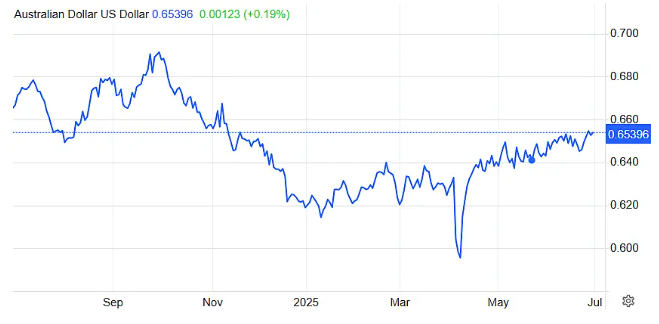
大摩揭示澳洲投资机遇:澳元已经见底,聚焦建筑增量板块
智通财经网· 2025-07-07 07:03
Core Viewpoint - The market has experienced significant volatility due to escalating geopolitical concerns and U.S. policy actions, with recent developments including the cancellation of retaliatory tariffs and a trade agreement framework with China [1][2] Group 1: Market Conditions - The S&P 500 index recently rebounded to a record closing high, while the ASX200 index is on track for its best performance since the COVID-19 pandemic [1] - Morgan Stanley's macro research head, Chris Nicol, highlighted that global economic growth is expected to slow from approximately 3.5% last year to 2.5% this year, slightly above the global recession threshold [1][2] Group 2: Key Risks - Nicol identified three major market risks to monitor: 1) Trade tensions potentially escalating during tariff negotiations, particularly from a U.S.-EU perspective; 2) Inflation risks as tariff costs may impact the U.S. and other countries; 3) Rising bond yields due to concerns over fiscal sustainability [2] - The mining and manufacturing sectors in Australia are expected to be significantly affected by the global growth slowdown, with more impact on prices rather than production in mining [2] Group 3: Investment Opportunities - Despite downward revisions in earnings expectations for resource companies, Nicol anticipates a potential recovery in earnings and emphasizes the importance of domestic policy in stimulating market activity [2][4] - Morgan Stanley suggests constructing an investment portfolio focused on four key areas: selecting large-cap stocks to leverage Australian economic resilience, capturing opportunities in interest rate-sensitive sectors, maintaining quality growth stocks, and holding resource stocks as a hedge against global risks [4] Group 4: Currency Outlook - The Australian dollar has faced pressure during risk asset sell-offs but is expected to stabilize against the U.S. dollar, with a forecasted moderate appreciation to 70 cents by mid-next year [2][4] - The Australian dollar's upward potential against a trade-weighted currency basket is currently limited due to the expected strengthening of the euro and yen against the U.S. dollar [4]