
港股回购

Search documents
蒙牛乳业(02319.HK)10月16日回购1443.90万港元,年内累计回购4.17亿港元
Zheng Quan Shi Bao Wang· 2025-10-16 12:42
Core Viewpoint - Mengniu Dairy (02319.HK) has repurchased shares worth HKD 14.439 million on October 16, 2025, bringing the total repurchase amount for the year to HKD 417 million [1][2]. Summary by Category Share Repurchase Details - On October 16, 2025, Mengniu Dairy repurchased 1 million shares at prices ranging from HKD 14.390 to HKD 14.490, totaling HKD 14.439 million [1]. - The closing price of the stock on the same day was HKD 14.430, reflecting a decrease of 0.82% with a total trading volume of HKD 347 million [1]. - Year-to-date, the company has conducted 92 repurchase transactions, acquiring a total of 25.768 million shares for a cumulative amount of HKD 417 million [2]. Historical Repurchase Data - The repurchase history includes various transactions with the highest repurchase price recorded at HKD 17.560 and the lowest at HKD 14.180 [2][3][4]. - Notable recent repurchases include: - October 9, 2025: 300,000 shares at a maximum price of HKD 14.650, totaling HKD 438.71 million [2]. - October 8, 2025: 500,000 shares at a maximum price of HKD 14.210, totaling HKD 709.78 million [2]. - October 6, 2025: 1 million shares at a maximum price of HKD 14.420, totaling HKD 1,440.99 million [2].
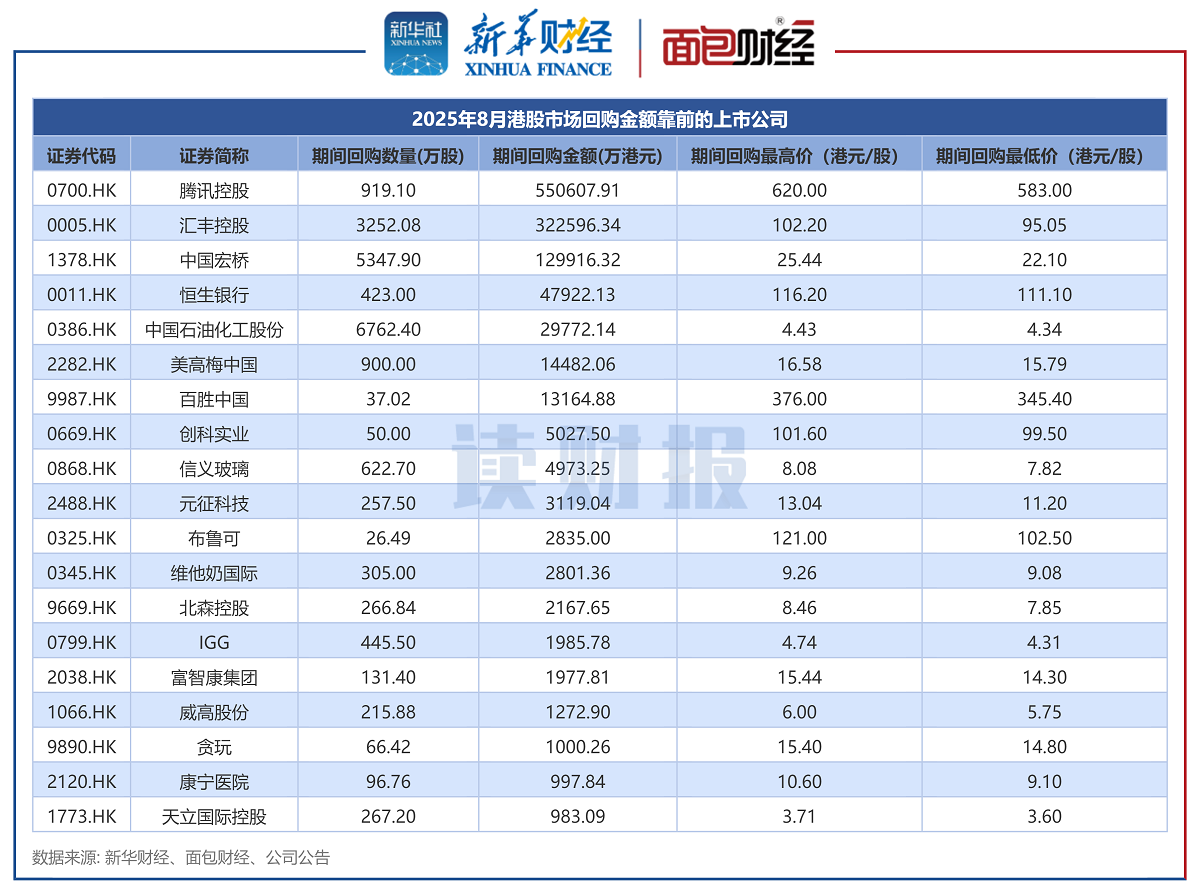
【读财报】港股8月回购透视:合计回购超114亿港元 恒生银行、信义玻璃等年内首度回购
Xin Hua Cai Jing· 2025-09-21 23:22
Summary of Key Points Core Viewpoint - In August 2025, Hong Kong stock market saw a total of 57 listed companies initiating share buybacks, with a cumulative repurchase of 259 million shares and a total amount of 11.457 billion HKD, representing a 51.01% decrease compared to 23.386 billion HKD in the same period last year [1][2]. Company-Specific Summaries - Tencent Holdings, HSBC, and China Hongqiao were among the top companies in terms of buyback amounts in August [2]. - MGM China increased its buyback efforts significantly in August, repurchasing shares worth 145 million HKD and totaling 1.67 billion HKD for the first eight months of 2025 [5]. - Hang Seng Bank conducted its first buyback of the year in August, amounting to 479 million HKD with a repurchase price range between 111.1 and 116.2 HKD per share [5]. - Xinyi Glass also initiated its first buyback of the year in August, with a total amount of 49.73 million HKD and a repurchase of 622.7 thousand shares [5]. Industry-Specific Summaries - The software services and food & beverage sectors had the highest number of companies initiating buybacks in August 2025 [6][8]. - In the software services sector, the total buyback amount reached 55.69 billion HKD with 8 companies participating [7]. - The food & beverage sector had 5 companies conducting buybacks, with Qinqin Food's buyback being its first of the year [8]. - The healthcare sector also saw a notable number of buybacks, with 5 companies including Weigao Group and Corning Hospital participating [8].

腾讯控股(00700.HK)连续22日回购,累计斥资121.13亿港元
Zheng Quan Shi Bao Wang· 2025-09-16 12:51
| 2025.01.14 | 401.00 | 379.400 | 365.600 | 150110.06 | | --- | --- | --- | --- | --- | | 2025.01.13 | 408.00 | 371.200 | 364.800 | 150343.72 | | 2025.01.10 | 401.00 | 379.200 | 370.200 | 150084.80 | | 2025.01.09 | 401.00 | 379.200 | 365.000 | 150060.94 | | 2025.01.08 | 405.00 | 379.200 | 366.000 | 150319.52 | | 2025.01.07 | 393.00 | 392.400 | 376.800 | 150095.97 | | 2025.01.06 | 171.00 | 415.000 | 407.400 | 70103.38 | | 2025.01.03 | 169.00 | 418.600 | 411.200 | 70092.51 | | 2025.01.02 | 168.00 | 424.600 | ...

威高股份(01066.HK)连续14日回购,累计斥资5830.50万港元
Zheng Quan Shi Bao Wang· 2025-09-16 12:51
(原标题:威高股份(01066.HK)连续14日回购,累计斥资5830.50万港元) 证券时报•数据宝统计,威高股份在港交所公告显示,9月16日以每股5.820港元至5.940港元的价格回购 53.00万股,回购金额达312.22万港元。该股当日收盘价5.940港元,上涨1.89%,全天成交额6305.22万 港元。 自8月28日以来公司已连续14日进行回购,合计回购1009.76万股,累计回购金额5830.50万港元。 其间 该股累计下跌8.47%。 注:本文系新闻报道,不构成投资建议,股市有风险,投资需谨慎。 港股回购 港股回购、公司回购、回购、股份回购、港股 威高股份回购明细 | 日期 | 回购股数 | 回购最高价 | 回购最低价 | 回购金额 | | --- | --- | --- | --- | --- | | | (万股) | (港元) | (港元) | (万港元) | | 2025.09.16 | 53.00 | 5.940 | 5.820 | 312.22 | | 2025.09.15 | 95.60 | 5.850 | 5.790 | 557.62 | | 2025.09.12 | 31.9 ...
恒生银行(00011.HK)连续33日回购,累计回购673.00万股
Zheng Quan Shi Bao Wang· 2025-09-16 12:51
(原标题:恒生银行(00011.HK)连续33日回购,累计回购673.00万股) | 日期 | 回购股数 | 回购最高价 | 回购最低价 | 回购金额 | | --- | --- | --- | --- | --- | | | (万股) | (港元) | (港元) | (万港元) | | 2025.09.16 | 20.00 | 119.700 | 118.400 | 2379.92 | | 2025.09.15 | 20.00 | 119.600 | 118.700 | 2384.98 | | 2025.09.12 | 21.00 | 119.800 | 119.100 | 2509.09 | | 2025.09.11 | 21.00 | 119.200 | 117.900 | 2488.22 | | 2025.09.10 | 21.00 | 118.900 | 116.000 | 2481.71 | | 2025.09.09 | 21.00 | 116.400 | 114.700 | 2430.79 | | 2025.09.08 | 21.00 | 115.200 | 114.100 | 2408.78 ...
港股市场回购统计周报2025.9.8-2025.9.14-20250916
Zhe Shang Guo Ji Jin Rong Kong Gu· 2025-09-16 05:54
Group 1: Market Overview - The total repurchase amount for the week was HKD 3.81 billion, a decrease from HKD 5.58 billion the previous week[12] - The number of companies repurchasing shares this week was 49, down from 59 last week[12] - Tencent Holdings (0700.HK) led the repurchase with an amount of HKD 2.75 billion[12] Group 2: Top Companies by Repurchase Amount - Tencent Holdings (0700.HK) repurchased shares worth HKD 275,285.23 thousand, accounting for 0.05% of its total share capital[11] - HSBC Holdings (0005.HK) repurchased shares worth HKD 49,042.12 thousand, representing 0.03% of its total share capital[11] - Hang Seng Bank (0011.HK) repurchased shares worth HKD 12,318.58 thousand, which is 0.06% of its total share capital[11] Group 3: Industry Distribution - The majority of repurchase amounts were concentrated in the Information Technology and Financial sectors[15] - The Information Technology sector had the highest number of repurchasing companies, with 12 firms participating[15] - The Consumer Discretionary and Healthcare sectors each had 9 companies engaging in repurchases[15] Group 4: Significance of Share Buybacks - Share buybacks indicate that companies believe their stock is undervalued, often occurring during bear markets[24] - Repurchases can stabilize investor confidence and signal that the stock price is significantly undervalued[24] - Historical data shows that the Hong Kong market has experienced five waves of buyback trends since 2008, typically followed by price increases[24]
港股年内回购超1200亿港元,互联网、金融领头,3家公司斥资超百亿港币
Xin Lang Cai Jing· 2025-09-11 14:01
来源:华夏时报 本报(chinatimes.net.cn)记者谢碧鹭 北京报道 2025年以来,港股市场在阶段性波动与估值修复需求的双重作用下,回购热潮持续升温。Wind数据显 示,截至9月11日,年内已有224家港股上市公司实施回购,累计回购金额突破1200亿港元,少数龙头企 业贡献了超八成的回购金额,形成"核心标的主导回购格局"的鲜明态势。 从行业脉络看,本轮回购延续了港股"互联网+金融"的双轮驱动传统:互联网领域以腾讯为绝对标杆, 其年内回购规模逼近500亿港元,叠加快手、美团等企业的梯队跟进,构成板块回购主力;金融板块则 凭借银行与保险的协同发力,既彰显盈利韧性,也强化了"稳回报"的市场形象。 更为关键的是,今年以来港股二级市场亦表现积极。南向资金作为港股重要配置力量,年内累计净买入 额已超万亿港元,不仅频繁出现单日净流入超百亿港元的情形,甚至还创下单日超300亿港元的流入高 峰。从长期趋势看,南向资金自2024年终结此前四年递减态势后,2025年流入节奏进一步加速,与回购 潮形成共振,共同为港股估值修复与市场生态优化提供支撑。 头部公司贡献超八成金额 2025年港股市场回购热潮再度显现,在市场波动与 ...

港股上市公司回购潮升温:年内1226亿港元创近年新高
Sou Hu Cai Jing· 2025-09-10 08:10
Group 1 - The Hong Kong stock market has seen a significant increase in share buybacks, with 223 companies repurchasing a total of 5.32 billion shares, amounting to HKD 122.57 billion as of September 9 [1] - The buyback trend is led by major internet and financial companies, with 44 companies repurchasing over HKD 100 million, including 16 companies exceeding HKD 500 million and 10 companies over HKD 1 billion [3][7] - The buyback landscape is diversifying, with active participation from sectors such as healthcare, consumer discretionary, and information technology, indicating a gradual recovery in industry confidence [4] Group 2 - Three main characteristics of the buyback trend in Hong Kong stocks include policy and market environment support, with regulatory reforms enhancing buyback flexibility and expectations of U.S. interest rate cuts attracting foreign capital back to emerging markets [5] - Overall profitability of Hong Kong companies has improved, with total revenue increasing by 0.67% year-on-year and net profit rising by 3.59% [8] - The buyback trend is supported by a "threefold driving" mechanism: optimized policy mechanisms enhancing operational space, leading companies setting examples for others, and improved profitability alongside foreign capital inflow boosting market confidence [9]

港股回购潮退坡?
Sou Hu Cai Jing· 2025-09-02 12:11
Group 1 - The Hong Kong stock market has seen significant growth this year, with the Hang Seng Index and Hang Seng Tech Index rising by 27.10% and 28.21% respectively, driven by major tech and financial companies [2] - Tencent, Alibaba, and AIA are the top three companies in terms of stock buybacks, with buyback amounts of HKD 460.99 billion, HKD 241.45 billion, and HKD 176.93 billion respectively, reflecting their strong stock performance [2] - Tencent's stock price has increased by 45.26% this year, while HSBC and AIA have also shown substantial gains of 38.01% and 31.78% respectively [3] Group 2 - Alibaba has been actively repurchasing shares in the US market, with a total buyback of USD 815 million (approximately HKD 63.61 billion) for 56 million shares, and still has a buyback capacity of USD 19.3 billion (approximately HKD 150.6 billion) [4][5] - Alibaba plans to invest over RMB 380 billion in cloud and AI infrastructure over the next three years, which may put pressure on its financial status despite having sufficient cash reserves [5] - HSBC's buyback strategy is driven by its low valuation, aiming to maintain investor attractiveness through buybacks and dividends [6] Group 3 - The overall buyback activity in the Hong Kong market has decreased as valuations have risen, indicating a cautious approach from companies regarding their buyback decisions [7][8] - The future of buyback activities will depend on two main factors: the sustainability of valuation levels and the performance of corporate cash flows, particularly in the context of AI investments and interest rate impacts [9] - Short-term buyback activities are expected to remain stable due to the strong cash reserves of leading companies like Tencent and Alibaba, as well as the stable dividend and buyback policies of HSBC and AIA [9]

伟仕佳杰(00856.HK)9月2日回购50.00万股,耗资498.80万港元
Zheng Quan Shi Bao Wang· 2025-09-02 10:09
Core Viewpoint - Weishi Jiajie (00856.HK) repurchased 500,000 shares on September 2, 2025, at a total cost of HKD 4.988 million, indicating a strategic move to enhance shareholder value amidst a declining stock price [1] Summary by Category Share Buyback Details - On September 2, 2025, Weishi Jiajie repurchased 500,000 shares at prices ranging from HKD 9.940 to HKD 10.030 per share, totaling HKD 4.988 million [1] - The stock closed at HKD 10.050 on the same day, reflecting a decrease of 3.83% with a total trading volume of HKD 196 million [1] - Year-to-date, the company has conducted five buybacks, acquiring a total of 1.598 million shares for a cumulative amount of HKD 10.1523 million [1] Buyback History - The buyback history for Weishi Jiajie includes: - September 2, 2025: 500,000 shares at a maximum price of HKD 10.030 and a minimum price of HKD 9.940 for a total of HKD 4.988 million - April 7, 2025: 360,000 shares at a maximum price of HKD 4.700 and a minimum price of HKD 4.660 for a total of HKD 1.6854 million - January 15, 2025: 124,000 shares at a maximum price of HKD 4.730 and a minimum price of HKD 4.700 for a total of HKD 585,300 - January 14, 2025: 240,000 shares at a maximum price of HKD 4.780 and a minimum price of HKD 4.740 for a total of HKD 1.1428 million - January 13, 2025: 374,000 shares at a maximum price of HKD 4.730 and a minimum price of HKD 4.600 for a total of HKD 1.7508 million [1]