黑天鹅事件

Search documents
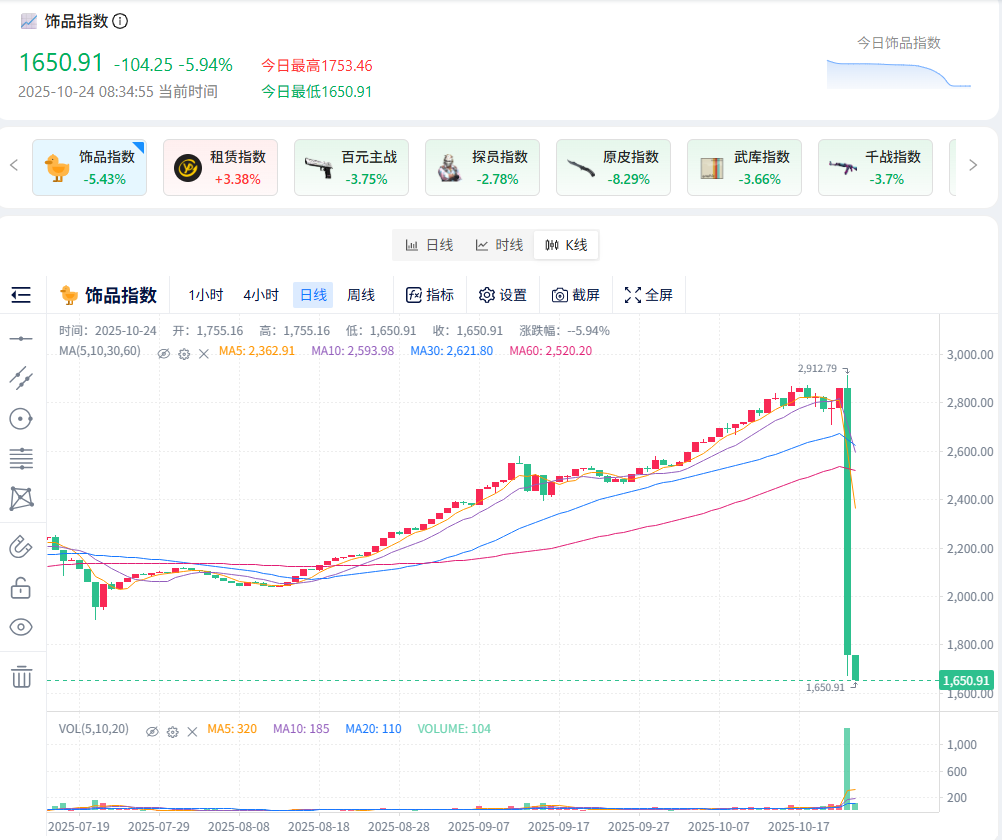
CS2饰品价格崩盘,职业选手选择“清仓”
Hu Xiu· 2025-10-24 06:29
Core Insights - The market for CS2 in-game items experienced a significant crash, with total market valuation dropping from $5.9 billion to $4.2 billion in just one day, resulting in a loss of nearly $2 billion [2] - High-end items saw a collective drop, with rare items like professional gloves and butterfly knives plummeting over 50% in value [2] - The crash was triggered by a major update from Valve, introducing a "trade-in" feature that diminished the scarcity of high-end items, allowing players to exchange five red skins for one gold item [4][5] Market Dynamics - The speculative nature of the CS2 item market has led players to compare it to the stock market, with the recent crash being viewed as a "black swan" event [5] - Valve's implementation of the "trade-in" feature and the "T+7" trading rule, which restricts item trading for seven days post-acquisition, has fundamentally reduced the speculative behavior in the market [5] - Historical context includes the "black egg" incident, where the price of a specific item skyrocketed from ¥19.89 to ¥3,400 before crashing again, highlighting the volatility of the market [5] Player Reactions - Professional players, such as MOUZ team member Spinx, expressed panic and sold all their items, indicating a loss of confidence in the market [4] - The drastic changes in item valuation and trading rules have led to a sense of urgency among players to exit the market [4] Player Base and Engagement - CS2 has a large player base, with peak concurrent players reaching 1.86 million and daily active users fluctuating between 600,000 and 1.5 million [6]

AI狂飙!巨头烧钱近千亿,2026美国经济是“支柱”还是“泡沫”?
Sou Hu Cai Jing· 2025-10-22 12:16
Core Insights - The surge in AI investments by major tech companies in the U.S. has reached nearly $100 billion in just one quarter, doubling compared to three years ago, with firms like Meta and Microsoft planning to increase their investments further [4] - AI-related investments contributed a full percentage point to economic growth in the first half of the year, nearly matching the contribution from consumer spending [4] - The capital expenditures of companies heavily investing in AI account for nearly one-third of the S&P 500 index, with their stock prices increasing almost fourfold over the past year [6] Investment Dynamics - Despite the apparent growth, a significant portion of the AI investments involves importing high-tech equipment, which may dilute the actual economic impact domestically [8] - The increase in productivity attributed to AI is visible, but the current growth rate of 2.2% in labor productivity is still below the 3.1% seen during the internet boom of the 1990s [10] - AI investments have only increased GDP's share by 0.4 percentage points, compared to 1.4 percentage points during the last tech revolution, indicating that the full benefits of AI are yet to be realized [10] Market Comparisons - Current leading tech companies in AI show a healthier financial profile compared to the internet bubble era, with their market value growth aligning closely with profit increases [14] - The risk of overextending financial resources is present, as companies may face cash flow challenges due to high AI investments, potentially leading to increased borrowing [16] - The energy consumption of data centers is projected to rise significantly, which could pose a risk to AI operations if power infrastructure does not keep pace [16][20] Future Outlook - The macroeconomic environment, including anticipated interest rate cuts and government support, may bolster AI investments through 2026, but long-term success will depend on overcoming challenges like profitability and energy shortages [20][22] - The AI investment landscape is characterized as a marathon requiring endurance and intelligence, with potential disruptions from unforeseen events like geopolitical tensions or sudden economic shifts [22]

黑天鹅事件下的黄金交易软件:六大平台应对极端波动的技术护城河
Sou Hu Cai Jing· 2025-10-16 04:11
Core Insights - The article emphasizes the increasing importance of gold as a safe-haven asset amid extreme market volatility due to geopolitical conflicts, rapid changes in Federal Reserve policies, and high global inflation in 2025 Group 1: Huimin Finance - Huimin Finance utilizes an AI-driven risk control system that analyzes global inflation data and geopolitical events, automatically generating anti-inflation strategies [2] - During significant price fluctuations, the system triggered stop-loss orders, helping users avoid potential losses exceeding 20% [2] - The platform features a unique "Gold Accumulation Plan" that allows users to set weekly investment amounts, achieving a reinvestment rate of over 85% during high inflation [2] - A community learning ecosystem is integrated, enabling users to follow high-success-rate traders, with a specific strategy yielding an 18% return in the first half of 2025 [2] Group 2: Ruifeng Finance - Ruifeng Finance covers a wide range of precious metals, including gold, silver, platinum, and palladium, catering to diverse investment needs [3] - The platform's dynamic risk control panel allows users to customize stop-loss ratios and other parameters, providing real-time monitoring of price volatility [3] - It employs blockchain technology for the traceability of physical gold bars, enhancing trust in the assets [3] Group 3: Wealth Alliance - Wealth Alliance promotes a social investment ecosystem where users can share high-success strategies, creating a beneficial cycle of experienced and novice investors [4] - The platform supports real-time collaboration among fund managers and traders, generating visual reports on risk metrics during periods of geopolitical tension [4] - Regular quantitative strategy competitions are held, with the winning strategy achieving an annualized return of 22% in 2025 [4] Group 4: Puhui Gold - Puhui Gold employs a multi-layered encryption system and third-party fund custody to ensure zero risk for user assets [5] - The platform maintained a 99.9% success rate for fund transfers during a surge in withdrawal requests amid market volatility [5] - It provides in-depth market analysis and investment recommendations, successfully predicting gold price rebounds [5] Group 5: Today Finance - Today Finance features a multi-dimensional data radar system that captures real-time dynamics from over 200 exchanges, aiding professional investors in decision-making [7] - The platform offers a three-dimensional visualization dashboard to track correlations among gold, the US dollar index, and bond yields, activating hedging strategies when discrepancies exceed 15% [7] - An expert ecosystem is available for real-time interaction, with a high accuracy rate for predictions during geopolitical conflicts [7] Group 6: Prohui - Prohui utilizes ultra-low latency architecture to minimize order execution delays, enhancing performance in high-frequency trading scenarios [6] - The platform supports seamless strategy synchronization across multiple devices, ensuring efficient trading execution [6] - A new user protection mechanism subsidizes initial trading losses, attracting over 500,000 new users with a retention rate of 78% in the first month [8] Group 7: Industry Trends - The gold market in 2025 has shifted from price competition to a comprehensive contest of technological capabilities and ecosystem development [9] - The six platforms redefine the gold investment experience through differentiated innovations, emphasizing the importance of utilizing these tools for stable returns in volatile markets [9]
暴跌后暴涨!加密货币后市如何表现?
Guo Ji Jin Rong Bao· 2025-10-13 15:48
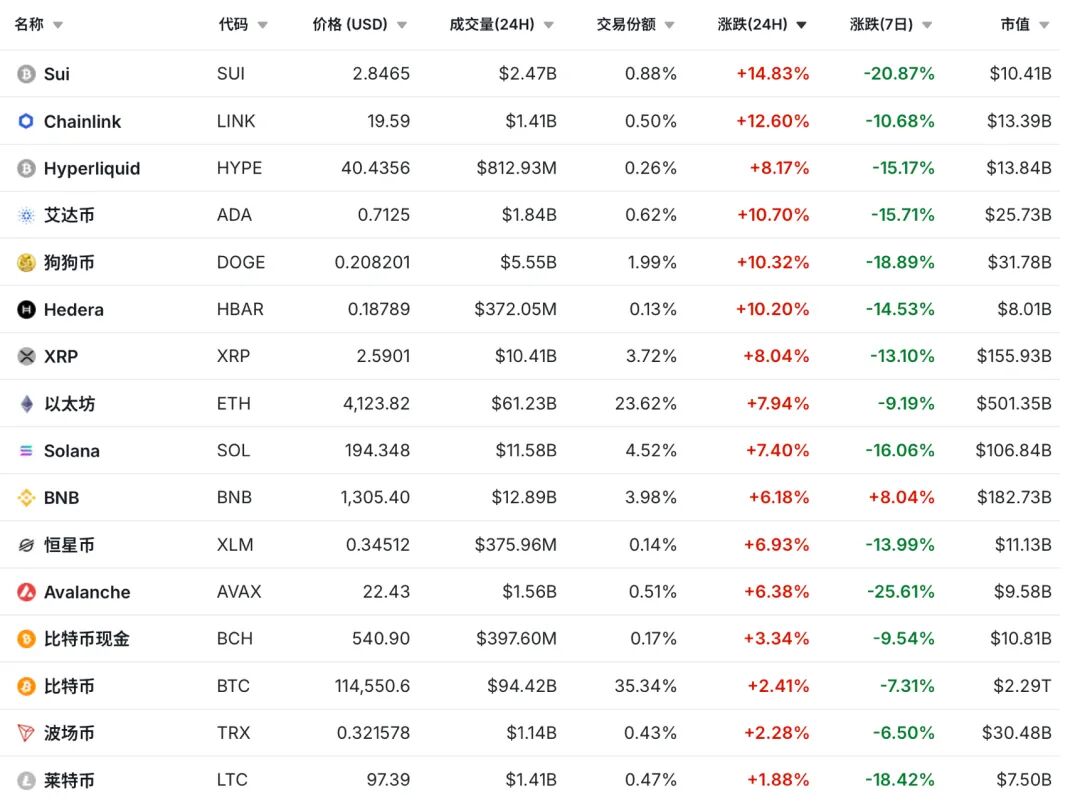
Market Overview - The cryptocurrency market experienced significant volatility, with Bitcoin dropping nearly 15% on October 10, and other cryptocurrencies like Ethereum, XRP, and Dogecoin seeing declines of over 20% from their peaks [1][3] - Following this drop, the market rebounded strongly on October 12 and 13, with Bitcoin rising nearly 4% and Ethereum, SOL, XRP, and Dogecoin all increasing by around 10% [1][6] Market Dynamics - The recent fluctuations in the cryptocurrency market are attributed to a combination of external shocks and the release of accumulated risks, highlighting the fragility of the market under high leverage and expectations [2][4] - The market's response to macroeconomic factors, such as U.S. trade policies and interest rates, has been significant, with a notable impact on investor sentiment and liquidity [4][8] Trading Activity - On October 10, the cryptocurrency market saw a massive liquidation event, with $19.3 billion in liquidations and nearly 1.67 million traders forced to close their positions, predominantly affecting long positions [3][4] - The extreme volatility was exacerbated by specific assets experiencing severe de-pegging on exchanges, leading to a non-linear amplification of price movements [5][9] Recovery Factors - The rebound in cryptocurrency prices is driven by technical corrections, short covering, and improved expectations regarding trade tensions, which have alleviated some of the previous market fears [6][7] - The market's recovery is also supported by a reduction in leverage and improved risk tolerance among investors, as well as a shift in sentiment regarding macroeconomic policies [7][9] Future Outlook - The cryptocurrency market is expected to remain in a phase of adjustment, influenced by macroeconomic conditions, liquidity levels, and regulatory expectations [8][9] - Key factors that will shape the future trajectory of the market include U.S. monetary policy, inflation rates, and geopolitical developments, particularly U.S.-China trade relations [8][9]
港股异动 | 加密货币概念股延续跌势 比特币价格远未达到充分调整区间 市场下行风险依然显著
智通财经网· 2025-10-13 02:27
Group 1 - Cryptocurrency concept stocks continue to decline, with OSL Group down 6.65% to HKD 15.45, Yunfeng Financial down 6.12% to HKD 5.52, OKLink down 4.35% to HKD 0.33, and others also experiencing losses [1] - As of October 13, Bitcoin briefly rose above USD 115,000, increasing by 4.25% in the last 24 hours, with a short-term surge of nearly USD 1,000 [1] - A total of 183,988 individuals were liquidated in the last 24 hours, with a total liquidation amount of USD 630 million, indicating significant market volatility [1] Group 2 - Since 2025, Bitcoin has experienced multiple fluctuations, starting the year around USD 95,000, dropping below USD 80,000 in April, and subsequently breaking through several key price levels [2] - Market uncertainty has led to a sharp decline in risk assets, with a surge in demand for downside protection in the derivatives market [2] - The dynamics of the options market may have a greater impact on the price movements of the underlying market than ever before [2]


币圈遭历史最大爆仓
Bei Jing Shang Bao· 2025-10-12 15:13
Market Overview - The cryptocurrency market experienced a significant liquidation event over the past weekend, with Bitcoin dropping to $109,992, a nearly 3% decline within 24 hours, while Ethereum fell over 3% to $3,719 [1] - Other cryptocurrencies faced even larger declines, with XRP down 4.83%, Solana down 7.32%, Dogecoin down over 8%, and Cardano down 6.58% [1] Causes of the Market Crash - Analysts attribute the recent cryptocurrency turmoil to U.S. President Trump's latest tariff comments, which heightened global market risk aversion, prompting investors to sell off risk assets [2] - Bitcoin plummeted from $122,000 to $103,900, a nearly 15% drop, while other cryptocurrencies like Ethereum, XRP, and Dogecoin saw declines exceeding 20% [2] Liquidation Statistics - The total liquidation across the cryptocurrency market reached $19.141 billion, marking the largest forced liquidation wave since early April, affecting over 1.6 million traders [2] - The largest single liquidation occurred on the Hyperliquid platform, involving an ETH-USDT contract worth $203 million [2] USDe Stablecoin Incident - The USDe stablecoin, the third-largest globally with a market cap exceeding $12 billion, experienced a significant de-pegging event, dropping to as low as $0.65 [3] - This incident coincided with a broader market crash, leading to a simultaneous decline in various wrapped tokens [3] Exchange Performance and Criticism - Centralized exchanges like Binance faced technical issues during the peak of the liquidation, leading to delays and trading interruptions, which exacerbated user losses [3] - The situation has reignited debates about the risk management capabilities of centralized versus decentralized finance (DeFi) platforms [3] Market Sentiment and Predictions - A trader known for accurately predicting the 2022 cryptocurrency crash warned that the recent downturn may be a precursor to a new "black swan" event, indicating ongoing market uncertainty [4] - The trader noted that while altcoins have experienced significant declines, major cryptocurrencies have not yet completed their deep corrections [4] Future Outlook - The sustainability of Bitcoin's price increase is heavily dependent on macroeconomic conditions and developments in trade [5] - Deutsche Bank predicts that by 2030, Bitcoin and gold may become significant components of central bank reserve assets, as the share of U.S. dollar reserves declines [5]
突发黑天鹅警告!集体暴跌,加密货币继续跳水!
Sou Hu Cai Jing· 2025-10-12 14:46
Core Insights - The cryptocurrency market has experienced a significant downturn, with over $19.3 billion in positions liquidated and approximately 1.67 million traders affected, marking the largest liquidation event on record in the crypto space [1] - Bitcoin has fallen below the $110,000 mark, with other cryptocurrencies like Solana, Ethereum, BNB, and XRP also experiencing declines [1][2] - A well-known trader has warned of a potential new "black swan" event in the cryptocurrency market, indicating that the recent downturn may be just the beginning of further declines [3][4] Market Performance - As of October 12, Bitcoin was priced at $109,992, with a 24-hour decline of nearly 3%. Ethereum dropped over 3% to $3,719, while XRP fell by 4.83%, Solana by 7.32%, and Dogecoin by over 8% [1] - In the last 24 hours, the total liquidation in the cryptocurrency market reached $570 million, affecting over 206,000 traders, with $420 million from long positions and $150 million from short positions [2] Trader Insights - The trader, known as "Crypto King," who accurately predicted the 2022 cryptocurrency crash, has indicated that the recent market drop is a precursor to a "black swan" event, suggesting that mainstream cryptocurrencies have not yet undergone sufficient correction [3][4] - The trader emphasized that while Bitcoin is holding above the $100,000 mark, it has not reached the adequate adjustment range of $60,000 to $70,000, indicating significant downside risk remains [4] Regulatory Environment - A major trading platform in the UK has warned investors against including cryptocurrencies in their portfolios, despite the recent lifting of a ban on retail investors participating in cryptocurrency exchange-traded notes (ETNs) [6] - The platform, Hargreaves Lansdown, stated that Bitcoin does not belong to any asset class and lacks the characteristics necessary for portfolio growth or achieving financial goals, highlighting the high volatility and risk associated with cryptocurrencies compared to stocks or bonds [6]

又有超20万人爆仓,比特币交易额骤减近70%
21世纪经济报道· 2025-10-12 07:38
Core Viewpoint - The cryptocurrency market is experiencing a significant downturn, marked by a record-breaking liquidation event where over $19 billion was lost in a single day, affecting 1.64 million traders, indicating a critical moment for the industry [1][8]. Market Performance Summary - On October 11, the total liquidation amount exceeded $19 billion, setting a historical record for the cryptocurrency market [1]. - On October 12, Bitcoin's price fell below $111,000, with major cryptocurrencies like Solana, Ethereum, BNB, and XRP also experiencing declines [1]. - The trading volume for major cryptocurrencies dropped significantly, with Bitcoin's trading volume decreasing by nearly 70% [1]. - Specific price changes for major cryptocurrencies include: - Bitcoin (BTC): $111,694.7, down 0.67%, trading volume of $84.847 billion, down 68.92% [2]. - Ethereum (ETH): $3,818.93, up 0.47%, trading volume of $81.44 billion, down 63.23% [2]. - Solana (SOL): $181.44, down 1.50%, trading volume of $24.062 billion, down 55.40% [2]. - XRP: $2.3851, down 2.02%, trading volume of $9.647 billion, down 64.90% [2]. - BNB: $1,147.97, up 3.51%, trading volume of $5.673 billion, down 59.53% [2]. Reasons for the Decline - The decline in Bitcoin's price is attributed to multiple market factors, including high leverage levels and a fragile market structure that exacerbated price drops during volatility [9]. - The announcement of increased tariffs by the U.S. on China has heightened global risk aversion, impacting the cryptocurrency market [9]. - Tight market liquidity and a cautious stance from institutional investors have further contributed to market fluctuations [9].

比特币又跳水 加密货币全网爆仓超20万人!知名交易员突发警告:“黑天鹅”
Mei Ri Jing Ji Xin Wen· 2025-10-12 07:14
Group 1 - The cryptocurrency market is experiencing significant volatility, with Bitcoin dropping to $109,992 and Ethereum falling to $3,719, reflecting a decline of nearly 3% in 24 hours [1] - A total of $570 million in cryptocurrency contracts were liquidated in the past 24 hours, affecting over 206,000 traders, with long positions accounting for $420 million of the liquidations [1] - The market saw a massive sell-off on October 10, with Bitcoin plummeting nearly 15% from $122,000 to $103,900, and other cryptocurrencies like Ethereum and XRP experiencing declines of over 20% [1] Group 2 - A trader known as "Crypto King" warned of a potential new "black swan" event in the cryptocurrency market, suggesting that the recent downturn may be just the beginning of further declines [2][4] - The recent crash was characterized as a precursor to a "black swan" event, with many altcoins experiencing historic levels of decline, while major cryptocurrencies have not yet completed their deep corrections [4] - The USDe stablecoin, which is the third-largest stablecoin globally with a market cap exceeding $12 billion, experienced a significant de-pegging event, dropping to as low as $0.65 [4] Group 3 - The uncertainty in the market has led to a surge in demand for downside protection in the derivatives market, indicating that options market dynamics may have a greater impact on the underlying market prices [5] - Bitcoin's price has seen multiple fluctuations since 2025, with significant support from institutional investments and its increasing correlation with the global financial system [5] - Predictions suggest that by 2030, Bitcoin and gold may become important components of central bank reserve assets, as the share of dollar reserves held by global central banks has decreased to 41% [5]

大跳水!突发警告:“黑天鹅”!
券商中国· 2025-10-12 06:20
Core Viewpoint - The cryptocurrency market is experiencing a significant downturn, primarily triggered by renewed tariff threats from the Trump administration, leading to massive liquidations and a potential new "black swan" event in the market [1][4][5]. Group 1: Market Performance - Over the past few days, the cryptocurrency market has seen over $19.3 billion in positions liquidated, with nearly 1.67 million traders affected, marking the largest liquidation event on record [1][2]. - On October 12, Bitcoin fell below $110,000, with Ethereum and other cryptocurrencies also experiencing declines, including Solana dropping over 7% and XRP falling by 4.83% [2]. - In a 24-hour period, the total liquidation amount reached $5.7 billion, with over 206,000 traders liquidated, predominantly from long positions [2]. Group 2: Market Sentiment and Predictions - A well-known trader, who accurately predicted the 2022 cryptocurrency crash, warned that the market may be facing a new "black swan" event, indicating that the recent downturn could be just the beginning of further declines [4][5]. - The trader emphasized that while Bitcoin has held the $100,000 mark, it has not yet reached a sufficient adjustment range of $60,000 to $70,000, suggesting significant downside risks remain [5]. Group 3: Regulatory Developments - Following the lifting of a long-standing ban on retail investors participating in cryptocurrency exchange-traded notes (ETNs) in the UK, there is a cautionary stance from major trading platforms urging investors to remain prudent [6]. - Hargreaves Lansdowne, a leading retail trading platform, advised against including cryptocurrencies in investment portfolios, citing their lack of inherent value and high volatility compared to traditional assets [6].