Transformer

Search documents
新一轮智驾PK,迈入实战时刻
Hu Xiu· 2025-08-27 10:38
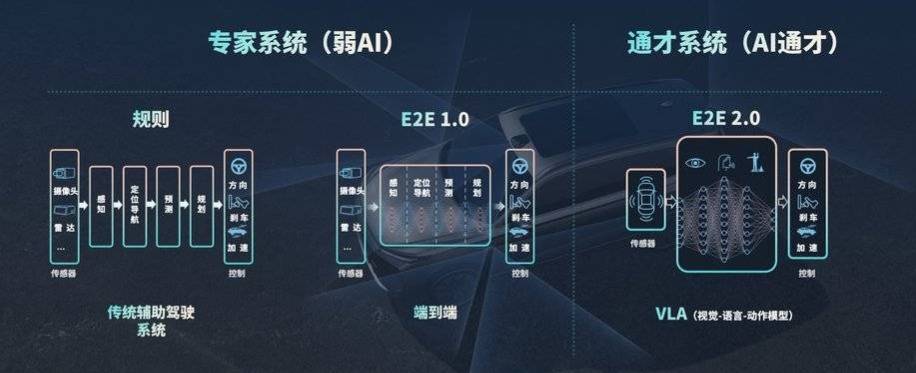
Core Viewpoint - The recent surge in advancements in intelligent driving technology is driven by several key factors, leading to a new competitive landscape in the industry [2][3][20]. Group 1: Industry Dynamics - Major players in the intelligent driving sector have recently launched their latest capabilities, reminiscent of past industry waves driven by end-to-end models [2][3]. - The competition has intensified due to regulatory pressures and public sentiment, which have delayed some companies' planned releases [6][20]. - Companies are prioritizing the release of "basic versions" of their technologies to avoid being outpaced by competitors [6][20]. Group 2: Technological Advancements - The VLA model has surpassed the capabilities of previous end-to-end models, with its lower limits exceeding the upper limits of earlier technologies [3][5]. - The transition from CNN to Transformer technology has significantly enhanced the model's ability to mimic human cognitive processes [8][10]. - The VLA model incorporates a chain of thought (CoT) capability, allowing for more logical and reliable decision-making in complex driving scenarios [11][12]. Group 3: Model Features and Performance - The VLA model's architecture is designed to handle perception, reasoning, and action execution, making it more suitable for intelligent driving applications compared to previous models [9][10]. - The model's ability to analyze and respond to potential risks has improved, enabling it to exhibit a form of "defensive driving" akin to human behavior [12][13][17]. - The VLA model can interpret traffic signs and respond to verbal commands, enhancing user interaction and operational efficiency [17][20]. Group 4: Future Outlook - The VLA model is still in the optimization phase, with significant improvements needed to fully realize its CoT capabilities [18][19]. - The industry is expected to focus on data collection and refining the performance of intelligent driving models in the coming period [19][20]. - The cost of implementing VLA technology varies, with higher-end models being more adaptable, while lower-cost models may require further optimization [20].

DiT突遭怒喷,谢赛宁淡定回应
量子位· 2025-08-20 07:48
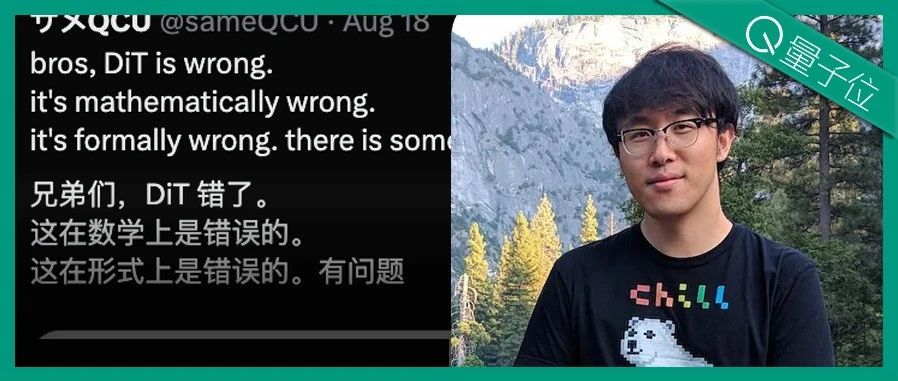
Core Viewpoint - The article discusses the recent criticisms of the DiT (Diffusion Transformers) model, which is considered a cornerstone in the diffusion model field, highlighting the importance of scientific scrutiny and empirical validation in research [3][10]. Group 1: Criticism of DiT - A user has raised multiple concerns about DiT, claiming it is flawed both mathematically and in its structure, even questioning the presence of Transformer elements in DiT [4][12]. - The criticisms are based on a paper titled "TREAD: Token Routing for Efficient Architecture-agnostic Diffusion Training," which introduces a strategy that allows early-layer tokens to be passed to deeper layers without modifying the architecture or adding parameters [12][14]. - The critic argues that the rapid decrease in FID (Fréchet Inception Distance) during training indicates that DiT's architecture has inherent properties that allow it to easily learn the dataset [15]. - The Tread model reportedly trains 14 times faster than DiT after 400,000 iterations and 37 times faster at its best performance after 7 million iterations, suggesting that significant performance improvements may undermine previous methods [16][17]. - The critic also suggests that if parts of the network are disabled during training, it could render the network ineffective [19]. - It is noted that the more network units in DiT that are replaced with identity mappings during training, the better the model evaluation results [20]. - The architecture of DiT is said to require logarithmic scaling to represent the signal-to-noise ratio differences during the diffusion process, indicating potential issues with output dynamics [23]. - Concerns are raised regarding the Adaptive Layer Normalization method, suggesting that DiT processes conditional inputs through a standard MLP (Multi-Layer Perceptron) without clear Transformer characteristics [25][26]. Group 2: Response from Xie Saining - Xie Saining, the author of DiT, responded to the criticisms, asserting that the Tread model's findings do not invalidate DiT [27]. - He acknowledges the Tread model's contributions but emphasizes that its effectiveness is due to regularization enhancing feature robustness, not because DiT is incorrect [28]. - Saining highlights that Lightning DiT, an upgraded version of DiT, remains a powerful option and should be prioritized when conditions allow [29]. - He also states that there is no evidence to suggest that the post-layer normalization in DiT causes issues [30]. - Saining summarizes improvements made over the past year, focusing on internal representation learning and various methods for enhancing model training [32]. - He mentions that the sd-vae (stochastic depth variational autoencoder) is a significant concern for DiT, particularly regarding its high computational cost for processing images at 256×256 resolution [34].
DiT在数学和形式上是错的?谢赛宁回应:不要在脑子里做科学
机器之心· 2025-08-20 04:26
Core Viewpoint - The article discusses criticisms of the DiT model, highlighting potential architectural flaws and the introduction of a new method called TREAD that significantly improves training efficiency and image generation quality compared to DiT [1][4][6]. Group 1 - A recent post on X claims that DiT has architectural defects, sparking significant discussion [1]. - The TREAD method achieves a training speed improvement of 14/37 times on the FID metric when applied to the DiT backbone network, indicating better generation quality [2][6]. - The post argues that DiT's FID stabilizes too early during training, suggesting it may have "latent architectural defects" that prevent further learning from data [4]. Group 2 - TREAD employs a "token routing" mechanism to enhance training efficiency without altering the model architecture, using a partial token set to save information and reduce computational costs [6]. - The author of the original DiT paper, Sseining, acknowledges the criticisms and emphasizes the importance of experimental validation over theoretical assertions [28][33]. - Sseining also points out that DiT's architecture has some inherent flaws, particularly in its use of post-layer normalization, which is known to be unstable for tasks with significant numerical range variations [13][36]. Group 3 - The article mentions that DiT's design relies on a simple MLP network for processing critical conditional data, which limits its expressive power [16]. - Sseining highlights that the real issue with DiT lies in its sd-vae component, which is inefficient and has been overlooked for a long time [36]. - The ongoing debate around DiT reflects the iterative nature of algorithmic progress, where existing models are continuously questioned and improved [38].

端到端VLA的起点:聊聊大语言模型和CLIP~
自动驾驶之心· 2025-08-19 07:20
Core Viewpoint - The article discusses the development and significance of end-to-end (E2E) algorithms in autonomous driving, emphasizing the integration of various advanced technologies such as large language models (LLMs), diffusion models, and reinforcement learning (RL) in enhancing the capabilities of autonomous systems [21][31]. Summary by Sections Section 1: Overview of End-to-End Autonomous Driving - The first chapter provides a comprehensive overview of the evolution of end-to-end algorithms, explaining the transition from modular approaches to end-to-end solutions, and discussing the advantages and challenges of different paradigms [40]. Section 2: Background Knowledge - The second chapter focuses on the technical stack associated with end-to-end systems, detailing the importance of LLMs, diffusion models, and reinforcement learning, which are crucial for understanding the future job market in this field [41][42]. Section 3: Two-Stage End-to-End Systems - The third chapter delves into two-stage end-to-end systems, exploring their emergence, advantages, and disadvantages, while also reviewing notable works in the field such as PLUTO and CarPlanner [42][43]. Section 4: One-Stage End-to-End and VLA - The fourth chapter highlights one-stage end-to-end systems, discussing various subfields including perception-based methods and the latest advancements in VLA (Vision-Language Alignment), which are pivotal for achieving the ultimate goals of autonomous driving [44][50]. Section 5: Practical Application and RLHF Fine-Tuning - The fifth chapter includes a major project focused on RLHF (Reinforcement Learning from Human Feedback) fine-tuning, providing practical insights into building pre-training and reinforcement learning modules, which are applicable to VLA-related algorithms [52]. Course Structure and Learning Outcomes - The course aims to equip participants with a solid understanding of end-to-end autonomous driving technologies, covering essential frameworks and methodologies, and preparing them for roles in the industry [56][57].

马斯克:谷歌最有可能成为AI行业领先者
3 6 Ke· 2025-08-15 01:21
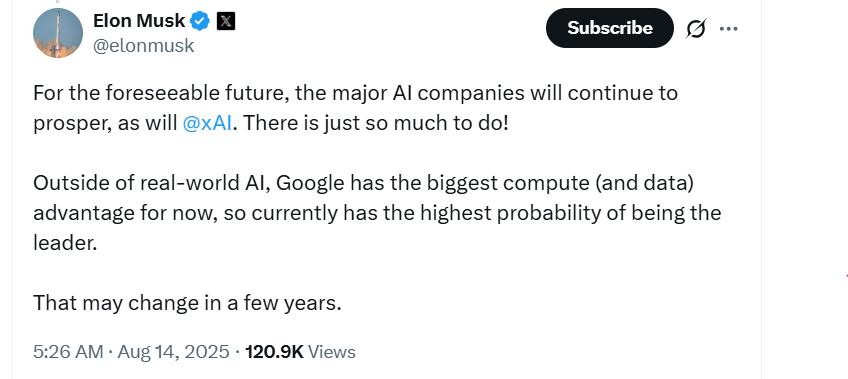
Core Viewpoint - Elon Musk praised Google as the most likely leader in the artificial intelligence industry due to its significant computational and data advantages, while also indicating that this situation may change in the coming years [1]. Group 1: Google's Position in AI - Google is recognized as a cornerstone in the AI field, having introduced the Transformer concept in a groundbreaking 2017 paper titled "Attention Is All You Need," which supports large language models like ChatGPT [1]. - Google has invested in AI startups such as Anthropic and Safe Superintelligence, holding a 14% stake in Anthropic [1]. - In its recent Q2 earnings call, Google announced a $10 billion increase in capital expenditures for the year, raising the total to $85 billion, aimed at meeting the growing demand for chips and AI products [2]. Group 2: Musk's Disputes and xAI - Musk's comments coincided with escalating tensions with OpenAI's CEO Sam Altman, including Musk's threat to sue Apple for promoting OpenAI's ChatGPT over his own xAI's Grok chatbot [3]. - Musk and Altman co-founded OpenAI in 2015, but their relationship soured after Musk left the board in 2018 due to differing views [3]. - Musk established xAI in July 2023, raising over $12 billion in funding across multiple rounds later that year [3]. - Tesla is set to hold a shareholder vote on whether to invest in xAI, although the timing of the vote has not been specified [4]. - Musk indicated that if it were solely his decision, Tesla would have already invested in xAI [5].


又是王冠:27M小模型超越o3-mini!拒绝马斯克的00后果然不同
Sou Hu Cai Jing· 2025-08-10 04:21
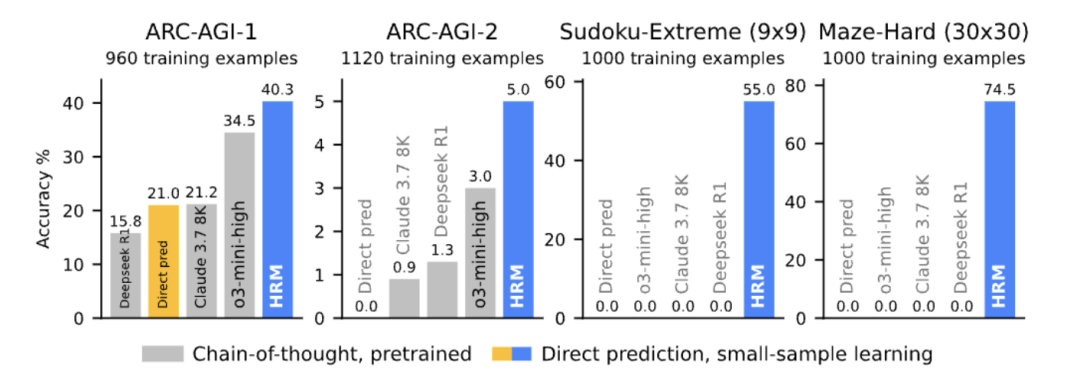
Core Insights - The article discusses the development of a new AI model called the Hierarchical Reasoning Model (HRM) by Sapient Intelligence, which has achieved superior performance compared to larger models with fewer parameters [3][5][18] - HRM utilizes innovative techniques inspired by brain functions, allowing it to perform complex reasoning tasks efficiently without relying on traditional pre-training methods [4][12][14] Model Performance - HRM, with only 27 million parameters, surpassed larger models like o3-mini-high and Claude 3.7 in various tests, achieving a 40.3% accuracy rate in the ARC-AGI challenge [16][18] - In extreme Sudoku tasks, HRM demonstrated near-perfect accuracy, while traditional models struggled significantly [16][18] Technical Innovations - HRM employs a dual-layer cyclical module design that mimics the brain's hierarchical processing and time-scale separation, enhancing both global direction and local execution efficiency [4][7] - The model incorporates a layered convergence mechanism to avoid premature convergence, allowing it to adaptively set new goals based on high-level updates [9][11] - It utilizes approximate gradient techniques to optimize memory usage and computational efficiency, aligning with biological learning patterns [12] - A deep supervision mechanism is integrated, allowing for periodic evaluations and adjustments during the learning process, which helps in correcting deviations promptly [13][14] Developer Background - The model's creator, Wang Guan, is a young entrepreneur who previously declined offers from major tech figures like Elon Musk, aiming instead to revolutionize AI architecture [20][22] - Wang co-founded Sapient Intelligence in 2024, focusing on developing models with advanced reasoning and planning capabilities [22]
自动驾驶之心技术交流群来啦!
自动驾驶之心· 2025-07-29 07:53
Core Viewpoint - The article emphasizes the establishment of a leading communication platform for autonomous driving technology in China, focusing on industry, academic, and career development aspects [1]. Group 1 - The platform, named "Autonomous Driving Heart," aims to facilitate discussions and exchanges among professionals in various fields related to autonomous driving technology [1]. - The technical discussion group covers a wide range of topics including large models, end-to-end systems, VLA, BEV perception, multi-modal perception, occupancy, online mapping, 3DGS, multi-sensor fusion, transformers, point cloud processing, SLAM, depth estimation, trajectory prediction, high-precision maps, NeRF, planning control, model deployment, autonomous driving simulation testing, product management, hardware configuration, and AI job exchange [1]. - Interested individuals are encouraged to join the community by adding a WeChat assistant and providing their company/school, nickname, and research direction [1].
Grok4全网玩疯,成功通过小球编程测试,Epic创始人:这就是AGI
猿大侠· 2025-07-12 01:45
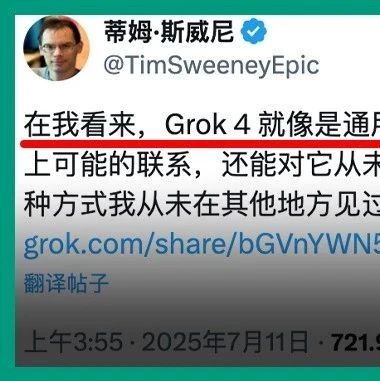
Core Viewpoint - The article discusses the rapid adoption and impressive capabilities of Elon Musk's Grok4 AI model, highlighting its performance in various tests and comparisons with other models like OpenAI's o3. Group 1: Performance Highlights - Grok4 successfully passed the hexagonal ball programming test, showcasing its ability to understand physical laws [2][12]. - In a comprehensive evaluation, Grok4 outperformed o3 in all eight tasks, including complex legal reasoning and code translation [23][18][20]. - Tim Sweeney, founder of Epic Games, praised Grok4 as a form of Artificial General Intelligence (AGI) after it provided deep insights on a previously unseen problem [9][10]. Group 2: User Interactions and Applications - Users have engaged with Grok4 in creative ways, such as visualizing mathematical concepts and generating SVG graphics, demonstrating its versatility [25][32]. - A user named Dan was able to create a visualization of Euler's identity with minimal interaction, indicating Grok4's efficiency in generating complex outputs [31][26]. - The article mentions a high-level application called "Expert Conductor," which simulates an expert collaboration environment, further showcasing Grok4's potential in problem-solving [54][56]. Group 3: Community Engagement - The article encourages readers to share their innovative uses of Grok4, indicating a growing community interest and engagement with the AI model [66]. - Various users have reported their experiences and findings, contributing to a collaborative exploration of Grok4's capabilities [12][66].
「Tokens是胡扯」,Mamba作者抛出颠覆性观点,揭露Transformer深层缺陷
机器之心· 2025-07-09 09:52
Core Viewpoint - The article discusses the trade-offs between State Space Models (SSM) and Transformers, arguing that tokenization is a limitation that SSM can overcome, leading to better computational efficiency and modeling capabilities [1][3][61]. Group 1: State Space Models (SSM) - SSM is defined as a modern version of recurrent neural networks (RNN) with key features that allow it to match the language modeling performance of Transformers [8][10]. - A significant characteristic of SSM is that its hidden state dimension is greater than the input and output dimensions, allowing for better context storage [9][10]. - The model's state update function must be expressive enough to accurately encode and retrieve necessary information, which is achieved through dynamic transfer matrices in selective SSM [11][12]. - Mamba, a specific SSM, integrates parallelization and memory management techniques to enhance computational efficiency [13][14]. - The article highlights that SSMs can outperform Transformers in language modeling tasks when computational resources are matched [53][56]. Group 2: Transformers - Transformers excel in tasks requiring fine-grained operations on individual tokens, but they suffer from quadratic complexity, limiting their efficiency [82][86]. - The article argues that Transformers have an inductive bias that affects their modeling capabilities, making them sensitive to the resolution and semantic content of the data [83][85]. - Despite their strengths, Transformers are not the ultimate solution for all modeling tasks, and there is still significant work to be done in the field [89]. Group 3: Tokenization - Tokenization is a critical step in language modeling, but it introduces limitations in understanding language details [39][40]. - The article posits that removing tokenization could lead to better model performance and aligns with the essence of deep learning, which aims to minimize manual feature engineering [44][45]. - The author suggests that without tokenization, models could learn more effective patterns directly from raw data, enhancing their capabilities [46][52].

Transformer死角,只需500步后训练,循环模型突破256k长度泛化极限
机器之心· 2025-07-08 04:09
Core Insights - The article discusses the advantages of linear recurrent models, such as Mamba, and linear attention mechanisms in handling long sequences, which is crucial for long-context reasoning tasks [1][2] - It highlights the performance improvements of recurrent models over time, indicating that they can now compete with Transformers in various tasks, despite previous limitations [3] - A significant finding is that recurrent models struggle with generalization beyond training lengths, leading to performance drops when faced with longer sequences [4][6] Group 1 - The article presents a solution to the generalization issue in recurrent models through simple training interventions, allowing them to generalize to sequences up to 256k in length with just 500 additional training steps [7] - The research emphasizes that recurrent models possess untapped potential rather than inherent flaws [7][8] - The authors propose the "Unexplored States Hypothesis" to explain why recurrent models fail to generalize in length, indicating that they only learn from a limited subset of possible states during training [13][14] Group 2 - The article outlines four training interventions to improve length generalization by altering the initial state of the model [19] - These interventions include Random Noise, Fitted Noise, State Passing, and Truncated Backpropagation Through Time (TBTT), each designed to expose the model to a broader range of state distributions [20][19] - The findings reveal that State Passing and TBTT mechanisms effectively enable length generalization, achieving results with only 0.02% of the original pre-training budget [23][24] Group 3 - The article discusses the performance of these interventions in various long-context tasks, demonstrating their ability to enhance length generalization [31] - Specific tasks mentioned include the BABILong benchmark, password retrieval, and synthetic copying tasks, where the interventions significantly improved model performance [32][35][39] - The results indicate that models trained with these interventions can effectively utilize relationships between tokens beyond the training context length [36][39] Group 4 - The article introduces the concept of "Effective Remembrance" to measure how well a model retains information from previous tokens, aiming for models to focus on recent context rather than distant tokens [44][50] - It shows that State Passing improves effective memory, allowing models to prioritize recent tokens in their predictions [51][52] - This adjustment is crucial for text modeling, ensuring that earlier tokens do not disproportionately influence the model's output [52]