
数字孪生

Search documents
【11月7日IPO雷达】南网数字、恒坤新材申购、德力佳、中诚咨询上市
Xuan Gu Bao· 2025-11-07 00:03
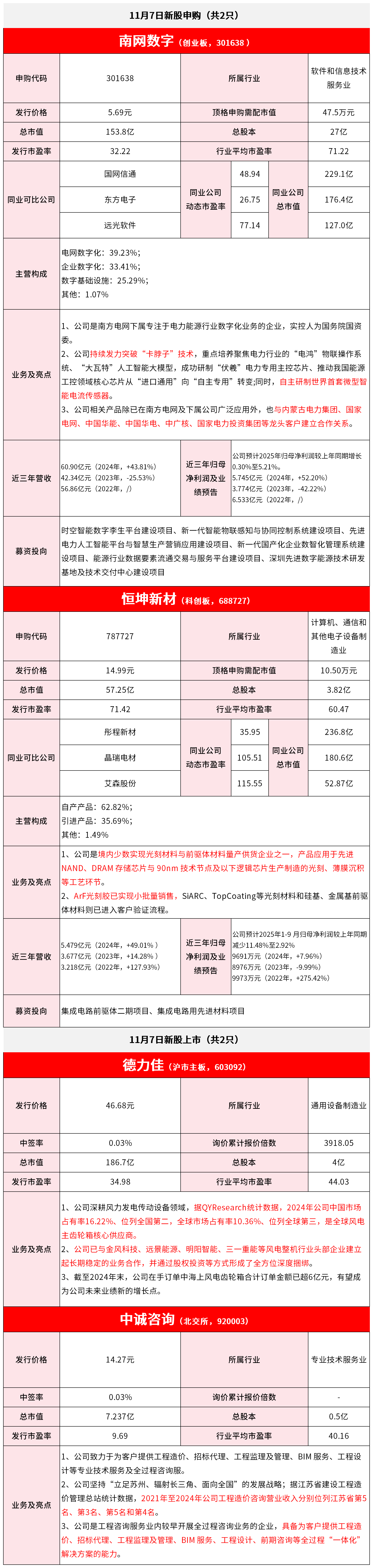
Group 1 - The company is a subsidiary of Southern Power Grid, focusing on digital solutions for the power energy sector, with a total market value of 15.38 billion yuan and an issuance price of 5.69 yuan [2][3] - The company's main revenue sources include digitalization of the power grid (39.23%), enterprise digitalization (33.41%), and digital infrastructure (25.29%) [2] - The company has achieved significant technological advancements, including the development of core chips for industrial control and proprietary sensors, moving from imported general-purpose products to self-developed specialized products [3] Group 2 - The company operates in the semiconductor materials sector, with a total market value of 5.725 billion yuan and an issuance price of 14.99 yuan, focusing on photolithography materials and precursors [4] - Recent financial performance shows a revenue increase of 49.01% projected for 2024, with previous years showing a revenue of 3.677 billion yuan in 2023 and 3.218 billion yuan in 2022 [4] - The company has successfully initiated small-scale sales of ArF photoresist and is in the customer validation phase for SiARC and TopC materials [4] Group 3 - The company specializes in wind power transmission equipment, holding a market share of 16.22% in China and ranking second nationally, with a total market value of 18.67 billion yuan and an issuance price of 46.68 yuan [5] - The company has established long-term partnerships with major players in the wind energy sector, including Goldwind Technology and Envision Energy, enhancing its market position [5] - Future growth is anticipated from offshore wind power gearbox orders, which are expected to contribute significantly to the company's performance [5] Group 4 - The company provides engineering cost management, bidding agency, and consulting services, with a total market value of 0.7237 billion yuan and an issuance price of 14.27 yuan [6] - The company has been recognized for its comprehensive consulting capabilities in the engineering sector, ranking among the top in various categories from 2021 to 2024 [6] - The company aims to expand its services from Suzhou to the Yangtze River Delta and nationwide, enhancing its market reach [6]

全景呈现智能生活美好未来——“互联网之光”点亮乌镇
Xin Hua Wang· 2025-11-07 00:03
Core Insights - The 2025 "Internet Light" Expo, a key segment of the World Internet Conference, commenced on November 6 in Wuzhen, Zhejiang, focusing on the theme "AI Coexistence, Intelligent Future" and highlighting four main areas: AI Frontiers, AI Ecosystem, AI + Industry, and AI + Life [1] Group 1: AI Innovations - A total of 670 global enterprises participated in the expo, showcasing over 1,000 AI innovations, making Wuzhen a focal point for global AI developments [1] - The SpatialTwin platform, launched by Qunkong Technology, is the world's first industrial AI digital twin platform capable of real-time simulation of dynamic industrial environments, supporting large-scale intelligent operations [2] - The platform integrates digital twin technology, AI, and real-time rendering to provide a comprehensive service system covering factory design, simulation validation, smart operation, and robotic training [2] Group 2: AI in Daily Life - The expo featured applications that demonstrate AI's impact on daily life, such as the AI health manager AQ developed by Ant Group, which connects users to over 5,000 hospitals for health consultations and appointments [3] - The Robbyant-R1 service robot, developed by Ant Group, is designed for various applications including dining services and medical inquiries, showcasing the practical use of AI in everyday scenarios [3] - The brain-controlled rehabilitation wheelchair by Hangzhou Manan Intelligent allows stroke patients to control movement through thought, illustrating the integration of AI in health recovery [3]
乌镇峰会风向标:AI应用竞逐“空间智能”新赛道
2 1 Shi Ji Jing Ji Bao Dao· 2025-11-06 13:36
Core Insights - The 2025 World Internet Conference in Wuzhen focuses on building an open, cooperative, and secure digital future, emphasizing the construction of a community in cyberspace [2][3] - The conference highlights the rapid development and application of large models in various industries, showcasing advancements in artificial intelligence and its integration into daily life and industrial processes [3][4] Group 1: AI and Industry Applications - The theme of this year's "Internet Light" Expo is "AI Coexistence, Intelligent Future," featuring over 1,000 cutting-edge AI technology products from more than 600 global companies [4] - Large models have evolved from single-modal capabilities to multi-modal integration, enabling applications that can understand and create across various formats such as text, voice, and visuals [5] - The integration of AI in healthcare is exemplified by AI-driven health consultations that provide immediate professional advice based on user data [4][5] Group 2: Open Source and Collaboration - The trend towards open-source development is gaining traction, allowing for collaborative innovation and lower barriers for small enterprises and research institutions to participate in the AI ecosystem [6][7] - The "Direct to Wuzhen" global internet competition introduced an open-source project track, attracting over 600 developers to participate in various challenges [6] Group 3: Digital Twin Technology - The application of digital twin technology in industrial settings is advancing, with companies like Qunhe Technology showcasing platforms that replicate real-world industrial environments in a digital space [10][11] - The digital twin platform enhances human-robot collaboration and allows for real-time monitoring and predictive analytics, significantly reducing trial-and-error costs in production [11][12] - The emphasis on open ecosystems and continuous innovation is seen as crucial for embedding AI capabilities across various sectors, moving beyond mere technological barriers to fostering collaborative industrial environments [12]
群核科技发布工业AI孪生平台SpatialTwin 与杭叉集团、斯坦德机器人达成战略合作
Zheng Quan Ri Bao· 2025-11-06 09:16
Core Insights - SpatialTwin, a cloud-native digital twin platform, is the first of its kind to support real-time simulation of industrial environments and large-scale operation of intelligent agents [3][4] - The platform aims to reconstruct human-machine collaboration in industrial manufacturing by integrating digital twin, AI, and real-time rendering technologies [3][5] Group 1: Product Launch and Features - SpatialTwin was officially launched at the 2025 World Internet Conference and was selected as one of the top ten debut achievements at the event [4] - The platform utilizes a cloud-native architecture to achieve "zero deployment," allowing for on-demand access to high-density simulation computing power, enhancing operational efficiency and reducing costs [3][5] Group 2: Strategic Partnerships - Strategic cooperation agreements were signed with Hangcha Group and Stand Robot to deepen collaboration in the field of industrial embodied intelligence [5][6] - SpatialTwin has significantly reduced the factory design cycle for Hangcha Group from one week to two hours, showcasing its efficiency in logistics warehouse planning and 3D visualization [5] Group 3: Future Development and Goals - The collaboration with Stand Robot aims to integrate industrial embodied intelligence and spatial intelligence, accelerating the large-scale application of digital twins in smart manufacturing [6] - The company emphasizes the necessity of digital twins in the era of embodied intelligence, highlighting the complexity of calculations required for autonomous operations in smart factories [6]

山东省地矿局鲁南院获批山东省数字经济产业创新中心
Zhong Guo Fa Zhan Wang· 2025-11-06 08:23
Core Insights - Shandong Province's Industrial and Information Technology Department has officially recognized the "Shandong Digital Economy Industry Innovation Center," with the Lunan Institute of the Shandong Provincial Bureau of Geology and Mineral Resources being awarded this status [1] Group 1: Digital Economy Development - The Lunan Institute has seized opportunities in digital economy development, establishing high-end research platforms such as the Geographic Information Digital Twin Innovation Laboratory and the Shandong Data Open Innovation Application Laboratory [1] - The institute has formed a professional R&D team with "Double Soft" certification and qualifications for classified information system integration, achieving breakthroughs in areas like 3D construction, remote sensing dynamic monitoring, and digital platform development [1] Group 2: Achievements and Recognition - The institute's achievements have garnered several provincial honors, including recognition as one of the top ten innovative application scenarios in 3D construction in Shandong, creating a significant demonstration effect [1] Group 3: Future Plans - The Lunan Institute plans to leverage the establishment of the digital economy industry innovation center to enhance R&D in digital technologies and data resource integration, promoting the deep integration of new-generation information technologies such as geographic information, digital twins, and artificial intelligence with the real economy [1]
山东李庄:电力护航绳网产业从“制造”走向“智造”
Xin Hua Wang· 2025-11-06 07:53
Core Insights - The intelligent power grid is significantly enhancing the rope net industry in Li Zhuang Town, Shandong, transitioning it from traditional manufacturing to smart manufacturing [1] - The rapid development of the rope net industry has led to the emergence of over 320 products across 8 series, catering to various sectors such as construction and sports [1] Industry Developments - The power supply capacity in Li Zhuang has improved, with local companies experiencing a surge in growth due to enhanced electricity reliability [1] - The production line of local companies consumes 500 kilowatt-hours per hour, highlighting the critical need for stable voltage to prevent equipment damage and order delays [1] Technological Advancements - State Grid Binzhou Power Supply Company has implemented a digital twin distribution network, utilizing drone inspections and AI load forecasting to help clients identify potential power issues in advance [1] - The company has established a responsive service model, dividing Li Zhuang into 7 power grid areas to ensure a "half-hour response and two-hour resolution" for customer requests [1] Customer Service Improvements - The "Online State Grid" app allows for convenient handling of electricity payments and fault reporting, enhancing customer experience [1]
达实智能跌2.28%,成交额1.40亿元,主力资金净流出2006.18万元
Xin Lang Zheng Quan· 2025-11-06 02:04
Core Viewpoint - The stock of Dasan Intelligent has experienced a significant decline in 2023, with a year-to-date drop of 12.41% and a recent trend of net capital outflow, indicating potential challenges in market performance [1][2]. Company Overview - Dasan Intelligent, established on March 17, 1995, and listed on June 3, 2010, is located in Shenzhen, Guangdong Province. The company specializes in building intelligence and energy-saving services, as well as green building public engineering, industrial automation, and smart medical industries [2]. - The revenue composition of Dasan Intelligent includes 79.25% from smart space overall solutions, 12.60% from smart space products and technical services, and 8.15% from smart space operation services and other businesses [2]. Financial Performance - For the period from January to September 2025, Dasan Intelligent reported a revenue of 1.473 billion yuan, a year-on-year decrease of 31.36%. The net profit attributable to shareholders was -415 million yuan, reflecting a significant decline of 964.15% compared to the previous year [2]. - The company has distributed a total of 540 million yuan in dividends since its A-share listing, with 180 million yuan distributed over the past three years [3]. Shareholder Information - As of September 30, 2025, the number of shareholders of Dasan Intelligent reached 129,500, an increase of 8.33% from the previous period. The average circulating shares per person decreased by 7.69% to 15,490 shares [2]. - The top ten circulating shareholders include Southern CSI 1000 ETF, holding 19.3932 million shares (a decrease of 247,100 shares), and Hong Kong Central Clearing Limited, holding 16.5015 million shares (an increase of 16,500 shares) [3].

以数字化转型推动高校实验室建设与管理创新
Xin Hua Ri Bao· 2025-11-05 21:49
Core Viewpoint - The digital transformation driven by the digital economy is profoundly changing university laboratories, evolving them into smart platforms that enhance resource allocation, governance models, and organizational structures to better support technological innovation and high-level talent cultivation [1] Digital Twin: Resource Reconstruction in Experimental Education - The integration of artificial intelligence in educational practices is essential for universities to adapt to the digital era, deepen teaching reforms, and cultivate innovative talents [2] - Traditional experimental education faces limitations due to physical space, equipment costs, and safety risks, making it difficult to meet the demands for scalable, personalized, and cutting-edge teaching [2] - The use of digital twin technology to create virtual simulation teaching platforms allows for precise mapping and real-time interaction between physical laboratories and virtual spaces, addressing high-risk, high-cost, and high-pollution issues in traditional experimental teaching [2] Bridging Theory and Practice - Virtual simulation teaching platforms effectively bridge the gap between theoretical knowledge and practical skills, ensuring students enhance their practical skills and cultivate innovative thinking in a safe environment [3] - By integrating cross-departmental and cross-disciplinary resources, virtual laboratories and high-quality experimental courses are developed, leading to a centralized and shared experimental teaching resource library [3] Smart Supervision: Strategy Transformation in Safety Governance - Establishing a new safety governance system that combines digitalization and safety is crucial for enhancing risk prevention capabilities and ensuring safety in university laboratories [4] - The integration of safety management standards and procedures into digital platforms allows for comprehensive traceable management of risk sources throughout their lifecycle [4] Intelligent Security System - A three-pronged intelligent security system that includes human, physical, and technical defenses is being developed to monitor laboratory safety in real-time and provide intelligent analysis and intervention [5] - Virtual simulation technology is utilized for safety training, enhancing emergency response capabilities among faculty and students [5] Open Sharing: New Ecological Model for Research Organizations - The creation of a digital and shared research organization ecosystem is necessary for universities to enhance service capabilities and strengthen research support [7] - Digital tools clarify responsibilities and benefits in the open sharing of large instruments, integrating management processes into a coordinated service chain [7] Platform Integration of Equipment Resources - The integration of dispersed equipment resources into a public service system enhances service professionalism and authority, promoting the free flow and recombination of innovative elements [8] - This open and shared research ecosystem addresses the challenges of resource isolation and fragmentation, improving resource utilization efficiency and supporting major original innovations [8] Future Directions - Continued digital empowerment is essential for laboratories to transition from traditional management to digital governance, from resource dispersion to shared collaboration, and from experience-driven to data-driven decision-making [8]
会议手册发布!CIMS大会盛会将启!日程/嘉宾/参会/食宿信息全攻略
机器人圈· 2025-11-05 12:45
Core Viewpoint - The 7th Modern Manufacturing Integration Technology Academic Conference will be held from November 7 to November 9, 2025, in Zhengzhou, focusing on the intelligent transformation of manufacturing driven by the new generation of artificial intelligence [4][8]. Conference Overview - The conference is a high-level academic event in the field of advanced manufacturing technology, supported by the Ministry of Science and Technology and organized by the editorial department of "Computer Integrated Manufacturing Systems" [7]. - The conference has been held annually since its inception in 2010, with previous editions focusing on topics such as intelligent manufacturing, cloud manufacturing, and industrial internet [7]. Conference Theme - The theme of this year's conference is "Intelligent Transformation of Manufacturing Driven by New Generation Artificial Intelligence," aiming to promote deep integration of technological and industrial innovation [8]. Objectives - The conference aims to enhance independent innovation capabilities in the manufacturing sector, improve the stability and competitiveness of industrial and supply chains, and support high-quality development through technological innovation [8]. Schedule Overview - The conference will feature various forums and discussions on topics such as AI-driven product design, manufacturing process optimization, and intelligent operation management [15][26][31]. - Specific sessions will include keynote speeches, thematic forums, and opportunities for networking and collaboration among industry experts [15][18]. Notable Participants - The conference will gather leading experts and scholars from various institutions, including prominent figures such as academicians and industry leaders, to share their insights and research findings [38][39][40]. Venue and Logistics - The event will take place at the Zhongzhou Huayue Hotel in Zhengzhou, with detailed arrangements for meals and accommodations provided for attendees [10][15]. Contact Information - For any inquiries, participants can reach out to the conference organizing committee through the provided contact details [11].

神州数码涨2.21%,成交额7.29亿元,主力资金净流出2947.22万元
Xin Lang Zheng Quan· 2025-11-05 03:20
Core Viewpoint - The stock of Digital China has shown a mixed performance in recent trading sessions, with a year-to-date increase of 23.62% but a slight decline over the past 20 days, indicating volatility in investor sentiment [1][2]. Financial Performance - For the period from January to September 2025, Digital China reported a revenue of 102.365 billion yuan, reflecting a year-on-year growth of 11.79%. However, the net profit attributable to shareholders decreased by 25.01% to 670 million yuan [2]. - The company has distributed a total of 1.388 billion yuan in dividends since its A-share listing, with 771 million yuan distributed over the past three years [3]. Stock Market Activity - As of November 5, Digital China's stock price was 43.00 yuan per share, with a trading volume of 729 million yuan and a market capitalization of 31.108 billion yuan [1]. - The stock has appeared on the "Dragon and Tiger List" three times this year, with the most recent instance on February 14, where it recorded a net purchase of 380 million yuan [1]. Shareholder Information - As of October 31, Digital China had 148,500 shareholders, a decrease of 4.87% from the previous period, while the average number of circulating shares per shareholder increased by 5.22% to 4,072 shares [2]. - Among the top ten circulating shareholders, the Southern CSI 500 ETF held 8.2754 million shares, a decrease of 162,100 shares, while the Hong Kong Central Clearing Limited increased its holdings by 148,200 shares to 5.4654 million shares [3]. Business Segments - Digital China's main business segments include consumer electronics (71.30% of revenue), enterprise value-added services (24.24%), proprietary brand products (4.33%), and cloud services and software (2.30%) [1].
