AGI

Search documents
CTO任职半年遭OpenAI撬墙角,英特尔震动,CEO陈立武被迫亲自接管AI
3 6 Ke· 2025-11-11 11:53
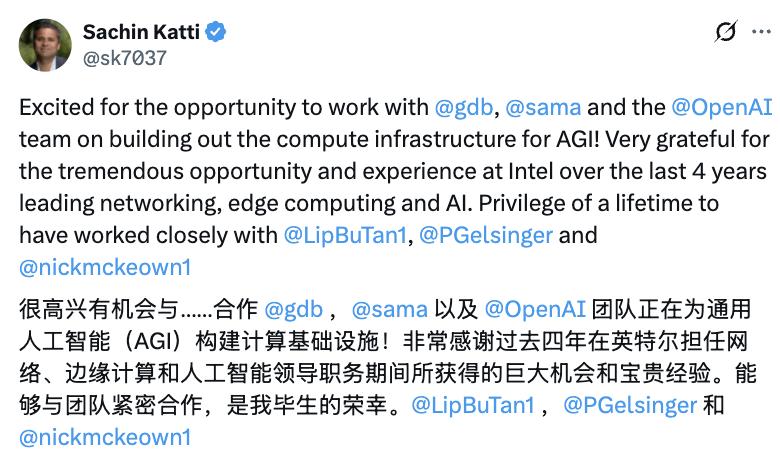
Core Insights - Intel faces a significant challenge as its CTO Sachin Katti unexpectedly resigns to join OpenAI, raising concerns about the leadership of its AI initiatives [1][7] - Katti's departure comes just six months after he was appointed, highlighting ongoing difficulties in Intel's AI strategy [7][10] - OpenAI's aggressive talent acquisition strategy is underscored by Katti's move, as the company aims to enhance its AGI research and infrastructure [8][9] Company Overview - Sachin Katti has a strong academic and industry background, holding a PhD from MIT and previously serving as a professor at Stanford [3][4] - Katti's experience includes founding multiple tech companies and significant contributions to the telecommunications sector [4][6] - He was appointed as Intel's CTO and AI officer in April 2025, tasked with leading the company's AI strategy and product roadmap [6] Industry Context - OpenAI has been actively securing partnerships with major chip manufacturers like NVIDIA and AMD, indicating its ambition to build robust AI infrastructure [8][9] - The company plans to invest approximately $1.4 trillion in data center development over the next eight years, aiming for substantial revenue growth [9] - Intel's recent leadership changes and layoffs, including a significant workforce reduction, reflect its struggle to compete in the AI space against rivals like NVIDIA and AMD [10][11]


AI投资泡沫化了吗?
Changjiang Securities· 2025-11-11 11:04
Investment Rating - The report does not explicitly state an investment rating for the industry, but it discusses the potential for growth and the current concerns regarding AI investment bubbles [4][9]. Core Insights - Recent quarterly reports from major cloud providers indicate an increase in capital expenditures (CapEx), raising concerns about the economic viability of current AI investments. The macroeconomic uncertainties in the U.S., such as government shutdowns, have intensified discussions about the potential bubble in AI investments [4][7]. - OpenAI's large-scale computing infrastructure is seen as a necessary long-term investment, with projected annual recurring revenue (ARR) expected to exceed $20 billion by 2025 and potentially reach hundreds of billions by 2030. The $1.4 trillion CapEx plan is viewed as an essential foundation for future growth [9]. - The report emphasizes that the current capital-intensive phase of AI investment reflects the industry's pre-investment characteristics rather than a systemic bubble, suggesting that short-term fluctuations should not be overly concerning [9]. Summary by Sections Event Description - Major cloud providers have reported increased CapEx, and OpenAI's extensive computing layout has raised concerns about the economic sustainability of current AI investments amid U.S. macroeconomic uncertainties [7]. Event Commentary - OpenAI's revenue plans indicate a strong future CapEx capacity, with expected ARR growth and healthy operating cash flows from the Big 5 tech companies. Historical analysis of Amazon's cloud computing investments shows that high CapEx can lead to significant long-term benefits [9]. - The transition in the AI industry is expected to shift from model development to application and system integration starting in 2025, with a focus on product capabilities and market penetration [11]. - Major players in the AI space are engaged in a competitive race to establish themselves as the operating systems and traffic gateways of the AI era, with significant investments in computing power and strategic partnerships [11].
重新估值Kimi
36氪· 2025-11-11 10:23
Core Viewpoint - The article discusses the competitive landscape of AI, highlighting that China is rapidly advancing in AI technology, potentially surpassing the US, as evidenced by the recent success of the Chinese startup "月之暗面" with its Kimi K2 Thinking model, which outperformed leading models like GPT-5 and Claude 4.5 in key benchmarks [4][5][7]. Group 1: Kimi K2 Thinking Model - Kimi K2 Thinking has achieved significant milestones, surpassing major AI models in benchmark tests, indicating a shift in the AI competitive landscape [5][7]. - The model's download exceeded 50,000 within two days of its release, making it the most popular open-source model on Hugging Face [12]. - Kimi K2 Thinking is designed to align with and potentially exceed the capabilities of closed-source models like OpenAI's offerings [18]. Group 2: Technical Innovations - Kimi K2 Thinking employs a novel "超稀疏MoE" architecture, activating only 3.2% of its 320 billion parameters during inference, achieving high efficiency [24]. - The model's training cost is reported to be only $4.6 million, significantly lower than traditional models, which enhances its accessibility for medium-sized enterprises [23][34]. - K2 Thinking utilizes native INT4 quantization, allowing for a twofold increase in inference speed while maintaining nearly the same precision, addressing a common challenge in AI model deployment [40][42]. Group 3: Tool Utilization and Performance - Kimi K2 Thinking can perform 200-300 tool calls without human intervention, a significant improvement over existing models, which typically manage only 5-20 calls [44]. - The model scored 78.3 in the TAU-Bench test, outperforming GPT-5 and Claude 4.5, showcasing its advanced capabilities in task execution [45]. - The architecture allows for dynamic task management and error correction, enhancing the model's robustness and reliability in complex tasks [46][47].
X @Sam Altman
Sam Altman· 2025-11-10 21:59
RT Greg Brockman (@gdb)Welcome @sk7037 to OpenAI!Incredibly excited to work with him on designing and building our compute infrastructure, which will power our AGI research and scale its applications to benefit everyone. https://t.co/GkZ5yHctBO ...
昆仑万维(300418) - 昆仑万维2025年11月3日投资者关系活动记录表
2025-11-10 09:06
Financial Performance - The company achieved a revenue of 5.8 billion CNY, representing a year-on-year growth of 51.6% [2] - Overseas business revenue reached 5.41 billion CNY, with a year-on-year increase of 58% [2] - The net profit attributable to shareholders for Q3 2025 was 190 million CNY, marking a turnaround from losses [2] AI Strategy and Development - The company is focusing on AGI and AIGC, enhancing its technological research and application efforts [3] - Multiple industry-leading models have been released, including Skywork-Reward-V2 and Skywork-R1V 3.0, with several papers accepted at NeurIPS 2025 [3] - The Skywork Deep Research Agent V2 has been upgraded to improve report generation quality and user experience [3] Product Innovations - The SkyReels-A3 model supports audio-driven digital human creation for various commercial scenarios [4] - Mureka V7 and V7.5 enable full-process automatic music generation, significantly improving Chinese music performance [4] - The AI social platform Linky is enhancing user interaction and experience through core model optimizations [5] Market Position and Future Outlook - The short drama platform DramaWave ranks third in overseas revenue, with ongoing content expansion into anime and web literature [5] - The company plans to deepen the industrialization of AI technologies and strengthen its global market presence [5] - The Opera Neon browser aims to provide a comprehensive automated decision-making experience, positioning itself as a task entry point in the AI era [8] Challenges and Competitive Landscape - The company acknowledges competition in the browser market but emphasizes its unique capabilities in task automation and multi-modal generation [8] - The profitability of the short drama industry is still developing, with a focus on improving ROI through content innovation and AI empowerment [9] - The dynamic comic sector is expected to capture a significant market share, with the company optimistic about its growth potential [11]

AGI 新技术路线:下一代稀疏注意力机制 Monte Carlo Attention 开源
AI科技大本营· 2025-11-10 01:03
Core Viewpoint - The article discusses the innovative Monte Carlo Attention mechanism used in the BigBang-Proton framework, which allows for efficient modeling of extremely long contexts by leveraging a unique inter-patch delegation mechanism, achieving linear complexity while overcoming the limitations of traditional attention methods [1][4][32]. Context Length in Material World Modeling - Monte Carlo Attention was developed to meet the theoretical demands of the BigBang-Proton framework, addressing the need for extremely long context lengths due to the integration of diverse scientific data [2][3]. - The estimated total sequence length required for comprehensive virtual cell integration is approximately 10¹⁵ tokens, necessitating a context length far exceeding current large language models [2][3]. Monte Carlo Attention Mechanism - Monte Carlo Attention reduces computational complexity from O(L²) to O(L), significantly improving training efficiency and convergence rates [4]. - This mechanism allows for the training of sequences that are multiple orders of magnitude longer than the device memory capacity, promoting the development of next-generation hardware architectures [4][32]. BigBang-Proton Architecture Components - The BigBang-Proton architecture consists of three core components: Binary Patch Encoding, Monte Carlo Attention, and a Temporal Convolutional Network (TCN) [7][8]. - The inter-patch delegation mechanism enables local and global information exchange, allowing context length to grow exponentially with the number of layers while maintaining linear computational complexity [8][9]. Delegate Operation Process - The delegate operation is a hierarchical process involving the decomposition of input sequences into blocks, generating delegate tokens, distributing them, and enhancing local representations with global context [17][20][22]. - The complexity of attention calculations within each block is O(P²), while global information flow complexity is determined by the number of blocks [28][30]. Comparison with Existing Attention Mechanisms - Monte Carlo Attention differs fundamentally from sparse attention methods by utilizing a reorganization-based mechanism for indirect information propagation, avoiding selection bias and information loss [40][42]. - The method allows for exponential context length expansion, surpassing the limitations of structured state space models and traditional linear attention models [43][44]. Temporal Convolutional Network (TCN) - TCN replaces traditional feedforward networks, enhancing the model's ability to capture local and global patterns through stacked convolutional layers [35][37]. - The architecture allows for direct learning of spatial and positional information from input sequences, eliminating the need for explicit positional embeddings [37]. Future Directions - The article indicates that further insights into the core technologies, cutting-edge applications, and future plans of the BigBang-Proton framework will be shared in subsequent publications [46].

汽车:零部件、整车AGI投资机会
Tianfeng Securities· 2025-11-10 00:11
Investment Rating - The industry investment rating is maintained at "Outperform" [2] Core Insights - The report highlights the significant growth in the penetration rate of L2 and above assisted driving in China, which increased from 3.3% in 2019 to 63.6% by July 2025 [10] - The report emphasizes the importance of AI and robotics in the automotive sector, particularly focusing on Tesla's advancements in autonomous driving and robotaxi services [3][9] - The report identifies key investment opportunities in the automotive sector, particularly in companies with strong positions in intelligent driving and robotics [5] Summary by Sections Section: Autonomous Driving - The report notes that L2-level NOA penetration has reached a high level, while L3-level autonomous driving is still in the early stages, presenting a favorable investment window [4] - The penetration rate of L3/L4 autonomous driving is expected to see significant growth, with new models from companies like Huawei, Li Auto, and XPeng leading the charge [15] Section: Company Recommendations - Recommended companies in the parts sector include "Nexteer" and "Bertel" for their advantages in specific segments [5] - In the complete vehicle sector, "XPeng Motors," "Li Auto," and "Seres" are recommended for their rapid progress in smart technology [5] Section: Financial Projections - XPeng Motors is projected to achieve revenues of 935.9 billion, 1402.2 billion, and 1695.8 billion yuan for the years 2025, 2026, and 2027, respectively, with year-on-year growth rates of 129%, 50%, and 21% [32][33] - Seres is expected to generate revenues of 1796.6 billion, 2179.6 billion, and 2459.9 billion yuan for the years 2025, 2026, and 2027, with corresponding year-on-year growth rates of 23.75%, 21.32%, and 12.86% [60][61]




乌镇里的中国科技新叙事
Bei Jing Shang Bao· 2025-11-09 16:04
Group 1 - The "Six Little Dragons" represent a new wave of innovation in China's tech landscape, showcasing advancements in robotics, brain-computer interfaces, spatial intelligence, gaming technology, and open-source AI [1][2] - The rise of these startups is set against the backdrop of the global AI competition, with significant breakthroughs in China's AI sector attracting widespread attention [2][3] - The interaction between technology and capital is crucial, as evidenced by multiple financing events and IPOs from companies like Qunhe Technology and Yushu Technology, indicating a deep recognition of value in these new players [3] Group 2 - The narrative emerging from Wuzhen reflects a profound inquiry into the future of the internet and serves as a deep commentary on the future of China [4] - The ecosystem of innovation is characterized by the necessity of foundational research, application technology, and financial support, all of which are essential for the success of new tech ventures [3] - The global resonance of the open-source internet ecosystem and the supportive environment for innovation in China signify a new paradigm for Chinese tech companies in the global competitive landscape [3]
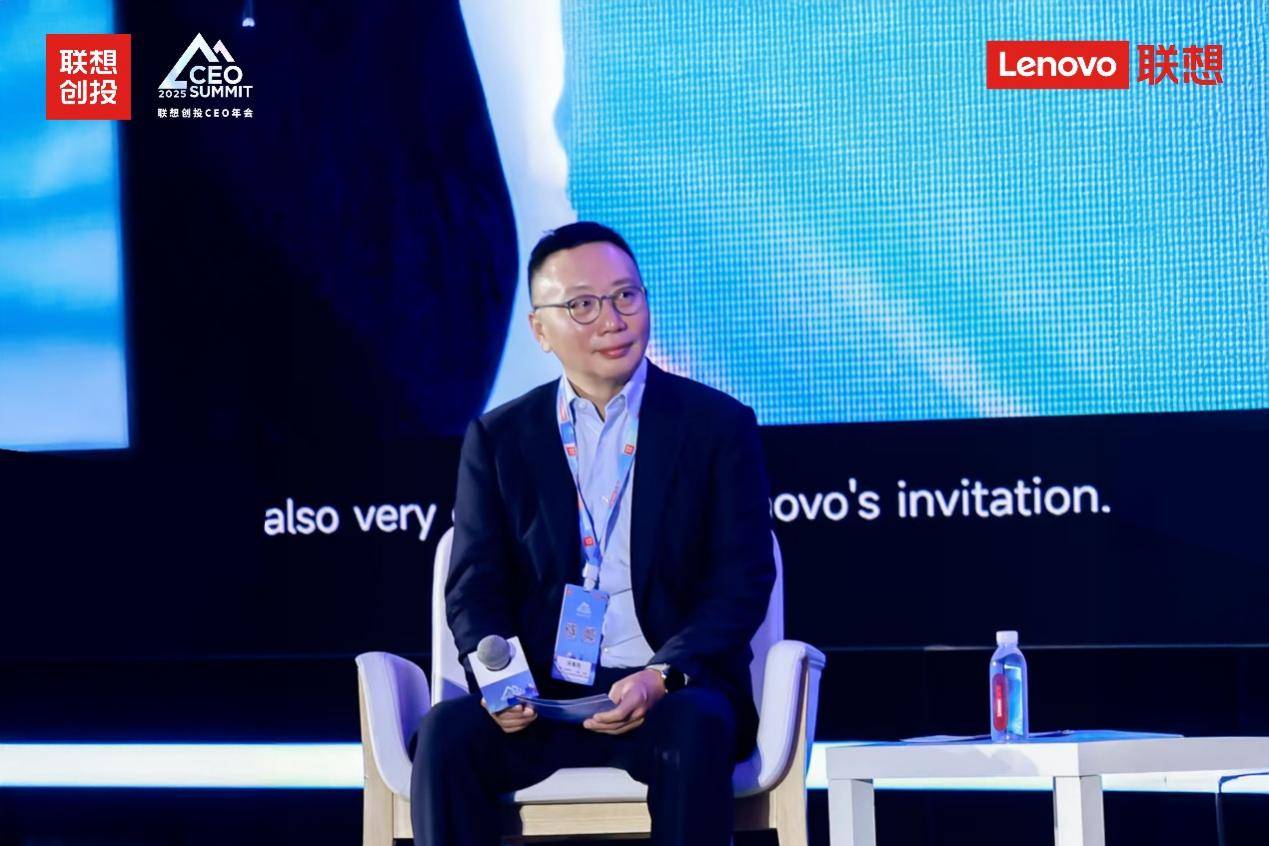
联想创投宋春雨:软硬一体、“双重智能”是AGI的核心路径
Sou Hu Wang· 2025-11-09 05:44
Core Insights - The core viewpoint presented by Song Chunyu emphasizes that silicon-based intelligence is becoming a key driving force for global change, with the integration of AI hardware and software shifting from mere performance enhancement to systemic and ecological reconstruction [1][2] - The concept of "dual intelligence," which combines digital world intelligent agents with physical world embodied intelligence, is seen as a necessary path towards achieving Artificial General Intelligence (AGI) [1][2] Industry Developments - The AI industry has experienced explosive changes over the past year, with advancements in computing power evolving from single GPU optimizations to new infrastructure like "AI factories," and Nvidia's Blackwell entering full-scale production [2] - The "Gateway to the Stars" project has reached a scale of over 400,000 GPUs, while OpenAI has launched GPT-5 and initiated a billion-dollar IPO, with Chinese companies like DeepSeek, Qianwen, and Doubao rapidly catching up [2] - Embodied intelligence has emerged as a new trend, with global financing for related startups reaching $10.3 billion in 2025, and domestic primary market financing in China exceeding 20 billion yuan in the first half of the year, far surpassing the total for the previous year [2] Company Strategy - Lenovo Capital has invested in over 100 companies in the AI sector over the past decade, covering the entire AI stack from intelligent agents to embodied intelligence, witnessing China's transition from technology follower to system innovator [2] - Song Chunyu asserts that "integrated hardware and software, along with dual intelligence," is the core path to AGI, which will create new platform-level opportunities and drive the emergence of new silicon-based intelligent entities [2] - The company emphasizes that AI also entails social responsibility, advocating for enhanced cross-sector collaboration, ethical governance, and the promotion of "human-centered intelligence" to ensure that AI serves as a partner for human progress rather than a replacement [2]
马斯克霸气回应特朗普:搞政治我不行,搞商业和科技你不行
Xin Lang Cai Jing· 2025-11-08 10:24
(来源:ETF阅天下) 在《庆余年》的经典对决中,范闲曾以一句"作诗我不行,做人你不行"回应庄墨韩的挑衅,既掷地有声地回击了质疑,也道破了各自领域与境界的差异。 而这一幕,如今在现实世界的商业与政治舞台上,似乎正以一种宏大的方式重现。 马斯克似乎和特朗普暗暗较劲:搞政治我不行,搞商业和科技你不行。 北京时间周五清晨,特斯拉股东以超过75%的票数通过了一项最高价值可达1万亿美元的薪酬计划,终结了围绕马斯克薪酬长达数年的纠葛。投票结果公 布后,现场爆发热烈欢呼,特斯拉股东们齐声高呼马斯克的名字。 这份薪酬协议为特斯拉CEO铺设了一条从世界首富到首个"万亿美元富豪"的道路。同时他对特斯拉的持股也将在未来10年里逐步提升至25%或更高。 1万亿美元不是重点,8.5万亿美元才是真野心 特斯拉此前披露了一份野心爆棚的阶梯式薪酬方案,将最多授予马斯克额外4.237亿股特斯拉股权。马斯克若要拿满所有奖励,需要达到的最终目标是特 斯拉公司市值超过8.5万亿美元,调整后EBITDA达到4000亿美元。 同时还有四大关键产品目标:特斯拉汽车累计交付量达到2000万辆、活跃FSD订阅用户数量连续3个月超过1000万人、累计交付100 ...