
智能家居

Search documents
麦格米特(002851) - 2025年8月30日投资者关系活动记录表
2025-08-31 05:46
Financial Performance - In the first half of 2025, the company achieved operating revenue of 1.1 billion yuan, a year-on-year increase of 16.52% [3] - Operating profit was 214.89 million yuan, a decrease of 34.83% compared to the same period last year [3] - Net profit attributable to shareholders was 173.59 million yuan, down 44.82% year-on-year [3] Reasons for Revenue Growth without Profit Increase - The decline in profit was significantly impacted by gross margin, primarily due to an increase in low-margin products such as those in the new energy vehicle and consumer sectors [4] - The company adjusted its pricing strategy to maintain market competitiveness amid intensified competition [4] - The air conditioning business faced challenges due to adverse weather conditions and a high base from the previous year, leading to a slowdown in overseas market revenue growth [4] - Excluding variable frequency household appliances, other business revenue grew approximately 26% year-on-year [4] R&D and Future Investments - The company maintains a high R&D expense ratio of around 11%, significantly above the industry average, which pressures current profit margins [5] - The company has a dedicated R&D team of approximately 3,000 people, accounting for over 35% of its workforce [5] - Future investments will focus on artificial intelligence data centers, new energy transportation, energy storage components, and smart home sectors [5] Market Expansion and Client Acquisition - The company has established partnerships with major international clients such as Ericsson and Cisco, gradually entering the server power supply market [6] - The company aims to become a leading provider of power drive control solutions in HVAC and industrial temperature control sectors [4] - The company has over 80 ongoing projects with mainstream automotive manufacturers, indicating strong future growth potential in the new energy vehicle sector [16] Competitive Advantages and Market Position - The company has built a comprehensive client base across the entire supply chain, covering technology solution leaders, system integrators, and end-user internet cloud manufacturers [13] - The company’s competitive edge lies in its early entry into the AI server power supply market, allowing it to accumulate valuable industry insights and customer relationships [13] - The company is focused on enhancing its product offerings and service responsiveness to maintain a competitive advantage in the rapidly evolving AI market [13] Challenges and Strategic Responses - The company faces increased competition in the smart home market, prompting adjustments in pricing strategies to secure market share [14] - The company is addressing production capacity constraints through flexible production line designs, allowing for adaptability to market demand changes [16]

美的集团:聘任王建国为公司执行总裁,拟每10股派5元
Zheng Quan Shi Bao· 2025-08-31 00:27
Group 1: Company Leadership Changes - Midea Group announced the appointment of Wang Jianguo as the new Executive President, effective after shareholder approval of the amendment to the company's articles of association [1] - Wang Jianguo has a long tenure with Midea, having joined in 1999 and held various leadership roles, including President of the Smart Home Business Group [1] Group 2: Financial Performance - For the first half of 2025, Midea Group reported revenue of 251.12 billion yuan, a year-on-year increase of 15.58% [1] - The net profit for the same period was 26.01 billion yuan, reflecting a growth of 25.04%, while the net profit excluding non-recurring items reached 26.24 billion yuan, up by 30.00% [1] Group 3: Business Segments Overview - Midea Group operates in various sectors, including smart home, renewable energy, industrial technology, and healthcare, with a balanced business matrix serving both consumers and enterprises [2] - The smart home segment generated revenue of 167.20 billion yuan in the first half of 2025, accounting for 66.58% of total revenue, with significant sales in air conditioning and washing machine products [2] Group 4: New Energy and Industrial Technology - The new energy and industrial technology segment achieved revenue of 21.96 billion yuan, marking a year-on-year growth of 28.61% [3] - Midea plans to establish a manufacturing base in Thailand and continue investments in India and Brazil, with over 1 million electric vehicle compressors shipped to date [3] Group 5: Profit Distribution - Midea Group announced a mid-year profit distribution plan, proposing a cash dividend of 5 yuan per 10 shares, totaling 3.80 billion yuan, based on a total share capital of 7.60 billion shares after accounting for repurchased shares [3]

美的集团:聘任王建国为公司执行总裁,拟每10股派5元
证券时报· 2025-08-31 00:23
Core Viewpoint - Midea Group announced the appointment of Wang Jianguo as the new Executive President, effective after shareholder approval, alongside the release of its 2025 semi-annual report showing significant revenue and profit growth [1][2]. Group 1: Company Leadership Changes - Midea Group's board approved the appointment of Wang Jianguo as Executive President, who previously held various senior roles within the company [1]. - Wang Jianguo has been with Midea since 1999 and has extensive experience in different divisions, including supply chain management and international operations [1]. Group 2: Financial Performance - For the first half of 2025, Midea Group reported revenue of 251.12 billion yuan, a year-on-year increase of 15.58% [1]. - The net profit for the same period was 26.01 billion yuan, reflecting a growth of 25.04%, while the non-recurring net profit increased by 30.00% to 26.24 billion yuan [1]. Group 3: Business Segments - Midea Group operates in various sectors, including smart home, renewable energy, industrial technology, and healthcare, with a balanced focus on both consumer and business markets [2]. - The smart home segment generated revenue of 167.20 billion yuan, accounting for 66.58% of total revenue, with significant sales in air conditioning and washing machine products [2]. Group 4: New Energy and Industrial Technology - The new energy and industrial technology segment achieved revenue of 21.96 billion yuan, marking a year-on-year growth of 28.61% [3]. - Midea plans to establish a manufacturing base in Thailand and continue investments in India and Brazil, enhancing its global manufacturing capabilities [3]. - The company has also made strides in the electric vehicle components market, with over 1 million units shipped and partnerships with major North American automotive companies [3]. Group 5: Profit Distribution - Midea Group announced a mid-term profit distribution plan, proposing a cash dividend of 5 yuan per 10 shares, totaling 3.80 billion yuan in cash dividends [3].


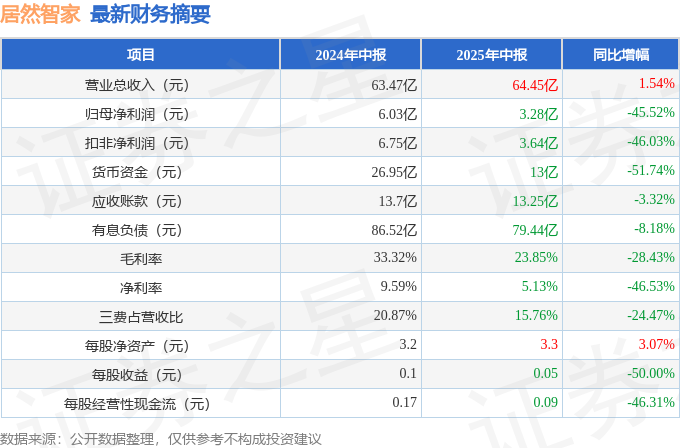
居然智家2025年中报简析:增收不增利,公司应收账款体量较大
Zheng Quan Zhi Xing· 2025-08-30 23:27
Core Insights - The company reported a total revenue of 6.445 billion yuan for the first half of 2025, a year-on-year increase of 1.54%, while the net profit attributable to shareholders decreased by 45.52% to 328 million yuan [1] - The second quarter revenue was 3.133 billion yuan, down 2.4% year-on-year, and the net profit for the same period fell by 53.95% to 117 million yuan [1] - The company's accounts receivable were significant, with accounts receivable accounting for 172.17% of the latest annual net profit [1] Financial Performance - Total revenue for 2024 was 6.347 billion yuan, compared to 6.445 billion yuan in 2025, reflecting a 1.54% increase [1] - Net profit for 2024 was 603 million yuan, while it dropped to 328 million yuan in 2025, showing a decline of 45.52% [1] - Gross margin decreased to 23.85% in 2025 from 33.32% in 2024, a decline of 28.43% [1] - Net margin also fell to 5.13% in 2025 from 9.59% in 2024, a decrease of 46.53% [1] - Total expenses (sales, management, and financial) amounted to 1.016 billion yuan, accounting for 15.76% of revenue, down 24.47% year-on-year [1] Business Model and Strategy - The company relies heavily on marketing-driven performance, indicating a need for careful analysis of the underlying drivers [3] - The company has been focusing on digital transformation and has made significant progress in upgrading its smart home experience centers and launching integrated experience centers [4] - The company is also expanding its overseas presence, establishing companies in North America and Singapore, and participating in global exhibitions to explore international markets [5] Future Plans - The company aims to leverage national policies to drive growth, focusing on smart home upgrades and digital management systems [4] - It is developing a smart home control system and enhancing its capabilities in various new consumer scenarios, including smart living and green low-carbon lifestyles [5]

中阿博览会助力参展商拓销增收,外国友人“点赞”,参展游客开启“买买买”模式
Huan Qiu Wang· 2025-08-30 04:07
Group 1 - The 7th China-Arab States Expo was held from August 28 to 31 in Yinchuan, Ningxia, attracting over 7,600 guests from 75 countries and regions, along with more than 2,200 business associations and enterprise representatives [1] - Various products showcased at the expo included handicrafts, cashmere scarves, jewelry, clothing, and carpets, which facilitated wider sales channels for participating companies [4] - The expo served as a significant platform for foreign exhibitors, such as those from Yemen and Egypt, to seek cooperation with Chinese enterprises and expand their market reach [4][10] Group 2 - Visitors expressed enthusiasm for the diverse range of products and foods available at the expo, including specialty items from Indonesia, Nepal, and local products from Ningxia [8] - The event highlighted advancements in fields such as smart agriculture, drones, and smart home products, impressing international attendees [10] - Overall, both foreign exhibitors and Chinese visitors praised the expo for providing an opportunity to experience a variety of unique products and innovations in one location [10]

美的集团高管层调整:聘任王建国为公司执行总裁
Zheng Quan Shi Bao· 2025-08-29 23:55
Group 1 - Midea Group announced the appointment of Wang Jianguo as the executive president, effective after shareholder approval of the amendment to the company's articles of association [2] - Midea Group's total revenue for the first half of the year reached 251.12 billion yuan, a year-on-year increase of 15.58%, while net profit was 26.01 billion yuan, up 25.04% [2] - The smart home business, as a core segment, generated revenue of 167.20 billion yuan, accounting for 66.58% of total revenue, with over 900,000 units sold of the T3 high-performance inverter air conditioner series [2] Group 2 - The new energy and industrial technology business reported revenue of 21.96 billion yuan, a year-on-year growth of 28.61%, focusing on green energy solutions and core components [3] - Midea Group plans to start construction of a manufacturing base in Thailand in the second half of 2025, while continuing investments in India and completing the manufacturing base in Brazil [3] - In the core component field for electric vehicles, domestic market sales of electric vehicle compressors exceeded 5%, with over 1 million units shipped [3]
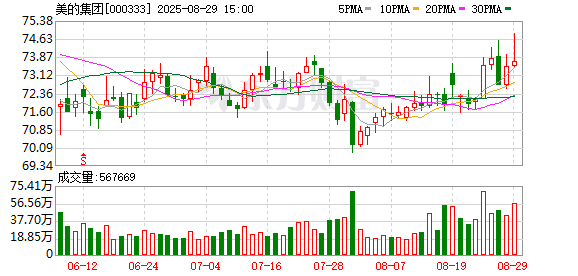
美的上半年归母净利增25%,王建国升任执行总裁
Sou Hu Cai Jing· 2025-08-29 15:17
Core Insights - Midea Group reported a significant increase in both revenue and net profit for the first half of 2025, with revenue reaching 251.12 billion yuan, a year-on-year growth of 15.58%, and net profit attributable to shareholders at 26.01 billion yuan, up 25.04% [2] Financial Performance - The smart home business generated revenue of 167.20 billion yuan, reflecting a year-on-year increase of 13.31% - The commercial and industrial solutions segment achieved revenue of 64.54 billion yuan, marking a growth of 20.79% [2] - The overall gross margin for the smart home business was 28.52%, down 0.84 percentage points year-on-year, while the commercial and industrial solutions segment's gross margin was 21.25%, down 0.81 percentage points [2] Market Dynamics - The domestic air conditioning market saw retail sales of 126.3 billion yuan, a year-on-year increase of 12.4%, driven by policy incentives, price competition, and high temperatures [2] - The competitive pricing environment has led to a decline in average industry prices, with the share of sales in the online market for air conditioners priced below 22,000 yuan rising to 35.2% [2] Regional Performance - Domestic revenue for Midea reached 143.93 billion yuan, a year-on-year growth of 14.05%, while overseas revenue was 107.19 billion yuan, up 17.7% [2] Management Changes - Midea appointed Wang Jianguo as the new Executive President, transitioning from his previous role as Vice President [3] - Zhao Lei has taken over as the President of Midea's Smart Home Business Group, succeeding Wang Jianguo [4]
锚定绿色家居需求,佰亿缘门窗以精密断桥设计引领节能门窗新标准
Qi Lu Wan Bao Wang· 2025-08-29 14:21
Core Viewpoint - Shandong Baiyiyuan Door and Window Co., Ltd. focuses on the production, research, and sales of customized aluminum alloy doors and windows, emphasizing innovation and sustainability in its operations [1][2]. Group 1: Company Overview - Established in 2017, the company has an annual production capacity of 250,000 square meters of customized system doors and windows [1]. - The company operates over 200 specialty stores, more than 300 distributors, and 500 service providers nationwide [1]. - Baiyiyuan has invested 55 million yuan in upgrading production equipment and digital information systems, enhancing product quality and reducing defect rates [1]. Group 2: Innovation and Technology - The company holds a total of 25 patents, including invention and utility model patents, showcasing its commitment to intellectual property [2]. - It employs a self-developed precision bridge design system, optimizing thermal insulation performance and meeting modern energy-saving and environmental standards [2]. - Baiyiyuan is developing smart window systems that integrate various sensors and control modules for enhanced user convenience and comfort [2][3]. Group 3: Sustainability and Customization - The company emphasizes the use of green materials and sustainable production processes, aiming for energy efficiency and waste reduction [2]. - It offers highly customizable services, allowing consumers to tailor aspects such as style, color, material, and functionality to their preferences [3]. - Baiyiyuan explores advanced materials like graphene and nanomaterials to create innovative, lightweight, and durable window products with special features [3].
聚焦港股IPO:华曦达2025上半年实现营收15.37亿,同比增长51.23%
Sou Hu Cai Jing· 2025-08-29 12:31
Core Viewpoint - The company, Huaxida, has demonstrated strong growth in its AIHome solutions, achieving significant revenue and profit increases in its 2025 semi-annual report, driven by its deep engagement in the smart home ecosystem [1][2] Financial Performance - Huaxida reported a revenue of 1.537 billion yuan, representing a year-on-year growth of 51.23% [1] - The net profit attributable to shareholders reached 103 million yuan, showing a substantial year-on-year increase of 100.53% [1] - Sales revenue from AIHome devices amounted to 1.234 billion yuan, with a year-on-year growth of 73.01%, serving as the core driver of overall revenue [1] Market Presence - The company has expanded its business to over 80 countries and regions across Europe, America, and Asia, serving more than 300 enterprise clients [1] - Huaxida is ranked as the eighth largest AIHome solution provider globally and the third in China based on projected 2024 revenues [1] Product and Technology Development - The company launched the Cedar home AI intelligent agent based on Gemini, enhancing user experience through high-precision intent recognition and multi-device control [2] - Huaxida is actively developing new AI+ product lines, including home robots, smart glasses, and home computing centers, to further expand its AIHome ecosystem [2] Strategic Partnerships - The company has established a strategic partnership with Tencent, which holds a 3.15% stake, and has collaborated with Luxshare Precision to create a joint laboratory focused on Home AI Agent and terminal research [2] - Huaxida has set up four overseas subsidiaries and formed multilingual, cross-cultural local service teams to enhance brand influence and customer satisfaction [2]
共达电声:公司专注在声学领域的发展
Zheng Quan Ri Bao Wang· 2025-08-29 11:40
Group 1 - The company, Gongda Electronics, focuses on the development in the acoustic field [1] - The products are widely used in consumer electronics such as smart automotive, smart wearables, smart home devices, smartphones, and the Internet of Things [1]
