
智能家居

Search documents
曲美家居上半年营收17.31亿元同比降3.97%,归母净利润-4686.02万元同比增62.39%,销售费用同比增长3.02%
Xin Lang Cai Jing· 2025-08-29 11:25
Core Insights - The company reported a revenue of 1.731 billion yuan for the first half of 2025, a year-on-year decrease of 3.97% [1] - The net profit attributable to shareholders was -46.86 million yuan, an increase of 62.39% year-on-year [1] - The basic earnings per share was -0.07 yuan, with a weighted average return on equity of -2.21% [1] Financial Performance - The gross margin for the first half of 2025 was 36.57%, up 4.88 percentage points year-on-year [1] - The net margin was -2.64%, an increase of 4.46 percentage points compared to the same period last year [1] - In Q2 2025, the gross margin was 36.30%, a year-on-year increase of 4.39 percentage points, but a quarter-on-quarter decrease of 0.53 percentage points [1] Expenses and Costs - Total operating expenses for the first half of 2025 were 706 million yuan, an increase of 6.0039 million yuan year-on-year [2] - The expense ratio was 40.77%, up 1.95 percentage points from the previous year [2] - Sales expenses increased by 3.02%, while management and R&D expenses decreased by 4.76% and 5.74%, respectively [2] Shareholder Information - As of the end of the first half of 2025, the total number of shareholders was 25,800, an increase of 42 from the previous quarter [2] - The average market value per shareholder rose from 75,600 yuan to 137,000 yuan, an increase of 81.33% [2] Company Overview - The company is located in Chaoyang District, Beijing, and was established on April 10, 1993, with its listing date on April 22, 2015 [2] - The main business involves the research, design, production, and sales of mid-to-high-end furniture and home products [2] - Revenue composition includes 71.26% from Ekornes products, 15.70% from custom furniture, 9.07% from finished furniture, and 2.00% from decorations and others [2]

万源通上半年营收净利双增长,海外布局与产品结构优化双轮驱动
Quan Jing Wang· 2025-08-29 07:05
Core Viewpoint - The company demonstrated strong operational resilience and strategic execution by achieving double growth in revenue and net profit despite a complex macroeconomic environment [1] Financial Performance - For the first half of 2025, the company reported revenue of 541 million yuan, a year-on-year increase of 16.40% - The net profit attributable to shareholders was 64.77 million yuan, reflecting a year-on-year growth of 7.56% - The company maintained a stable gross margin despite challenges such as rising precious metal prices and capacity constraints, thanks to product structure optimization and overseas market expansion [2] Product and Market Optimization - Revenue from double-sided and multi-layer boards saw significant growth, with year-on-year increases of 28.37% and 25.36% respectively - The company successfully expanded its overseas business, achieving a remarkable 100% year-on-year growth in foreign income, aided by the establishment of a subsidiary in Thailand [3] Research and Development - The company invested 20.93 million yuan in R&D during the reporting period, marking a 9.92% increase - Ongoing projects focus on advanced fields such as optical module products and thick copper plate technology, enhancing the company's core competitiveness [4] Financial Management - The company effectively utilized idle fundraising, with a cash management balance of 175 million yuan - The net cash flow from operating activities was 78.51 million yuan, indicating a healthy financial status to support daily operations and investment needs [5] Future Outlook - The company plans to continue focusing on traditional sectors like consumer electronics and automotive electronics while exploring emerging markets such as smart home technology and artificial intelligence - The construction of new facilities is expected to enhance production capacity and support long-term growth, positioning the company for broader development opportunities in the second half of 2025 and beyond [6]
蒙娜丽莎跌2.04%,成交额8329.20万元,主力资金净流入1195.94万元
Xin Lang Cai Jing· 2025-08-29 06:13
Core Viewpoint - Mona Lisa's stock has shown significant volatility and growth in recent months, with a notable increase in trading activity and a mixed financial performance in the first half of 2025 [2][3]. Stock Performance - As of August 29, Mona Lisa's stock price was 12.96 CNY per share, down 2.04% for the day, with a market capitalization of 5.381 billion CNY [1]. - Year-to-date, the stock has increased by 25.06%, with a 12.11% rise in the last five trading days, 46.28% in the last 20 days, and 56.47% in the last 60 days [2]. Financials - For the first half of 2025, Mona Lisa reported a revenue of 1.915 billion CNY, a year-on-year decrease of 17.96%, and a net profit attributable to shareholders of -5.6682 million CNY, a decline of 106.86% [2]. - Cumulative cash dividends since the A-share listing amount to 818 million CNY, with 266 million CNY distributed over the past three years [3]. Shareholder Information - As of June 30, 2025, the number of shareholders was 27,200, a decrease of 17.10% from the previous period, with an average of 8,076 circulating shares per shareholder, an increase of 20.62% [2]. - The seventh largest circulating shareholder is ICBC Strategic Transformation Stock A, holding 5.7978 million shares, unchanged from the previous period [3].
立讯精密涨2.08%,成交额45.24亿元,主力资金净流出1.34亿元
Xin Lang Cai Jing· 2025-08-29 06:13
Core Viewpoint - Lixun Precision has shown significant stock price growth and financial performance in 2023, indicating strong market interest and operational success [1][2]. Financial Performance - As of July 18, 2025, Lixun Precision achieved a revenue of 124.5 billion yuan, representing a year-on-year growth of 20.18% [2]. - The net profit attributable to shareholders for the same period was 6.644 billion yuan, reflecting a year-on-year increase of 23.13% [2]. - The company has distributed a total of 7.652 billion yuan in dividends since its A-share listing, with 4.530 billion yuan distributed in the last three years [3]. Stock Market Activity - On August 29, 2023, Lixun Precision's stock price increased by 2.08%, reaching 47.06 yuan per share, with a trading volume of 4.524 billion yuan [1]. - The stock has risen by 16.03% year-to-date, with a 10.21% increase over the last five trading days, 28.44% over the last 20 days, and 51.22% over the last 60 days [1]. - The company has appeared on the "Dragon and Tiger List" once this year, with a net buy of -0.508 billion yuan on April 3 [1]. Shareholder Structure - As of July 18, 2025, the number of shareholders decreased to 332,300, with an average of 21,782 shares held per shareholder, which is an increase of 20.24% [2]. - The second-largest shareholder is Hong Kong Central Clearing Limited, holding 343 million shares, a decrease of 11.4 million shares from the previous period [3]. - Various ETFs have increased their holdings, with Huatai-PB CSI 300 ETF and E Fund CSI 300 ETF showing notable increases in shares held [3].

帝欧家居跌2.09%,成交额5321.33万元,主力资金净流出934.07万元
Xin Lang Cai Jing· 2025-08-29 04:08
Core Viewpoint - The stock of Diou Home fell by 2.09% on August 29, 2023, with a current price of 6.55 CNY per share, reflecting a significant fluctuation in trading activity and overall market sentiment towards the company [1]. Financial Performance - Diou Home's stock price has increased by 49.54% year-to-date, but it has experienced a decline of 8.01% over the last five trading days [1]. - The company reported a revenue of 1.176 billion CNY for the first half of 2025, a year-on-year decrease of 15.35%, and a net profit attributable to shareholders of -84.32 million CNY, down 53.13% year-on-year [2]. Business Overview - Diou Home, established on March 14, 1994, and listed on May 25, 2016, specializes in the research, design, manufacturing, and sales of acrylic boards, sanitary ware, and mid-to-high-end ceramic tiles [2]. - The revenue composition of Diou Home includes 78.32% from ceramic tiles, 16.47% from sanitary products, 4.18% from new materials, and 1.03% from other sources [2]. Shareholder Information - As of June 30, 2023, Diou Home had 20,300 shareholders, an increase of 0.09% from the previous period, with an average of 16,762 circulating shares per shareholder, up 4.84% [2]. Dividend Information - Diou Home has distributed a total of 385 million CNY in dividends since its A-share listing, with no dividends paid in the last three years [3].

喜临门涨2.08%,成交额8525.59万元,主力资金净流出115.00万元
Xin Lang Cai Jing· 2025-08-29 03:07
Company Overview - Xilinmen Furniture Co., Ltd. is located in Shaoxing, Zhejiang Province, and was established on November 6, 1996. The company went public on July 17, 2012. Its main business includes the research, production, and sales of mattresses, soft beds, and hotel furniture, along with cultural media-related businesses [2]. Business Performance - For the first half of 2025, Xilinmen achieved operating revenue of 4.021 billion yuan, representing a year-on-year growth of 1.59%. The net profit attributable to the parent company was 266 million yuan, showing a year-on-year increase of 14.04% [2]. - The revenue composition of Xilinmen's main business is as follows: mattresses 60.37%, soft beds and accessories 27.93%, sofas 8.24%, wooden furniture 1.91%, and others 1.55% [2]. Stock Performance - On August 29, Xilinmen's stock price increased by 2.08%, reaching 18.65 yuan per share, with a total market capitalization of 6.927 billion yuan. The stock has risen 14.84% year-to-date, with a 4.54% increase over the last five trading days, 18.11% over the last 20 days, and 16.20% over the last 60 days [1]. - The company has appeared on the "Dragon and Tiger List" twice this year, with the most recent appearance on August 21, where it recorded a net purchase of 62.774 million yuan [1]. Shareholder Information - As of June 30, 2025, Xilinmen had 15,700 shareholders, a decrease of 1.69% from the previous period. The average circulating shares per person were 23,660, down by 0.31% [2][3]. - The company has distributed a total of 802 million yuan in dividends since its A-share listing, with 414 million yuan distributed over the past three years [3]. Institutional Holdings - As of June 30, 2025, Hong Kong Central Clearing Limited has exited the list of the top ten circulating shareholders of Xilinmen [3].

万鑫电器科技(江西)有限公司成立 注册资本100万人民币
Sou Hu Cai Jing· 2025-08-29 02:47
Group 1 - The establishment of Wanxin Electric Technology (Jiangxi) Co., Ltd. has been officially registered with a legal representative named Li Xiaolong and a registered capital of 1 million RMB [1] - The company's business scope includes a wide range of activities such as sales of household appliances, research and development of resource recycling technology, and various product development and wholesale [1] - The company is also involved in artificial intelligence application system integration services, brand management, and internet sales, among other services [1] Group 2 - The company plans to engage in the research and development of smart robots and provide technical services, development, consulting, and promotion [1] - Additional activities include the sale and repair of household appliances, as well as the sale of daily necessities and ceramic products [1] - The company is permitted to operate independently within the scope of its business license, excluding projects that require approval [1]
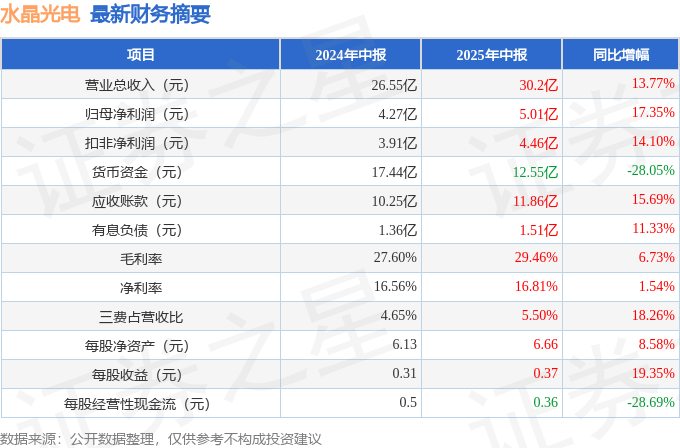
水晶光电2025年中报简析:营收净利润同比双双增长,盈利能力上升
Zheng Quan Zhi Xing· 2025-08-28 22:59
Core Viewpoint - Crystal Optoelectronics (002273) reported a strong performance in its 2025 mid-year report, with significant increases in revenue and net profit, indicating improved profitability and operational efficiency [1] Financial Performance - The total revenue for the first half of 2025 reached 3.02 billion yuan, a year-on-year increase of 13.77% - The net profit attributable to shareholders was 501 million yuan, up 17.35% year-on-year - In Q2 2025, revenue was 1.538 billion yuan, reflecting a 17.45% increase compared to the same quarter last year - The net profit for Q2 was 280 million yuan, showing a 12.8% year-on-year growth [1] Profitability Metrics - The gross margin improved to 29.46%, an increase of 6.73% year-on-year - The net margin rose to 16.81%, up 1.54% year-on-year - Total selling, administrative, and financial expenses amounted to 166 million yuan, accounting for 5.5% of revenue, which is an 18.26% increase year-on-year [1] Key Financial Ratios - Earnings per share (EPS) increased to 0.37 yuan, a rise of 19.35% year-on-year - The company's net asset value per share was 6.66 yuan, up 8.58% year-on-year - Operating cash flow per share decreased to 0.36 yuan, down 28.69% year-on-year [1] Investment Insights - The company's return on invested capital (ROIC) was 10.62% last year, indicating a generally average capital return rate - Analysts expect the company's performance in 2025 to reach 1.236 billion yuan, with an average EPS forecast of 0.89 yuan [3] Fund Holdings - Notable funds holding Crystal Optoelectronics include Invesco Great Wall Quality Evergreen Mixed A and Dongwu Mobile Internet Mixed A, with significant changes in their holdings [4] Strategic Planning - The company is focusing on its "15th Five-Year Plan," which aims to leverage advancements in AI and AR technologies, ensuring proactive positioning in emerging markets [5]


汉桑科技(301491)新股介绍:AIOT智能产品深度布局者
Xin Lang Cai Jing· 2025-08-28 08:50
Core Insights - The company, AIT, specializes in high-performance audio products and innovative audio and AIoT smart products, with projected revenues of 1.386 billion, 1.031 billion, and 1.454 billion yuan for 2022, 2023, and 2024 respectively, showing a year-over-year growth of 36.08%, -25.60%, and 40.98% [1] - The company has established itself as a significant player in the high-end audio market, collaborating with renowned brands and achieving a notable export market share in audio amplifiers [2] - AIT has a strong focus on R&D, with a dedicated team and increasing investment in innovation, resulting in numerous patents and industry awards [3] - The business structure is diversified, with significant growth potential in innovative audio and AIoT products, which are expected to drive future revenue growth [4] Financial Performance - The company reported revenues of 1.386 billion yuan in 2022, with a net profit of 190 million yuan, reflecting a year-over-year increase of 79.08% [1] - For Q1 2025, the company achieved revenues of 251 million yuan, a decline of 13.39% year-over-year, with a net profit of 38 million yuan, down 15.18% [1] Market Position - AIT is one of the few influential Chinese companies in the high-end amplifier and Hi-Fi audio sector, with a strong reputation built over 20 years [2] - The company’s export share of audio amplifiers was 3.84%, 2.15%, and 3.12% from 2022 to 2024, indicating a solid position in the niche market [2] R&D and Innovation - The company has established three R&D centers and employs a specialized team of 278, representing 17.03% of its workforce, with a focus on audio signal processing and system intelligence [3] - R&D expenses have consistently increased, reaching 82.87 million yuan in 2024, maintaining a stable ratio of 5%-7% of revenue [3] - AIT holds 112 authorized patents and has received multiple international awards for its products [3] Business Structure and Growth Potential - The company’s revenue structure for 2024 is divided into high-performance audio products (44.25%), innovative audio and AIoT products (50.23%), and other products (5.51%) [4] - The innovative audio segment has shown significant growth, with revenues of 724 million yuan in 2024, a 37.6% increase from 2022 [4] - Future growth is anticipated in the smart home and wearable technology sectors, leveraging audio IoT modules compatible with Matter protocol [4]
恒玄科技上半年净利润同比增长106.45% 继续加大研发投入
Zheng Quan Ri Bao Wang· 2025-08-28 06:45
Core Insights - Hengxuan Technology (Shanghai) Co., Ltd. reported a significant increase in revenue and net profit for the first half of 2025, with revenue reaching 1.938 billion yuan, a year-on-year growth of 26.58%, and net profit attributable to shareholders at 305 million yuan, up 106.45% [1][2] Financial Performance - The company achieved a gross margin of 39.3%, an increase of 6.1 percentage points year-on-year, which contributed to the rapid growth in net profit [1] - The non-recurring net profit was 284 million yuan, reflecting a year-on-year increase of 153.37% [1] Market Position and Product Development - Hengxuan Technology focuses on the design and development of low-power wireless computing SoCs, with a strong emphasis on the smart wearable and smart home markets, leading to an increase in market share [1] - The new generation smart wearable chip, BES2800, has been widely adopted in customer products such as smartwatches and smart glasses, reinforcing the company's technological leadership in the industry [1] Customer Base and Product Expansion - The company successfully onboarded new domestic and international clients in the smartwatch market, including Xiaotianzi and Songtuo, leading to rapid growth in chip shipments for smartwatches [1] - Beyond Bluetooth headsets and smartwatches, the company's chips are gradually extending into low-power wireless applications such as smart glasses and wireless microphones [1] Research and Development - Hengxuan Technology maintained a high level of R&D investment, with expenses amounting to 395 million yuan, a year-on-year increase of 22.77% [2] - As of the end of the reporting period, the total number of R&D personnel reached 621, accounting for 86.25% of the workforce [2]
