AGI

Search documents
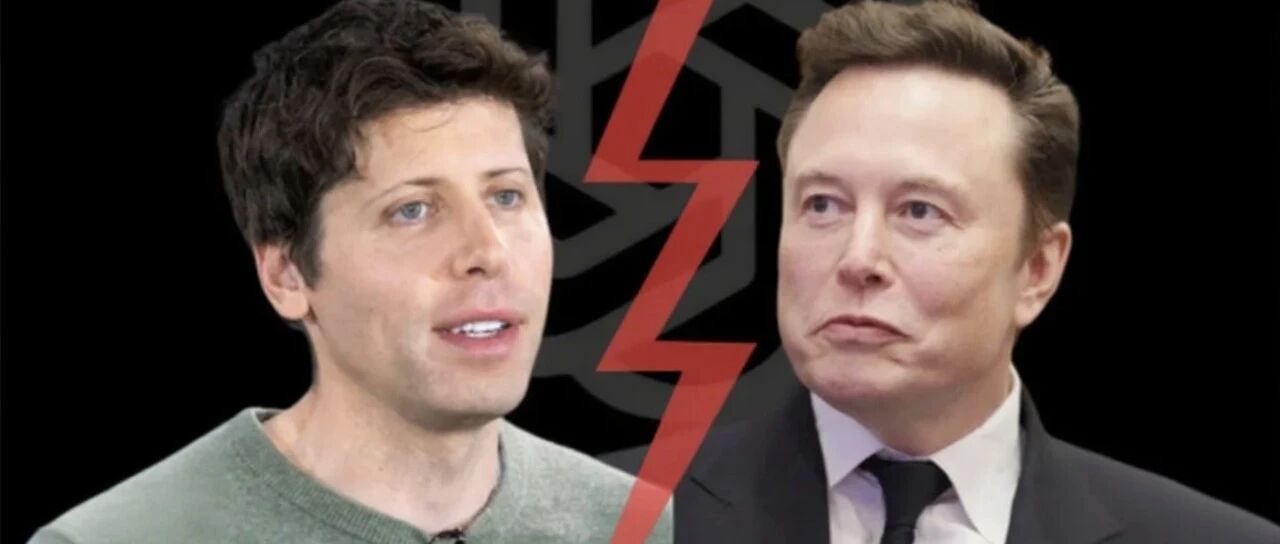
硅谷甄嬛传爆更,马斯克转发,Ilya动手那一夜,谁捅了奥特曼一刀?
3 6 Ke· 2025-11-04 00:36
Core Insights - The memo, dated October 1, reveals internal conflicts within OpenAI, highlighting a complex and immature power struggle among its top talents, including Ilya Sutskever and Sam Altman [1][4][8] - The document suggests that while Ilya may be committed to AI safety, his actions could be hindering the development of AI technologies [11][10] Group 1: Internal Conflicts - Ilya Sutskever conspired for over a year to remove Sam Altman from his position, indicating a long-term strategy that lacked clear communication with OpenAI's employees [15][21] - The memo accuses Ilya of lying, undermining executives, and creating divisions among team members, portraying a darker image of the internal dynamics at OpenAI [8][10] - Dario Amodei's desire to take full control of OpenAI's research department and his attempts to have Greg Brockman removed are also highlighted, showcasing the competitive nature of the leadership [16][31] Group 2: Financial and Legal Aspects - Ilya's legal fees are reportedly covered by OpenAI, raising questions about the implications of this arrangement on the company's governance and accountability [17][18] - The board of OpenAI, including Adam D'Angelo, played a significant role in the events leading to Altman's temporary ousting, suggesting a complex relationship among board members [27][30] Group 3: Broader Implications - The memo reflects a paradox where Ilya's commitment to AI safety may slow down the progress of AI development, indicating a tension between safety and innovation [11][10] - The ongoing drama within OpenAI is likened to a theatrical performance, suggesting that the public perception of the company may not align with the internal realities [4][40]

昆仑万维单季扭亏毛利率达69.9% 深化全球布局海外收入占超九成
Chang Jiang Shang Bao· 2025-11-04 00:14
Core Insights - Kunlun Wanwei's AI-driven business has led to significant growth, with a third-quarter revenue of 2.072 billion yuan, a year-on-year increase of 56.16%, and a net profit of 190 million yuan, compared to a loss of 237 million yuan in the same period last year [1][2] AI Business Growth - The company has focused on AGI and AIGC, achieving substantial progress in technology development, product innovation, and commercialization, resulting in a strong overall performance [1][2] - For the first three quarters of 2025, the company reported total revenue of 5.805 billion yuan, a year-on-year increase of 51.63% [1] Globalization Strategy - Kunlun Wanwei has deepened its global strategy, achieving overseas revenue of 5.41 billion yuan in the first three quarters, a 58% increase, with overseas revenue accounting for 93.3% of total revenue, up 3.6 percentage points year-on-year [3] - The company has established a solid user base in over 100 countries, with nearly 400 million monthly active users globally, enhancing its international competitiveness [3] R&D Investment and Technological Advancements - The company has significantly increased its R&D investment, with expenditures reaching 1.211 billion yuan in the first three quarters of 2025, a year-on-year increase of 5.83% [3] - Kunlun Wanwei's "Tiangong" model has evolved to version 4.0, featuring a parameter scale of 400 billion, making it one of the largest open-source MoE models globally [4] Industry Positioning - The company is transitioning from a gaming company to a leading global AI enterprise, leveraging its global layout and deep integration of AI technology as core competitive advantages [4]

AI Engineer Code Summit 2025: AIE/CODE Track
AI Engineer· 2025-11-03 21:03
AI Coding Agents & Tools - Focus on building and improving AI coding agents, covering topics from agent reinforcement fine-tuning to proactive agents [1] - Discussions on tools and platforms for AI-assisted coding, including code evaluation, world models for computation, and agent-ready codebases [1] - Exploration of using AI to speed up code execution and address software crisis [1] Reinforcement Learning (RL) in Coding - Research on efficient reinforcement learning and its application in coding environments at scale [1] - Agent Reinforcement Fine Tuning [1] - Building a fast frontier model with RL [1] Future of Software Development - Examination of the future of software development with AI, including continual system-prompt learning and the path towards AGI [1] - Investment trends in the future of software development [1] - Measurement gap between benchmarks and economics in AI capability [1] Codebase Management & Problem Solving - Strategies for solving hard problems in complex codebases [1] - Making Codebases "Agent-Ready" [1] - Transition from code snippets to codebases in coding evaluations [1]
Who should be on the AGI / digital god panel? #Vergecast
The Verge· 2025-11-03 17:23
Sam Alman has spent the last couple of years like kind of rapidly bringing down the bar for what qualified as AGI. So anyway, let's let's let's do this press release. Once AGI is declared by OpenAI, that declaration will now be verified by an independent expert panel.>> What are you talking about. Once we develop digital god and a verified panel of experts will be like, "Yep, there he is. >> That's God." >> What. That's the first bullet.Who's on your panel. other guys go. >> Is it the pope.>> Like what are ...
OpenAI and Microsoft’s Grand Bargain, Sam Altman’s Next Three Years, A New Humanoid Robot
Alex Kantrowitz· 2025-11-03 14:14
OpenAI's Transformation & Strategy - OpenAI converts to a public benefit corporation, signaling a shift in its organizational structure [1] - Sam Altman outlines OpenAI's next three years, indicating future strategic direction [7] - OpenAI aims to become its own AI cloud, suggesting a move towards infrastructure independence [9] - OpenAI is becoming similar to Facebook, raising questions about its future role and impact [10] Microsoft's AI Ambitions & Partnership - Microsoft aims to host every AI model on Azure, highlighting its cloud computing strategy [4] - Microsoft's negotiation with OpenAI is discussed, revealing the dynamics of their partnership [6] AI Development & Industry Concerns - The discussion questions whether AGI (Artificial General Intelligence) is dead, reflecting on the progress and future of AI development [5] - The report questions the value of building automated AI researchers, prompting reflection on the goals of AI research [8] - OpenAI employees express concerns about becoming "engagement farmers", highlighting ethical considerations [11] - The discussion considers whether the current situation is an "AI wobble" instead of an "AI bubble", suggesting potential instability in the AI field [13] Competitive Landscape - Meta's threat from OpenAI is analyzed, indicating the competitive dynamics in the AI industry [12] - The discussion questions the desirability of the 1X Technologies Neo humanoid robot, raising questions about the future of robotics [14]

llya证词太狗血了!奥特曼坏,Mira茶,OpenAI差点跟Anthropic合并
量子位· 2025-11-03 09:16
Core Viewpoint - The article discusses the ongoing tensions and conflicts within OpenAI, particularly focusing on Sam Altman's decision to not hold equity in the company and the implications of this choice on governance and control [2][21][40]. Group 1: OpenAI's Structure and Altman's Role - Sam Altman has maintained a 0% equity stake in OpenAI despite being the CEO, a decision he claims is based on his wealth and passion for technology [9][12][40]. - The restructuring of OpenAI has led to speculation about Altman's motivations, with some suggesting that his lack of equity allows him to maintain control over the company's direction without being tied to its financial performance [22][41]. - OpenAI's mission emphasizes safety and human benefit, which sometimes conflicts with commercial interests, leading to governance challenges [23][27]. Group 2: Internal Conflicts and Governance Issues - Recent testimonies reveal that internal conflicts, including Altman's alleged manipulative behavior, contributed to tensions within the company [31][32][34]. - The article highlights a significant incident where Altman was nearly ousted from his position, but employee support led to his reinstatement [38]. - The governance structure of OpenAI, which includes both non-profit and for-profit elements, has created friction regarding decision-making and operational execution [27][40]. Group 3: Financial Performance and Future Prospects - OpenAI's revenue has surpassed $13 billion annually and is projected to reach $100 billion by 2027, indicating rapid growth [40]. - The company is preparing for an IPO with a valuation of $1 trillion, which would mark one of the largest IPOs in history [42][43]. - Altman's role as CEO of a potentially trillion-dollar company may be more appealing than personal financial gain through equity [43].
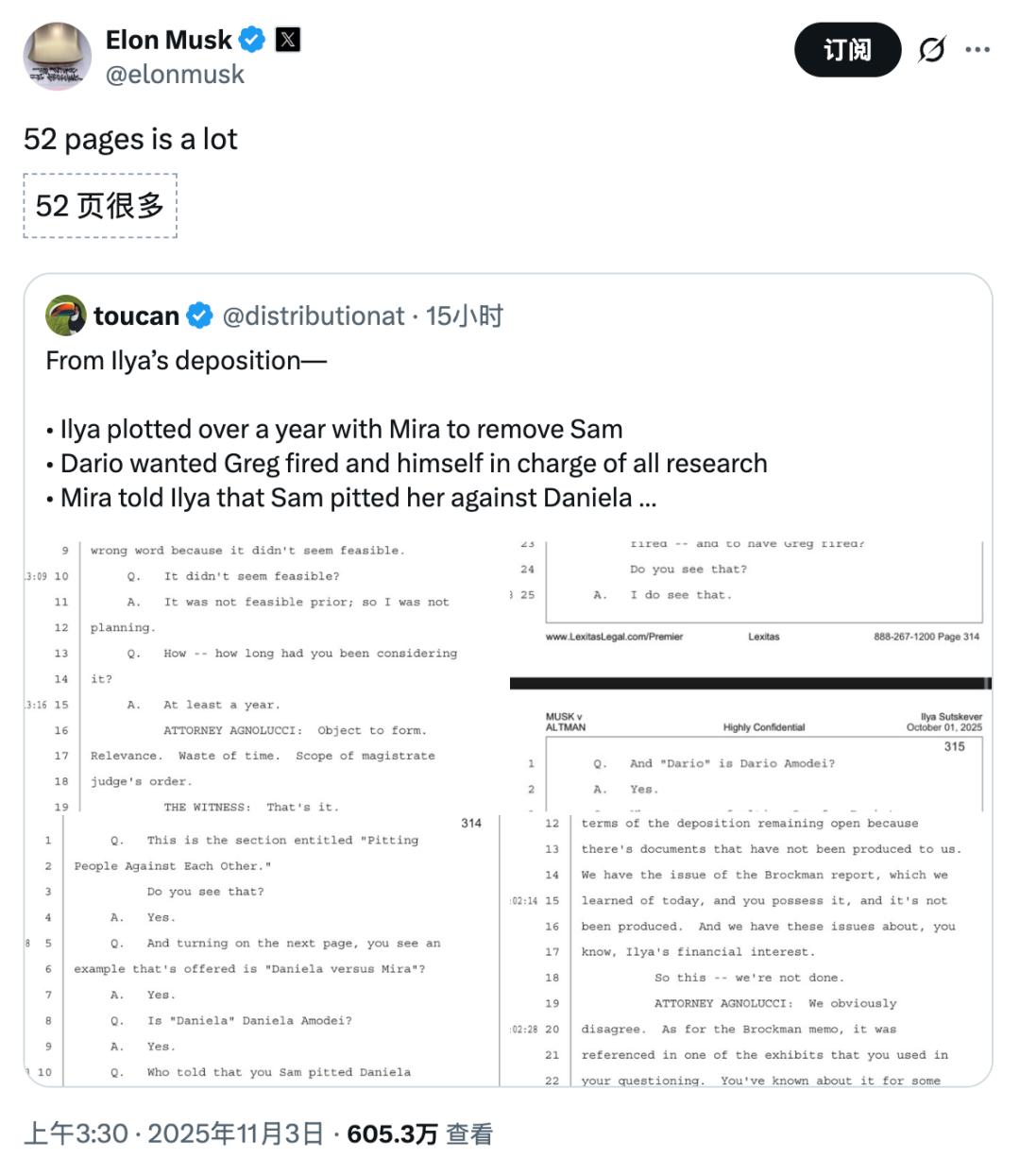
马斯克、奥特曼X上再开撕,Ilya最新52页证词曝光,抖出OpenAI更多内幕
3 6 Ke· 2025-11-03 08:34
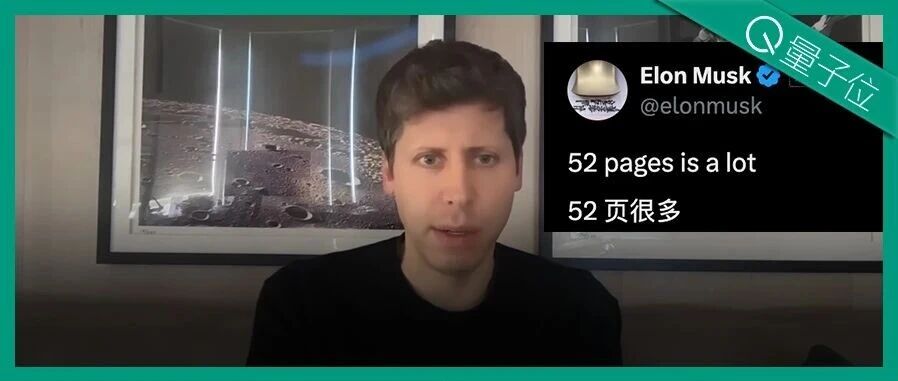
Core Points - The ongoing feud between Elon Musk and Sam Altman has escalated, with Altman publicly criticizing Musk's claims regarding OpenAI's success and Musk accusing Altman of stealing from a non-profit organization [3][4][6]. - The conflict stems from their shared history at OpenAI, which Musk co-founded in 2015 as a non-profit, but later left due to disagreements, leading to Altman's leadership and the company's significant valuation increase to $500 billion [6][8]. - Recent developments include a 52-page testimony from Ilya Sutskever, revealing internal conflicts and accusations against Altman, which were based on second-hand information [10][13][14]. Group 1 - Musk and Altman have exchanged accusations on social media, with Musk claiming Altman received a refund for a canceled Tesla Roadster order within 24 hours, while Altman argues he transformed OpenAI into a $500 billion AI giant after Musk's departure [3][4][6]. - The tension is compounded by Musk's legal actions against OpenAI, which he believes has strayed from its original non-profit mission [6][8]. - Sutskever's testimony highlights a lack of direct communication and reliance on second-hand information regarding Altman's alleged misconduct, raising questions about the board's decision-making process [10][13][14]. Group 2 - The internal dynamics of OpenAI's board are under scrutiny, with Sutskever indicating that the board acted hastily in removing Altman, attributing this to a lack of experience [15][24][30]. - A proposal for a merger with Anthropic was discussed shortly after Altman's removal, but it did not progress due to practical obstacles [17][18][30]. - Sutskever's motivations for Altman's ousting appear to have been brewing for at least a year, suggesting deeper issues within the company's governance [19][29].
深度|Anthropic曾考虑合并OpenAI,马斯克诉讼揭开AI界最大权力暗战
Sou Hu Cai Jing· 2025-11-03 07:52
Core Insights - A recent court deposition revealed internal conflicts at OpenAI, including a potential merger with competitor Anthropic after Sam Altman's abrupt dismissal [2][3] - Ilya Sutskever, OpenAI's co-founder, expressed his opposition to the merger, highlighting differing views among board members regarding Altman's leadership [3] - Following Altman's firing, over 700 employees threatened to resign, leading to his reinstatement, while both OpenAI and Anthropic have seen significant financial growth since then [4] Group 1: Internal Conflicts and Leadership Changes - Ilya Sutskever admitted to sending numerous emails detailing internal conflicts before Altman's dismissal, indicating a deep divide within the company [2] - Helen Toner, a board member, voted to remove Altman due to allegations of misinformation and dishonesty, reflecting the board's lack of consensus [3] - Sutskever's position shifted to support Altman's return after employee backlash, showcasing the influence of staff sentiment on leadership decisions [4] Group 2: Financial Performance and Market Position - Anthropic's annual revenue is approaching $7 billion, with a valuation of $183 billion, while OpenAI's market capitalization exceeded $500 billion with annual revenue over $12 billion [4] - Both companies are engaged in fierce competition for talent and model development, as well as debates over AI regulation and technology openness [4] - OpenAI has undergone a restructuring to prepare for a potential IPO, maintaining control through its non-profit entity to align with its mission [5] Group 3: Legal and Ethical Considerations - Elon Musk has accused OpenAI of straying from its original mission and misusing its non-profit status, leading to a lawsuit against the company [5] - Sutskever's deposition included serious allegations against Altman, suggesting a culture of mistrust and division within OpenAI's leadership [6] - The internal strife and subsequent actions have significantly shaped the current landscape of the AI industry, influencing the dynamics between OpenAI and Anthropic [7]
奥尔特曼喊话马斯克:我们难道不能都翻过这一页吗?
Sou Hu Cai Jing· 2025-11-03 04:32
Core Points - The recent conflict between Elon Musk and Sam Altman highlights a significant rift regarding the direction and mission of OpenAI, which was initially founded as a non-profit organization [1][5][7] - Altman claims to have transformed OpenAI into the largest non-profit organization in history, countering Musk's assertion that the organization has deviated from its original mission [1][5] - Musk has publicly criticized OpenAI for prioritizing profit over its foundational goal of benefiting humanity through AI development [5][7] Summary by Sections - **Background of the Conflict** - The disagreement between Musk and Altman dates back to 2015 when they co-founded OpenAI as a non-profit research entity [7] - Musk left the board in 2018 due to differences in leadership and company direction, suggesting that OpenAI should be financially supported by Tesla [7] - **Recent Developments** - Altman expressed frustration over a delayed refund for a Tesla Roadster he ordered in 2018, which Musk responded to by accusing Altman of "stealing" a non-profit organization [3][5] - Musk has initiated legal action against OpenAI and Altman, claiming they abandoned the company's original mission [5] - **Statements from Key Figures** - Altman asserts that OpenAI has achieved significant success, while Musk continues to criticize the organization's focus on profitability [1][5]

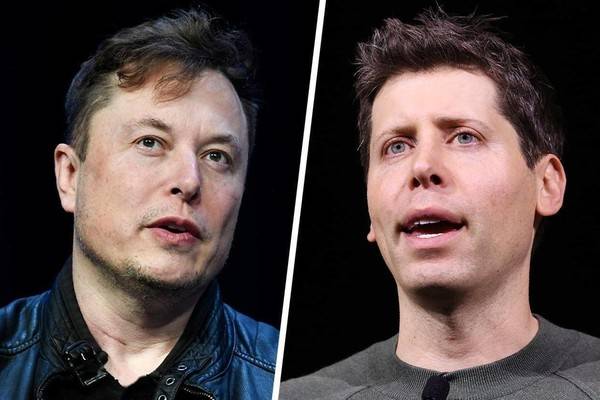
马斯克、奥特曼X上再开撕,Ilya最新52页证词曝光,抖出OpenAI更多内幕
机器之心· 2025-11-03 04:04
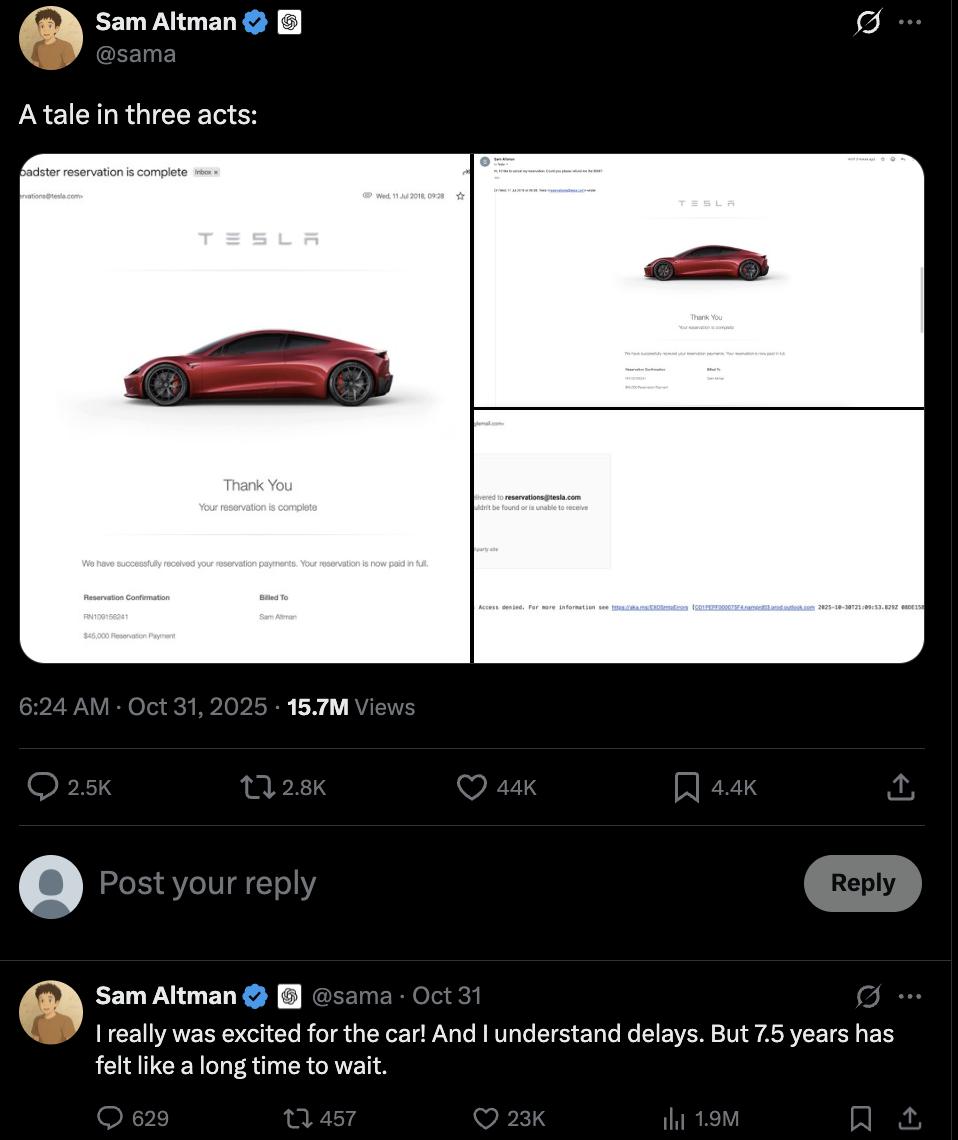
Core Points - The article discusses the ongoing feud between Elon Musk and Sam Altman, highlighting a recent exchange on social media regarding a refund issue related to a Tesla Roadster reservation made by Altman [2][4][5] - It also delves into the internal dynamics at OpenAI, particularly focusing on the circumstances surrounding Altman's dismissal and the subsequent board actions [11][16][22] Group 1: Musk and Altman's Dispute - Altman canceled his Tesla Roadster reservation after waiting for 7.5 years and faced difficulties in obtaining a refund due to a non-functional email address [4][5] - Musk responded to Altman, suggesting that the refund issue was resolved quickly and accused Altman of stealing from a non-profit organization [7] - Altman defended his leadership of OpenAI, emphasizing its growth to a valuation of $500 billion and criticizing Musk's past comments about the company's success rate [8][11] Group 2: OpenAI's Internal Dynamics - The article outlines the timeline of OpenAI's founding, Musk's departure, and the establishment of a for-profit subsidiary that attracted a $1 billion investment from Microsoft [11] - Ilya Sutskever's testimony reveals that Altman was accused of a consistent pattern of lying and undermining executives, leading to his dismissal [16][22] - The board's decision-making process was criticized for being rushed and lacking experience, particularly regarding the roles of board members Helen Toner and Tasha McCauley [22][43] - A proposal for a merger with Anthropic was discussed shortly after Altman's dismissal, but it ultimately did not proceed due to practical obstacles [23][47]