医保目录调整

Search documents
310个目录外药品拟角逐进入医保
第一财经· 2025-08-23 09:09
Core Viewpoint - The annual adjustment of the national basic medical insurance (BMI) drug list has begun, with a significant increase in the number of drugs passing the preliminary review, indicating intensified competition for inclusion in the insurance coverage [3][5]. Summary by Sections Drug Approval and Competition - A total of 310 drug names passed the preliminary review this year, up from 249 in 2024, reflecting a growing number of innovative drugs approved [3][5]. - The number of first-class innovative drugs approved in China has shown a clear upward trend, with 48 approved in 2024, more than five times the number in 2018 [5]. Impact on Patients and Accessibility - The inclusion of innovative drugs in the BMI list significantly improves patient access, with over 70 anti-tumor drugs added from 2018 to 2024, addressing the issue of patients lacking available treatments [5][6]. - The pricing of new drugs is crucial for patient affordability, as high costs can limit access despite the availability of innovative treatments [7][8]. Pricing Negotiations and Challenges - The negotiation process for drug pricing involves expert evaluations and discussions with companies to establish mutually acceptable reimbursement standards [7][10]. - Balancing the need for affordable pricing with the necessity for companies to recoup R&D costs presents a significant challenge in the negotiation process [8][11]. Policy Directions and Innovation Support - The 2025 adjustment plan emphasizes maintaining fund security while encouraging innovation and optimizing the drug list structure [10][11]. - The focus is on supporting genuine innovation and ensuring that new drugs provide real clinical benefits, with a comprehensive evaluation of their value [10][12]. Real-World Data and Evaluation - The importance of real-world data in assessing drug effectiveness and safety is highlighted, as it provides insights beyond controlled clinical trials [14][15]. - The need for a robust drug value assessment system is increasingly urgent, as it informs decisions on funding and resource allocation [13][16].


310个目录外药品拟角逐进入医保 面临价格博弈与“真创新”的考量
Di Yi Cai Jing· 2025-08-23 08:55
Core Points - The annual adjustment of the national basic medical insurance catalog has begun, with the National Medical Insurance Administration announcing a list of drugs that have passed preliminary review, indicating increased competition for drug inclusion in the insurance catalog this year [1][3] - A total of 310 generic drugs passed the preliminary review, significantly up from 249 in 2024, reflecting a substantial increase in the number of innovative drugs approved [1][3] - The adjustment process involves expert evaluation, negotiation, and price consultation, with a focus on balancing drug pricing and patient accessibility [1][6] Group 1: Drug Approval and Inclusion - The National Medical Insurance Administration has been adjusting the drug catalog since its establishment in 2018, with 530 drugs added through negotiations, enhancing the accessibility of innovative drugs [3] - Over 70 anti-tumor drugs have entered the insurance catalog from 2018 to 2024, addressing the needs of patients with various cancers [3] - The approval of innovative drugs has surged, with 48 first-class innovative drugs approved in 2024, more than five times the number in 2018 [3] Group 2: Pricing and Negotiation - The negotiation process for drug pricing is crucial, as it determines the reimbursement standards and affects the financial viability of innovative drugs [6][7] - The challenge lies in finding a balance between drug pricing and patient accessibility, as high prices can limit patient access while low prices may hinder the return on investment for pharmaceutical companies [6][9] - The adjustment of the insurance catalog is seen as a way to optimize the use of limited medical resources and improve the efficiency of the insurance fund [4][6] Group 3: Innovation and Evaluation - The 2025 adjustment plan emphasizes supporting true innovation and optimizing the structure of the drug catalog while ensuring fund security [8][9] - The need for a comprehensive drug value assessment system is highlighted, focusing on real-world data to evaluate the effectiveness and safety of drugs post-approval [10][12] - The integration of health technology assessments (HTA) in drug pricing negotiations is noted as a practice that could enhance transparency and fairness in the process [13]
310个目录外药品拟角逐进入医保,面临价格博弈与“真创新”的考量
Di Yi Cai Jing· 2025-08-23 08:37
Core Insights - The competition for access to the national medical insurance (NMI) directory is expected to intensify this year, with a significant increase in the number of drugs passing the preliminary review [2][4]. Group 1: NMI Directory Adjustments - The annual adjustment of the national basic medical insurance directory has commenced, with 310 drug names passing the preliminary review, up from 249 in 2024, indicating a more competitive environment for drug access [2][4]. - Since the establishment of the National Medical Insurance Administration in 2018, there have been eight rounds of adjustments to the NMI drug directory, with 530 drugs added through negotiations, enhancing the accessibility of innovative drugs [4]. - The approval of innovative drugs has surged, with the number of first-class innovative drugs approved reaching 48 in 2024, over five times that of 2018, and nearly 40 approved in the first half of this year alone [4][5]. Group 2: Pricing and Negotiation - The negotiation process for drug pricing involves expert evaluations and discussions with companies to establish mutually acceptable reimbursement standards, referred to as "soul bargaining" [7]. - The pricing of newly approved drugs is often high due to substantial R&D investments, making affordability a critical factor for patients [7][8]. - The balance between low reimbursement prices, which may hinder innovation returns, and high prices, which could strain the insurance fund, is a significant challenge in the NMI directory adjustments [7][11]. Group 3: Innovation and Evaluation - The NMI adjustments emphasize supporting true innovation and optimizing the structure of the drug directory, with a focus on filling clinical gaps and encouraging differentiated innovations [9][10]. - The establishment of a comprehensive drug value assessment system is increasingly urgent, with a need for scientific methods to guide financial decisions in the NMI [12]. - Real-world data is crucial for evaluating the effectiveness and safety of drugs post-approval, and it is essential for adjusting reimbursement standards based on actual clinical outcomes [13][14].
医保新增商保目录,医药板块发展再提速,医疗创新ETF(516820.SH)涨超2%
Xin Lang Cai Jing· 2025-08-13 05:48
Group 1 - The core viewpoint is that the expectation of interest rate cuts by the Federal Reserve has boosted market sentiment, leading to a rise in the Medical Innovation ETF (516820.SH) by 2.08% [1] - Key stocks in the sector, such as Haikang (002653), Kanglong Chemical (300759), Kanghong Pharmaceutical (002773), and WuXi AppTec (603259), have seen significant increases in their share prices, with gains of 7.81%, 6.63%, 6.33%, respectively [1] - The National Healthcare Security Administration has announced a plan for the adjustment of the drug catalog for basic medical insurance and commercial health insurance, establishing a dual-track system of "basic medical insurance + commercial insurance for innovative drugs" to alleviate pressure on basic medical insurance funds [1] Group 2 - The upcoming catalysts include the release of mid-year reports in August, with positive trends expected in the innovative drug sector and its supply chain, as some companies are already seeing a recovery in orders [2] - The approaching Innovative Drug Industry Conference in late August, along with updates from major cancer conferences like WCLC and ESMO, are anticipated to be significant events for the sector [2] - Domestic policy changes, including adjustments to the medical insurance catalog and the promotion of commercial insurance policies in the second half of the year, are also seen as important catalysts for the industry [2]
医保商保“双目录”初审揭幕,创新药如何跨过支付“门槛”?
2 1 Shi Ji Jing Ji Bao Dao· 2025-08-13 01:33
Core Points - The National Healthcare Security Administration (NHSA) has published the preliminary results of the review for the 2025 National Basic Medical Insurance (BMI) and commercial insurance innovative drug directories, with 534 drug names approved for the BMI directory and 121 for the commercial insurance directory [1][2] - The review process includes initial review, public announcement of results, re-evaluation, and final announcement, with the initial review being the first step in the overall directory adjustment process [1][2] Summary by Sections Initial Review Results - A total of 718 submissions were received for the BMI directory, involving 633 drug names, with 534 passing the initial review [2] - The number of drugs passing the initial review from outside the directory increased significantly from 249 in 2024 to 310 in 2025 [2] - The approved drugs cover various fields, including oncology, chronic diseases, and rare diseases, with notable CAR-T products and antibody-drug conjugates (ADCs) included [2][3] Pricing and Evaluation - Some high-priced drugs, such as CAR-T therapies and enzyme replacement therapies, have passed the initial review but may not meet the BMI's implicit pricing thresholds [3] - The NHSA emphasizes that passing the initial review does not guarantee inclusion in the BMI directory, as further evaluations and negotiations are required [3][4] Payment Mechanisms and Sustainability - The need for differentiated payment mechanisms to support innovative drugs while ensuring sustainable development is highlighted [4][5] - The introduction of the commercial insurance innovative drug directory aims to enhance service attributes and drive transformation in the commercial insurance sector [5][6] Dual Directory System - The commercial insurance directory received 141 submissions, with 121 drug names passing the initial review, indicating a strong focus on innovative and high-value drugs [5][6] - The dual directory system is expected to foster innovation in drug development and improve patient access to treatments [7]
121个药品通用名通过商保创新药目录初步形式审查
Zhong Guo Zheng Quan Bao· 2025-08-12 21:06
Group 1 - The National Healthcare Security Administration (NHSA) announced that 534 drug generic names passed the preliminary formal review for the 2025 National Basic Medical Insurance, Maternity Insurance, and Work Injury Insurance Drug Catalog, a significant increase compared to the previous year [1][2] - A total of 718 submissions were received for the basic medical insurance catalog, with 633 drug generic names involved, and 534 passed the preliminary review, indicating a notable rise from 249 in 2024 [1][2] - The introduction of a commercial insurance innovative drug catalog alongside the basic medical insurance catalog reflects an enhancement of the role of commercial insurance in the multi-tiered medical security system [3] Group 2 - The formal review process is designed to ensure that submitted drugs meet the necessary conditions and that the information provided is complete and accurate, which is crucial for subsequent evaluation and assessment stages [2] - The NHSA emphasized that passing the preliminary formal review only indicates eligibility for further processes and does not guarantee inclusion in the drug catalog [2][3] - Feedback received during the public notice period will be used to verify the information of the drugs and finalize the list of those that passed the formal review [3]
国家医保局:商保创新药目录121个药品通用名通过形式审查
Xin Hua Cai Jing· 2025-08-12 08:25
Group 1 - The National Healthcare Security Administration (NHSA) has released information regarding the preliminary review of the 2025 National Basic Medical Insurance, Maternity Insurance, and Work Injury Insurance drug catalog adjustments, including the commercial insurance innovative drug catalog [1][2] - A total of 141 applications for the commercial insurance innovative drug catalog were received, with 121 drug names passing the preliminary review [1] - For the basic medical insurance catalog, 718 applications were received, involving 633 drug names, with 534 passing the preliminary review, indicating a significant increase from 249 in 2024 [1] Group 2 - The adjustment process includes several stages: enterprise application, preliminary review, expert evaluation, negotiation, and price consultation, with the preliminary review being the first step [2] - Passing the preliminary review only indicates that the drug meets the application criteria and qualifies for the next steps, not that it is included in the basic medical insurance or commercial insurance innovative drug catalog [2] - The NHSA acknowledged that some expensive drugs exceeding basic insurance coverage have passed the preliminary review, but their final inclusion depends on strict evaluation processes and successful negotiations [2]
新华鲜报丨新增商保创新药目录!2025年医保目录调整启动
Xin Hua Wang· 2025-08-12 05:42
Core Points - The 2025 National Basic Medical Insurance Drug Directory adjustment has officially started, with a notable addition of a commercial health insurance innovative drug directory [1] - The adjustment will focus on areas with insufficient basic coverage, such as pediatric and rare disease medications, to address clinical medication needs [1] - The introduction of the commercial insurance innovative drug directory aims to better meet the diverse medication needs of insured individuals [1][2] Group 1: Drug Directory Adjustments - The basic medical insurance directory has seen a dynamic adjustment over the past seven years, adding a total of 835 new drugs, primarily high clinical value drugs for cancer, chronic diseases, rare diseases, and pediatric use [1] - A total of 438 drugs that are ineffective, prone to abuse, or have been eliminated from clinical use have been removed from the directory [1][2] - By the end of 2024, negotiated drugs have benefited 8.85 billion patient visits, reducing patient costs by over 930 billion yuan [2] Group 2: Commercial Insurance Innovative Drug Directory - The newly added commercial insurance innovative drug directory will include innovative drugs that exceed basic insurance coverage and are temporarily not included in the basic directory [2] - Drugs approved for marketing within the last five years or exclusive drugs for rare diseases can be submitted for the commercial insurance innovative drug directory [3] - The process for a drug to enter the commercial insurance innovative drug directory involves expert review and price negotiations among the National Medical Insurance Bureau, commercial insurance companies, and pharmaceutical companies [4]
国家医保局:即使药品最终确定通过形式审查,不代表其已经纳入了基本医保目录或商保创新药目录
Zheng Quan Shi Bao Wang· 2025-08-12 04:33
Core Points - The National Healthcare Security Administration (NHSA) announced the preliminary review of the 2025 National Basic Medical Insurance, Maternity Insurance, and Work Injury Insurance drug catalog adjustments [1] - The adjustment process includes multiple stages: enterprise declaration, formal review, expert evaluation, and price negotiation [1] - Passing the preliminary formal review indicates that a drug meets the initial application conditions but does not guarantee inclusion in the basic medical insurance catalog or commercial health insurance innovative drug catalog [1]
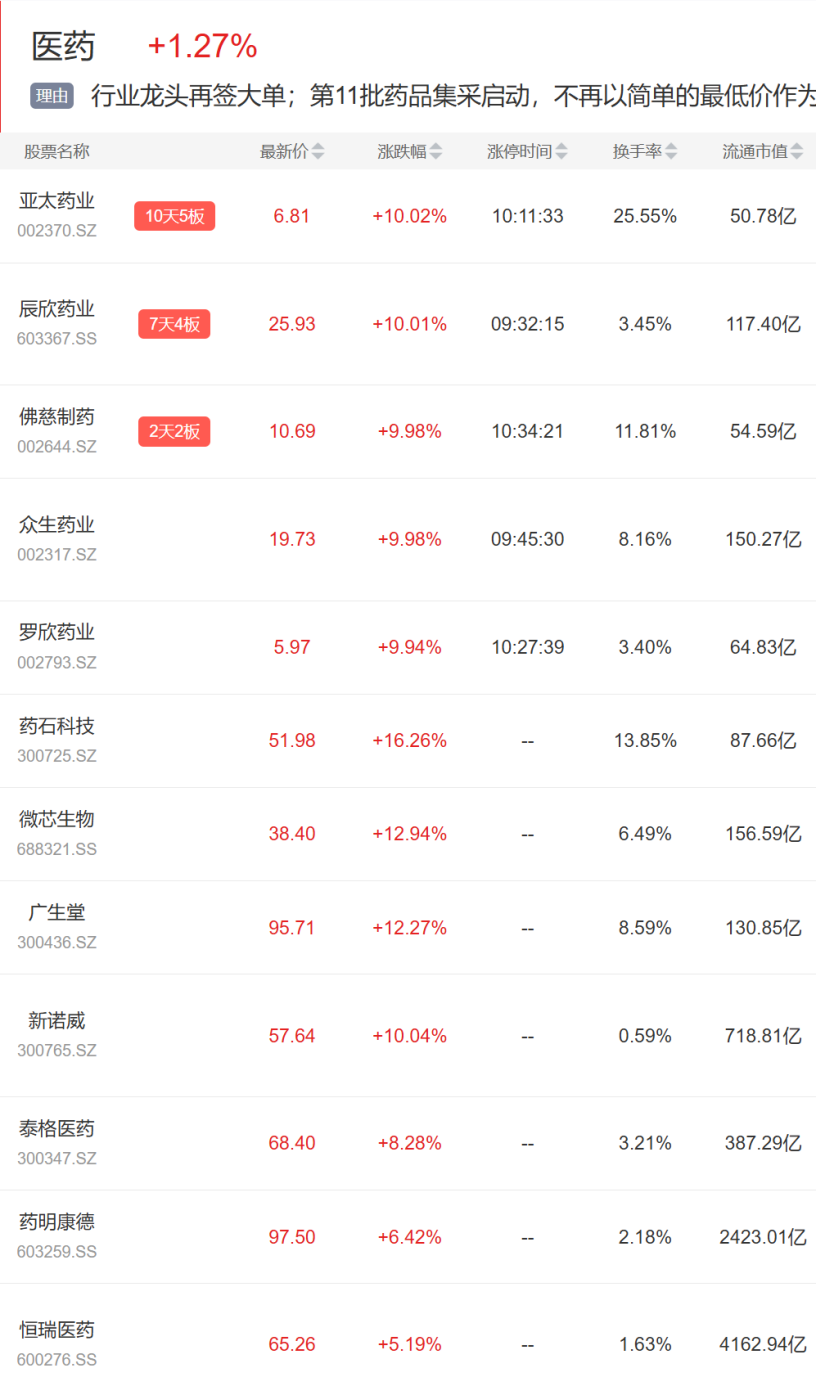
【大涨解读】医药:创新药龙头签百亿美元大单,国内药企研究成果密集兑现,未来两月还有新催化
Xuan Gu Bao· 2025-07-29 03:01
Core Viewpoint - The pharmaceutical sector has experienced significant growth, with major companies like Hengrui Medicine achieving record highs and forming strategic partnerships to enhance their innovation capabilities [1][3]. Group 1: Market Performance - On July 29, the pharmaceutical sector saw a substantial increase, with companies such as Asia-Pacific Pharmaceutical, Chenxin Pharmaceutical, and Zhongsheng Pharmaceutical reaching their daily price limits, while Hengrui Medicine rose by 5%, marking a new high for the year [1]. - According to data from Yao Medicine Magic Cube, the number of global pharmaceutical transactions reached 456 in the first half of 2025, a 32% year-on-year increase, with total upfront payments amounting to $11.8 billion, a 136% increase compared to the previous year [4]. Group 2: Strategic Partnerships - On July 28, Hengrui Medicine announced a collaboration with GlaxoSmithKline (GSK) to co-develop up to 12 innovative drugs, with GSK paying an upfront fee of $500 million and potential milestone payments totaling approximately $12 billion based on successful development and sales [3]. - Several Chinese pharmaceutical companies, including Hengrui Medicine, Heber Pharmaceuticals, and Shiyao Group, have recently engaged in overseas licensing collaborations, covering popular drug categories such as monoclonal antibodies, bispecific antibodies, GLP-1, and ADCs [3]. Group 3: Industry Trends - In the first half of the year, the total amount of license-out deals for Chinese innovative drugs approached $66 billion, surpassing the total BD transaction amount for the entire year of 2024, indicating sustained interest from multinational pharmaceutical companies in Chinese innovative drug assets [5]. - The current trend in the innovative drug industry is shifting from "follower" to "leader," with 2025 expected to be a breakout year for Chinese innovative drugs in overseas markets, as many products are projected to exceed $3-5 billion in sales [5].