
伊基奥仑赛注射液

Search documents
南京6只“瞪羚”,跑进全球榜单
Sou Hu Cai Jing· 2026-01-27 09:45
Core Insights - The HuRun Research Institute released the "2025 HuRun Future Unicorn: Global Gazelle Enterprises List," featuring six companies from Nanjing that are likely to achieve a billion-dollar valuation by 2028 [1] - China has 278 gazelle enterprises, with 27 located in Jiangsu province, highlighting the region's strong entrepreneurial ecosystem [1] Group 1: Company Highlights - Nanjing's listed companies include BanJie Electronics, XinDe Semiconductor, XunLu Bio, YunZhangFang, BoLiu Intelligent, and AoTeKu [1] - BoLiu Intelligent focuses on developing high-integration, low-power IoT wireless connection chips, addressing the need for efficient device connectivity while reducing power consumption and costs [6][9] - XunLu Bio's CAR-T therapy, Ikigai Lunsai injection, received approval from the National Medical Products Administration in 2023 and has since gained recognition in multiple international markets [12] Group 2: Technological Innovations - The AI-driven accounting system developed by YunZhangFang has significantly increased efficiency, allowing accountants to manage up to 1,800 clients, compared to the traditional limit of 20 [3][6] - BoLiu Intelligent's BL704L chip, used in Amazon Basics products, operates at ultra-low power levels, addressing concerns about battery life in IoT devices [8] - A collaboration between STMicroelectronics and AoTeKu resulted in a cutting-edge audio solution for smart vehicles, overcoming challenges in audio transmission technology [10] Group 3: Policy and Support - Nanjing's government has implemented policies to foster the growth of unicorn and gazelle enterprises, aiming for a total of 800 such companies by 2027 [15] - The city is providing financial support and incentives to nurture these high-potential companies, ensuring a conducive environment for innovation and growth [15][16]


2025胡润全球瞪羚企业榜发布
Nan Jing Ri Bao· 2026-01-27 02:41
Core Insights - The HuRun Research Institute released the "2025 HuRun Future Unicorn: Global Gazelle Enterprises List," identifying high-growth companies likely to reach a $1 billion valuation by 2028, with 278 gazelle companies in China, including 27 from Jiangsu province [1] - The report highlights the rapid emergence of innovative companies in sectors like semiconductors and biotechnology, driven by technological breakthroughs and market expansion [1] Group 1: Technological Innovations - Cloud accounting systems developed by companies like Yunzhangfang utilize AI to automate accounting processes, significantly increasing efficiency by at least 30%, with some scenarios achieving up to a tenfold increase [2] - The semiconductor company Boliu Intelligent focuses on low-power IoT wireless connection chips, with their BL704L chip being used in Amazon products, demonstrating a standby power consumption of only 1 microamp [3] - The collaboration between STMicroelectronics and Aoteku resulted in a distributed audio solution for smart cars, addressing technical challenges in Ethernet audio transmission [5] Group 2: Market Expansion and Regulatory Approvals - Reindeer Biotech's CAR-T therapy, Ikiorun, received approval in China and is expanding into international markets, including Hong Kong and Saudi Arabia, showcasing the potential for innovative biopharmaceuticals [6] - Nanjing's policies aim to cultivate unicorn and gazelle companies, targeting a total of 800 such companies by 2027, with significant financial support for startups [7] Group 3: Supportive Ecosystem - Nanjing's government initiatives include financial backing and tailored policies to foster the growth of high-potential gazelle companies, exemplified by the recent funding round for Chipde Semiconductor totaling nearly 400 million yuan [7]
商保创新药药房遇冷,这些进口药院内渗透快
第一财经· 2026-01-22 13:23
Core Viewpoint - The article discusses the implementation and sales performance of the newly established commercial insurance innovative drug directory, highlighting the concentration of sales in major cities and the challenges faced in expanding access to these drugs across the country [3][7]. Summary by Sections Sales Performance of New Drug Directories - As of January 20, 2026, 99 new drugs from the basic medical insurance directory have been sold in 12,198 designated medical institutions, while 14 drugs from the commercial insurance innovative drug directory have been sold in 223 institutions [3][4]. - Over 70% of the commercial insurance innovative drugs have recorded sales, with Alzheimer's disease treatments showing the highest penetration in the hospital market [4][5]. Specific Drug Sales Insights - The drug Lecanemab, developed by Eisai, has been sold in 158 institutions, while Eli Lilly's Donanemab has been recorded in 46 institutions [4]. - The number of patients with mild cognitive impairment or mild dementia due to Alzheimer's disease in China is projected to reach 17 million by 2024, indicating a broad patient base for these treatments [5]. Challenges in Rare Disease Drug Sales - Rare disease drugs face challenges due to their limited patient populations and the concentration of prescriptions in specialized hospitals, resulting in sparse sales data [5][6]. - For instance, Takeda's drug for short bowel syndrome has only been sold in one designated pharmacy in Shenzhen this year [5]. Market Access and Policy Implications - Five innovative drugs have yet to achieve sales in designated medical institutions, including CAR-T products priced between 990,000 to 1.3 million yuan per injection [6]. - The National Healthcare Security Administration has implemented a "three exclusions" policy to facilitate the entry of high-cost drugs into hospitals, but the transition from "entry" to "sales" remains complex due to various factors [6][7]. Regional Disparities in Sales - Sales of commercial insurance innovative drugs are still concentrated in major provinces like Beijing, Shanghai, Jiangsu, and Guangdong, with retail pharmacies accounting for less than 10% of sales [7][8]. - Some regions, such as Guangdong and Chongqing, have begun to support the prescription flow of commercial insurance innovative drugs, but broader implementation is needed [8].
商保创新药药房遇冷,这些进口药院内渗透快
Di Yi Cai Jing· 2026-01-21 13:48
Core Insights - The sales of commercial insurance innovative drugs remain concentrated in public hospitals in a few provinces such as Beijing and Shanghai, with a low proportion of sales through pharmacies [1][5] - As of January 20, 2023, 99 new basic medical insurance drugs were sold in 12,198 designated medical institutions, while 14 commercial insurance innovative drugs were sold in 223 institutions [1][5] Group 1: Sales Data and Trends - Over 70% of commercial insurance innovative drugs have recorded sales, but the specific sales performance varies among the 14 drugs [2] - Alzheimer's disease treatment drugs have the highest penetration in the hospital market, with drugs like Lecanemab and Donanemab achieving sales in 158 and 46 institutions respectively [2] - Multiple anti-tumor drugs are also penetrating the hospital market, with drugs like Ipilimumab and Lurbinectedin being sold in 35 and over 10 institutions respectively [2] Group 2: Challenges and Market Dynamics - Five innovative drugs have not yet formed sales in designated medical institutions, including CAR-T products priced between 990,000 to 1,300,000 yuan per injection [3] - The lack of sales does not imply that these drugs are not benefiting from the supportive policies for commercial insurance innovative drugs [3] - The transition from "hospital entry" to "sales" involves several factors, including physician prescriptions and patient payments, which may hinder the sales volume of these drugs [3] Group 3: Policy and Implementation - Most provinces have clarified that the entry of commercial insurance innovative drugs into hospitals will follow the guidelines of "nationally negotiated drugs" [4] - There is a push for the inclusion of all 19 drugs in the commercial insurance innovative drug directory into the procurement lists of hospitals, which may improve access for patients [4] - The integration of commercial insurance innovative drugs with the dual-channel policy of medical insurance is essential for enhancing confidence in the allocation of these drugs in hospitals [5]
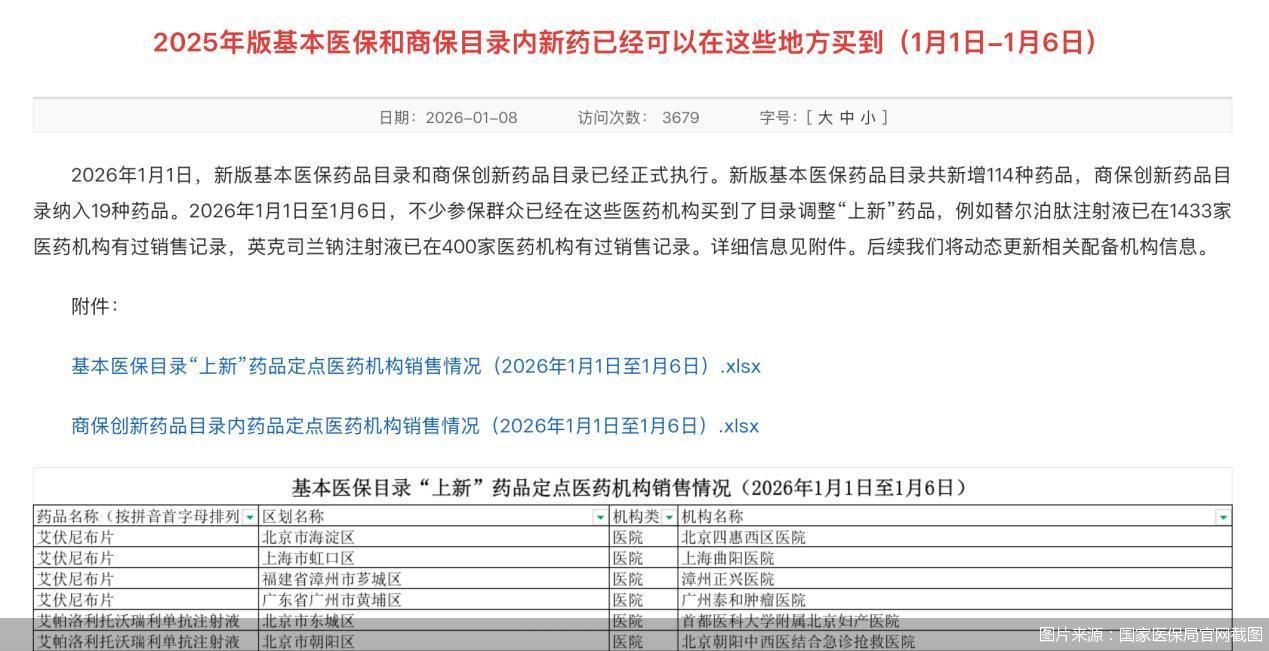
新医保目录实施一周:创新药“首单”频现
Bei Jing Shang Bao· 2026-01-08 15:45
Core Insights - The new medical insurance directory has entered a substantial implementation phase, with multiple innovative drugs, including Tislelizumab and Fuzhengzhu, being covered by insurance in various hospitals, indicating a rapid reduction in access barriers for patients [1][3] - The adjustment includes 114 new drugs and introduces a commercial health insurance innovative drug directory for 2025, marking a significant shift towards a multi-tiered insurance payment system [1][3] Group 1: Innovative Drug Inclusion - The new medical insurance directory reflects increased support for "true innovation" with 124 unique products included, showcasing a strong emphasis on high clinical value [3][4] - Notable drugs like Tislelizumab, the first targeted therapy for thyroid eye disease, and Fuzhengzhu, a biological agent for psoriasis, have been rapidly integrated into the insurance system, filling long-standing treatment gaps [3][4] - Heng Rui Medicine is highlighted as a major beneficiary, with 20 products and indications adjusted, including 10 new drugs, enhancing patient access to innovative therapies [3][4] Group 2: Biotech Sector Impact - Companies like BeiGene, Innovent Biologics, and Kangfang Biotech are also benefiting from the new directory, accelerating their commercialization processes [4] - BeiGene is the only company with two products included in the first commercial insurance innovative drug directory, addressing unmet needs in cholangiocarcinoma and neuroblastoma [4] - Innovent Biologics has expanded its offerings to 12 innovative drugs under the new directory, creating a robust product matrix [4] Group 3: Shift in R&D Strategies - The introduction of the commercial insurance innovative drug directory is seen as a solution to the payment challenges faced by high-value innovative drugs, encouraging companies to focus on true innovation rather than me-too products [5][6] - The directory allows for a second market for high-priced therapies, with price reductions between 15% and 50%, which is less severe than the typical cuts seen in basic insurance [6][7] - This dual-directory model is expected to drive pharmaceutical companies to align their R&D strategies with real-world clinical needs, particularly in oncology and rare diseases [7][9] Group 4: Drug Exclusions - The adjustment also involved the removal of 29 drugs from the insurance directory, including Benalutide injection, which faced competition from more effective alternatives [8][9] - This "one in, one out" approach aims to enhance the efficiency of insurance fund usage by prioritizing high-demand and effective medications [9]
新版医保目录实施一周:创新药“首单”频现,患者用药门槛降低
Bei Jing Shang Bao· 2026-01-08 08:10
Core Insights - The new medical insurance directory has entered a substantial implementation phase, with several innovative drugs, including Tislelizumab and Fuzhengzhu, being prescribed under insurance in various hospitals, indicating a reduction in access barriers for patients [1] - The adjustment includes 114 new drugs and introduces a commercial health insurance directory for innovative drugs, marking a significant shift towards a multi-tiered insurance system [1][5] - The rapid inclusion of innovative drugs in the insurance directory reflects increased support for "true innovation" with high clinical value [5] Group 1: New Drug Inclusion - The new medical insurance directory has added 124 unique products, including Tislelizumab, the first targeted drug for thyroid eye disease, and Fuzhengzhu, a biological agent for psoriasis [5] - Heng Rui Medicine is a major beneficiary, with 20 products and indications adjusted, including 10 new drugs entering the directory for the first time [5][6] - Other biotech companies like BeiGene and Innovent Biologics have also benefited, with multiple products included in the new directory, enhancing their commercialization prospects [7] Group 2: Commercial Health Insurance Directory - The introduction of the commercial health insurance directory provides a secondary market for high-value innovative drugs, with price reductions ranging from 15% to 50%, which is less severe than the basic insurance cuts [9] - The directory aims to improve accessibility for high-priced drugs while ensuring adequate returns for pharmaceutical companies [9] - Notable CAR-T therapies have been included in the commercial directory, overcoming previous barriers to entry, with prices for these therapies exceeding 1 million yuan [8][10] Group 3: Market Dynamics and Drug Exits - The adjustment process has also seen the removal of 29 drugs from the insurance directory, including Benarutide, which faced competition from more effective alternatives [12][14] - The dynamic adjustment mechanism emphasizes the need for drugs to demonstrate clinical value, reinforcing a "can enter, can exit" policy [14] - Companies are encouraged to shift from "me-too" products to genuine innovations, focusing on high-value areas such as oncology and rare diseases [10][14]



创新药商保破冰
Xin Lang Cai Jing· 2025-12-23 09:51
Core Viewpoint - The introduction of the commercial health insurance innovative drug directory marks a substantial phase of collaboration between medical insurance and commercial insurance, opening a market-oriented payment channel and enhancing the accessibility of innovative drugs [1][21]. Group 1: Policy and Implementation - The national medical insurance bureau has added a commercial health insurance innovative drug directory, which includes 19 drugs, effective from January 1, 2026 [2][23]. - The directory focuses on highly innovative drugs with significant clinical value that exceed the basic medical insurance coverage, aiming to complement the basic insurance system [2][23]. - The commercial health insurance innovative drug directory is expected to serve as a "transition pool" for innovative drugs, allowing them to first enter the commercial insurance directory before considering inclusion in the basic medical insurance [3][36]. Group 2: Drug Inclusion and Impact - Notable drugs included in the directory are five CAR-T products, which have been a focal point in previous medical insurance negotiations due to their high costs, often exceeding one million yuan [2][25]. - The inclusion of CAR-T products is anticipated to significantly reduce the out-of-pocket expenses for patients, potentially saving them hundreds of thousands of yuan [7][27]. - The directory also includes treatments for rare diseases and high-profile conditions like Alzheimer's disease, reflecting a commitment to support vulnerable patient groups [8][28]. Group 3: Challenges and Considerations - The implementation of the commercial health insurance innovative drug directory faces challenges such as balancing the interests of pharmaceutical companies, insurance costs, and patient accessibility [3][24]. - There is a need for improved data integration and actuarial foundations to support long-term efficacy data and claims risk models for innovative drugs [3][24]. - The collaboration between medical institutions and payment systems requires breakthroughs to ensure the effective entry of directory drugs into hospitals [3][24]. Group 4: Market Opportunities - The launch of the commercial health insurance innovative drug directory opens significant market opportunities for commercial health insurance, with a focus on designing specialized insurance products for high-value innovative drugs [4][24]. - The directory is expected to enhance the clinical medication level and overall research return rates in the industry, particularly benefiting leading innovative pharmaceutical companies [20][37]. - The mechanism is seen as a step towards a multi-layered and collaborative medical insurance system in China, although its long-term sustainability will depend on effective risk management by commercial insurance institutions [19][36].
重大突破,5款百万一针抗癌药被纳入商保
21世纪经济报道· 2025-12-15 13:38
Core Viewpoint - The inclusion of 19 drugs in the first version of the commercial health insurance innovation drug directory marks a significant step towards improving access and affordability of innovative drugs, particularly high-cost CAR-T therapies, while presenting challenges for insurance companies in product development and risk management [1][4][10]. Group 1: Policy and Implementation - The National Medical Security Work Conference emphasized the support for the development of commercial health insurance and the establishment of a multi-tiered medical security system, with a focus on the implementation of the commercial health insurance innovation drug directory by January 1, 2026 [1][2]. - The first version of the commercial health insurance innovation drug directory includes 19 drugs, focusing on high-cost and innovative treatments, including five CAR-T products and drugs for rare diseases [2][4]. Group 2: Challenges for Insurance Companies - Insurance companies face significant challenges in translating the drug directory into viable insurance products, including issues related to pricing, risk control, and compliance [4][5]. - Accurate pricing for insurance products relies on detailed data regarding potential patient populations, disease incidence, treatment cycles, and real-world efficacy, which are primarily held by pharmaceutical companies and hospitals [4][5]. Group 3: Risk Management and Compliance - The inclusion of Alzheimer's disease treatments raises concerns about adverse selection risks, as these drugs have high costs and long treatment durations, necessitating strict eligibility criteria for insurance coverage [5][6]. - Establishing transparent and compliant financial flows between insurance companies and pharmaceutical firms is crucial for effective collaboration [5][6]. Group 4: Data Sharing and Integration - The "医保+商保" one-stop clearing and settlement model aims to break down data silos, enhancing the efficiency of claims processing and improving patient experiences [6][8]. - Successful implementation of data sharing initiatives in regions like Shanghai and Beijing indicates potential for nationwide adoption, which could facilitate better integration of commercial health insurance with innovative drug offerings [8][10]. Group 5: Investment in Innovative Drugs - The policy encourages insurance funds to invest in the upstream of the pharmaceutical industry, positioning them as "patient capital" for innovative drug development [10][11]. - Major insurance companies are already investing in health industry funds, supporting numerous innovative drug companies and enhancing the overall funding environment for drug development [10][11]. Group 6: Future Outlook - Despite the potential for increased investment in innovative drugs, insurance companies remain cautious due to the high risks and costs associated with drug development, which may lead to a preference for established pharmaceutical firms over smaller, innovative companies [12].
药明巨诺换帅,新管理层迎战CAR-T市场机遇与挑战
2 1 Shi Ji Jing Ji Bao Dao· 2025-12-12 12:48
Core Viewpoint - WuXi AppTec's management restructuring aims to enhance operational stability and drive growth in the competitive CAR-T therapy market, particularly following the inclusion of its CAR-T product in the national commercial health insurance directory [1][2][5]. Management Changes - Tian Feng will officially become the CEO and Executive Director on December 29, 2025, while Dr. Liu Cheng will assume the role of Chairman of the Board from December 12, 2025 [1]. - The current CEO, Liu Min, will resign on December 12, 2025, due to personal career development plans, and his previously approved stock options will be canceled [1][2]. - The existing management team will temporarily take over the CEO responsibilities to ensure smooth operations during the transition period [1]. New Leadership Background - Tian Feng has over 20 years of experience in the biopharmaceutical industry, with a strong background in commercialization, marketing, and strategic management [2]. - Dr. Liu Cheng has more than 20 years of experience and holds over 300 patents in the biopharmaceutical field, ranking highly in global CAR-T patents [3]. Financial Performance - In the first half of the year, WuXi AppTec reported revenues of 106 million yuan, a year-on-year increase of 22.5%, but also recorded a loss of 267 million yuan, with the loss margin widening by 11.24% [3]. - The company's core product, the CAR-T therapy, has been approved for treating specific types of lymphoma [3]. Strategic Partnerships - WuXi AppTec has entered into several business collaborations, including a technology licensing agreement with Juno Therapeutics valued at up to 10 million USD and a strategic cooperation agreement with Regeneron worth up to 50 million USD [4]. Market Context - The inclusion of WuXi AppTec's CAR-T product in the national commercial health insurance directory is a significant breakthrough, with five CAR-T therapies listed, including WuXi's product priced at 1.29 million yuan per dose [5][6]. - The price reduction for these therapies is expected to range between 15% and 50%, which may facilitate better access to these innovative treatments [6]. Challenges and Opportunities - The new management faces the challenge of improving market penetration for core products and accelerating pipeline development amid intense competition in the new drug development landscape [5][7]. - The company must also navigate hospital access issues to ensure the successful implementation of its products in the healthcare system [6][7].
5款百万元抗癌药进商保 能为患者省多少钱?
Zhong Guo Xin Wen Wang· 2025-12-11 07:21
Core Viewpoint - The inclusion of five CAR-T products in the newly released commercial insurance innovation drug directory is expected to significantly reduce out-of-pocket expenses for patients undergoing CAR-T therapy, which is a high-cost cancer treatment option [1][2][3]. Group 1: CAR-T Products and Pricing - Five CAR-T products have been included in the commercial insurance innovation drug directory, with prices around one million yuan each: Fosun Kite's Aikensai injection at 1.2 million yuan, WuXi AppTec's Rikeolun injection at 1.29 million yuan, Reindeer Biotech's Ikelun injection at 1.166 million yuan, Huyuan Biotech's Nakilun injection at 999,000 yuan, and Kexing Life Science's Zewokilun injection at 1.15 million yuan [2]. - The average cost of CAR-T therapy is around 1 million yuan, which previously was not covered by basic medical insurance, leading to high out-of-pocket expenses for patients [1][2]. Group 2: Impact on Patients and Insurance - Patients can expect to reduce their out-of-pocket expenses to between 100,000 to 200,000 yuan after purchasing commercial health insurance that covers these CAR-T products [2][3]. - A case study highlighted a patient who received over 800,000 yuan in reimbursements for CAR-T therapy costs through a commercial health insurance policy, demonstrating the potential financial relief for patients [2]. Group 3: Insurance Market Dynamics - The inclusion of CAR-T products in the commercial insurance directory is likely to lead to the development of more health insurance products that cover CAR-T therapy, enhancing the attractiveness of commercial health insurance [4][5]. - Currently, over 60% of "Hui Min Bao" projects provide coverage for CAR-T therapy, indicating a growing acceptance of these high-cost treatments within the insurance market [5]. - The estimated total reimbursement for CAR-T therapy by commercial health insurance is projected to exceed 190 million yuan in 2024, with an average payout of nearly 1.16 million yuan per patient [5]. Group 4: Future Considerations - Insurance companies may need to carefully manage the risks associated with high-cost CAR-T therapies, potentially leading to higher premiums or specific coverage conditions [6][7]. - The introduction of CAR-T products into the commercial insurance directory is expected to increase competition among insurance providers, as they seek to attract consumers looking for innovative and personalized medical treatments [7].