少子化

Search documents
尹烨:我们正在跟韩国pk谁生的最少
Feng Huang Wang Cai Jing· 2025-07-21 06:31
Core Viewpoint - The CEO of BGI Group, Yin Ye, emphasizes that China's total fertility rate ranks second lowest globally, indicating a significant demographic challenge that could lead to a future scenario where three 60-year-olds support one newborn [1][2]. Group 1: Fertility Rate Concerns - China's fertility rate is critically low, currently competing with South Korea for the lowest rate, even below Japan [1]. - The low birth rate is attributed to a complex interplay of factors, including high infertility rates, which are reported to be between 15% and 20% [2]. Group 2: Economic Considerations - The decision to have children is heavily influenced by the perceived "input-output ratio," where families weigh the costs and benefits of raising children [2][3]. - There is skepticism about the effectiveness of subsidies in increasing birth rates, as successful long-term examples globally are rare, with only short-term effects observed in countries like France and Hungary [2]. Group 3: Future Implications - The demographic trend poses a significant challenge for future societal structures, with a potential imbalance where an aging population outnumbers the youth, leading to unsustainable support systems [2]. - The advancement of technology raises questions about the necessity of a large human population, as future innovations may alter traditional roles and needs [3].
花式催生30年,日本年轻人心态彻底崩了
3 6 Ke· 2025-07-15 01:22
Group 1 - Japan is implementing a new system called "Child and Childcare Support Fund" starting in April 2024, requiring all insured citizens to pay up to 12,000 yen annually based on their income to fund childcare subsidies for eligible families [3][4][5] - The new policy is seen as a "single tax" that pressures single and childless individuals to contribute financially to support families, amidst a declining birth rate and aging population [4][6][16] - Japan's birth rate has been declining for 44 consecutive years, with the total fertility rate dropping to a historic low of 1.15, raising concerns about the country's future [5][22] Group 2 - The policy requires all individuals earning over 2 million yen annually to pay additional fees, regardless of their family status, which has sparked significant public backlash [7][8][19] - Critics argue that the subsidies disproportionately benefit wealthier families who can afford to have more children, while lower-income families struggle to make ends meet [10][13][50] - The controversy surrounding the "single tax" has led to widespread public dissatisfaction with the government's approach to addressing the declining birth rate, highlighting a disconnect between policy intentions and public sentiment [19][49] Group 3 - The government has spent over 66 trillion yen in the past 20 years on various initiatives to combat declining birth rates, yet the effectiveness of these measures remains questionable [50][51] - The recent backlash against the "single tax" reflects a culmination of frustrations regarding the government's long-standing failure to effectively address the root causes of low birth rates, such as housing and employment pressures [51][52] - The ongoing debate around Japan's population crisis is not only a national issue but part of a broader global trend of declining birth rates, influenced by various socio-economic factors [54][55]


日本HR下跪求年轻人上班,这世界怎么了?
3 6 Ke· 2025-07-14 11:32
Core Viewpoint - The Japanese job market is experiencing a dramatic reversal, with companies now adopting humble approaches to attract young talent, contrasting sharply with the past decade's culture of employee subservience [3][4][15]. Group 1: Employment Market Changes - The employment rate for Japanese university graduates in spring 2024 reached 98.1%, the highest since 1997, indicating a significant shift in the job market dynamics [6]. - Companies are offering attractive incentives such as a signing bonus of 1 million yen and guaranteed annual leave of 129 days to entice graduates [6][10]. - The average monthly salary for formal employees in Japan increased by 5.1%, marking the highest growth in 33 years [12]. Group 2: Demographic Challenges - Japan's declining birth rate is a critical factor, with 2023 recording the lowest number of newborns at 758,631, a 5.1% decrease from 2022 [7][9]. - The aging population poses a significant challenge, with one in three Japanese individuals being elderly, leading to a shrinking workforce [7][9]. Group 3: Changing Attitudes of Young Workers - Young Japanese workers are increasingly prioritizing work-life balance over traditional job stability, with many rejecting full-time offers for freelance opportunities that allow for personal freedom [14][15]. - The shift in mindset reflects a collective disillusionment with traditional workplace expectations, as young people now seek jobs that respect their personal time and offer flexibility [14][15]. Group 4: Corporate Adaptations - Companies are breaking long-standing workplace norms, such as abolishing seniority-based promotion systems to attract younger employees to management positions [10]. - Some businesses are even allowing employees to bring pets to work as a strategy to retain young part-time workers [9].

国家级催婚:日本「单身税」要来了,影响有多大?
36氪· 2025-07-05 12:26
Core Viewpoint - Japan is facing a severe population crisis, prompting the government to implement a new "Child and Childcare Support Fund" system to encourage childbirth and support families [4][5][15]. Group 1: Policy Implementation - Starting from April 2026, Japan will introduce a tax ranging from 2,400 to 12,000 yen annually (approximately 120 to 600 RMB) to fund subsidies for families with children [5][6]. - The tax is mandatory and linked to health insurance, affecting both citizens and foreigners, regardless of whether they have children [8][9]. - The policy is being referred to as a "universal fertility tax" rather than a "single tax," as it applies to all individuals [7][10]. Group 2: Demographic Challenges - Japan's total population has decreased from 128 million to 123.8 million over the past decade, with a significant drop in birth rates, falling below 700,000 last year [17][15]. - The country has the lowest birth rate globally and the highest aging rate, with a growing proportion of single-person households, reaching 38% [20][25]. - Predictions indicate that by 2035, half of the population aged 15 and above may be single, with a third of men and a fifth of women potentially never marrying [26][28]. Group 3: Historical Context and Comparisons - Historical precedents for "single taxes" exist, such as in ancient Greece and Rome, and more recently in the Soviet Union, which had similar taxation policies [11][13]. - Discussions around implementing a "single tax" have also emerged in South Korea, reflecting a broader trend in addressing demographic issues [14]. Group 4: Financial Incentives and Support - Japan has invested over 66 trillion yen (approximately 3 trillion RMB) in fertility-related budgets over the past 30 years, with current annual spending around 3 trillion yen (about 150 billion RMB) [31][32]. - Various subsidies are available, including a one-time childbirth allowance of 500,000 yen (about 25,000 RMB) and ongoing childcare support for children aged 0-3 years [33][34]. - Education subsidies cover public and private kindergarten fees, and there are plans for free public high school education starting in 2025 [34][35]. Group 5: Systemic Challenges - Despite extensive financial support, Japan's birth rate continues to decline, indicating that stimulating childbirth is more complex than merely providing financial incentives [37][38]. - The decline in birth rates is a global phenomenon influenced by cultural shifts, high costs of living, and economic stagnation, which are particularly pronounced in Japan [39][40]. - Addressing the issue requires a comprehensive approach beyond financial subsidies, including breaking the cycle of "deflationary economy" and "low-desire society" [42][44].

日本计划征收单身税!靠惩罚和奖励能解决老龄化问题吗?
Sou Hu Cai Jing· 2025-06-30 15:17
Group 1 - The Japanese government will implement a "Child and Childcare Support Fund" system starting April 2026, requiring residents over 20 years old without children and earning over 2 million yen annually to pay a monthly fee of 200-1000 yen, with higher earners facing increased fees by 2028 [1][3] - The policy has been met with significant public backlash, with over 60% of citizens opposing it, highlighting the societal tensions surrounding Japan's declining birth rate and the perception of single individuals as financial burdens [1][9] - The policy is criticized for creating a one-way wealth transfer, where single individuals contribute without receiving benefits, while families with children receive subsidies, leading to a societal divide [3][4] Group 2 - Economic pressures, such as rising living costs and stagnant wages, are identified as primary barriers to increasing birth rates, with many young people delaying parenthood due to financial instability [6][11] - The cultural expectation of parental responsibility and the high costs associated with raising children further deter young couples from having children, as the financial support provided by the government is insufficient [6][12] - The increasing rate of lifelong singlehood among Japanese men and women is driven by economic factors, with lower-income individuals being more likely to remain unmarried [7][11] Group 3 - The "single tax" is seen as exacerbating social divisions, with younger generations feeling stigmatized and pressured by the government to conform to traditional family structures [9][14] - Historical examples from other countries, such as South Korea and France, demonstrate that punitive measures do not effectively address declining birth rates, suggesting that structural issues must be resolved first [9][12] - A comprehensive approach is needed to address the dual crises of declining birth rates and an aging population, focusing on work-life balance, intergenerational support, and a supportive environment for families [11][12]
日本“单身税”来袭!中国网友瑟瑟发抖!
Sou Hu Cai Jing· 2025-06-30 09:21
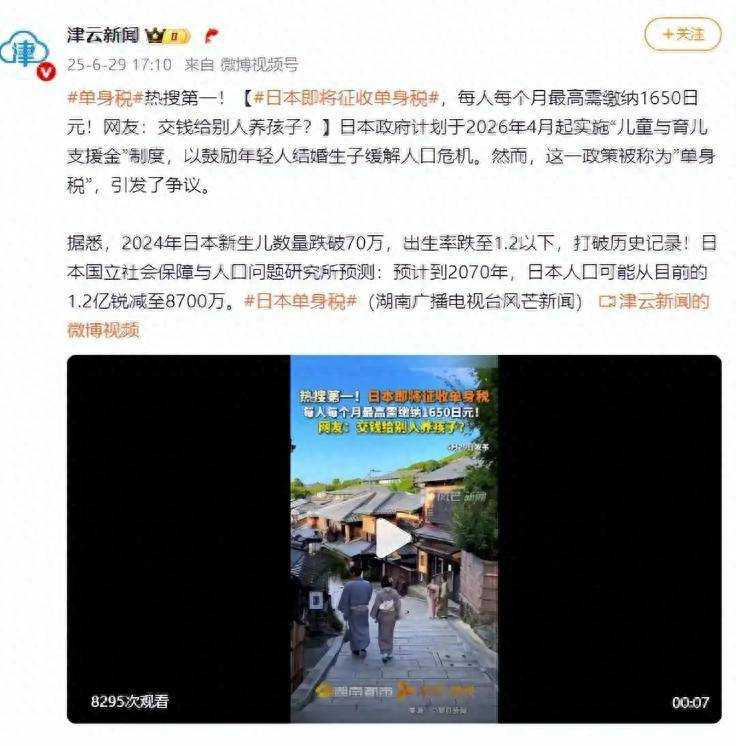
Group 1 - The Japanese government plans to implement a "Child Future Strategy" starting in 2026, requiring all citizens and businesses to pay a "support fund" through health insurance surcharges, with monthly contributions expected to range from 250 to 700 yen by 2028 [3] - The initiative aims to address Japan's declining birth rate, which is projected to fall below 700,000 newborns in 2024, with a birth rate of 1.2, significantly below the replacement level of 2.1 [5] - The strategy includes expanding child allowances and providing educational subsidies to encourage marriage and childbirth among young people [5] Group 2 - In contrast, China faces similar demographic challenges, with a population decrease of 2.08 million in 2023 and a natural growth rate of -0.15‰, alongside a declining birth rate of 9.02 million [5] - The Chinese single population exceeds 240 million, with over 77 million living alone, indicating a significant economic burden on this demographic, which could be exacerbated by a potential "single tax" [6] - China has implemented various measures to encourage childbirth, including the promotion of two-child and three-child policies, extended parental leave, and increased investment in childcare services [7]
最新统计出炉:幼儿园一年关掉2万所,民办校少了1.5万所
Nan Fang Du Shi Bao· 2025-06-15 09:34
Group 1 - The 2024 National Education Development Statistical Bulletin reveals a total of 470,000 schools in China, including 253,300 kindergartens and 152,800 private schools, continuing a decline of over 10,000 schools since 2023 [1] - In the early childhood education sector, the impact of declining birth rates is evident, with 25,330 kindergartens and 35.84 million children enrolled, reflecting a gross enrollment rate of 92.00% [1] - The number of kindergartens decreased by over 20,000 compared to 2023, with a significant drop in the number of inclusive kindergartens from 236,400 to 221,000, a reduction of more than 15,000 [1] Group 2 - The private education sector is facing challenges due to a continuous decline in birth rates, with the number of private schools decreasing from 167,200 to 152,800, a drop of nearly 15,000 [2] - In 2024, there are 46.22 million students enrolled in private schools, accounting for 16.13% of total enrollment, down from 49.40 million in 2023 [2] - The number of private colleges stands at 803, representing 25.75% of all colleges, with a decrease of over 3 million students compared to the previous year [2] Group 3 - The decline in birth rates and total population is directly impacting the private education sector, leading to a shift from rapid expansion to a focus on sustainable growth and differentiation [3] - The number of special education schools increased to 2,396, with 158,200 students enrolled, indicating a growing coverage and support for special education [3] - The number of special education students rose from 155,000 to 158,200, reflecting an upward trend in special education enrollment [3]
全球平均生育率大降!为什么不生?联合国报告这么说→
第一财经· 2025-06-12 12:41
Core Viewpoint - The article discusses the declining birth rates in Japan, South Korea, and globally, highlighting the economic and social factors contributing to this trend, and suggests measures to create a more supportive environment for families [1][2][4]. Group 1: Declining Birth Rates - Japan's newborns in 2024 are projected to be approximately 686,000, a decrease of 41,200 from 2023, marking the first time since 1899 that the number falls below 700,000, 14 years earlier than expected [1] - South Korea has declared a "population emergency" due to its own declining birth rates, reflecting a broader trend across many countries [2] - The UNFPA reports that the global average fertility rate has dropped from 3.31 children per woman in 1990 to 2.3 in 2024, with 55% of countries below the replacement level of 2.1 children [2] Group 2: Economic Factors Influencing Birth Rates - Economic constraints are a significant factor in declining birth rates, with 39% of surveyed individuals citing "financial limitations" as the primary reason for having fewer children than desired [5] - In South Korea, 58% of respondents identified financial constraints as a key reason for their reluctance to have more children [5] - Other economic concerns include job security (21%), housing issues (19%), and lack of quality childcare services (12%) [5] Group 3: Recommendations for Supporting Families - The report emphasizes the need to alleviate economic burdens to enhance fertility intentions, suggesting measures such as paid parental leave, affordable healthcare, and supportive partnerships [7] - Sweden's new law allowing grandparents to receive compensation for childcare is highlighted as an innovative approach to reduce the burden on young parents [7] - The article advocates for equitable parental leave policies to encourage shared parenting responsibilities, which can improve women's workforce participation and men's involvement in childcare [7] Group 4: Government Initiatives - Japan's government aims to increase the male parental leave rate from 30.1% in 2023 to 50% by 2025 and potentially 80% by 2030, with new benefits for immediate paternity leave [8] - South Korea has seen positive changes in birth rates due to government policies such as extended leave, tax reductions, and housing support, with a notable increase in monthly births for nine consecutive months [9] - The report calls for governments to transform into "fertility enablers" to create an environment where individuals can realize their family planning desires [9]

日本2024年新生儿数量与总和生育率均创历史新低
Zhong Guo Xin Wen Wang· 2025-06-04 13:51
Group 1 - Japan's newborn population for 2024 is projected at 686,061, marking a decrease of 41,227 from the previous year and the first time it has fallen below 700,000 since 1899 [1][2] - The total fertility rate for Japan in 2024 is 1.15, a decline of 0.05 from the previous year, representing the lowest level since statistics began in 1947 [1][2] - The highest fertility rate is in Okinawa at 1.54, while Tokyo has the lowest at 0.96 [1] Group 2 - The number of deaths in Japan for 2024 is recorded at 1,605,298, the highest in history, leading to a natural population decrease of 919,237, also a record high [1] - The number of marriage registrations in 2024 is 485,063, an increase of 10,322 from the previous year, while divorce registrations rose by 2,081 to 185,895 [1] - The trend of declining birth rates is attributed to factors such as a decreasing young population and the increasing trend of late marriage and childbearing [2]
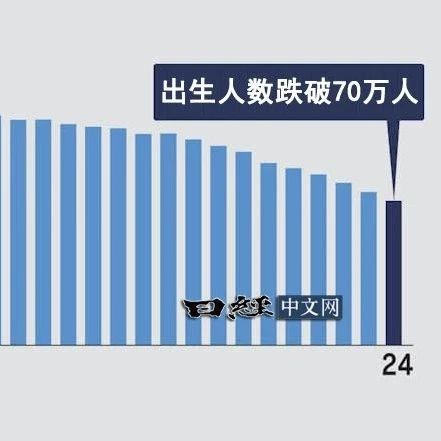
日本2024年出生人数首次跌破70万人
日经中文网· 2025-06-04 06:40
2024年在日本出生的日本儿童人数同比减少5.7%,降至68万6061人,自有统计数据以来首次 跌破70万人。总和生育率降至1.15,连续3年创新低。远远低于维持人口所需的约2.07…… 日本2024年的总和生育率(显示一名女性一生生育孩子的数量)为1.15。较上年(1.20)下降0.05个百 分点,连续3年创历史最低。远远低于维持人口所需的"约2.07"。以2005年的1.26为底部,2015年恢复到 1.45,2016年以后持续减少。 在日本,未婚生育的人很少,非婚生子的比例仅为2.5%(2023年)。未婚和事实婚姻难以生育和育儿 的社会规范根深蒂固,婚姻数的减少将直接导致出生人数下降。 2024年日本的死亡人数增加1.9%,增至160万5298人,人口自然减少(出生人数与死亡人数之差)为91 万9237人,均创出历史新高。人口自然减少的幅度比上年扩大了7万人。1年内减少了与香川县人口(91 万6000人)相同的规模。 人口急剧减少给日本经济的前景投下阴影。 随着劳动年龄人口(15~64岁)的减少,日本劳动力不足的问题日益严重。迄今为止,通过促进女性和 老年人就业,劳动力人口稳步增长,但日趋无法弥补少子化 ...