
要素市场化改革

Search documents
打好要素改革组合拳 激活统一大市场新动能
Zhong Guo Xin Wen Wang· 2025-08-30 14:07
Core Viewpoint - The State Council's meeting on August 29 emphasized the importance of factor market-oriented reforms as a crucial measure for building a high-level socialist market economy and advancing the construction of a unified national market [1][8]. Group 1: Reform Objectives - The meeting outlined three main goals targeting the core shortcomings of the current factor market: price distortion, limited mobility, and imbalanced allocation [4]. - It was highlighted that the market should play a decisive role in resource allocation, with a focus on allowing market-determined pricing, autonomous and orderly flow, and efficient and fair allocation of factors [3][4]. Group 2: Specific Factor Areas - The meeting identified six key factors for targeted reforms: - **Technology**: Emphasizing innovation vitality, addressing issues like patent conversion and intellectual property protection [5]. - **Land**: Focusing on efficient allocation, with urban-rural land reform and revitalization of existing land as priorities [5]. - **Human Resources**: Aiming to guide reasonable mobility, indicating potential breakthroughs in household registration and social security across regions [5]. - **Data**: Accelerating the cultivation and improvement of the market in response to the "Twenty Data Measures," with a focus on foundational institutional implementation [5]. - **Capital**: Enhancing the ability to serve the real economy, aligning with recent financial support for technological innovation [5]. - **Resource and Environment**: Improving market system construction, including trading mechanisms for carbon emissions and water rights [5]. Group 3: Systematic Reform Approach - The meeting signaled a multi-factor collaborative reform approach to avoid institutional friction from isolated reforms, emphasizing the need for systematic enhancement [6]. - "Differentiated exploration" was highlighted as a key term, encouraging targeted pilot reforms in key areas and allowing regions to innovate based on local conditions [6]. Group 4: Interaction Between Local and Central Initiatives - The need for "grassroots innovation + top-level design" was reinforced, with examples of local practices such as data cross-border flow in the east and ecological resource trading in the west [7]. - In the Guangdong-Hong Kong-Macao Greater Bay Area, solutions for medical data interoperability issues were successfully implemented, showcasing practical applications of the reforms [7]. Group 5: Overall Impact - The meeting emphasized the importance of coordination and guidance, aiming to create replicable and scalable practices [8]. - Factor market-oriented reform is not only an economic issue but also a foundational institutional basis for building national competitive advantages, directly impacting the efficiency and resilience of the Chinese economy [8].

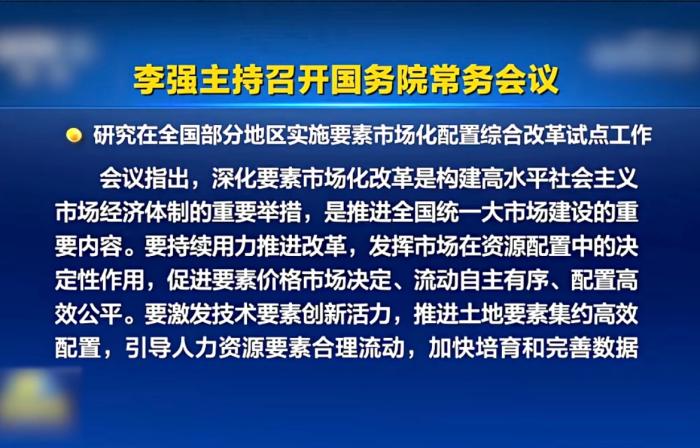
事关深化要素市场化改革,国常会作出新部署
第一财经· 2025-08-30 10:43
Core Viewpoint - The article discusses the new deployment of factor market-oriented reform in China, emphasizing its importance in building a high-level socialist market economy and addressing issues like "involution" in competition [3][5]. Group 1: Reform Objectives and Background - The State Council aims to deepen factor market-oriented reform as a crucial measure for constructing a high-level socialist market economy [3]. - The government report highlights the need to advance the construction of a unified national market, eliminate local protectionism, and address barriers to economic circulation [5]. - Despite 97.5% of commodity and service prices being market-determined, the development of factor markets such as land, labor, capital, technology, and data remains relatively lagging [5]. Group 2: Implementation and Focus Areas - The recent State Council meeting emphasized the need to focus on key areas and encourage differentiated reform explorations in pilot regions [6]. - The goal is to facilitate the smooth flow of advanced production factors towards new productive forces, thereby stimulating market vitality and expanding development space [6][7]. - The reform aims to enhance the efficiency of factor allocation and further unleash societal creativity and market vitality [5][7]. Group 3: Challenges and Progress - Current challenges in the factor market include an inadequate pricing mechanism, particularly in land, technology, and data markets, due to systemic barriers and administrative interference [7][8]. - The article notes that significant progress has been made in various areas, including land supply methods and the establishment of technology and data markets [7]. - The need for a unified assessment system in the technology market is highlighted, as the lack of such a system hampers the realization of market value for innovative achievements [8]. Group 4: Data Market Development - The article emphasizes the importance of data as a new production factor, with ongoing reforms aimed at establishing a national integrated data market and improving data property rights [9]. - The National Data Bureau is actively promoting data market-oriented reforms, introducing policies to enhance data sharing and utilization [9]. - The establishment of a credible data infrastructure is crucial for ensuring efficient data circulation and application in various scenarios [9].

事关深化要素市场化改革,国常会作出新部署
Di Yi Cai Jing· 2025-08-30 08:19
Group 1 - The core viewpoint emphasizes the importance of deepening factor market-oriented reforms as a crucial measure for building a high-level socialist market economy system [1][3] - The State Council meeting highlighted the need for differentiated reform explorations in pilot areas to break down institutional barriers and enhance market efficiency [1][3] - The government aims to address the challenges of "involution" competition and create a fairer market environment to stimulate endogenous economic growth [1][2] Group 2 - The report indicates that 97.5% of commodity and service prices in China are now market-determined, but factor markets such as land, labor, capital, technology, and data remain underdeveloped [2][4] - The 2021 pilot program aims to complete the reform tasks by 2025, achieving significant results in factor market-oriented allocation [2][3] - The current pricing mechanisms for land, technology, and data markets are inadequate, leading to challenges in realizing the value of these factors [4][5] Group 3 - The government is focusing on enhancing the innovation vitality of technology factors, promoting efficient land allocation, and improving the flow of human resources [5][6] - The reform of data as a new production factor is a key focus, with initiatives aimed at establishing a national integrated data market and improving data property rights [5][6] - The National Data Bureau is actively promoting data factor market-oriented reforms, with policies aimed at enhancing data sharing and utilization [6]
国务院常务会议解读|国务院研究实施要素市场化配置综合改革试点工作
Xin Hua She· 2025-08-30 07:57
Core Viewpoint - The State Council's meeting on the 29th emphasized the importance of deepening factor market-oriented reforms as a crucial step in building a high-level socialist market economy and promoting a unified national market [1][2] Group 1: Policy Initiatives - The meeting outlined a series of targeted deployments for implementing comprehensive pilot reforms in factor market-oriented allocation in certain regions [1] - The reforms aim to address "involution" competition issues, create a fairer market environment, and stimulate endogenous economic growth [1] Group 2: Historical Context - The implementation of the "Opinions on Building a More Complete Factor Market-Oriented Allocation System" by the Central Committee and the State Council in 2020 laid the foundation for these reforms [1] - The 20th National Congress proposed improving factor market systems and rules to facilitate the smooth flow of production factors and efficient resource allocation [1] Group 3: Focus Areas for Reform - The reforms will focus on stimulating innovation in technological factors, promoting efficient land use, guiding the rational flow of human resources, and accelerating the cultivation of a data factor market [1] - Key areas and critical links will be prioritized for pilot reforms, encouraging localized and bold innovations [1] Group 4: Government Role - The relationship between an effective market and a proactive government is crucial for the success of these reforms [2] - The government is expected to correct market failures and regulate competition to ensure effective market operation [2] Group 5: Expected Outcomes - Successful implementation of the pilot reforms is anticipated to enhance market vitality and open up new development spaces by allowing advanced production factors to flow smoothly towards new productive forces [2]
国务院常务会议:部署开展县域普通高中振兴行动等
Jing Ji Guan Cha Bao· 2025-08-30 03:29
Group 1 - The meeting emphasized the importance of deepening factor market-oriented reforms as a crucial measure for constructing a high-level socialist market economy system and promoting the construction of a unified national market [1] - The focus is on enhancing the market's decisive role in resource allocation, promoting market determination of factor prices, and ensuring efficient and fair allocation [1] - Key areas for reform include stimulating innovation in technological factors, promoting efficient allocation of land factors, guiding reasonable flow of human resources, and accelerating the cultivation of a data factor market [1] Group 2 - The construction of county-level ordinary high schools is vital for the growth and success of countless students, especially those from rural areas [2] - The meeting called for optimizing resource allocation to accelerate the construction of county-level ordinary high schools, adapting to urbanization and population flow trends [2] - The implementation of the Medical and Health Strengthening Foundation Project is crucial for the health and well-being of the population, focusing on enhancing grassroots medical and health service functions [2]
美上诉法院裁定特朗普大部分全球关税政策非法;纳指月线5连涨;净利增76%,阿里巴巴大涨13%;贵州茅台控股股东拟增持至少30亿元丨每经早参
Mei Ri Jing Ji Xin Wen· 2025-08-29 23:00
Group 1 - The State Council, led by Premier Li Qiang, is implementing pilot reforms for market-oriented allocation of factors in several regions, aiming to enhance resource allocation efficiency and promote a unified national market [4] - The meeting emphasized the importance of continuous reform efforts to stimulate innovation in technology and improve the flow of human resources [4] - The meeting also discussed the revitalization of county-level high schools and approved the implementation plan for strengthening basic medical and health services [4] Group 2 - The U.S. stock market saw a collective decline, with the Nasdaq down 1.15%, the S&P 500 down 0.64%, and the Dow Jones down 0.2% [4] - Major tech stocks experienced significant drops, with Tesla, Nvidia, and AMD falling over 3% [4] - Chinese concept stocks mostly rose, with the Nasdaq China Golden Dragon Index increasing by 1.55%, and Alibaba's stock surged nearly 13% [4] Group 3 - International precious metal futures generally rose, with COMEX gold futures up 1.20% to $3516.10 per ounce, and silver futures up 2.64% to $40.75 per ounce [5] - The oil prices declined, with WTI crude oil down 0.91% to $64.01 per barrel, while Brent crude oil fell 0.76% to $67.46 per barrel [6] Group 4 - The China Securities Regulatory Commission (CSRC) aims to consolidate the positive momentum in the capital market and enhance its attractiveness and inclusiveness [7] - The CSRC plans to deepen investment and financing reforms and promote long-term and value investing [7] Group 5 - From January to July 2025, state-owned enterprises reported total operating revenue of 473,110.9 million yuan, remaining flat year-on-year, while total profits decreased by 3.3% to 24,786.4 million yuan [8] - The asset-liability ratio for state-owned enterprises increased to 65.1% by the end of July, up 0.3 percentage points year-on-year [8] Group 6 - In July 2025, the bond market issued a total of 77,536.2 million yuan in various bonds, including government bonds and corporate credit bonds [9] - The issuance included 12,226.5 million yuan in national bonds and 13,496.8 million yuan in corporate credit bonds [9] Group 7 - The total market capitalization of listed companies in China reached nearly 95 trillion yuan by the end of July 2025, marking the highest point in nearly three years [11] - There are 5,427 listed companies in total, with 137 companies having a market capitalization exceeding 1,000 million yuan [11] Group 8 - In July 2025, 1,874 private asset management products were registered by securities and futures institutions, marking a 33.95% increase month-on-month [12] - The total scale of private asset management products reached 12.48 trillion yuan by the end of July [12] Group 9 - Alibaba reported a net profit increase of 76% for the first quarter of the 2026 fiscal year, with revenue of 247.65 billion yuan, a 2% year-on-year growth [20] - The adjusted EBITDA for the first quarter was 45.74 billion yuan, while free cash flow showed a net outflow of 18.815 billion yuan [20] Group 10 - Huawei reported a revenue of 427.04 billion yuan for the first half of 2025, a year-on-year increase of 3.95%, while net profit decreased by 32% to 371.95 billion yuan [21] - R&D investment reached 96.95 billion yuan, accounting for 22.7% of revenue [21] Group 11 - Xiaomi announced a voluntary recall of certain PB2030MI model power banks due to potential safety hazards from specific battery cells [31] - The recall affects 146,891 units produced between August and September 2024 [31]


增强资本要素服务实体经济能力
Zhong Guo Zheng Quan Bao· 2025-08-29 22:26
Group 1 - The core viewpoint of the meeting emphasizes the importance of deepening factor market-oriented reforms as a crucial measure for building a high-level socialist market economy and promoting the construction of a unified national market [1] - The meeting outlines the need to enhance the innovation vitality of technological factors, promote efficient allocation of land factors, and guide the reasonable flow of human resources [1] - The meeting stresses the importance of optimizing resource allocation in the construction of county-level ordinary high schools to support the growth and development of students, especially those from rural areas [2] Group 2 - The implementation of the Medical and Health Strengthening Foundation Project is highlighted as essential for improving the health and well-being of the population, with a focus on enhancing grassroots medical services [2] - The meeting calls for increased investment in grassroots medical and health institutions and the improvement of medical insurance payment policies to better meet the diverse health service needs of the public [2] - The meeting also discusses the need for coordinated efforts in medical, health insurance, and pharmaceutical policies to strengthen the capabilities of grassroots healthcare [2]
国常会研究在全国部分地区实施要素市场化配置综合改革试点工作
Shang Hai Zheng Quan Bao· 2025-08-29 19:52
Group 1: Market-oriented Reform - The meeting emphasized that deepening market-oriented reform of factors is a crucial measure for building a high-level socialist market economy system and advancing the construction of a unified national market [1] - The focus is on promoting the decisive role of the market in resource allocation, ensuring efficient and fair allocation of factors, and enhancing the service capacity of capital elements to the real economy [1] - Key areas for reform include innovation in technological factors, efficient allocation of land resources, and the establishment of a data factor market [1] Group 2: Education Reform - The construction of county-level ordinary high schools is vital for the growth and success of many students, especially those from rural areas [2] - The meeting called for optimizing resource allocation to accelerate the development of county-level high schools, addressing shortcomings in development, and improving both hardware and software aspects of education [2] - Emphasis was placed on creating a conducive learning environment that supports students' physical and mental health and overall development [2] Group 3: Healthcare Improvement - The implementation of the healthcare foundation project is crucial for the health and well-being of the population [2] - Strengthening the functionality of grassroots medical and health services is prioritized, with a focus on chronic disease prevention and rehabilitation care [2] - The meeting highlighted the need for coordinated efforts in medical, insurance, and pharmaceutical policies to enhance the capabilities of grassroots healthcare institutions [2]
国常会研究在全国部分地区 实施要素市场化配置综改试点
Zheng Quan Shi Bao· 2025-08-29 19:11
Group 1 - The core viewpoint of the meeting emphasizes the importance of deepening factor market-oriented reforms as a crucial measure for building a high-level socialist market economy and promoting the construction of a unified national market [1] - The meeting outlines the need to enhance the innovation vitality of technological factors, promote efficient allocation of land factors, and guide the reasonable flow of human resources [1] - It highlights the necessity of accelerating the cultivation and improvement of the data factor market and enhancing the service capacity of capital factors for the real economy [1] Group 2 - The meeting stresses the significance of constructing county-level ordinary high schools for the growth and success of countless students, especially those from rural areas [2] - It calls for scientific optimization of resource allocation to accelerate the construction of county-level ordinary high schools, adapting to urbanization and population flow trends [2] - The meeting emphasizes the implementation of the Medical and Health Strengthening Foundation Project, focusing on enhancing grassroots medical and health service functions to better meet the diverse and high-quality health service needs of the public [2]
国常会:深化要素市场化改革,引导试点地区开展差别化探索
2 1 Shi Ji Jing Ji Bao Dao· 2025-08-29 13:41
但是,当前土地市场改革难点不少,劳动力合理畅通流动存在阻碍,数据孤岛难题待解,资本市场支持 科技发展的能力有待提升,要素市场化改革仍需进一步深化。 南京财经大学国际经贸学院教授杨向阳表示,我国要素市场化配置改革已取得显著成效,但是依然面临 不少挑战。进一步深化土地、劳动力、资本等传统要素价格改革,应健全城乡统一的建设用地价格形成 机制,支持有条件的地区加快打破户籍限制等壁垒,推动形成多层次资本市场定价。完善技术、数据等 新型要素评估及定价标准,继续优化专利价值评估体系,积极发展技术交易市场;鼓励和支持制定数据 资产确权、定价、交易等规则,培育建设一批专业化数据交易平台。建议构建跨行政区合作发展新机 制,可以在长三角、粤港澳大湾区等设立跨行政区要素交易中心,定期评估试点效果,总结具有复制推 广价值的经验。 十四届全国政协经济委员会副主任、中央财经委员会办公室原副主任尹艳林对21世纪经济报道记者表 示,推进深层次改革,既是破解发展难题的"突破口",更是面向未来竞争的"关键招"。推进人力资源要 素合理流动,要深化户籍制度改革。下一步,户籍制度改革,必须两头发力。一方面是保障农民合法权 益,增强进城落户意愿。要保障进 ...