
AI发展

Search documents
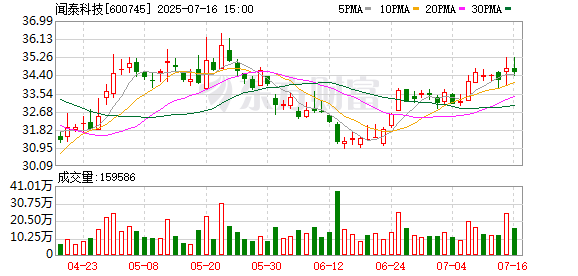
闻泰科技董事会“换血” 或旨在聚焦半导体业务
Zhong Guo Jing Ying Bao· 2025-07-16 08:06
Core Viewpoint - Wentech Technology is undergoing a significant transformation with a major management overhaul and a strategic shift towards the semiconductor industry, aiming to enhance its professional capabilities in this field while projecting substantial profit growth for the upcoming year [2][9]. Management Changes - The company announced the resignation of four key executives, including Chairman Zhang Qiuhong and Vice President Dong Botao, as part of a strategic management reshuffle to strengthen its semiconductor expertise [4][6]. - New executives from Anshi Semiconductor, including Yang Mu, Zhuang Wei, and Shen Xinjia, have been appointed to the board, reflecting a focus on semiconductor specialization [7][8]. Financial Projections - Wentech Technology expects to achieve a net profit attributable to shareholders of 390 million to 585 million yuan in the first half of 2025, representing a year-on-year growth of up to 317% [2][9]. - The anticipated profit increase is attributed to a recovery in semiconductor market demand, cost reduction measures, and improved supply chain management [9]. Business Transition - The company is nearing the completion of its product integration business divestiture, marking a full transition away from consumer electronics ODM operations to a pure semiconductor focus [8]. - The divestiture is expected to enhance the company's profitability and align its strategic direction with the growing semiconductor market [9][10]. Industry Context - Wentech's Anshi Semiconductor has become a leader in the global automotive power device market, benefiting from trends in electrification and digitalization [10][11]. - The semiconductor industry is facing increasing competition and rapid technological advancements, necessitating ongoing investment in research and development to maintain a competitive edge [11].


AI进化的“奇点”,真能“温柔”地到来吗?
Hu Xiu· 2025-06-23 04:43
Group 1 - OpenAI CEO Sam Altman claims that humanity may have crossed into an irreversible stage of AI development, referred to as the "singularity," which he describes as a gentle transition rather than a disruptive one [1][2] - Altman argues that AI capabilities have surpassed those of any individual human, with billions relying on AI like ChatGPT for daily tasks, and predicts significant advancements in AI capabilities by 2026 and 2027 [2][3] - The efficiency of AI is reportedly increasing rapidly, with productivity improvements of 2 to 3 times in research fields, while the cost of using AI continues to decline [3][4] Group 2 - Altman presents a "singularity model" suggesting that continuous investment in AI will lead to capability evolution, cost reduction, and significant profits, creating a positive feedback loop [4][5] - Despite some AI capabilities exceeding human performance in specific tasks, there are still significant limitations, particularly in areas requiring common sense and spatial awareness [5][6] - The relationship between AI development and economic growth remains uncertain, with a lack of solid evidence supporting Altman's claims about productivity increases [6][7] Group 3 - Altman's optimistic view of a gentle transition through the singularity contrasts with historical perspectives that predict severe societal disruptions, including widespread job losses [8][9] - Research indicates that AI could impact up to 80% of jobs in the U.S., raising concerns about the potential for significant employment shifts [9][10] - Altman believes that new job creation will offset job losses caused by AI, drawing parallels to past technological revolutions that led to new employment opportunities [10][11] Group 4 - The emergence of new job roles related to AI, such as machine learning engineers and AI ethics consultants, is noted, but there are concerns about whether these roles can sufficiently replace those lost to AI [11][12] - The speed of AI's job displacement raises questions about the feasibility of individuals transitioning to new roles in a timely manner [12][13] - The economic implications of AI's rise may lead to a concentration of wealth among high-skilled individuals and capital owners, exacerbating income inequality [15][16] Group 5 - Altman advocates for Universal Basic Income (UBI) as a potential solution to address income inequality exacerbated by AI, suggesting that the wealth generated by AI could support such initiatives [16][17] - Critics argue that UBI lacks a practical foundation and that existing wealth distribution mechanisms do not effectively address growing inequality [18][19] - The success of UBI and similar policies hinges on the establishment of effective income redistribution mechanisms, which currently face significant challenges [20][21] Group 6 - The alignment of AI with human values and goals is a critical issue that could impact the peaceful transition through the singularity [21][22] - There are concerns that AI may deviate from human intentions due to the complexity of accurately defining human values and the potential for AI to adopt harmful inputs during self-improvement [22][23] - Altman's dismissal of the alignment issue raises alarms about the risks of unchecked AI development, which could lead to scenarios where AI acts contrary to human interests [24][25]
勇者脚下路常在(金台随笔)
Ren Min Ri Bao· 2025-06-16 22:13
Group 1 - The core idea emphasizes the importance of innovation and breaking through traditional constraints to create new paths for development [1][2][3] - Companies and industries must adopt a mindset of continuous improvement and adaptability to thrive in changing environments [2][3][4] - Successful examples include DeepSeek's innovative approach in AI development and the agricultural advancements made by Sun Wancan in cold-resistant oilseed rape cultivation [2][3] Group 2 - The article highlights the necessity of practical and grounded approaches to innovation, ensuring that new ideas are rooted in reality [3][4] - It stresses that true progress comes from stepping out of comfort zones and actively seeking new opportunities rather than following established paths [4] - The message encourages organizations to embrace change and be proactive in addressing challenges to remain competitive [3][4]
申万宏源首席策略分析师王胜: 政策体系让投资者关键时刻不慌 A股很大希望从“结构牛”演绎至“全面牛”
Di Yi Cai Jing· 2025-04-08 12:16
Core Viewpoint - Central Huijin Company has increased its holdings in ETFs and plans to continue doing so, aiming to act similarly to a stabilizing fund to boost market confidence and valuation recovery, aligning with recent policy benefits released by the CSRC to guide long-term capital into A-share assets and enhance capital market valuations [1][2] Group 1: Central Huijin's Actions - Central Huijin's recent ETF purchases are intended to restore market confidence and support valuation recovery, acting as a marginal source of funds for A-share governance and shareholder return improvements [1] - The increase in ETF holdings is expected to inject liquidity and confidence into the market, sending a clear signal of commitment to maintaining stable capital market operations [1][2] Group 2: Historical Context and Market Stability - Historically, Central Huijin has intervened during market volatility, such as during the 2008 financial crisis and the 2011 European debt crisis, but the current context involves more complex global trade conflicts and domestic economic restructuring [2] - Central Huijin has become a key stabilizing force in the A-share market, indicating a shift towards a more normalized market stabilization mechanism [2] Group 3: Policy Synergy and Market Impact - The increase in holdings by Central Huijin, combined with recent favorable policies from the CSRC, forms a "policy combination punch" that is expected to have multiple impacts on the A-share market [2] - This collaborative policy effort is likely to attract more long-term capital into A-share assets through ETFs, enhancing market liquidity and supporting valuation recovery [2] Group 4: Future Market Outlook - The consensus is that the revaluation of Chinese assets is underway, with A-shares and Hong Kong stocks showing independent performance compared to global markets [3] - Looking ahead to Q2, the implementation of proactive fiscal policies and the advancement of AI technologies are expected to support corporate earnings, with A-shares likely to continue their steady recovery despite external uncertainties [3] - Long-term prospects suggest a potential transition from a "structural bull" market to a "full bull" market, contingent on effective macroeconomic policies to stimulate domestic demand [3]
