多边主义

Search documents
虽未取得预期目标但转型是“大势所趋”,贝伦气候峰会“加时谈判”后闭幕
Huan Qiu Shi Bao· 2025-11-23 22:55
Core Insights - The COP30 climate conference in Belem, Brazil, concluded with a "voluntary political document" after extended negotiations, failing to achieve expected goals due to differing demands from participating countries [1][2] - The final document titled "Global Mobilization: Unity and Cooperation to Address Climate Change Challenges" aims to promote the implementation of the Paris Agreement, covering aspects such as mitigation, adaptation, funding, and international cooperation [1][3] Group 1: Conference Outcomes - The conference did not reach consensus on phasing out fossil fuels, which disappointed some environmental organizations in Brazil [1][2] - Developed countries agreed to triple climate financial aid to developing nations, committing to provide $120 billion annually starting in 2035 to address damages from global warming [2] Group 2: Negotiation Dynamics - Tensions during negotiations were high, with Colombia's representative strongly opposing a climate document that disregarded scientific evidence, labeling it as ineffective [2] - Over 80 countries, led by the UK, France, and Colombia, advocated for a transition plan from fossil fuels based on resolutions from COP28, facing strong opposition from major oil-producing countries like Saudi Arabia and Russia [2] Group 3: Global Climate Diplomacy - COP30 marked the first formal acknowledgment of the significant risk of a 1.5-degree Celsius global temperature rise, despite criticisms of the conference's limited outcomes [3] - The conference was seen as a test of globalization and multilateralism, with the ability to reach a consensus document indicating a glimmer of hope for global climate diplomacy [3] - UN Secretary-General António Guterres emphasized that the political document reflects a collective commitment to tackle challenges that cannot be addressed individually [3]
李强在二十国集团领导人第二十次峰会上的讲话
Xin Hua She· 2025-11-23 15:52
Group 1 - The theme of the G20 summit is "Unity, Equality, and Sustainability," with a strong emphasis on "Unity" as a key to overcoming global challenges [2] - The G20 was established in response to the Asian financial crisis in 1999 and has evolved to address various global economic issues, highlighting the importance of cooperation among diverse member states [2][3] - Current global challenges include unilateralism and protectionism, which threaten international cooperation and require the G20 to seek solutions to restore unity [2][3] Group 2 - The G20 should promote free trade and an open world economy to facilitate mutual benefits among nations, with China announcing initiatives to support industrialization in Africa and alleviate debt in developing countries [3][4] - Addressing climate change and ecological issues is crucial, with the G20 urged to enhance cooperation in environmental protection and achieve the goals of the Paris Agreement [4][5] - The G20 is called to strengthen global food security and ensure stable supply chains, particularly for countries facing hunger, by optimizing food distribution and enhancing agricultural cooperation [5][6] Group 3 - The rapid advancement of technology presents both opportunities and challenges, necessitating equitable access to development and the benefits of innovation for all nations [6][7] - The G20 should facilitate cooperation in artificial intelligence and critical minerals to ensure sustainable supply and resource security, while also addressing potential security risks [6][7] - Empowering developing countries, particularly in Africa, through capacity building and technological support is essential for inclusive global development [7][8]
闪评 | G20峰会通过联合宣言 美国缺席“聪明反被聪明误”
Yang Shi Xin Wen Ke Hu Duan· 2025-11-23 15:48
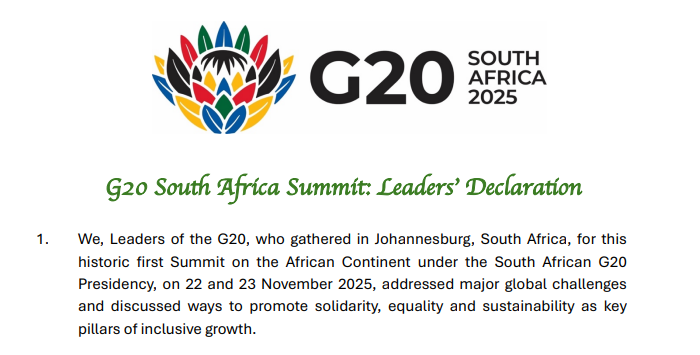
二十国集团(G20)领导人第二十次峰会当地时间11月22日在南非约翰内斯堡开幕。南非国际关系与合作部长罗纳德•拉莫拉在当天下午召开的记 者发布会上表示,与会各方已就会议核心议程达成共识,并通过了《二十国集团领导人约翰内斯堡峰会宣言》。 二是要加强团结合作。面对气候变化、可持续发展以及公共健康危机等全球性问题,只有国际社会团结起来才能够有效应对。 二十国集团领导人第二十次峰会官网截图 这是G20峰会首次于开幕当日通过联合宣言。峰会宣言共包含122条内容,强调通过多边合作应对全球挑战,并呼吁加强对发展中国家的支持,以 推动包容性增长与可持续发展。这反映了当前国际社会的共识与诉求,将重塑未来的国际秩序。 二十国集团领导人第二十次峰会现场 中国社科院西亚非洲研究所研究员朱伟东: 85 0:00 / 0:00 一是坚持多边主义。目前国际社会面临治理迟滞、和平迟滞、发展迟滞和安全迟滞等问题,这些问题的解决需要在多边框架下进行,而某些西方 大国奉行的单边主义、保护主义只会恶化这些全球性问题。 来源 | 总台环球资讯 三是要重视全球南方的呼声与需求。全球南方国家在西方主导的国际经济秩序中缺乏代表性和发言权,他们在应对气候变化 ...

李强会见德国总理默茨
Xin Hua She· 2025-11-23 15:12
Group 1 - The core viewpoint emphasizes the importance of mutual respect and win-win cooperation in the Sino-German relationship, which has been strengthened over 53 years of diplomatic ties [1] - Both countries are committed to enhancing strategic communication and expanding practical cooperation across various fields, including emerging sectors such as new energy, smart manufacturing, and biotechnology [2] - The Chinese side expresses a willingness to collaborate with Germany to seize future development opportunities and promote global governance while maintaining multilateralism and free trade [2] Group 2 - The German Chancellor acknowledges the strong development of Sino-German relations and the increasing economic interdependence, highlighting the mutual benefits of their economic partnership [3] - Germany is open to deepening bilateral political and economic relations and is keen to explore cooperation in technology and other emerging fields [3] - Both countries are seen as beneficiaries and supporters of economic globalization, with Germany willing to enhance communication and coordination in international affairs to maintain free trade and a multilateral trading system [3]
新华时评丨为全球治理体系变革凝聚南方共识
Xin Hua She· 2025-11-23 14:38
Group 1 - The G20 summit held in Johannesburg marks the first time the event is hosted on the African continent, reflecting the collective desire of global South countries to express development demands and play a greater role in global governance reform [1] - The G20 members account for approximately 85% of the global economy and represent two-thirds of the world's population, making it a key platform for global economic governance [1] - The summit's declaration emphasizes the need for multilateral cooperation to address global challenges and calls for increased support for developing countries to promote inclusive growth and sustainable development [1] Group 2 - The current international situation is characterized by rising unilateralism, protectionism, and geopolitical tensions, leading to sluggish global economic growth and an expanding development gap [2] - A report released before the summit highlights significant disparities between the global North and South in wealth, trade, resources, and education, warning that global prosperity cannot be built on the foundation of increasing poverty for the poor and wealth for the rich [2] - The Johannesburg summit, themed "Unity, Equality, and Sustainability," is particularly important as the global South accelerates its awakening, transitioning from passive participants in international rules to key shapers of global governance [2] Group 3 - As a major G20 member and the largest developing country, China is committed to promoting unity and revitalization among the global South [3] - China's global governance initiative, proposed in September, emphasizes principles such as sovereign equality, adherence to international law, and a focus on people-centered, action-oriented approaches, gaining broad international recognition [3] - The deepening cooperation between China and Africa aims to enhance the autonomous development capabilities of African countries and elevate the importance of the African development agenda in the international community [3]
和音:共同推动全球气候治理行稳致远
Ren Min Ri Bao· 2025-11-23 11:10
COP30期间,中国发挥积极建设性作用,与各方一道支持主席国巴西推动大会取得成功,致力于在坚持 多边主义、聚焦行动落实的基础上,为下一个10年的全球气候治理指明方向、创造条件。中方举办 了"中国角"系列边会,主题包括中国碳达峰碳中和之路、中国能源转型与新能源发展等,为全球气候治 理提供中国经验参考。COP30主席多拉戈称赞,"中国提出的解决方案惠及所有人,而不仅仅是中国自 身。" 人与自然和谐共生是中国式现代化的鲜明特点。中国将碳达峰碳中和作为国家战略,构建了全球最系统 完备的碳减排政策体系,建成了全球最大、发展最快的可再生能源体系,是世界能耗强度下降最快的国 家之一。中国的绿色发展正不断为世界增添新绿意。 在应对气候变化领域,中国是多边主义的坚定拥护者、国际合作的积极推动者、低碳技术的主要贡献 者、绿色转型的重要引领者。中国始终积极落实《联合国气候变化框架公约》及其《巴黎协定》,落实 2030年国家自主贡献取得显著成效,提前完成风电、太阳能发电总装机容量和森林蓄积量等目标。截至 2025年10月底,中国已与43个发展中国家签署55份气候变化南南合作谅解备忘录。中国已向《联合国气 候变化框架公约》秘书处提交了 ...
新华时评:为全球治理体系变革凝聚南方共识
Xin Hua She· 2025-11-23 11:10
Group 1 - The G20 summit, held for the first time in Africa, emphasizes the collective desire of global South countries to express development demands and play a greater role in global governance reform [1] - The summit's declaration stresses the importance of multilateral cooperation to address global challenges and calls for increased support for developing countries to promote inclusive growth and sustainable development [1] - South African President Ramaphosa highlighted the need for the G20 agenda to reflect the development priorities of the global South and Africa, which is crucial for global stability, resource pressure alleviation, and conflict risk reduction [1] Group 2 - The current international situation is characterized by unilateralism, protectionism, and geopolitical tensions, leading to sluggish global economic growth and widening development gaps [2] - A report released before the summit revealed alarming disparities in wealth, trade, resources, and education between the global North and South, indicating that global prosperity cannot be built on the foundation of increasing poverty for the poor and wealth for the rich [2] - The Johannesburg summit, themed "Unity, Equality, Sustainability," is particularly significant as the global South accelerates its awakening and transitions from passive participants to key shapers of global governance [2] Group 3 - As a major G20 member and the largest developing country, China is committed to promoting unity and revitalization among global South countries [3] - China's global governance initiative, proposed in September, emphasizes sovereign equality, adherence to international law, multilateralism, and a people-centered approach, gaining broad international recognition [3] - The deepening of China-Africa cooperation focuses on enhancing the autonomous development capabilities of African countries and increasing the international community's attention to the African development agenda [3]
COP30大会闭幕 各方就多个议题达成共识
Yang Shi Xin Wen· 2025-11-23 08:25
Core Points - The COP30 conference concluded in Belem, Brazil, with the adoption of a comprehensive agreement titled "Global Mobilization and Collaborative Response to Climate Change Challenges" [1] - The agreement emphasizes climate financing, technological cooperation, and international collaboration as essential actions to address climate change [3] - This year marks the tenth anniversary of the Paris Agreement, prompting countries to prioritize consensus and action over differences in tackling global climate issues [3] Group 1 - The conference highlighted the view that climate change is a shared global challenge, particularly for developing countries, which face severe impacts [4] - There is a call for strengthening multilateral cooperation and using scientific methods to address global warming [6] - The absence of the United States and the rise of unilateralism, along with geopolitical tensions, pose challenges to global climate governance [8] Group 2 - The conference chair emphasized China's commitment to true multilateralism and its role as a practitioner of climate action and a promoter of global green development [8] - The chair also noted that China and Brazil share similar goals, with China's delegation playing a crucial role in the negotiations [10]
李强会见意大利总理梅洛尼
Xin Hua She· 2025-11-23 07:37
梅洛尼表示,意中关系发展势头良好,双边各层级交往不断,务实合作取得积极进展。意方愿同中方以 庆祝两国建交55周年为契机,用好意中政府委员会、经济合作混委会等机制,加紧落实关于加强全面战 略伙伴关系的行动计划,深化贸易、投资、科技等领域合作,促进人文交往。意方欢迎更多中国企业赴 意投资兴业,鼓励意企业继续投资中国。意方愿同中方加强在多边平台的沟通协调,共同维护多边主 义。(完) 责任编辑:何俊熹 新华社约翰内斯堡11月23日电(记者白舸 王越)当地时间11月22日,国务院总理李强在约翰内斯堡会 见意大利总理梅洛尼。 李强表示,今年是中意建交55周年。去年7月,习近平主席同总理女士在北京举行会晤,就深化中意关 系作出战略规划。一年多来,双方积极落实两国领导人重要共识。中方愿同意方进一步弘扬传统友好, 加强发展战略对接,打造更加稳定、更富成果的全面战略伙伴关系。 李强指出,中方愿同意方持续推进双向开放,加强市场、产业等联通对接,推动双边贸易优化平衡发 展,做强传统合作优势,拓展新兴产业交流合作,促进共同发展繁荣。中方欢迎更多意大利企业借助进 博会、服贸会、消博会、链博会等平台进入中国市场,希望意方为中国企业赴意投资 ...
李强出席二十国集团领导人第二十次峰会第一阶段会议并发表讲话
证监会发布· 2025-11-23 03:14
Group 1 - The core message emphasizes the importance of unity among G20 members to address global economic challenges, highlighting that division is not a viable solution [2][3] - The article discusses the need for maintaining free trade and building an open world economy in the face of economic recovery difficulties [3] - It stresses the necessity of reforming international institutions like the World Bank and IMF to enhance the voice of developing countries and create a fairer international economic order [3] Group 2 - The G20 has become a crucial platform for international cooperation over the past 20 years, addressing challenges and sharing opportunities [3] - The article mentions initiatives such as the "Implementation of the G20 Support for Africa and Least Developed Countries Industrialization Initiative" and the establishment of a global development academy to promote collective development [3] - It calls for G20 members to take responsibility, strengthen collaboration, and uphold multilateralism to tackle ongoing global uncertainties [3]