
产教融合

Search documents
深职大与龙头企业协同育人(民生一线·职业教育观察)
Ren Min Ri Bao· 2025-09-17 22:22
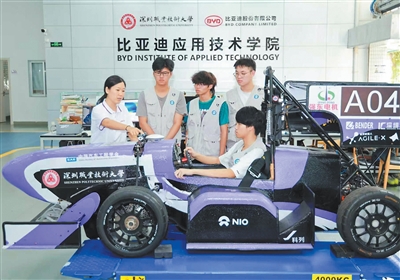
Core Points - Shenzhen Polytechnic University has established a collaborative education model with industry associations and Fortune 500 companies, creating 16 specialized industry colleges to enhance vocational education's appeal and recognition [2][4][7]. Group 1: Enrollment and Academic Performance - This year, 100% of the admitted students in physics and history at Shenzhen Polytechnic University exceeded the provincial control line, with 10 students scoring above 600 in physics [4]. - The university's successful enrollment reflects the increasing attractiveness and recognition of vocational undergraduate education [4]. Group 2: Industry-Education Integration - The university emphasizes integrating professional courses with the industrial chain, extending classrooms to industrial parks, and embedding talent cultivation into production lines [5][6]. - The collaborative model has led to significant achievements, such as a graduate applying for 14 patents within three years, with 8 already authorized for use [5]. Group 3: Collaborative Projects and Achievements - Shenzhen Polytechnic University has established a "nine common" model for school-enterprise cooperation, including joint curriculum development and addressing key technological challenges [6][8]. - The university has initiated over 1,400 technology development and consulting projects for enterprises in the past three years, establishing 43 joint research centers with leading companies like DJI [8]. Group 4: Internationalization and Global Competence - The university has launched international training programs to meet the talent needs of companies like BYD in overseas markets, creating pathways for students to work abroad [9][10]. - It has established partnerships with 205 institutions across 45 countries and regions, promoting the internationalization of vocational education and the export of "Chinese standards" [11].

激发潜能打造行业产教融合共同体
Xin Hua Ri Bao· 2025-09-17 21:45
Core Viewpoint - The article emphasizes the importance of vocational education in cultivating high-skilled talent to advance China's modernization, highlighting the need for deeper integration between industry and education through the establishment of industry-education integration communities [1] Group 1: Community Construction - The construction of industry-education integration communities is crucial for promoting deep integration of education and industry, addressing the supply-side reform of high-quality technical talent, and facilitating industrial transformation [1] - Current challenges in community construction include a disconnect between educational institutions and enterprises, outdated curriculum content, and insufficient practical experience among educators, necessitating further collaboration and potential activation [1] Group 2: Strategic Planning - Accurate understanding of the goals for community construction is essential, with a focus on integrating community development with regional economic and social planning, as well as talent strategy [2] - Establishing a robust operational mechanism based on property rights and interests is necessary to facilitate long-term collaboration between schools and enterprises, ensuring effective talent supply and demand matching [2] - A systematic layout should be developed based on regional industry characteristics and educational resources, addressing specific issues and value needs to advance community construction [2] Group 3: Institutional Collaboration - Promoting the integration of technological innovation and talent cultivation is vital, with an emphasis on the role of leading enterprises in initiating and leading community construction [3] - Enhancing enterprise participation in curriculum development and practical training is crucial, focusing on the needs of technological upgrades and innovation [3] - Establishing a mutual recognition mechanism for positions between schools and enterprises, and incorporating outstanding talents into a skills talent pool, is recommended [3] Group 4: Government Role - The government should play a leading role in resource allocation and creating a favorable policy environment for community construction [4] - Establishing a coordinated mechanism among government departments and creating advisory organizations for vocational education policy is essential [4] - Implementing precise incentive policies and increasing public resource investment are necessary to attract social and industrial capital into vocational education [4] Group 5: Overall Principles - The construction of industry-education integration communities should adhere to principles of government guidance, market leadership, industry traction, and multi-faceted integration [5] - There is a need to transform theoretical frameworks into practical, collaborative mechanisms that support the dual engagement of universities and enterprises [5]
国脉科技(002093) - 002093国脉科技投资者关系管理信息20250917
2025-09-17 13:14
Group 1: Company Overview and Technology - The Internet of Bodies (IoB) technology connects the human body to the internet, optimizing public health resources and enabling personalized health management [2][4] - The company has achieved significant milestones in IoB development, launching the "Guomai University Elderly Care" experimental community [2][4] Group 2: Elderly Care Project - "Guomai University Elderly Care" integrates IoB sensing technology with AI algorithms to create precise health management solutions for home-based elderly care [4] - The project emphasizes lifelong learning and intergenerational communication, aiming to enhance the well-being of the elderly [4] Group 3: Market Insights - By the end of 2024, the elderly population aged 60 and above in China is projected to reach 310 million, accounting for 22% of the total population, with an annual increase of approximately 10 million [6] - Home-based elderly care dominates the market, representing about 90% of care options, indicating a strong demand and potential for exponential growth in this sector [6] Group 4: Business Strategy and Collaboration - The company plans to promote its elderly care services by integrating physical care with AI technology, enhancing service efficiency and user experience [8] - Collaboration with government and third-party organizations will be sought to explore standardized and scalable applications of smart elderly care solutions [8] Group 5: Educational Support - The company operates Fuzhou University of Technology, which focuses on industry-education integration to cultivate high-quality applied talents [8] - The university adapts to industry needs and regional economic development, enhancing its scale and educational level [8] Group 6: Financial Performance - In 2024, the company reported a net profit growth of 94.39% in the first half of the year, with a 212.03% increase in net profit for the second quarter [8] - The company has maintained a net profit growth rate exceeding 35% for ten consecutive reporting periods [8]

新疆这所大学里有24座实训工厂
Ke Ji Ri Bao· 2025-09-17 12:25
Core Viewpoint - The establishment and rapid expansion of the China University of Petroleum (Beijing) Karamay campus is significantly contributing to the education and training of professionals in the oil and gas industry, with a focus on practical training and integration with industry needs [1][2]. Group 1: Campus Development - The Karamay campus was approved by the Ministry of Education on October 21, 2015, and has seen its undergraduate enrollment grow from 510 to 2,820 students per year, with a target of over 11,000 students by 2025 [1]. - The campus features 24 practical training factories that cover the entire oil and petrochemical industry chain, enhancing hands-on learning for students [1][2]. Group 2: Investment and Infrastructure - The engineering education base training center was jointly invested in by the Karamay municipal government and central enterprises, amounting to 3.9 billion yuan, creating a world-class practical engineering base in the oil and petrochemical sector [2]. Group 3: Student Experience and Outcomes - Graduates like Fan Yiyang attribute their swift entry into management roles to the solid practical training received during their studies, which includes exposure to the entire oil exploration and development process [3]. - The campus promotes a strong connection between classroom learning and practical training, with 62.3% of graduates choosing to work in western regions of China, and 84.7% of local graduates coming from outside Xinjiang [3].
发改委:深入实施“人工智能+”行动,推动人工智能在服务消费等领域加快应用
Xin Lang Cai Jing· 2025-09-17 07:43
Core Viewpoint - The National Development and Reform Commission emphasizes enhancing service supply quality and expansion through innovation, improved service levels, and a vibrant market environment [1] Group 1: Promoting Innovation - The focus is on encouraging enterprises to innovate, particularly through the implementation of the "Artificial Intelligence+" initiative, which aims to accelerate AI applications in service consumption [1] - There is an emphasis on integrating various consumption sectors, including online and offline services, travel, culture, and sports, to create new consumption scenarios and experiences [1] Group 2: Enhancing Service Quality - The initiative includes building training bases supported by vocational schools and leading enterprises to increase the supply of high-skilled service talent [1] - A "Credit+" project will be implemented in key areas such as childcare, elderly care, housekeeping, and tourism to establish a reliable incentive and penalty mechanism for consumers [1] Group 3: Creating a Vibrant Market - The commission aims to promote the construction of a unified market by removing market access barriers, particularly benefiting small and medium-sized enterprises [1] - There will be ongoing communication and problem-solving mechanisms with private enterprises to address their concerns and support their healthy development [1]
黑龙江:职业教育与产业“共生共长” 为区域产业发展注入人才活水
Xin Hua She· 2025-09-17 06:03
Group 1 - The core viewpoint emphasizes the importance of integrating vocational education with industry needs, highlighting the collaboration between Heilongjiang Forestry Vocational Technical College and Hangzhou Qunhe Information Technology Co., Ltd. to train skilled personnel in furniture intelligent manufacturing [1][2] - Heilongjiang Province has established 13 regional industry-education joint bodies and 37 industry integration communities, resulting in the joint training of 13,022 individuals and the employment of 5,877 people [1] - The province is focusing on building vocational education that aligns with modern industrial systems, promoting a model of "coexistence and mutual growth" between schools and enterprises [1] Group 2 - The provincial education department is pushing for precise alignment between industry, positions, and specialties, fostering the development of vocational education industry colleges and high-level professional groups [2] - New technologies such as artificial intelligence are being integrated into teaching practices, with collaborative development of course materials and industry standards between schools and enterprises [2] - The establishment of the industry-education integration base in Suifenhe by Harbin Institute of Technology aims to cultivate applied talents for border economy and cooperation with Russia [2]
深耕注安赋能未来!河南中安建培教育的企业成长之路
Jin Tou Wang· 2025-09-17 00:03
Core Insights - The article highlights the shift in vocational education from "scale expansion" to "quality cultivation," with a focus on specialized institutions like Henan Zhong'an Jianpei Education Technology Co., Ltd. that emphasize teaching quality and student needs [1] Group 1: Focused Strategy - Henan Zhong'an Jianpei has chosen to focus on the core demand in the safety production sector, specifically the registered safety engineer course, rather than adopting a broad approach [2] - The company aims to provide education that genuinely helps students obtain certifications and meet enterprise talent needs, supported by a team of experienced educators with over ten years in safety production [2] Group 2: Innovative Teaching Methods - The company addresses common challenges faced by working students, such as time constraints and overwhelming study materials, by implementing an internet-based teaching model that includes layered instruction and reinforcement [4] - Course design is segmented into three stages: introductory, intensive, and final sprint classes, allowing students to build knowledge progressively and focus on high-frequency exam points [4] Group 3: Industry Collaboration - The core value of vocational education is to bridge the gap between learning and employment, with Henan Zhong'an Jianpei establishing strategic partnerships with numerous large enterprises to align training with actual industry needs [5] Group 4: Social Responsibility - The company integrates social responsibility into its operations by promoting safety awareness through public welfare initiatives, such as safety inspections and training for local institutions [7] - Henan Zhong'an Jianpei has received several accolades, including AAA credit rating and recognition as a technology-based small and medium-sized enterprise, which motivates the company to continue its mission in vocational education [7]
深耕产教融合 锻造卓越能源经管人才
Jing Ji Ri Bao· 2025-09-16 22:14
Group 1 - The core philosophy of the Northeast Petroleum University School of Economics and Management is to "root in the industry, serve society, and prioritize education," focusing on deep integration of industry and education to cultivate high-level management talents with international vision and practical abilities for the Chinese energy sector [1] - The school has established a new paradigm of industry-education integration, closely aligning with the transformation and high-quality development needs of the oil and petrochemical industry, and has engaged in strategic cooperation with major energy companies like Daqing Oilfield and Liaohe Oilfield [1][2] - Over the past two years, the school has conducted more than 40 training sessions, training over 2,000 participants, with an excellent assessment rate consistently above 95% [1] Group 2 - The school has developed a three-dimensional talent training model combining "theory + practice + industry mentors," employing over 20 senior executives from oilfields as industry mentors and offering cutting-edge courses [2] - More than 70% of the MBA graduates from the school have been employed by major state-owned energy enterprises such as China National Petroleum Corporation and China Petroleum & Chemical Corporation, producing numerous industry leaders and excellent managers [2] - The school plans to establish a "Smart Energy Management Research Center" to focus on research and teaching cooperation in cutting-edge fields such as carbon asset management and energy digital economy [2] Group 3 - The school is enhancing its faculty by attracting high-level doctoral talents domestically and internationally, aiming to improve the proportion of doctoral faculty and internationalization [3] - The school is committed to improving experimental teaching conditions and building a modern management experimental center to create a practical teaching platform that meets industry development needs [3] - The Northeast Petroleum University School of Economics and Management aims to become a thought leader, talent base, and innovation source in the field of energy economic management in China, contributing to national energy security and regional economic development [3]


会思考也会动手,将成为未来人才硬核竞争力
第一财经· 2025-09-16 11:41
Core Viewpoint - Fuyao Technology University aims to be a research-oriented university focused on engineering and applied industries, emphasizing the importance of practical education and hands-on skills [3][4]. Group 1: University Establishment and Philosophy - Fuyao Technology University was founded by Cao Dewang with a donation of 10 billion yuan, reflecting his vision for education that integrates industry and practical applications [3]. - The establishment of the university was influenced by Cao's experiences at the 2009 Davos Forum and his observations of educational practices in the U.S., particularly the collaboration between universities and industries [3][4]. Group 2: Educational Reform and Trends - The Chinese government is addressing the "involution" phenomenon in education, with plans to optimize and adjust 20% of higher education disciplines by 2025, focusing on emerging fields that meet national and industrial needs [4]. - The emphasis on practical skills is increasing, as evidenced by the rising admission scores for vocational colleges, which sometimes exceed those of traditional universities [4]. Group 3: Employment and Skills Development - Over 70% of new employees in modern manufacturing and strategic emerging industries come from vocational schools, highlighting the demand for skilled labor [5]. - Graduates from Fuyao Technology University are predicted to have starting salaries 30% higher than those from many traditional universities, indicating a strong market demand for practical skills [5].

壹快评丨会思考也会动手,将成为未来人才硬核竞争力
Di Yi Cai Jing· 2025-09-16 10:06
Group 1 - The core idea of the articles emphasizes the need for education to be practical and industry-oriented, moving away from traditional exam-focused approaches [1][2] - Fuyao University, founded by Cao Dewang with a donation of 10 billion yuan, aims to be a research-oriented university centered on science and engineering, integrating industry applications [1] - The Chinese education system has been criticized for producing "test-takers" rather than practical thinkers and doers, leading to a shift in educational focus towards hands-on skills and critical thinking [1][2] Group 2 - In 2023, the Ministry of Education and other departments announced a plan to optimize and adjust 20% of higher education disciplines by 2025, eliminating low-demand programs and introducing new ones aligned with national strategies [2] - The rise in enrollment scores for vocational universities indicates a growing recognition of the importance of practical skills, with many students opting to pursue vocational training after obtaining a bachelor's degree [2] - Predictions suggest that graduates from Fuyao University may have starting salaries 30% higher than those from many traditional universities, reflecting the demand for skilled labor in modern industries [2]