
关联交易

Search documents
大智慧涉及诉讼事项 原告要求撤销股东大会通过的湘财股份吸收合并公司事项等议案
Zhi Tong Cai Jing· 2025-11-12 04:35
Core Viewpoint - The company is facing a lawsuit regarding the validity of its second extraordinary general meeting resolution in 2025, which the plaintiff claims violates relevant regulations due to a lack of proper evaluation of a significant related party transaction [1][2]. Group 1: Lawsuit Details - The plaintiff, Wang Gongwei, filed a lawsuit on October 15, 2025, in the Shanghai Pudong New District People's Court, seeking to annul the company's second extraordinary general meeting resolution of 2025 [1]. - The plaintiff argues that the merger with Xiangcai Co. constitutes a major related party transaction, which should have undergone evaluation by a qualified intermediary due to its size exceeding 30 million yuan and accounting for more than 5% of the company's latest audited net assets [1]. - The plaintiff claims that the company did not hire a securities service institution to audit or evaluate the overall assets of Xiangcai Co., nor did the shareholders' meeting review any such audit or evaluation report [1]. Group 2: Company's Response - As of the announcement date, the company has completed various tasks related to the absorption merger according to relevant rules and has followed the necessary review procedures, asserting that the shareholders' meeting resolution is legal and valid [2]. - The company plans to actively address the lawsuit in accordance with the relevant regulations [2].


关联采购超60%绑定中国巨石,振石股份IPO陷产能过剩与财务承压双重困局
Zhong Jin Zai Xian· 2025-11-12 03:03
Core Viewpoint - Zhejiang Zhenstone New Materials Co., Ltd. (referred to as "Zhenstone") is facing multiple risks as it pursues an IPO, including declining revenue, significant reliance on a single supplier, high debt levels, and challenges in the glass fiber industry due to overcapacity and international trade protectionism [1][8]. Group 1: Supply Chain Dependency - Zhenstone's supply chain is heavily reliant on China Jushi, with over 82% of its procurement coming from its top five suppliers, and China Jushi alone accounting for over 62% of its operating costs [2]. - The shared control by the Zhang family raises concerns about pricing fairness, as China Jushi has significant price-setting power in the glass fiber industry [2]. - Any changes in the relationship with China Jushi could lead to severe operational risks for Zhenstone, including increased costs and supply shortages [2]. Group 2: Industry Cycle and Expansion Challenges - Zhenstone's expansion plans are challenged by an oversupply in the glass fiber market, with an expected additional capacity of 500,000 tons by May 2025, while current production capacity exceeds 7.8 million tons [3]. - The company's revenue has declined from 5.267 billion yuan in 2022 to an estimated 4.439 billion yuan in 2024, indicating a downward trend in sales prices amid increasing competition [3][4]. - The strategy of expanding during a downturn poses risks, including potential depreciation costs and the inability to absorb new capacity if a price war ensues [4]. Group 3: Financial Vulnerability - Zhenstone's financial statements reveal a high debt ratio, consistently above 67%, with a ratio of 69.27% as of June 2025, indicating significant short-term repayment pressure [5]. - The company has reported negative cash flows from operating activities in the first two years of the reporting period, highlighting a struggle to convert profits into cash [5]. - High accounts receivable, amounting to 2.653 billion yuan (40.51% of revenue), poses additional risks, particularly if customer payment delays occur [5]. Group 4: Trade Protection and International Operations - Zhenstone's international business faces challenges from rising global trade barriers, with a consistent overseas revenue share of over 15% [6]. - Recent anti-dumping duties imposed by the EU and India on Chinese glass fiber products complicate Zhenstone's market expansion efforts [6]. - Plans to establish a production base in Spain may be hindered by geopolitical tensions and fluctuating trade policies, raising concerns about profitability in foreign markets [6]. Group 5: Internal Control and Governance Issues - Zhenstone has a history of financial irregularities, including improper lending and related party transactions, which raises concerns about its internal control systems [7]. - The absolute control by the Zhang family over the company could lead to conflicts of interest and potential harm to minority shareholders [7]. - The company also faces risks related to employee benefits, which could impact operational stability and innovation capabilities [7]. Group 6: Overall Risk Assessment - The interplay of various risks, including supply chain dependency, financial instability, and external market pressures, creates a complex environment for Zhenstone's IPO journey [8]. - The company's ability to mitigate these risks and improve its operational and financial health will be crucial for its long-term sustainability [8].

强一股份单一客户依赖八成:对赌协议暗藏隐忧,韩国公司曾被调查
Sou Hu Cai Jing· 2025-11-12 02:10
Core Viewpoint - The company, Qiangyi Semiconductor (Suzhou) Co., Ltd., is preparing for its IPO on the Sci-Tech Innovation Board, with significant revenue concentration from a single major client, raising concerns about sustainability and independence [2][8]. Financial Performance - The company reported sales revenue from probe cards of 2.17 billion, 3.1 billion, 6.07 billion, and 3.59 billion CNY for the years 2022 to 2025 (first half), accounting for over 96% of total revenue during these periods [3][5]. - The total revenue for the same periods was 2.54 billion, 3.54 billion, 6.41 billion, and 3.74 billion CNY, with net profits of 156.22 million, 186.58 million, 2.33 billion, and 1.38 billion CNY respectively [5][6]. - For the first nine months of 2025, the company achieved a revenue of 6.47 billion CNY, a year-on-year increase of 65.88%, and a net profit of 2.48 billion CNY, up 100.13% [5]. Customer Concentration - Over 80% of the company's revenue comes from a single major client, referred to as Company B, with sales to the top five clients accounting for 62.28%, 75.91%, 81.31%, and 82.84% of total revenue during the reporting periods [7][8]. - The company has established a long-term procurement agreement with Company B, which has significantly influenced its revenue growth [8][9]. Product Sales Breakdown - The sales revenue from 2D/2.5D MEMS probe cards was 1.24 billion, 2.32 billion, 4.78 billion, and 3.17 billion CNY, representing 57.12%, 74.74%, 78.82%, and 88.37% of total sales respectively [4]. - The sales of cantilever probe cards showed a decrease in quantity but an increase in revenue due to prioritizing higher-value products [4][5]. Supply Chain and Related Transactions - The company has a high concentration of suppliers, with the top five suppliers accounting for 49.14%, 40.19%, 60.67%, and 64.27% of total procurement [11]. - The company has been involved in significant related-party transactions, with a notable portion of sales and purchases linked to Company B and a related entity, Nantong Yuan Zhou Li [10][12]. Future Outlook - The company plans to raise 1.5 billion CNY through its IPO, with 1.2 billion CNY allocated for R&D and production of probe cards, and 300 million CNY for the construction of its headquarters and R&D center [16]. - The company aims to reduce customer concentration by expanding its product offerings and market reach, particularly in the storage sector [9].


A股罕见!自然人起诉上市公司,要求撤销股东大会决议
Zhong Guo Ji Jin Bao· 2025-11-12 01:01
Core Viewpoint - Dazhihui is facing a lawsuit regarding the validity of its second extraordinary general meeting resolution, which approved a significant asset restructuring transaction with Xiangcai Co. [1][5] Group 1: Lawsuit Details - The plaintiff, Wang Gongwei, filed a lawsuit on October 15, 2025, claiming that the resolution from the second extraordinary general meeting should be revoked [1] - The lawsuit does not specify a monetary amount and is currently in process, with the final impact on the company dependent on the court's ruling [5] - Investors are concerned that the lawsuit may affect the merger process with Xiangcai Co. and could potentially lead to the transaction's failure [6] Group 2: Allegations Against Dazhihui - Wang Gongwei alleges multiple violations by Dazhihui, including failure to conduct necessary audits and evaluations for the related party transaction with Xiangcai Co. [7][8] - He argues that the transaction constitutes a significant related party transaction, requiring compliance with specific regulations, including hiring qualified intermediaries for asset evaluation [7] - The plaintiff claims that Dazhihui did not adhere to the Shanghai Stock Exchange's listing rules regarding the disclosure and approval of asset transactions [7][8] Group 3: Dazhihui's Defense - Dazhihui asserts that the transaction does not involve acquiring Xiangcai Co.'s stock or cash, thus not falling under the asset purchase or sale category as per relevant regulations [9] - Financial and legal advisors have stated that the procedures followed for the extraordinary general meeting were legal and compliant with applicable laws [9] - The law firm representing Dazhihui has provided a special opinion confirming the legality of the meeting's procedures and resolutions [9] Group 4: Transaction Overview - The merger involves Xiangcai Co. issuing shares to Dazhihui's shareholders, with Dazhihui set to terminate its listing and dissolve as a legal entity post-merger [10] - Xiangcai Co. plans to raise up to 8 billion yuan in supporting funds as part of the merger [10] - Prior to the merger, Xiangcai Co. was a significant shareholder of Dazhihui, holding over 5% of its shares [10] Group 5: Company Background - Dazhihui, established in December 2000 and listed in January 2011, has faced challenges including poor performance and regulatory penalties for information disclosure violations and financial fraud [11] - As of November 11, 2025, Dazhihui's market capitalization was 27.27 billion yuan [12]
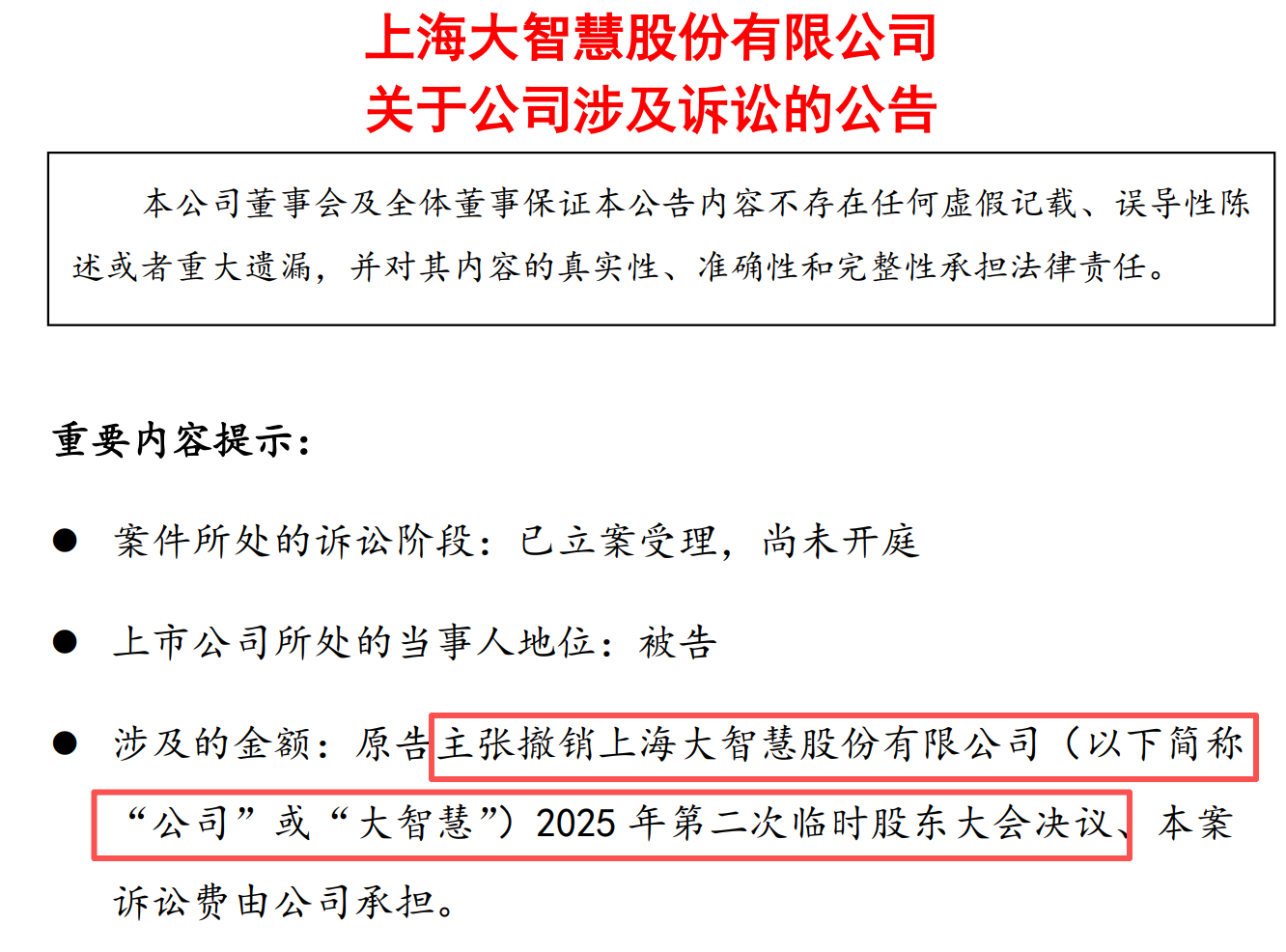
A股罕见!自然人起诉上市公司,要求撤销股东大会决议
中国基金报· 2025-11-12 00:55
Core Viewpoint - Dazhihui is facing a lawsuit regarding the validity of its second extraordinary general meeting resolution, which approved a major asset restructuring involving the merger with Xiangcai Co. [1][5] Group 1: Lawsuit Details - The plaintiff, Wang Gongwei, filed a lawsuit on October 15, 2025, seeking to annul the resolution from Dazhihui's second extraordinary general meeting held on October 13, 2025 [1][4] - The lawsuit claims that the merger constitutes a significant related party transaction, which should have undergone proper evaluation and been submitted for shareholder approval according to company rules [7][8] - Wang Gongwei argues that Dazhihui failed to hire a qualified intermediary to assess the transaction, violating both the company's rules and the Shanghai Stock Exchange's regulations [8][9] Group 2: Company Response - Dazhihui asserts that the merger does not involve acquiring Xiangcai's shares or cash, thus not falling under the asset purchase or sale regulations that require auditing or evaluation [10][11] - The company’s financial and legal advisors have stated that the procedures followed during the extraordinary general meeting were legal and compliant with relevant laws [10][11] - Dazhihui's latest market capitalization is reported to be 27.27 billion [13] Group 3: Merger Implications - The merger will result in Dazhihui being delisted and its legal entity being dissolved, with Xiangcai Co. inheriting all of Dazhihui's assets, liabilities, and operations [11][12] - Xiangcai Co. plans to raise up to 8 billion for supporting funds in conjunction with the merger [11] - The merger is classified as a related party transaction, as Xiangcai Co. holds over 5% of Dazhihui's shares and has directors in common [12]

天津力生制药股份有限公司 关于使用闲置自有资金进行现金管理的进展公告
Zhong Guo Zheng Quan Bao - Zhong Zheng Wang· 2025-11-12 00:45
Core Viewpoint - The company has approved the use of up to RMB 1 billion of idle funds for cash management through the purchase of short-term financial products, ensuring safety and liquidity [1] Group 1: Cash Management Details - The company has invested a total of RMB 210 million in financial products issued by Bohai Bank [1] - The investment is part of a broader approval for cash management activities, which includes the use of idle funds for financial products with a maturity of no more than 12 months [1] Group 2: Related Party Transactions - Bohai Bank, where the company has invested, is a related party as the company's indirect controlling shareholder holds 20.34% of its shares [1] - The bank's registered capital is RMB 1,776.2 million, with total assets of RMB 1,905.876 billion and liabilities of RMB 1,792.743 billion as of September 30, 2025 [1] Group 3: Risk Control Measures - The company aims to manage risks by investing in high-safety, liquid short-term financial products issued by major banks or securities institutions [3] - The finance department is responsible for managing these investments and monitoring any potential risks [3] - Regular audits and checks will be conducted by the audit department and independent directors to ensure compliance and safety of the investments [3] Group 4: Impact on the Company - The cash management strategy is designed to enhance fund utilization efficiency without affecting the company's daily operations or core business development [4] - This approach is expected to yield certain investment returns, thereby improving overall performance and safeguarding shareholder interests [4] Group 5: Historical Cash Management Activities - Over the past twelve months, the company has utilized a total of RMB 800 million for cash management, which remains within the authorized limits set by the shareholders' meeting [5]

福达合金3.5亿收购问询回复一拖再拖 财务压力加剧标的被诉侵权面临2亿索赔
Chang Jiang Shang Bao· 2025-11-11 23:22
Core Viewpoint - Fuda Alloy (603045.SH) is under regulatory scrutiny for a high-premium acquisition of over 51% stake in Zhejiang Guangda Electronic Technology Co., Ltd. from the controlling shareholder's family, with a valuation increase of 171.38% and performance commitments lower than forecasts [1][4][10]. Group 1: Acquisition Details - Fuda Alloy plans to acquire 52.61% of Guangda Electronic for approximately 352 million yuan, with the transaction being a related party deal [1][4]. - Guangda Electronic, established in 2010, specializes in the R&D, production, and sales of new electronic pastes, primarily for solar photovoltaic and electronic communication applications [4]. - The acquisition is questioned as it appears to facilitate cashing out for the controlling shareholder's son, raising concerns about potential conflicts of interest [5][10]. Group 2: Financial Performance and Risks - Guangda Electronic's financial performance shows a declining gross margin trend, with rates of 7.41%, 6.26%, and 5.85% over the past three years, attributed to increased competition in the photovoltaic silver paste industry [6][7]. - Fuda Alloy's financial health is under pressure, with a debt ratio of 64.71% as of September 2025, the highest in its history, and cash reserves of only 346 million yuan against a planned cash acquisition of 352 million yuan [8][9]. - The company has struggled with profitability, maintaining a net profit of around 46 million yuan since 2014, despite a significant increase in revenue [8][10]. Group 3: Legal and Market Concerns - Guangda Electronic is facing a lawsuit from Zhejiang Suote Material Technology Co., Ltd. for patent infringement, claiming damages of 200 million yuan [2][10]. - The stock exchange has raised questions regarding the rationale behind the acquisition, the financial health of the target company, and the assumptions used in the valuation process [5][6][11].

潜江永安药业股份有限公司第七届董事会第十一次临时会议决议公告
Shang Hai Zheng Quan Bao· 2025-11-11 20:39
Core Viewpoint - The company announced the absorption merger of its associate company Huanggang Daily Chemical by its wholly-owned subsidiary Tianan Daily Chemical, which will lead to a change in investment targets and related transactions [1][4][5]. Group 1: Merger Details - The merger will not involve cash payments, and shareholders of Huanggang Daily Chemical will exchange their shares for equity in Tianan Daily Chemical on a pro-rata basis [2][5]. - After the merger, Huanggang Daily Chemical will be dissolved, and all its assets, liabilities, and equity will be inherited by Tianan Daily Chemical [5][10]. - The company's previous investment of 30 million yuan in Huanggang Daily Chemical will convert into a direct investment in Tianan Daily Chemical, maintaining a shareholding ratio of 6.5217% [2][5]. Group 2: Board Meeting and Approval - The board meeting to discuss the merger was held on November 11, 2025, with all seven directors participating, and the proposal was approved with five votes in favor and two abstentions [1][6]. - The independent directors had previously reviewed and approved the proposal before it was submitted to the board [3][6]. Group 3: Purpose and Impact - The merger aims to optimize the management structure of the associate company, reduce management costs, and improve decision-making efficiency, aligning with the company's overall development strategy [13]. - The financial statements of Tianan Daily Chemical will not be included in the company's consolidated financial statements post-merger, indicating no significant impact on the company's financial status or overall business development [13]. Group 4: Related Transactions - From January to October 2025, the total amount of related transactions between the company and its associated entities was approximately 28.19 million yuan, with 24.52 million yuan specifically involving Tianan Daily Chemical and Huanggang Daily Chemical [13].

成都银行股份有限公司第八届董事会第二十一次(临时)会议决议公告
Shang Hai Zheng Quan Bao· 2025-11-11 19:48
Core Viewpoint - Chengdu Bank's board of directors held a temporary meeting to discuss and approve several key financial proposals, including investment and financing management for 2026, issuance of capital instruments, and bonds to support various financial needs [2][3][4][5][7]. Group 1: Meeting Overview - The meeting was held on November 11, 2025, with 11 directors present, including 3 in person and 7 via video [2]. - The meeting complied with relevant laws and regulations, ensuring the legality and validity of the resolutions made [2]. Group 2: Approved Proposals - The board approved the proposal for implementing investment management related to state-owned enterprises in Chengdu for 2026, with unanimous support [3]. - The board also approved the financing management proposal for state-owned enterprises in Chengdu for 2026, again with unanimous support [4]. - A proposal was approved to issue up to 7 billion yuan in secondary capital bonds, with a 10-year term and an option for early redemption after 5 years, aimed at enhancing the bank's capital adequacy [5]. - The board approved a proposal to issue up to 10 billion yuan in special and ordinary financial bonds, including specific allocations for technology innovation and green finance, with a maximum term of 5 years [7]. - A proposal for related party transactions with Chengdu Inclusive Financing Guarantee Co., Ltd. was approved, with one director abstaining from the vote [8].

远江盛邦安全科技集团股份有限公司关于签订房屋租赁合同暨关联交易的公告
Shang Hai Zheng Quan Bao· 2025-11-11 19:27
Core Viewpoint - The company, Yuanjiang Shengbang Security Technology Group Co., Ltd., is entering into a related party transaction by signing a lease agreement for office space with an associated individual, Meng Xianying, for a period of three years, with a total rental amount of 640,400 yuan excluding tax [2][4][13]. Summary by Sections 1. Overview of Related Party Transaction - The company's wholly-owned subsidiary, Beijing Shengbang Saiyun Technology Co., Ltd., plans to lease an office space of 292.4 square meters located at Room 505, Building B, No. 8 Longyu North Street, Huilongguan, Changping District, Beijing, from Meng Xianying for three years, from November 12, 2025, to November 11, 2028, at a monthly rent of 17,800 yuan, totaling 640,400 yuan for the lease term [2][4][13]. 2. Legal and Approval Process - The transaction has been approved by the company's independent directors, audit committee, and board of directors, and does not require shareholder meeting approval as it does not constitute a major asset restructuring [3][14][15]. 3. Details of the Lease Agreement - The lease agreement specifies that the first rental payment will be made alongside a security deposit of 17,800 yuan. The rental payments will be made quarterly, and the lessee is responsible for various utility costs [4][8][9]. 4. Necessity and Impact of the Transaction - This related party transaction is necessary for the company to secure a stable office location for important operational qualifications, positively impacting the company's business activities without harming the interests of the company or its shareholders [13][17]. 5. Related Party Information - Meng Xianying is identified as the spouse of the company's major shareholder and actual controller, qualifying her as a related party under relevant regulations. There are no other significant relationships between the company and Meng Xianying beyond this transaction [4][5].
