
宽基指数

Search documents
A股市场快照:宽基指数每日投资动态-20251127
Jianghai Securities· 2025-11-27 06:37
| | | 2025 年 11 月 27 日 江海证券研究发展部 金融工程定期报告 金融工程研究组 A 股市场快照:宽基指数每日投资动态 2025.11.27 投资要点: 分析师:梁俊炜 执业证书编号: S1410524090001 ◆市场表现:2025年11月26日,各宽基指数(表1)涨跌各现,其中创业板指(2.14%) 和沪深 300(0.61%)涨幅最大,而中证 2000(-0.34%)和中证 1000(-0.02%)下 跌。当年涨跌情况,创业板指(42.17%)涨幅最大,其次是中证 2000(29.53%) 和中证 1000(21.66%),中证 500(21.64%)和中证全指(19.77%)涨幅扩大,而 上证 50 (10.69%) 涨幅最小。另外,中证 500、中证 1000 和中证全指连续三日连 阳。 相关研究报告 A 股市场快照:宽基指数每日投资动 态 2025.11.26 A 股市场快照:宽基指数每日投资动 态 2025.11.25 A 股市场快照:宽基指数每日投资动 态 2025.11.24 ◆均线比较:所有跟踪指数已突破5日均线,市场获得一定修复,但所有跟踪指 数仍低于 10 日、20 ...
A股市场快照:宽基指数每日投资动态-20251126
Jianghai Securities· 2025-11-26 12:38
证券研究报告·金融工程报告 2025 年 11 月 26 日 江海证券研究发展部 金融工程定期报告 A 股市场快照:宽基指数每日投资动态 2025.11.26 ◆市场表现:2025 年 11 月 25 日, 各宽基指数(表 1)全部上涨,其中创业板指(1.77%) 分析师:梁俊炜 投资要点: 执业证书编号:S1410524090001 A 股市场快照:宽基指数每日投资动 和中证 2000(1.75%)涨幅最大。当年涨跌情况,创业板指(39.19%)涨幅最大, 其次是中证 2000(29.96%)和中证 1000(21.69%),中证 500(21.46%)和中证全 指(19.48%)涨幅扩大,而上证 50(10.56%)涨幅最小。 ◆均线比较:中证 1000 和中证 2000 突破 5 日均线。所有跟踪指数仍低于 10 日、 20 日及 60 日均线。中证 500 和创业板指近期跌幅较大,相对深度地偏离短期均线。 ◆资金占比与换手:2025 年 11 月 25 日, 中证 2000(25.1%)交易金额占比最高, 相关研究报告 态 2025.11.25 A 股市场快照:宽基指数每日投资动 态 2025.11. ...
A股市场快照:宽基指数每日投资动态-20251125
Jianghai Securities· 2025-11-25 12:21
证券研究报告·金融工程报告 2025 年 11 月 25 日 江海证券研究发展部 金融工程研究组 A 股市场快照:宽基指数每日投资动态 2025.11.25 ◆市场表现:2025 年 11 月 24 日, 各宽基指数(表 1)涨跌各现,其中中证 2000 分析师:梁俊炜 投资要点: 执业证书编号:S1410524090001 A 股市场快照:宽基指数每日投资动 (1.86%)和中证 1000(1.26%)涨幅最大,而上证 50(-0.18%)和沪深 300(-0.12%) 下跌。当年涨跌情况,创业板指(36.77%)涨幅最大,其次是中证 2000(27.73%) 和中证 1000(20.12%),中证 500(19.97%)和中证全指(18.06%)涨幅扩大,而 上证 50(9.9%)涨幅最小。另外,上证 50、沪深 300 和创业板指连续三日连阴。 ◆均线比较:所有跟踪指数仍低于 5 日、10 日、20 日及 60 日均线。中证 2000 修 复较迅速。中证 500 和创业板指跌幅较大,相对深度地偏离短期均线。 ◆资金占比与换手:2025 年 11 月 24 日, 沪深 300(25.12%)交易金额占比最 ...
一周市场数据复盘20251121
HUAXI Securities· 2025-11-22 14:34
- The report does not contain any quantitative models or factors, nor their construction, evaluation, or backtesting results
每日钉一下(什么是行业指数,投资时需要注意些什么?)
银行螺丝钉· 2025-11-21 12:56
Group 1 - The article emphasizes the importance of diversifying investments across different asset classes, including both RMB and foreign currency assets, as well as stocks and bonds [2] - It introduces a free course that systematically covers investment knowledge related to US dollar bond funds, highlighting its significance in a diversified portfolio [2] Group 2 - The article explains the concept of industry indices, which focus on stocks within specific sectors such as consumer, healthcare, and finance [5] - It outlines the need to manage investment proportions in individual industries due to their higher volatility, which can average between 30%-50% annually, compared to broader indices like the CSI 300, which typically sees volatility around 20%-25% [5] - It advises investors to limit exposure to any single industry to 15%-20% to mitigate risk [5] - The article also stresses the importance of selecting strong industries for investment and ensuring a diversified allocation across different sectors [6][7]


A股市场快照:宽基指数每日投资动态-20251121
Jianghai Securities· 2025-11-21 08:06
- The report primarily focuses on tracking and analyzing the performance of broad-based indices in the A-share market, including metrics such as daily returns, moving averages, turnover rates, risk premiums, PE-TTM, dividend yields, and net asset ratios[1][3][4] - The analysis includes a detailed comparison of indices against their moving averages (5-day, 10-day, 20-day, 60-day, 120-day, and 250-day), as well as their positions relative to the highest and lowest points over the past 250 trading days. For example, the ChiNext Index has retraced 8.5% from its 250-day high[15][16] - Turnover rates and trading volume proportions are calculated for each index. For instance, the CSI 2000 has the highest turnover rate at 4.0%, while the CSI 500 has a turnover rate of 1.4%[18] - The report evaluates the distribution of daily returns for each index, highlighting kurtosis and skewness. The ChiNext Index exhibits the largest negative kurtosis deviation, while the CSI 1000 shows the smallest. Similarly, the ChiNext Index and SSE 50 have the largest negative skewness, while the CSI 2000 has the smallest[24][25] - Risk premiums are calculated using the yield of 10-year government bonds as the risk-free rate. The report notes significant mean reversion in risk premiums, with indices like the CSI 1000 and CSI 2000 showing higher volatility. For example, the current risk premium for the SSE 50 is -0.41%, with a 5-year percentile rank of 33.41%[27][31][34] - The PE-TTM ratios of indices are analyzed as valuation metrics. The CSI 1000 and CSI 500 have the highest 5-year percentile ranks at 95.54% and 95.29%, respectively, while the ChiNext Index has the lowest at 54.3%[39][42][43] - Dividend yields are tracked as a measure of cash return. The ChiNext Index has the highest 5-year historical percentile rank at 71.57%, while the CSI 500 has the lowest at 17.6%[52][53] - The report also examines the net asset ratios of indices, noting that the SSE 50 has the highest percentage of stocks trading below net asset value at 18.0%, while the ChiNext Index has the lowest at 1.0%[54]
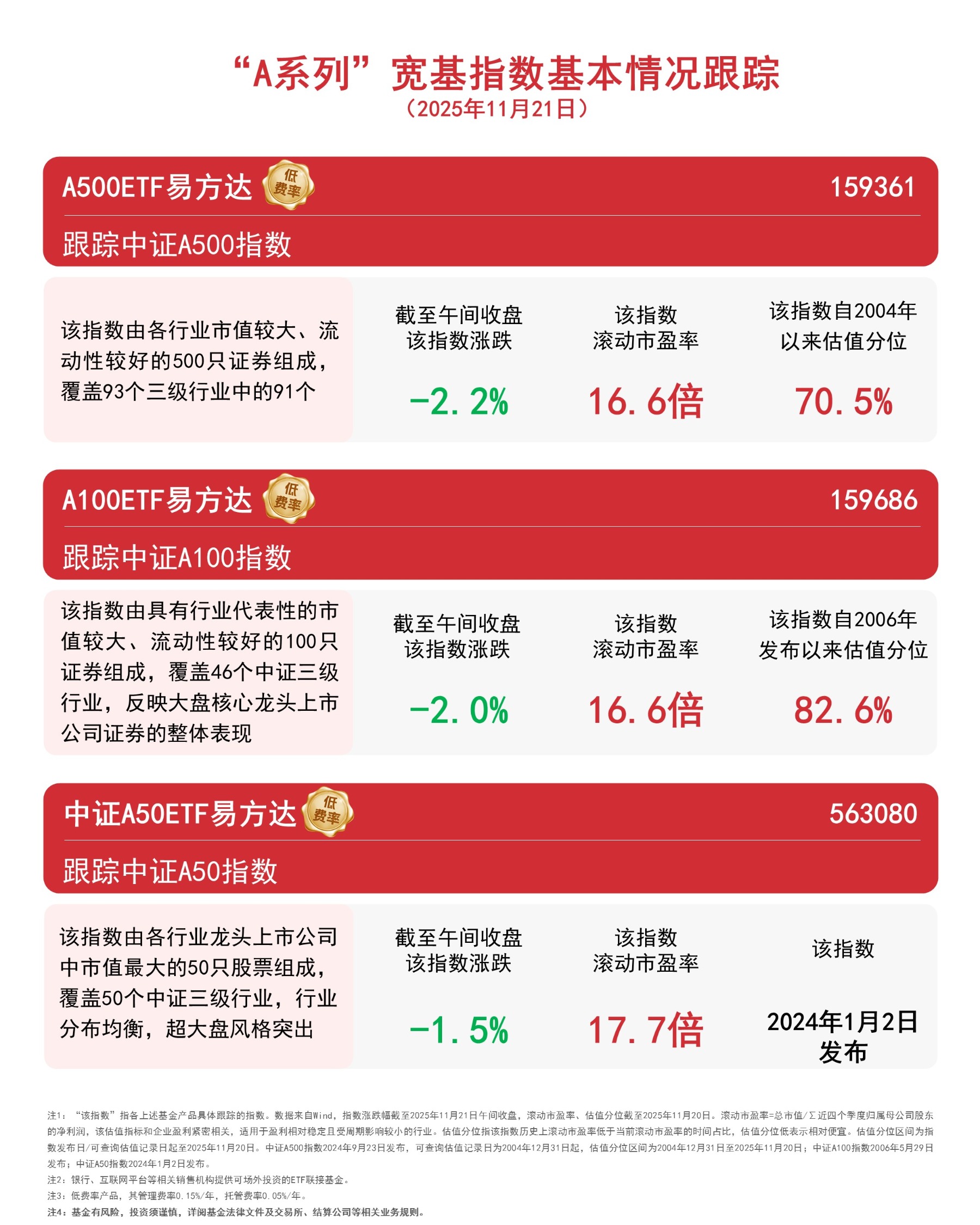
“A系列”宽基指数震荡调整,A500ETF易方达(159361)半日净申购约2.7亿份
Mei Ri Jing Ji Xin Wen· 2025-11-21 05:33
Group 1 - The China Securities A500 Index has experienced a decline of 2.2% as of the midday close [2] - The A500 ETF by E Fund tracks the China Securities A500 Index, which consists of 500 securities with large market capitalization and good liquidity, covering 91 out of 93 sub-industries [2] - The A100 ETF by E Fund tracks the China Securities A100 Index, which includes 100 representative securities with large market capitalization and good liquidity, reflecting the overall performance of core leading listed companies [2] Group 2 - The A100 Index has also seen a decline of 2.0% as of the midday close [2]
麦高视野:ETF观察日志(2025-11-19)
Mai Gao Zheng Quan· 2025-11-20 05:45
- The report includes the construction of the RSI (Relative Strength Index) factor, which is calculated using the formula: $ RSI = 100 - 100 / (1 + RS) $, where RS represents the ratio of average gains to average losses over a 12-day period. RSI values above 70 indicate an overbought market, while values below 30 suggest an oversold market [2] - The report also introduces the calculation of net subscription (NETBUY), defined as $ NETBUY(T) = NAV(T) - NAV(T-1) * (1 + R(T)) $, where NETBUY(T) represents the net subscription amount, NAV(T) is the ETF's net asset value on day T, and R(T) is the return on day T [2] - The report tracks various ETFs categorized into "Broad-based" and "Thematic" indices, such as CSI 300, CSI 500, and industry-specific indices like non-bank financials, dividends, and China internet sectors. It provides daily performance metrics, including RSI values, net subscription amounts, and institutional holding percentages [2][4][7] - The RSI factor is evaluated as a useful indicator for identifying market conditions, such as overbought or oversold states, aiding in short-term trading decisions [2] - The net subscription metric is assessed as a valuable measure for understanding fund flows and investor sentiment towards specific ETFs [2] - RSI values for various ETFs range from 11.05 to 77.25, reflecting diverse market conditions across different indices and sectors [4][7] - Net subscription values vary significantly, with some ETFs showing positive inflows while others exhibit outflows, indicating mixed investor sentiment across different funds [4][7]
螺丝钉指数地图来啦:指数到底如何分类|2025年11月
银行螺丝钉· 2025-11-18 07:01
Core Viewpoint - The article presents an index map that includes various commonly used stock indices, their codes, selection rules, industry distribution, average and median market capitalization of constituent stocks, and the number of constituent stocks, which will be updated regularly for easy reference [1][2]. Group 1: Types of Indices - The index map includes several categories of stock indices: broad-based indices, strategy indices, industry indices, thematic indices, and overseas indices [4][2]. Group 2: Index Details - The article provides detailed information on specific indices, including: - CSI 300 Index (000300.SH): Average market cap of ¥214.64 billion, median market cap of ¥108.39 billion, consisting of 300 stocks [7]. - CSI 500 Index (000905.SH): Average market cap of ¥33.42 billion, median market cap of ¥29.64 billion, consisting of 500 stocks [7]. - CSI 800 Index (000906.SH): Average market cap of ¥101.38 billion, median market cap of ¥40.13 billion, consisting of 800 stocks [7]. - CSI 1000 Index (000852.SH): Average market cap of ¥14.66 billion, median market cap of ¥12.79 billion, consisting of 1000 stocks [7]. - CSI 2000 Index (932000.CSI): Average market cap of ¥6.06 billion, median market cap of ¥5.32 billion, consisting of 2000 stocks [7]. Group 3: Industry Distribution - The article outlines the industry distribution across various indices, highlighting the following: - Materials: 8.86% in broad-based indices, 18.14% in strategy indices, and 11.44% in industry indices [11]. - Real Estate: 0.65% in broad-based indices, 1.34% in strategy indices, and 0.83% in industry indices [11]. - Financials: 25.45% in broad-based indices, 33.98% in strategy indices, and 4.49% in industry indices [11].

A股市场快照:宽基指数每日投资动态-20251117
Jianghai Securities· 2025-11-17 13:05
- The report tracks and analyzes the market data of major indices, including their performance, moving averages, trading volume, turnover rates, and risk premiums[1][2][3] - The report provides a detailed comparison of the indices' performance against their moving averages and the highest and lowest points over the past 250 trading days[13][14] - The report includes the distribution of daily returns for each index, highlighting the kurtosis and skewness of the distributions[23] - The risk premium of each index relative to the 10-year government bond yield is analyzed, showing significant mean reversion and volatility patterns[25][26][27] - The report evaluates the PE-TTM (Price-to-Earnings Trailing Twelve Months) ratios of the indices, comparing their current values to historical percentiles[37][38][40] - The report examines the dividend yields of the indices, noting their historical percentiles and recent trends[45][46][50] - The report discusses the net asset value (NAV) break rates of the indices, indicating the proportion of stocks trading below their net asset value[52]