注册制

Search documents
最高法、证监会:依法打击欺诈发行和持续信息披露造假
news flash· 2025-05-15 08:27
Core Viewpoint - The Supreme Court and the China Securities Regulatory Commission (CSRC) have issued guidelines to strictly enforce fair law enforcement and judicial services to support the high-quality development of the capital market, emphasizing the need to combat fraudulent issuance and continuous information disclosure fraud [1] Regulatory Measures - High-quality information disclosure is identified as a crucial foundation for the registration system, necessitating strict legal actions against fraudulent issuance and violations in information disclosure to ensure investor confidence and promote capital formation [1] - Regulatory authorities are urged to enhance daily supervision and penalties for fraudulent issuance and continuous information disclosure fraud, with a focus on swift and severe actions against various fraudulent behaviors [1] Legal Accountability - The guidelines advocate for a comprehensive approach to legal accountability, emphasizing the need to hold issuers, controlling shareholders, actual controllers, relevant intermediary institutions, and third-party suppliers accountable for financial disclosure fraud [1] - The principle of "pursuing the principal offender" and "targeting accomplices" is highlighted, with a call for precise accountability for those who organize or instruct illegal activities [1] Civil and Criminal Liability - Issuers found liable for civil responsibilities are encouraged to seek recourse from responsible parties such as controlling shareholders, actual controllers, directors, supervisors, and senior management, with courts expected to support such claims [1] - The guidelines stress the need for severe punishment for planners, organizers, and implementers of financial disclosure fraud, as well as criminal liability for third parties that assist in such fraud, aiming for a comprehensive crackdown on financial disclosure fraud [1]
业绩数据承压 商标纠纷缠身 好博窗控IPO宣告终止
Xi Niu Cai Jing· 2025-05-14 09:02
5月10日,深圳好博窗控技术股份有限公司(以下简称"好博窗控")深交所IPO终止,其保荐机构国信证券及公司主动撤回发行上市申请。据深交所官网披 露,好博窗控自2023年3月启动IPO以来,已三次因财务资料过期被中止审核,最近一次财务数据更新至2024年6月29日。 好博窗控主营业务涵盖门窗传动系统、智能控制系统的研发与销售,为房地产产业链下游企业,主要客户包括皇派家居、森鹰窗业等上市公司。实控人为李 增榜、孙朝霞夫妇,股权结构显示,李增榜、孙朝霞夫妇通过直接和间接方式合计控制94.58%股份, 财务数据显示,2021-2023年好博窗控营收从6.68亿元增长至10.42亿元,净利润由6014万元攀升至1.88亿元,但2024年上半年营收4.44亿元、净利润7308万元 均呈现增速放缓趋势。值得注意的是,好博窗控预测2024年全年营收9.1-9.3亿元,同比下滑10.76%-12.68%;净利润1.35-1.4亿元,降幅达25.38%-28.04%, 在房地产行业深度调整的背景下,好博窗控业绩下行压力显著。 回顾好博窗控此轮IPO进程,其此前的商标纠纷成为此次IPO终止的关键点之一。1996年,德国好博集团(H ...


紫天科技三度被查陷退市倒计时 财务造假链条遭监管重锤 审计机构同步领罚
Xin Lang Zheng Quan· 2025-05-07 02:57
Core Viewpoint - The case of Zitian Technology highlights the deep-seated contradictions in corporate governance and regulatory arbitrage within the capital market, serving as a cautionary tale of systemic financial fraud and extreme resistance to regulation [1] Group 1: Financial Fraud and Regulatory Resistance - The crisis of Zitian Technology traces back to the change of actual controller in 2016, leading to aggressive capital operations that created a facade of prosperity, with accounts receivable reaching 2.194 billion yuan by the end of 2022, exceeding annual revenue [2] - Systematic fabrication of transactions was revealed, including the forgery of 812 million yuan in server prepayments in 2022, which later turned into unsubstantiated inventory, and the recognition of revenue from cloud services that had not commenced operations [2] Group 2: Regulatory Confrontation and Consequences - The company faced comprehensive resistance during the on-site inspection initiated by the Fujian Securities Regulatory Bureau in April 2024, including a vacant registered address and refusal to provide financial materials, leading to two investigations by the CSRC in September and October 2024 [3] - As of May 6, 2025, the company's stock has been suspended, with a risk of delisting if the annual report is not disclosed within two months, following a net outflow of 140 million yuan in principal funds in the five trading days before suspension [4] Group 3: Punitive Measures and Regulatory Changes - The incident set multiple regulatory records, with the audit partner fined 1 million yuan and banned from the market for six years, while the actual controller and executives faced fines totaling 800,000 yuan and a ten-year market ban [5] - This combination of penalties signifies a shift in regulatory focus from mere punishment to disrupting the capacity for illegal activities, particularly targeting key links in the financial fraud ecosystem [5] Group 4: Transformation and Governance Deficiencies - Zitian Technology's aggressive transformation from traditional forging machinery to internet advertising and cloud services is characterized as "pseudo-innovation," lacking substantial business support, leading to significant goodwill impairment of 569 million yuan in 2023 [6] - The crisis of Zitian Technology transcends individual cases, becoming a litmus test for the market clearing mechanism under the registration system, with potential delisting marking a precedent for forced delisting due to continuous regulatory resistance and systemic financial fraud [6]

新财富 · 董秘特辑 | 胡之奎:大陆首批董秘,见证1.0到4.0的变迁
新财富· 2025-05-06 07:58
Core Viewpoint - The New Fortune Gold Medal Secretary selection has become a benchmark in China's capital market, reflecting the evolution and high-quality development of the market over 21 years [1] Group 1: Overview of Hu Zhikui - Hu Zhikui, born in May 1965, has extensive educational qualifications and has been recognized as a leading figure in the industry, winning the New Fortune Gold Medal Secretary award six times [3][4] - Hu's career began in 1992, and he participated in the first domestic board secretary training organized by the Shanghai Stock Exchange in 1996, marking the start of his long-standing commitment to the role [6][8] Group 2: Evolution of the Board Secretary Role - The role of board secretaries has evolved through four key stages, starting from the information disclosure-focused 1.0 era to the current 4.0 era, which emphasizes deep involvement in decision-making [10][14] - The 2.0 era introduced market value management, requiring board secretaries to focus on stock performance and investor relations, while the 3.0 era saw a shift towards strategic participation amid the "Internet+" wave [12][13] Group 3: Essential Skills for Board Secretaries - Board secretaries must possess five core competencies: professional knowledge, communication skills, information disclosure management, strategic decision-making, and leadership abilities [15][16] - Continuous learning is emphasized as a critical requirement for board secretaries to keep up with evolving market regulations and enhance their professional capabilities [22][27] Group 4: Challenges and Solutions - The complexity of the board secretary role includes challenges in ensuring accurate and timely information disclosure, balancing diverse stakeholder interests, and maintaining high professional standards [23][24][25] - To navigate these challenges, board secretaries should focus on continuous learning, adopt a problem-solving mindset, and build a multi-dimensional communication network [27][28]

券商诉讼频发折射风控短板 虚假陈述与股票质押成“重灾区”
Huan Qiu Wang· 2025-04-29 05:41
Core Viewpoint - The major lawsuits disclosed in the 2024 brokerage annual reports highlight significant risks in the areas of securities false statements, stock pledge repurchase, and margin financing disputes, revealing dual challenges in business risk management and intermediary service quality [1] Group 1: Securities False Statements - Securities false statement lawsuits have become a core risk point for brokerages, with cases like Meishang Ecology, which inflated net profits by 457 million yuan from 2012 to 2020, leading to investor accountability [3] - Dongxing Securities and GF Securities were named as joint defendants for failing to fulfill due diligence obligations [3] - Jin Tong Ling's financial fraud from 2017 to 2022 saw profit figures inflated or deflated by as much as 5774.38%, implicating Huaxi Securities, Everbright Securities, and Guohai Securities in related disputes [3] - The new Securities Law and judicial interpretations have increased the likelihood of brokerages facing lawsuits due to "presumed fault" for joint liability [3] Group 2: Stock Pledge Repurchase Disputes - Stock pledge repurchase disputes are on the rise, with cases like Dongfang Securities and Qingdao Yaxing Industrial facing litigation over a pledge transaction default involving 653 million yuan in principal and interest [4] - Guohai Securities reported multiple stock pledge disputes, with some cases already executing repayments while others are still in progress [4] - In 2024, Guohai Securities accumulated 219 million yuan in asset impairment provisions due to pledge business risks, reducing net profits by 164 million yuan [4] Group 3: Risk Management and Compliance - Industry insiders emphasize the need for brokerages to integrate diligence and compliance requirements throughout their business processes to mitigate joint liability risks arising from listed company violations [4] - As the registration system deepens, the "gatekeeper" role of intermediary institutions will be further strengthened, making risk management capabilities a key competitive indicator for brokerages [4]





武汉新芯IPO:万万没想到这么大的公司无实际控制人!募资才 48 亿!
Sou Hu Cai Jing· 2025-04-26 05:56
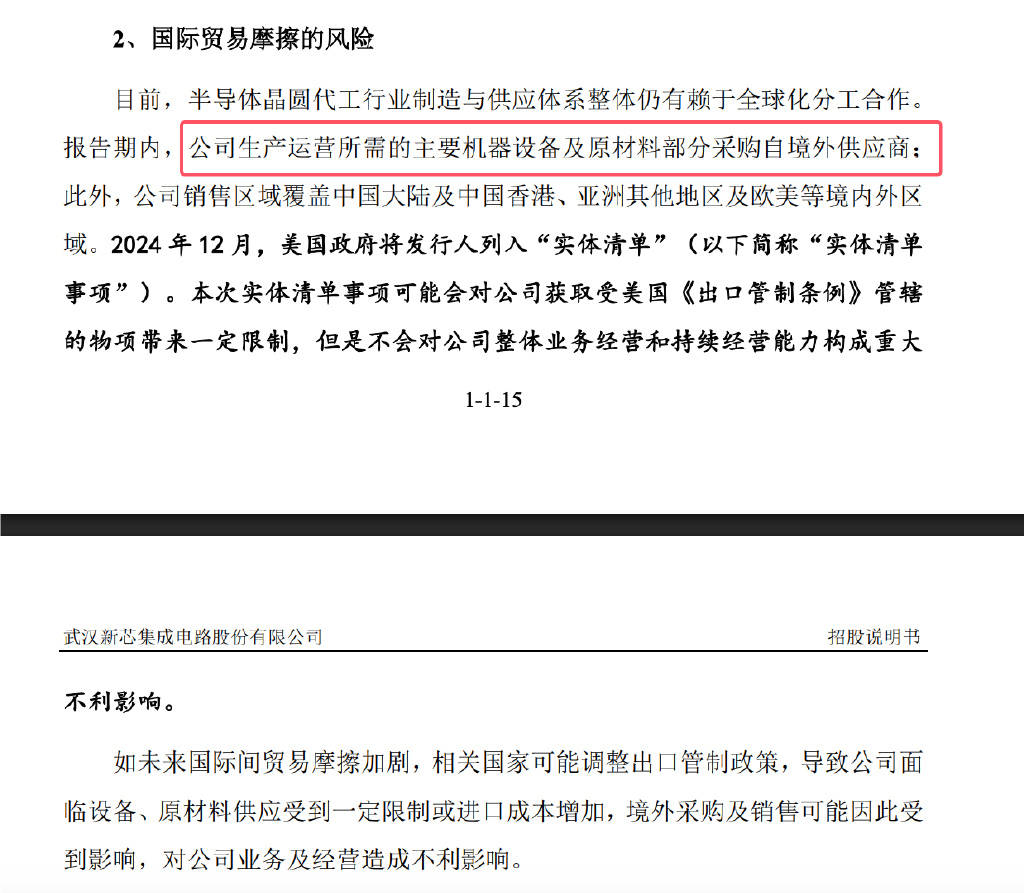
Core Viewpoint - Wuhan Xinxin's IPO process has revealed significant concerns, including the absence of a controlling shareholder and low fundraising of only 4.8 billion yuan, which is inadequate for a company competing with industry giants like TSMC and SMIC [1][2][10]. Financial Performance - As of September 30, 2024, the total assets of the company reached approximately 1,996.44 million yuan, an increase from 1,503.35 million yuan in 2023 and 1,152.44 million yuan in 2022 [6]. - The company's net profit for the first nine months of 2024 was approximately 138.13 million yuan, a decline from 393.76 million yuan in 2023 and 716.60 million yuan in 2022 [6]. - The company's revenue for the first nine months of 2024 was approximately 3,146.16 million yuan, compared to 3,814.54 million yuan in 2023 [6]. Control and Governance - The company has been highlighted for lacking a controlling shareholder, with many local state-owned enterprises being involved but not classified as acting in concert [1][10]. - The inquiry raised questions about the company's independence and governance structure, indicating potential issues with decision-making processes [12][13]. Market Position and Product Offering - The company's products primarily serve international markets, with higher profit margins from overseas operations compared to domestic ones [2][14]. - The company relies heavily on imported equipment and materials, raising concerns about supply chain vulnerabilities amid trade tensions [2][4]. Research and Development - Research and development expenses accounted for 7.88% of the company's revenue in the first nine months of 2024, up from 6.86% in 2023 [8]. Profitability and Margins - The gross profit margin for overseas wafer foundry services is significantly higher than that for domestic services, attributed to different application scenarios [15][16]. - The company reported a low overall profit margin, which may limit investor expectations post-IPO [2].
基石资本张维:耐心资本和大胆资本形成的关键在于打通上市和减持通道
投中网· 2025-04-19 05:28
将投中网设为"星标⭐",第一时间收获最新推送 大胆资本和耐心资本的本质是社会信用,资本市场是社会信用的更高等级的形式。 整理丨 陶辉东 来源丨 投中网 中国创投的退出有多难? 基石资本董事长张维用他们对全亿健康的控股投资举例,生动展现了这一点。从 2016 年开始,基石资本通过五年整合,让全亿健康成为一家年销售额 达 60 亿元、门店逾 2000 家的连锁药房企业。但一算账发现,如果要想实现 A 股上市并减持退出,至少需要 17 年的时间。最终,基石资本选择把 它卖给了某国际知名私募巨头。"他们的基金周期是 12 年,而我的基金周期是' 5+2 '。" 中国创投面临的是"上市难"与"减持难"的双重难题。这样的现状,对于耐心资本和大胆资本的形成非常不利。张维指出,对上市和减持的严防死守,削 弱了创业的财富效应,因为投资的本质是为了增值,如果不能增值为什么投资?创业者如果不能卖股票又为什么要创业呢? 历史上的股权分置改革,释放了大量的流通股,股市迎来一个牛市。张维认为,核心是实行真正的注册制,同时实行严格的退市制度,进一步打击造假 和违规信批,从而使资本市场实现动态平衡。 更进一步,张维认为大胆资本和耐心资本的本 ...
当小宋去会所
叫小宋 别叫总· 2025-04-18 01:27
Core Viewpoint - The article discusses the evolution and current state of the massage industry in a specific city, highlighting regulatory changes and market dynamics that affect business operations and valuations. Group 1: Industry Evolution - The massage industry has transitioned from a chaotic environment requiring approval from regulatory bodies to a more structured "registration system" that still involves significant oversight [7][8]. - The concept of a "blue channel" is introduced, suggesting that certain establishments can bypass standard regulations if they have connections within the regulatory body [10][12]. Group 2: Market Dynamics - There is a market for selling massage parlors or even the staff if they do not obtain the necessary approvals to operate [14]. - The practice of "valuation management" is noted, where businesses may bring in teams to enhance their perceived value before a sale [15][16]. Group 3: Regulatory Challenges - Despite the increase in applications for operating licenses, the actual approval process remains opaque, with establishments claiming to be in line for approval without clear evidence [20]. - Regulatory bodies may intervene in business transactions, even when both parties are willing, indicating a level of control over market competition [18][19]. Group 4: Personal Perspectives - Industry professionals express a desire for autonomy, with some exploring alternative business models such as home service offerings [22]. - The conversation reflects a broader sentiment of adapting to market conditions, akin to seeking alternative stock exchanges when primary options are unavailable [23].

当小宋去会所
叫小宋 别叫总· 2025-04-18 01:27
小宋我去某个四线城市尽调项目,做了一天访谈,晚上急需"回回血"。打开大众点评,搜索"按摩",找到一间会所,看评论还算正规,我就去了。 安排给我的是一位看起来 40 多岁的姐姐,简称"吴姐"。 我刚躺下,吴姐就开腔:先生你是做金融的吧? 我惊讶:你怎么看出来的? 因为你操着普通话,说明是来出差的。然后,你看着年龄不大,但是有些秃顶,还有黑眼圈。 我们当地有很多挺大的企业,叫什么 ...ipo 阶段企业。像你这行业的人,我经常接待,都差不多长你这个样子。 我心想,这个姐有内容,有意思。"你干这行多久啦?" 吴姐说: 18 岁我就入行喽,也算是见过这行业的大风大浪的。 嗷?啥风浪? 我入行的时候,按摩业务已经不能随便上了,要去 X 局审批,简称"审核制"。 然后呢,那个时候,很乱的,你只要 X 局里有人,就能上。要是没人呢,就找个对缝的,帮你对接 X 局的人。 然后,你得给帮你忙的人,一些好处。 我:还可以这么搞?不怕被查到嘛? 吴姐:我们都很守规矩的,大家嘴都很严。上面要是问,就咬死说,是我们会所软硬件达标,是凭实力上的。 我:有意思。后来呢? 后来肯定逐渐正规啦,这种灰色操作没得搞啦。再后来,说要提高市场效率, ...
@A股上市公司,信披规则有变!
证券时报· 2025-03-28 10:23
Core Viewpoint - The revised "Information Disclosure Management Measures" aims to enhance the quality of information disclosure by listed companies, aligning with the new Company Law and the capital market's "1+N" policy framework, thereby improving transparency and protecting investors' rights [1][3]. Group 1: Key Information Disclosure Requirements - The revised measures strengthen the disclosure of risk factors that may significantly impact a company's core competitiveness and future development, especially for companies that are unprofitable at the time of listing [3]. - Companies are required to disclose industry-specific operational information relevant to their business, facilitating informed decision-making by investors [3]. - The annual report format guidelines have been refined to include detailed financial indicators, such as revenue deductions and the impact of share-based payments on net profit [3][4]. Group 2: Management Discussion and Analysis Enhancements - The annual report format now mandates enhanced disclosure of significant non-core business activities, including strategic considerations and sustainability of operations [4]. - Companies must disclose the names and transaction amounts of their top five customers and suppliers, particularly those with high trade volumes or under special treatment [4]. - There are new requirements for disclosing performance commitments, including details on commitment periods, targets, actual amounts, and completion rates [4]. Group 3: Adjustments to Supervisory Structures - The revised measures eliminate previous regulations regarding the supervisory board and shift responsibilities to the audit committee for overseeing periodic report preparation [6]. - The guidelines also remove the requirement to disclose details of board and shareholder meetings, streamlining the reporting process [6]. Group 4: New Disclosure Regulations - The measures introduce a system for deferring and exempting disclosures, ensuring compliance with legal and regulatory requirements [7]. - There are new regulations prohibiting the outsourcing of information disclosure tasks to non-licensed entities, thereby enhancing the quality of disclosures [9][10]. - Companies are allowed to release significant information during non-trading hours, provided they announce it before the next trading session begins [10]. Group 5: Implementation Timeline - The revised measures and reporting guidelines will take effect on July 1, 2025, allowing companies to prepare adequately and minimizing disruptions to the 2024 annual report disclosures [11].