
社会主义现代化

Search documents
高质量发展,破解矛盾赢长远(连线评论员)
Ren Min Ri Bao· 2025-11-12 22:19
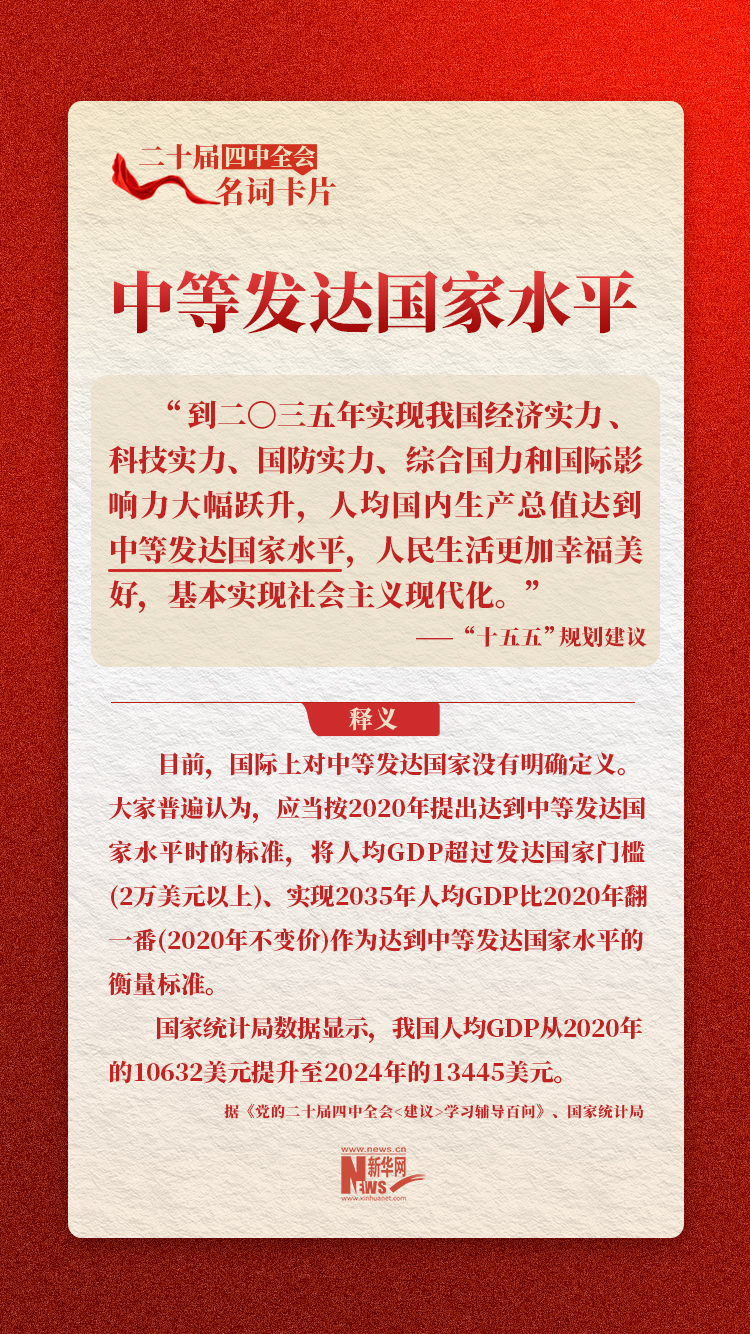
李拯:党的二十届四中全会擘画了"十五五"时期的发展蓝图。习近平总书记强调:"2035年基本实现社 会主义现代化,一个重要标志性指标就是人均国内生产总值达到中等发达国家水平,这要求'十五五'时 期经济社会发展保持适当速度。"同时,未来5年继续以推动高质量发展为主题。"高质量发展"与"保持 适当速度"之间,有着怎样的深刻联系? 刘元春:2024年,我国人均国内生产总值超1.3万美元,但距离中等发达国家水平还有不小差距。保持 适当速度,才能创造更多就业和社会财富,为到2035年基本实现社会主义现代化奠定更加坚实的基础。 高质量发展与保持适当速度,是一种动态的、积极的战略协调关系。我国经济在如此大体量的基础上保 持适当速度,必须依靠高质量发展,通过创新驱动和全要素生产率提升来实现一种更可持续、更有韧性 的增长。反过来,保持适当速度也为进一步全面深化改革、推动高质量发展提供了必要的回旋空间。 李拯:"十四五"时期,我国高质量发展迈出坚实步伐。"十五五"时期是破解高质量发展面临突出矛盾问 题的关键时期,具体来说有哪些着力点? 刘元春:有几个数据可以提供观察视角:2024年,我国全员劳动生产率达到173898元/人,单位G ...
二十届四中全会名词卡片:中等发达国家水平
Xin Hua Wang· 2025-11-11 04:24
Core Points - The article discusses China's goal to achieve a significant leap in economic, technological, defense, and overall national strength by 2035, with a specific focus on reaching a per capita GDP level comparable to that of moderately developed countries [2][4]. Group 1: Economic Goals - By 2035, China's per capita GDP is expected to exceed $20,000, effectively doubling the 2020 figure of $10,632 [3][5]. - The National Bureau of Statistics projects that per capita GDP will rise from $10,632 in 2020 to $13,445 in 2024, indicating a steady growth trajectory towards the 2035 target [3]. Group 2: Strategic Framework - The 19th National Congress of the Communist Party of China outlined a two-phase strategy for achieving the second centenary goal, emphasizing the importance of reaching a per capita GDP level indicative of modernization [4]. - The 20th National Congress further clarified the overall development goals for 2035, with a strong emphasis on economic and technological advancements [4]. Group 3: Feasibility and Conditions - The article asserts that China has the conditions and capabilities to achieve the per capita GDP target, requiring an average annual GDP growth rate of 4.17% during the 14th and 15th Five-Year Plans [6]. - The focus on high-quality development, reform, and innovation is highlighted as essential for overcoming obstacles to growth and realizing the GDP goals by 2035 [6].

准确认识和深入理解“十五五”时期的重要地位(人民观点)
Ren Min Ri Bao· 2025-11-10 22:41
实现社会主义现代化,寄托着中华民族孜孜以求的美好夙愿,承载着中国共产党矢志不渝的历史宏愿。 今天,中国式现代化航船,又行至新的关键一程—— 党的二十届四中全会擘画了"十五五"时期发展蓝图,这是新征程上的又一次总动员、总部署。全会指 出:"'十五五'时期是基本实现社会主义现代化夯实基础、全面发力的关键时期,在基本实现社会主义 现代化进程中具有承前启后的重要地位。" 习近平总书记就"十五五"时期的重要地位作出了深刻阐述。学习贯彻全会精神,一个十分重要的方面就 是准确认识和深入理解"十五五"时期的重要地位。 (一) 从基本实现社会主义现代化的历史进程看,"十五五"时期起着"承前启后"的重要作用。 党的二十大作出全面建成社会主义现代化强国"两步走"战略安排,其中第一步是到2035年基本实现社会 主义现代化。通过实施"十四五"至"十六五"三个五年规划,我们就能完成这第一步的历史任务。 分步骤看,"十四五"是开局起步,"十六五"将是最后收官,"十五五"时期恰好处于中段,"承前启后"正 是对这一时期的精准定位。全会提出"十五五"时期"具有承前启后的重要地位",这是根据这一时期应承 担的历史任务作出的重要判断。 对"十五五" ...
学习贯彻党的二十届四中全会精神中央宣讲团在河南宣讲
Xin Hua She· 2025-11-08 12:06
潘功胜表示,"十五五"时期经济社会发展任务繁重、前景光明,我们要更加紧密地团结在以习近平同志 为核心的党中央周围,把学习贯彻全会精神同学习领会习近平新时代中国特色社会主义思想贯通起来, 为基本实现社会主义现代化而共同奋斗。 8日下午,潘功胜来到郑东新区金融岛中原银行,与基层员工互动交流,开展面对面座谈宣讲。(记者 韩朝阳) 新华社郑州11月8日电 学习贯彻党的二十届四中全会精神中央宣讲团报告会11月8日在河南省郑州市举 行。中央宣讲团成员,中国人民银行党委书记、行长潘功胜作宣讲报告。 报告会上,潘功胜围绕学习贯彻习近平总书记在党的二十届四中全会上的重要讲话精神和全会《建 议》,从深刻认识党的二十届四中全会的重大意义,准确把握"十五五"时期在基本实现社会主义现代化 进程中的重要地位,深刻领会"十五五"时期经济社会发展的指导方针和主要目标,全面理解"十五五"时 期经济社会发展的战略任务和重大举措,坚持和加强党的全面领导,凝聚起推进中国式现代化的磅礴力 量等方面,对全会精神作了全面宣讲和系统阐释。 ...
江苏发展高层论坛举行第41次会议深入学习贯彻党的二十届四中全会精神为谋划好江苏“十五五”发展贡献智慧和力量信长星刘小涛到会听取意见
Xin Hua Ri Bao· 2025-11-07 23:20
Core Insights - The 41st Jiangsu Development High-Level Forum was held at Nanjing University, focusing on the implementation of the spirit of the 20th Central Committee of the Communist Party and planning for Jiangsu's "14th Five-Year" development [1][2] - Key discussions included accelerating the development of the artificial intelligence industry, boosting consumption, strengthening the private economy, fostering an open innovation ecosystem, and encouraging increased R&D investment [1][2] Group 1 - The meeting was attended by prominent figures including Jiangsu Provincial Party Secretary Xin Changxing and Governor Liu Xiaotao, who praised the insightful contributions from experts [2] - The forum emphasized the importance of aligning Jiangsu's development with the overarching goals of building a "strong, prosperous, beautiful, and high" new Jiangsu, and contributing to national development [2] - Strategic tasks for the next five years include promoting breakthroughs in key areas, enhancing green transformation, and ensuring coordinated urban-rural development [2] Group 2 - The forum highlighted the need to explore new growth points in sectors such as "Artificial Intelligence+", marine economy, and urban renewal [2] - The goal is to achieve qualitative improvements in the economy while ensuring reasonable quantitative growth, laying a solid foundation for the realization of socialist modernization [2]
学习贯彻党的二十届四中全会精神丨学习贯彻党的二十届四中全会精神中央宣讲团在广西宣讲
Xin Hua Wang· 2025-11-06 11:06
Core Viewpoint - The report emphasizes the significance of the 20th Central Committee's Fourth Plenary Session and the importance of implementing Xi Jinping's key speeches and the session's recommendations for advancing China's modernization and economic development [1] Group 1: Major Significance of the Session - The session is recognized as a crucial milestone in the process of achieving socialist modernization in China [1] - It highlights the guiding ideology, major principles, primary goals, strategic tasks, and significant measures for economic and social development during the "14th Five-Year Plan" period [1] Group 2: Reform and Development - Reform is identified as the fundamental driving force behind China's economic and social development [1] - There is a call to focus on deepening reforms to address development challenges and to enhance high-quality development by overcoming institutional and mechanism obstacles [1] - The report advocates for expanding high-level openness to continuously boost development momentum and social vitality [1] Group 3: Interaction and Engagement - Following the report, there was an interactive session at the China-ASEAN Artificial Intelligence Application Cooperation Center, involving staff, enterprise representatives, and grassroots officials [1]
学习贯彻党的二十届四中全会精神中央宣讲团在广西宣讲
Xin Hua She· 2025-11-06 10:41
Core Points - The report emphasizes the significance of the 20th Central Committee's Fourth Plenary Session and the importance of Xi Jinping's speech and the session's recommendations [1] - It highlights the need for deepening reforms as a fundamental driver for economic and social development in China, focusing on addressing systemic barriers to high-quality development [1] Group 1 - The report discusses the major significance of the 20th Central Committee's Fourth Plenary Session and its implications for the "14th Five-Year Plan" period [1] - It outlines the guiding ideology, major principles, main goals, strategic tasks, and significant measures for economic and social development during the "14th Five-Year Plan" [1] - The report stresses the importance of maintaining and strengthening the Party's overall leadership in the reform process [1] Group 2 - The report calls for a focus on using reform methods to solve development challenges and to promote deep-level reforms [1] - It emphasizes the need to expand high-level openness to continuously enhance development momentum and social vitality [1] - After the report, there was an interactive exchange with staff and representatives at the China-ASEAN Artificial Intelligence Application Cooperation Center [1]
深入学习贯彻党的二十届四中全会精神丨深刻领会党的二十届四中全会的重大意义
Zhong Yang Ji Wei Guo Jia Jian Wei Wang Zhan· 2025-11-06 06:28
Group 1 - The 20th Central Committee's Fourth Plenary Session is a significant meeting aimed at advancing the second centenary goal, affirming achievements since the Third Plenary Session, and providing strategic direction for the next five years [1][2] - The session emphasizes the importance of the "15th Five-Year Plan" in laying a solid foundation for achieving socialist modernization and ensuring decisive progress during this period [2][3] - The meeting highlights the need for unity among the party and the people to effectively respond to challenges and achieve major accomplishments in governance and development [4] Group 2 - The "15th Five-Year Plan" is positioned as a critical phase for the construction of a strong nation and national rejuvenation, with a focus on strategic planning for economic and social development [2][3] - The session aims to enhance the strategic guiding role of national development planning, ensuring that significant breakthroughs are made in tasks related to Chinese-style modernization [3] - The importance of maintaining centralized leadership and unifying thoughts and actions under the party's innovative theories is emphasized to foster a collaborative and proactive environment for socialist modernization [4]
“十五五”时期经济社会发展的主要目标
Ren Min Ri Bao· 2025-11-04 05:05
Group 1 - The core viewpoint of the article emphasizes the strategic requirements for achieving decisive progress in socialist modernization during the "15th Five-Year Plan" period, which is crucial for laying the foundation for future development [1][2] - The "15th Five-Year Plan" aims to ensure a solid start for the new journey of building a modern socialist country, with GDP expected to reach approximately 140 trillion yuan by 2025, alongside advancements in technology, reform, ecological civilization, and public welfare [2][3] - The plan outlines the need for a phased approach to achieve the overall goal of modernization by 2035, with specific targets and strategies for various sectors [3][4] Group 2 - High-quality development is a significant focus, with the goal of increasing per capita GDP to the level of middle-income countries by 2035, emphasizing the importance of domestic demand and consumption [5][6] - The plan highlights the necessity of enhancing self-reliance in technology, aiming to establish China as a technological powerhouse by 2035, with a strong emphasis on education and talent development [6][7] - Comprehensive reforms are essential for modernizing the governance system and enhancing the market economy, with over 300 reform tasks set to be completed by 2029 [8][9] Group 3 - The plan aims to elevate social civilization, promoting both material and spiritual wealth, and enhancing cultural confidence and public cultural services [9][10] - Improving the quality of life for citizens is a priority, focusing on stable employment, equitable income distribution, and a robust social security system [10][11] - Environmental sustainability is a key goal, with initiatives aimed at achieving peak carbon emissions by 2030 and promoting a green economy [11][12] Group 4 - National security is emphasized as a foundation for national rejuvenation, with a focus on enhancing security systems and capabilities to address various risks [13] - The successful implementation of the "15th Five-Year Plan" requires strong leadership from the Communist Party, ensuring alignment with the central government's directives [14][15] - The plan stresses the importance of practical execution and adaptability in achieving the outlined goals, fostering a collective effort from all sectors of society [15]
“十五五”时期经济社会发展的主要目标(学习贯彻党的二十届四中全会精神)
Ren Min Wang· 2025-11-03 22:24
Core Viewpoint - The article discusses the "15th Five-Year Plan" (2021-2025) proposed by the Chinese Communist Party, emphasizing the importance of achieving decisive progress in building a modern socialist country by 2035, with a focus on high-quality development, technological self-reliance, and comprehensive reforms [1][2][3]. Group 1: Economic and Social Development Goals - The "15th Five-Year Plan" aims for significant economic achievements, projecting a GDP of approximately 140 trillion yuan by 2025, with advancements in technology, reform, ecological civilization, and improved living standards [2]. - The plan outlines the necessity of establishing a solid foundation for achieving modernization by setting clear goals for each sector, ensuring a strategic approach to national development [2][3]. - The plan recognizes the complex and changing development environment, balancing strategic opportunities with risks, and emphasizes the importance of domestic demand in driving economic growth [3][5]. Group 2: High-Quality Development - The focus on high-quality development is crucial, with goals to elevate per capita GDP to levels comparable to developed countries by 2035, while addressing domestic demand and enhancing consumption [5]. - The plan emphasizes the need for a unified national market and the development of new industrialization, information technology, urbanization, and agricultural modernization [5]. Group 3: Technological Advancement - The "15th Five-Year Plan" highlights the goal of becoming a technological powerhouse by 2035, with a focus on enhancing national strategic technological capabilities and fostering innovation [6]. - It stresses the importance of education and talent development in supporting technological advancements and creating a robust innovation ecosystem [6]. Group 4: Comprehensive Reforms - The plan outlines over 300 reform tasks to be completed by 2029, focusing on improving the socialist market economy and enhancing the role of the market in resource allocation [7]. - It emphasizes the need for institutional reforms to support high-level openness and the establishment of a more effective governance system [7]. Group 5: Social and Cultural Development - The plan aims to enhance social civilization and cultural confidence, promoting a balanced development of material and spiritual wealth [8]. - It calls for the promotion of core socialist values and the development of cultural industries to meet the growing cultural needs of the population [8]. Group 6: Improvement of People's Livelihood - The plan prioritizes improving the quality of life for citizens, focusing on stable employment, satisfactory income, and equitable access to public services [9]. - It aims to enhance the social security system and ensure that development benefits are distributed fairly among the population [9]. Group 7: Environmental Sustainability - The "15th Five-Year Plan" emphasizes the importance of ecological civilization, aiming for a green and low-carbon transformation of the economy [10][11]. - It sets ambitious targets for carbon emissions and environmental protection, highlighting the need for sustainable development practices [11]. Group 8: National Security - The plan underscores the significance of national security in the context of modernization, addressing both traditional and non-traditional security challenges [12]. - It advocates for a comprehensive approach to public safety and social governance, ensuring a stable environment for development [12].