美联储货币政策转向

Search documents
高盛预警:非农就业数据或成美元新一轮走弱导火索 欧元和日元有望受益
智通财经网· 2025-07-02 06:49
Group 1 - The upcoming US June employment report is expected to be a critical turning point for the US dollar's trajectory, with potential implications for monetary policy expectations [1] - The foreign exchange market is undergoing significant changes, with traditional macroeconomic data becoming the primary driver of currency fluctuations, overshadowing geopolitical tensions and domestic fiscal policy disputes [1] - A decline in risk aversion has led to downward pressure on US short-term Treasury yields, further diminishing the dollar's safe-haven appeal [1] Group 2 - Goldman Sachs views the June employment report as a "stress test" for the dollar's performance, with a significant miss in expectations likely to trigger concentrated selling of the dollar [2] - If the employment data meets expectations, the market is likely to continue the trend of "moderate dollar depreciation + benefits for risk assets" [2] - This shift in the foreign exchange market narrative is moving away from being driven by geopolitical and fiscal policy factors towards being dominated by traditional economic data [2]

美联储转向迷雾:谨慎与博弈中的货币政策抉择
Xin Hua Cai Jing· 2025-06-27 01:20
Core Viewpoint - The Federal Reserve is at a critical juncture regarding its monetary policy, with mixed signals from officials reflecting a deep examination of economic data and awareness of risk factors [1][2]. Group 1: Policy Divergence - There is significant division within the Federal Reserve regarding the urgency of interest rate cuts, with some officials advocating for a July cut while others, including Powell and Williams, oppose it [2]. - Officials emphasize the need to observe several months of data to assess the impact of tariffs on inflation, noting the persistent risk of sticky inflation despite a recent drop in April's inflation data [2][3]. - Most officials are targeting action in the fall, preferring a data-driven approach to monetary policy adjustments rather than responding to political pressure [2]. Group 2: Economic Indicators - The U.S. economy experienced a contraction in Q1, with GDP declining at an annualized rate of 0.5%, reversing previous growth expectations [3]. - The trade deficit unexpectedly widened to $96.6 billion in May, driven by a 5.2% drop in exports, particularly in industrial goods like crude oil [3]. - The preferred inflation measure, the Personal Consumption Expenditures (PCE) price index, fell to 2.1% in April, with expectations for a slight increase to 2.3% in May due to rising import costs being passed to consumers [3]. Group 3: Political Dynamics - President Trump has expressed dissatisfaction with Powell's leadership and is considering early nominations for the next Fed chair, although current plans indicate no immediate changes [4][5]. - The Chicago Fed President emphasized that any potential changes in leadership would not affect current monetary policy, reinforcing the Fed's commitment to its independent decision-making process [5]. Group 4: Future Outlook - The Fed is closely monitoring upcoming economic data, including June's non-farm payrolls and Q2 GDP, with a potential interest rate cut in September if core PCE falls near 2% and unemployment does not worsen significantly [6]. - Market expectations suggest three rate cuts this year, with a 75% probability for a September cut, while July's cut is seen as less likely [6]. - The Fed's challenge lies in balancing the need to support economic growth and employment while managing inflation risks, particularly in light of rising unemployment claims and sticky core inflation [8].
帮主郑重:中东火药桶又炸了!原油金价要上天?这3个信号你得盯紧了!
Sou Hu Cai Jing· 2025-06-14 09:11
Group 1: Gold Market - Gold prices have surged, nearing $3432 per ounce, driven by geopolitical tensions between Israel and Iran and increasing expectations of interest rate cuts by the Federal Reserve [3][4] - Investors are flocking to gold as a safe haven amid rising uncertainties, with the market reacting sensitively to any news [3][4] - There is a potential for short-term price corrections, and caution is advised against chasing high prices [3] Group 2: Oil Market - WTI crude oil prices have increased by 13%, approaching the $70 mark, primarily due to escalating tensions in the Middle East and concerns over the security of oil supply routes [3][4] - The OPEC+ production cuts and underperformance of U.S. shale oil are contributing to a widening supply-demand gap, making price increases likely [3][4] - If Iran were to block the Strait of Hormuz, oil prices could potentially spike to $120, although this scenario is considered unlikely [3] Group 3: Long-term Investment Considerations - The global economy is facing multiple challenges, including geopolitical conflicts, high inflation, and trade tensions, which could impact market stability [4][5] - Key signals to monitor for long-term investors include any signs of de-escalation in the Middle East, shifts in Federal Reserve monetary policy, and the sustainability of OPEC+ production agreements [4] - Long-term asset performance will ultimately depend on cash flow generation rather than short-term market sentiment [5]


翁富豪:5.16美联储政策预期反转黄金命运,黄金最新操作策略
Sou Hu Cai Jing· 2025-05-16 07:58
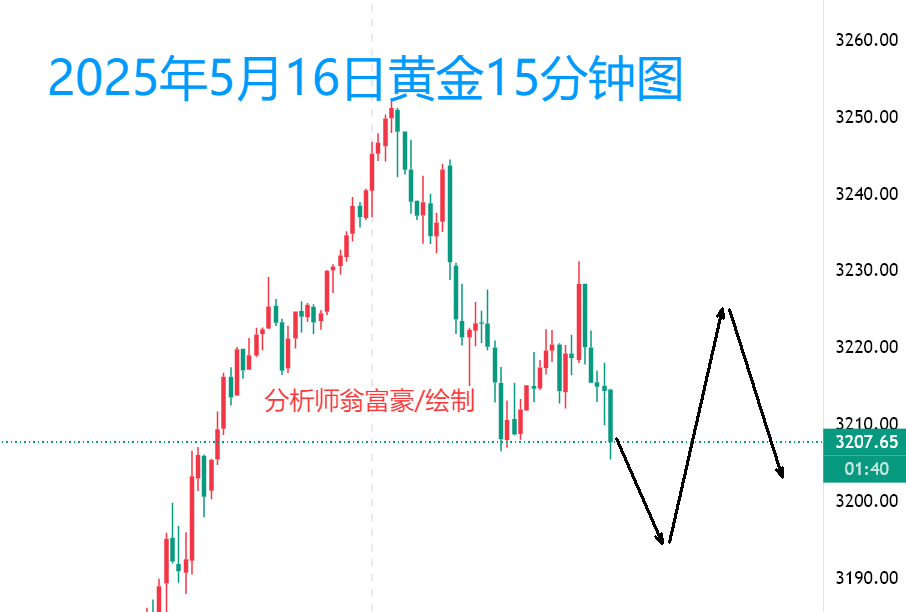
Group 1 - The core viewpoint of the articles highlights the significant volatility in the gold market, with prices experiencing a sharp decline followed by a strong rebound, driven by geopolitical tensions and economic data from the U.S. [1][3] Group 2 - On May 15, gold prices fell to a low of $3120.64 per ounce, marking the lowest level since April 10, before rebounding to close at $3239.58 per ounce, reflecting a daily increase of 1.97% and a price fluctuation exceeding $100 [1] - On May 16, gold prices continued to rise, surpassing the $3250 per ounce mark, reaching $3252.06 per ounce, driven by changes in geopolitical risk perceptions and disappointing U.S. economic data [1] - The rebound in gold prices is attributed to two main factors: the stalled peace talks between Russia and Ukraine, leading to a return of safe-haven investments in gold, and the underperformance of recent U.S. economic data, which has heightened expectations for a shift in Federal Reserve monetary policy [1] Group 3 - From a technical analysis perspective, gold prices showed strong support after hitting the key support level of $3120 per ounce, with a significant rebound observed, indicating a potential end to the recent downtrend [3] - The current focus is on whether gold prices can stabilize above the 5-day moving average, currently around $3220 per ounce, which could signal the end of the downtrend and a possible challenge to higher targets, such as $3500 per ounce [3] - Short-term trading strategies suggest buying on dips around $3200-$3195 with a stop loss at $3187 and a target of $3220-$3240, while also considering selling on rebounds around $3225-$3230 with a stop loss at $3238 and a target of $3215-$3200 [3]
翁富豪:5.15黄金空头主导格局延续,黄金今日操作建议
Sou Hu Cai Jing· 2025-05-14 23:58
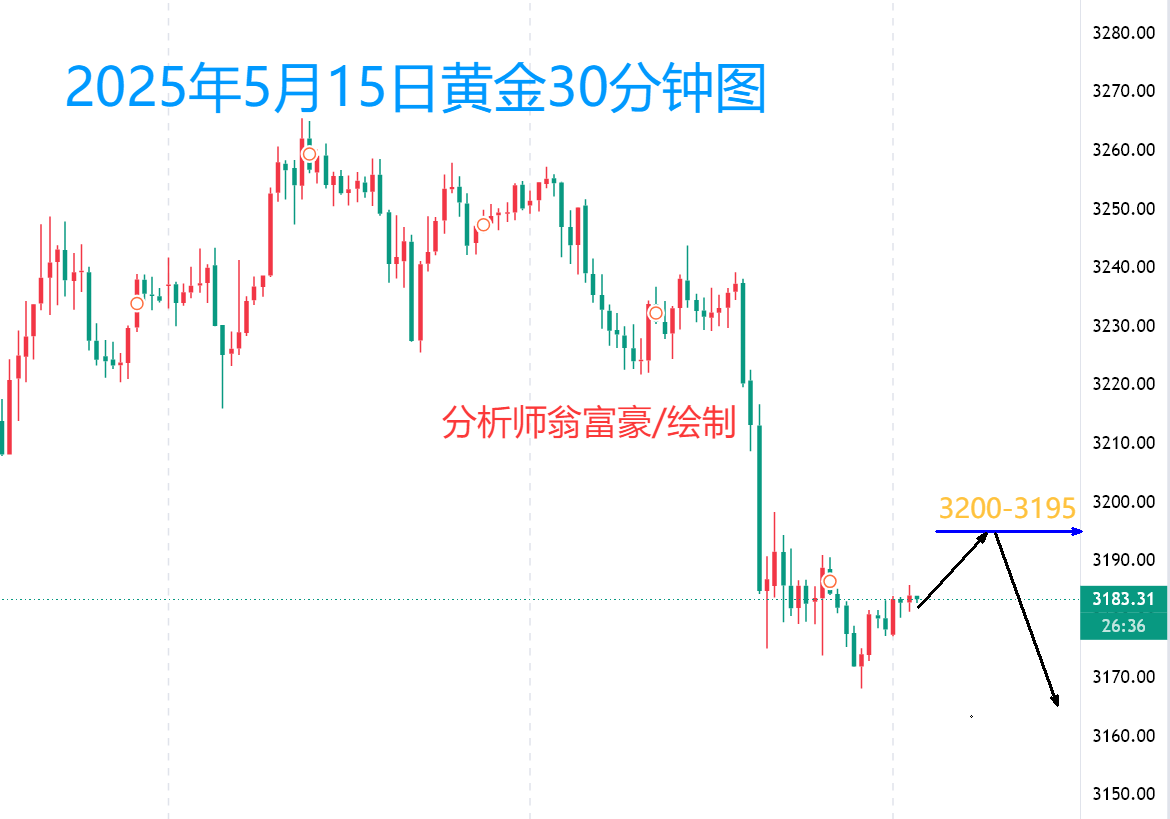
Group 1 - The core viewpoint is that the gold market continues to experience a downward trend despite a weak US dollar and expectations of a shift in Federal Reserve monetary policy [1][2] - The market is currently influenced by the lack of significant economic data and a retreat in safe-haven demand due to recent statements from Trump regarding tariff policies [1] - Geopolitical developments, particularly the ongoing Russia-Ukraine conflict and potential diplomatic negotiations, are also affecting market sentiment [1] Group 2 - On Wednesday, the gold market showed a bearish trend, breaking below the key support level of $3200 per ounce, indicating strong downward momentum [2][4] - Technical indicators such as the MACD are showing expanding bearish momentum, while the RSI is approaching oversold territory, suggesting a potential for short-term technical corrections [2] - The suggested trading strategy is to sell on rebounds in the $3195-$3200 range, with a stop-loss at $3203 and targets set at $3180-$3160 [4]
特朗普喊话“抄底”与美英贸易协议共振,美股能狂奔多久?
Sou Hu Cai Jing· 2025-05-09 03:14
Group 1 - The U.S. stock market saw a collective rise on May 8, with the Nasdaq index increasing by over 1%, and the Dow Jones and S&P 500 rising by 0.62% and 0.58% respectively, driven by President Trump's call for citizens to "buy stocks" and a new trade agreement between the U.S. and the U.K. [1] - The U.S.-U.K. trade agreement includes key concessions in the automotive, agricultural, and industrial sectors, with specific tariffs set for U.K. car exports and the complete removal of U.S. tariffs on U.K. steel and aluminum products [1] - Boeing announced a $10 billion order for wide-body aircraft from a U.K. airline, boosting confidence in the industrial sector and contributing to a more than 4% increase in Boeing's stock price [1] Group 2 - Major tech stocks, including Tesla and Nvidia, were central to the market's rise, with both seeing increases of over 3%, influenced by expectations of a shift in Federal Reserve monetary policy [2] - The U.S. core PCE price index for January fell to 2.6%, the lowest since June 2024, leading to a decline in long-term U.S. Treasury yields and reinforcing bets on potential interest rate cuts by the Federal Reserve in 2025 [2] - Trump's previous calls to "buy stocks" have historically led to short-term market spikes, but the long-term effects have often resulted in market corrections [3] Group 3 - There are concerns regarding the sustainability of the current market rally, as corporate earnings growth is slowing while valuations remain high, particularly among major tech companies [3] - The delayed effects of the Federal Reserve's monetary policy shift are becoming apparent, with high federal funds rates potentially increasing corporate financing costs and impacting tech companies' capital expenditures [3] - Global geopolitical risks and supply chain restructuring are expected to impact multinational companies' earnings, with the U.S.-U.K. trade agreement potentially exacerbating trade tensions with European allies [3]