
数字货币

Search documents
大爆发!数字货币概念批量涨停,中油资本3天2板
2 1 Shi Ji Jing Ji Bao Dao· 2025-08-21 10:23
(原标题:大爆发!数字货币概念批量涨停,中油资本3天2板) A股市场全天震荡调整,三大指数涨跌不一。从板块来看,数字货币概念股集体大涨,三未信安与北信 源均斩获20CM涨停,中油资本走出3天2板,天融信、京北方等多股涨停,高伟达、东港股份、金一文 化等个股跟涨。 日前,重庆市政府办公厅印发《重庆市做好金融"五篇大文章"实施方案》。其中提到,持续加强数字人 民币服务体系和金融基础设施建设。 (声明:文章内容仅供参考,不构成投资建议。投资者据此操作,风险自担。) ...

数据看盘机构减仓数字货币概念股 机器人概念股遭游资甩卖
Sou Hu Cai Jing· 2025-08-21 10:22
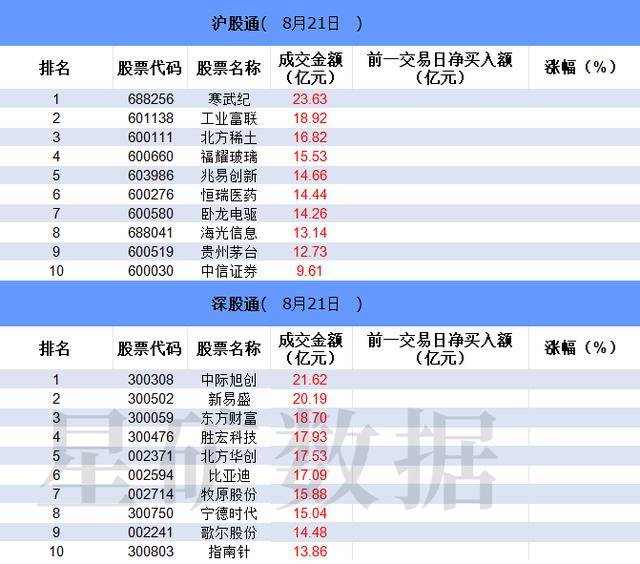
Trading Summary - The total trading volume of the Shanghai and Shenzhen Stock Connect today reached 309.77 billion, with Cambricon and Zhongji Xuchuang leading in trading volume for the Shanghai and Shenzhen stock connect respectively [1][2] - The top ten stocks by trading volume in the Shanghai Stock Connect included Cambricon (2.36 billion), Industrial Fulian (1.89 billion), and Northern Rare Earth (1.68 billion) [3][4] - In the Shenzhen Stock Connect, the top stocks were Zhongji Xuchuang (2.16 billion), Xinyi Technology (2.02 billion), and Dongfang Caifu (1.87 billion) [4] Sector Performance - The multi-financial sector saw the highest net inflow of funds, totaling 0.662 billion, with a net inflow rate of 4.80% [6] - Other sectors with notable inflows included steel and commercial retail, while the electronic sector experienced the largest outflow, with a net outflow of 17.09 billion [7] ETF Trading - The top ETF by trading volume was the Hong Kong Securities ETF, with a trading amount of 19.35 billion, followed by the Hong Kong Innovative Drug ETF at 7.00 billion [10][11] - The Sci-Tech 100 ETF (588190) saw a significant increase in trading volume, growing by 127% compared to the previous trading day [12] Futures Positioning - All four major index futures contracts saw a significant reduction in both long and short positions, with the short positions decreasing more than the long positions [13] Institutional Activity - Institutional buying was notable in stocks like Zhongdian Xilong (1.09 billion) and Chuangyitong (over 600 million), while significant selling occurred in stocks like Hengbao Shares (1.09 billion) and Chuanrun Shares (1.23 billion) [14][15] - The activity of first-tier speculative funds was moderate, with Northern Trust receiving over 2.5 billion in net buying from three first-tier speculative seats [16]






8月21日沪深两市强势个股与概念板块
2 1 Shi Ji Jing Ji Bao Dao· 2025-08-21 10:08
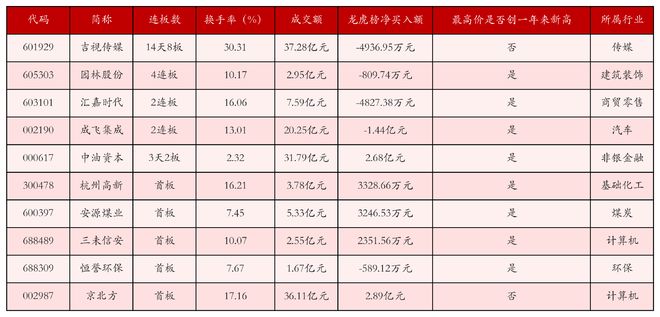
Strong Stocks - As of August 21, the Shanghai Composite Index rose by 0.13% to 3771.1 points, while the Shenzhen Component Index fell by 0.06% to 11919.76 points, and the ChiNext Index decreased by 0.47% to 2595.47 points [1] - A total of 58 stocks in the A-share market hit the daily limit up, with the top three strong stocks being: Jishi Media (601929), Garden Shares (605303), and Huijia Times (603101) [1] - Jishi Media (601929) had 14 trading days with 8 limit ups, a turnover rate of 30.31%, and a transaction amount of 3.728 billion yuan, with a net buying amount from the Dragon and Tiger list of -49.3695 million yuan [1] - Garden Shares (605303) achieved 4 consecutive limit ups, a turnover rate of 10.17%, and a transaction amount of 295 million yuan, with a net buying amount of -8.0974 million yuan [1] - Huijia Times (603101) recorded 2 consecutive limit ups, a turnover rate of 16.06%, and a transaction amount of 759 million yuan, with a net buying amount of -48.2738 million yuan [1] Strong Concept Sectors - The top three concept sectors with the highest increase in A-shares were: Combustible Ice, Digital Currency, and Cross-Border Payment (CIPS) [2] - The Combustible Ice sector rose by 3.12%, with 8.33% of its component stocks hitting the limit up, and 100% of its component stocks increasing [2] - The Digital Currency sector increased by 2.38%, with 7.22% of its component stocks hitting the limit up, and 79.38% of its component stocks rising [2] - The Cross-Border Payment (CIPS) sector saw a rise of 2.19%, with 5.41% of its component stocks hitting the limit up, and 82.43% of its component stocks increasing [2]
龙虎榜 | 游资爆买数字货币概念!佛山系、宁波桑田路出逃成飞集成
Ge Long Hui A P P· 2025-08-21 10:08
Market Overview - On August 21, A-shares showed mixed performance with the Shanghai Composite Index reaching a 10-year high. The total trading volume was 2.46 trillion yuan, an increase of 11.9 billion yuan compared to the previous trading day [1]. Market Trends - Market hotspots focused on cross-border payment, combustible ice, and digital currency sectors. Conversely, the generator concept and liquid cooling concept saw significant declines, with EEK materials, PCB, and CPO concepts also experiencing notable drops [2]. Stock Performance - A total of 43 stocks hit the daily limit up, with 9 stocks achieving consecutive limit-ups. The limit-up rate was 61% (excluding ST and delisted stocks) [4]. - Key stocks included: - Kosen Technology achieved a 5-day consecutive limit-up, marking a new high in the market [5]. - Garden Shares in the computing power industry chain recorded a 4-day consecutive limit-up [5]. - Jishi Media saw a limit-up at the close, achieving 8 limit-ups in 14 days [5]. Trading Data - The top three net buying stocks on the daily leaderboard were: - Jingbeifang with a net purchase of 289 million yuan [7]. - Zhongyou Capital with a net purchase of 268 million yuan [7]. - Beixin Source with a net purchase of 243 million yuan [7]. - The top three net selling stocks were: - Hengbao Shares with a net sale of 389 million yuan [8]. - Chongda Technology with a net sale of 359 million yuan [8]. - Chengfei Integration with a net sale of 144 million yuan [8]. Notable Stocks and Their Developments - Jingbeifang is focusing on digital currency and financial technology, having signed a strategic cooperation agreement with Guofu Quantum to explore cross-border payment and RWA financing [11]. - Beixin Source is integrating AI capabilities into its new market value analysis management system, enhancing security for users [12]. - Chengfei Integration has maintained a long-term strategic partnership with Chengfei Group, focusing on military products and aviation components [15]. Institutional Activity - Institutional net buying was significant in stocks like Zhongyou Capital and Jingbeifang, while Hengbao Shares and Chengfei Integration saw substantial net selling [19][20].




御银股份股价上涨10.05%,数字货币概念表现活跃
Sou Hu Cai Jing· 2025-08-21 09:56
Group 1 - The latest stock price of Yuyin Co., Ltd. is 9.09 yuan, which has increased by 0.83 yuan compared to the previous trading day [1] - The stock opened at 9.09 yuan, with both the highest and lowest prices also at 9.09 yuan, and a trading volume of 243,000 hands, resulting in a transaction amount of 221 million yuan [1] - Yuyin Co., Ltd. operates in the computer equipment sector, focusing on financial self-service equipment and digital currency technology research and development [1] Group 2 - The digital currency concept has been active recently, with Yuyin Co., Ltd. experiencing three consecutive trading days of price limit increases [1] - There is a growing demand for innovation and transformation in the financial sector, as well as for data platform construction, which has attracted market attention to the performance expectations of related companies [1] - Today, the net inflow of main funds into Yuyin Co., Ltd. was 101 million yuan, with a cumulative net inflow of 729 million yuan over the past five days [1]

移卡(09923.HK)公布2025年中期业绩:战略升级驱动强劲利润增长,差异化价值主张加速全球版图扩张,垂直领域认知深化AI服务
Ge Long Hui· 2025-08-21 09:13
Core Viewpoint - The company has demonstrated strong performance in the first half of 2025, showcasing advancements in technology, successful business model transformation, and robust international growth [3]. Business and Financial Summary - The company has successfully obtained the Money Services Business federal payment license in the U.S. and the Money Transmitter License in Arizona, expanding its global footprint [2]. - Approval from Japan's Ministry of Economy, Trade and Industry has been secured to conduct online and offline QR code payment services, enhancing local operations and commercial capabilities [2]. - The company has supported HSBC in enhancing its payment management solutions, adding support for Alipay, Alipay Hong Kong, and WeChat Pay, indicating strong international product penetration [2]. - The subsidiary, focusing on AI-generated content, has seen a monthly transaction volume growth of approximately 40%, with material costs reduced by 80%, and AI-generated content now accounts for 20% of total video production [2]. - The company maintains its leading position in one-stop payment services, with peak daily transaction volumes reaching nearly 60 million [2]. - Total Gross Payment Volume (GPV) for the first half of 2025 was RMB 1,144.4 billion, a decrease of 1.9% year-on-year, while overseas transaction volume exceeded RMB 1.5 billion, surpassing the total for the previous year [2]. - The payment fee rate for the first half of 2025 was 12.5 basis points, an increase of 1.0 basis point year-on-year, reflecting superior commercialization and business expansion capabilities [2]. - Revenue for the first half of 2025 was RMB 1,641.5 million, a year-on-year increase of 4.0% [2]. - Gross profit for the first half of 2025 was RMB 383.0 million, up 27.6% year-on-year, with gross profit margin rising from 19.0% to 23.3% [2]. - The gross profit margin for one-stop payment services increased from 6.9% in the first half of 2024 to 13.7% in the first half of 2025, with overseas gross profit margins exceeding 50% [2]. - The application of AI across various business lines has led to a 19.3% reduction in sales, administrative, and R&D expenses year-on-year [2]. - Financing costs for the first half of 2025 decreased by 52.7% year-on-year due to structural upgrades and financial cost optimization [2]. - Net profit for the first half of 2025 was RMB 41.4 million, a year-on-year increase of 27.0% [2]. Outlook - The company plans to continue its dual strategy of international expansion and product innovation, embracing technological trends such as AI and blockchain to enhance operational efficiency and service intelligence [4].
移卡发布中期业绩,股东应占利润4307.5万元,同比增加36.19%
Zhi Tong Cai Jing· 2025-08-21 09:13
Core Viewpoint - The company reported a revenue of RMB 1.641 billion for the six months ending June 30, 2025, reflecting a year-on-year increase of 4.04%, with a profit attributable to equity holders of RMB 43.075 million, up 36.19% year-on-year, indicating strong growth in both domestic and international operations [1][2]. Group 1: Financial Performance - The company's revenue for the first half of 2025 was RMB 1.641 billion, a 4.04% increase compared to the previous year [1]. - Profit attributable to equity holders reached RMB 43.075 million, marking a 36.19% year-on-year increase [1]. - Basic earnings per share were reported at RMB 0.11 [1]. Group 2: Business Growth and Strategy - The overseas business demonstrated robust growth, with overseas GPV transaction volume exceeding RMB 1.5 billion in the first half of 2025, surpassing the total transaction volume of approximately RMB 1.1 billion for the entire previous year [2]. - The company’s overseas payment rate was recorded at 67.0 basis points, with a gross margin exceeding 50% [2]. - The company’s diversified business model and one-stop payment services for international brand clients highlight its global scalability [1]. Group 3: Operational Efficiency and Innovation - The company has seen a gradual recovery in domestic payment business rates and profitability, supported by strengthened partnerships and a more stable digital ecosystem [1]. - Continuous optimization of operational efficiency has been achieved, with the deepening application of artificial intelligence technology simplifying processes and reducing costs [1]. - The precision marketing business set a new transaction volume record in the second quarter, while the in-store e-commerce business achieved monthly profitability, enhancing overall sustainability [1].
【每日收评】三大指数震荡分化涨跌不一,数字货币概念集体活跃,高位人气股再遭重创
Xin Lang Cai Jing· 2025-08-21 08:59
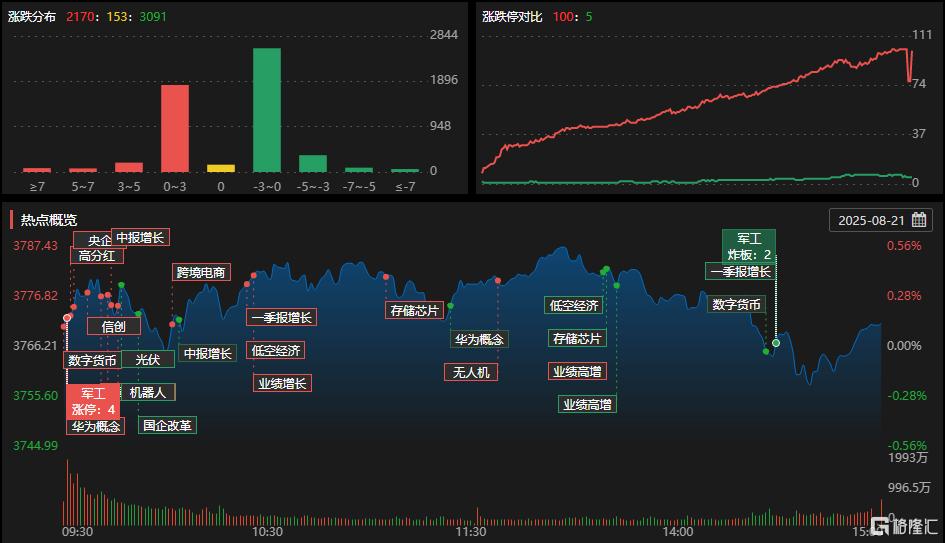
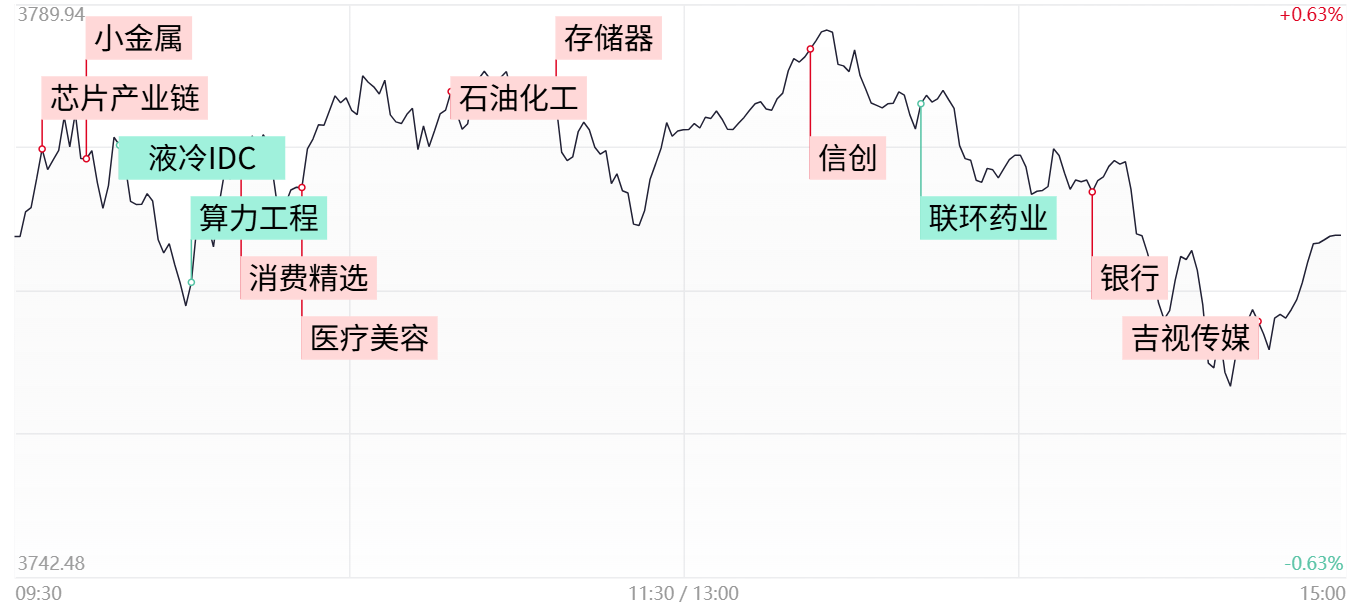
Market Overview - The market experienced fluctuations with mixed performance across the three major indices, with the Shanghai Composite Index up by 0.13% and the Shenzhen Component down by 0.06% [1] - The total trading volume in the Shanghai and Shenzhen markets reached 2.42 trillion yuan, an increase of 158 billion yuan compared to the previous trading day, marking the seventh consecutive day of trading volume exceeding 2 trillion yuan [1] Sector Performance - The digital currency sector saw a collective surge, with stocks like Yuyin Co., Ltd. hitting the daily limit [2] - The beauty and personal care sector also performed well, with stocks such as Jieya Co., Ltd. and Shuiyang Co., Ltd. rising over 8% [3] - Bank stocks showed resilience, with Agricultural Bank of China reaching a historical high and a year-to-date increase of over 40% [3][4] Individual Stock Movements - High-priced stocks faced significant declines, with stocks like Chuanrun Co., Ltd. and Feilong Co., Ltd. hitting the daily limit down [6] - The number of stocks with consecutive gains dropped to 9, indicating a shift in market sentiment [6] Future Market Analysis - The market remains in a reasonable correction phase, with no clear signs of short-term weakness despite the high-level stock adjustments [8] - The focus is on which high-profile stocks can attract capital back after recent declines, as this will indicate new investment directions [8] Key Industry Insights - The digital currency concept is driven by news and speculation, with potential for significant differentiation among stocks in the sector [2] - The beauty care industry is experiencing high growth due to transparency in skincare ingredients and the rise of domestic brands leveraging advanced technologies [3]
电子身份证概念涨1.93%,主力资金净流入这些股
Zheng Quan Shi Bao Wang· 2025-08-21 08:56
Group 1 - The electronic ID concept sector rose by 1.93%, ranking fifth among concept sectors, with 30 stocks increasing in value, including Tianrongxin and Jingbeifang hitting the daily limit [1] - Notable gainers in the electronic ID sector included Kechuang Information, Xin'an Century, and Donggang Shares, which rose by 13.17%, 11.00%, and 6.92% respectively [1] - The sector experienced a net inflow of 1.587 billion yuan, with 25 stocks receiving net inflows, and 9 stocks seeing inflows exceeding 100 million yuan [1] Group 2 - The top stocks by net inflow included Jingbeifang with 922.86 million yuan, followed by China Software, Donggang Shares, and Tianrongxin with net inflows of 228.49 million yuan, 189.03 million yuan, and 170.26 million yuan respectively [2] - The net inflow ratios for Tianrongxin, Jingbeifang, and Donggang Shares were 62.03%, 25.56%, and 15.43% respectively, indicating strong investor interest [2] - The trading volume and turnover rates for key stocks in the electronic ID sector showed significant activity, with Jingbeifang having a turnover rate of 17.16% [2] Group 3 - The electronic ID sector's performance was contrasted with other sectors, such as combustible ice and digital currency, which also saw gains, while sectors like rare earth permanent magnets and PCB concepts experienced declines [1] - The overall market sentiment reflected a mixed performance across various sectors, with electronic ID showing resilience amid broader market fluctuations [1][2]


25.03亿主力资金净流入,跨境支付(CIPS)概念涨2.19%
Zheng Quan Shi Bao Wang· 2025-08-21 08:53
Group 1 - The cross-border payment (CIPS) concept increased by 2.19%, ranking third among concept sectors, with 61 stocks rising, including Sanwei Xinan with a 20% limit up, and Zhongyou Capital, Tianrongxin, and Jingbeifang also hitting the limit up [1][2] - The top gainers in the CIPS sector included *ST Dongtong, Xinchen Technology, and Xinan Century, which rose by 15.74%, 12.59%, and 11.00% respectively [1][2] - The sector saw a net inflow of 2.503 billion yuan from main funds, with 42 stocks receiving net inflows, and 11 stocks exceeding 100 million yuan in net inflow [2][3] Group 2 - The leading stocks in terms of net inflow included Zhongyou Capital with a net inflow of 1.077 billion yuan, followed by Jingbeifang, Sifang Jingchuang, and Xinchen Technology with net inflows of 923 million yuan, 333 million yuan, and 270 million yuan respectively [2][3] - The net inflow ratios for Tianrongxin, Zhongyou Capital, and Jingbeifang were 62.03%, 33.89%, and 25.56% respectively, indicating strong investor interest [3] - The overall performance of the CIPS sector reflects a positive sentiment among investors, as evidenced by the significant net inflows and stock price increases [1][2][3]

