
脑机接口

Search documents
【图解】532万件、18万亿元……从这份成绩单看中国专利“含金量”
Zhong Guo Jing Ji Wang· 2026-01-24 05:18
Group 1 - The core viewpoint of the article highlights the significant progress in China's intellectual property landscape, with a focus on the increase in effective patents and the economic impact of patent-intensive industries [2][9]. - By the end of 2025, the effective number of invention patents in China (excluding Hong Kong, Macau, and Taiwan) is projected to reach approximately 4 million [2]. - The effective number of registered trademarks has reached 49.877 million, with a total of 5,066 recognized geographical indication products [3]. Group 2 - The number of high-value invention patents has reached 2.292 million, with a year-on-year growth rate 2.2 percentage points higher than the overall level [5]. - Key sectors such as information technology management, computer technology, and medical technology are experiencing the fastest growth in effective invention patents [5]. - China ranks first globally in the number of artificial intelligence patents, with significant advancements in quantum technology, biomanufacturing, brain-computer interfaces, and sixth-generation communications [6]. Group 3 - The Yangtze River Delta, Beijing-Tianjin-Hebei, and Guangdong regions account for approximately two-thirds of the total effective invention patents in China, totaling 3.549 million [8]. - These regions also hold over half of the effective registered trademarks, totaling 28.058 million [8]. - In the 2025 Global Top 100 Innovation Clusters ranking by the World Intellectual Property Organization, the Shenzhen-Hong Kong-Guangzhou cluster ranks first, while the Beijing cluster ranks fourth and the Shanghai-Suzhou cluster ranks sixth [8]. Group 4 - The value added by patent-intensive industries has surpassed 18 trillion yuan, increasing its share of GDP from 11.97% in 2020 to 13.38% in 2024 [9]. - Chinese brands are valued at 1.81 trillion USD, ranking second globally among the top 5,000 brands [9]. - The direct annual output value of geographical indication products has seen continuous growth, nearing 1 trillion yuan, contributing to the economic prosperity of these industries [9].


截至2025年底我国每万人口高价值发明专利拥有量达到16件 人工智能专利有效量居全球前列
Yang Guang Wang· 2026-01-24 02:43
Group 1 - The core viewpoint of the articles highlights the significant growth and impact of intellectual property in China, with a focus on the increase in high-value invention patents and their contribution to economic growth [1][2] - By the end of 2025, the effective number of invention patents in China is expected to reach 5.32 million, with a per capita high-value invention patent ownership of 16, exceeding the targets set in the "14th Five-Year Plan" [1] - The growth rate of high-value invention patents is 2.2 percentage points higher than the overall level, with the number reaching 2.292 million, particularly in fields like information technology management, computer technology, and medical technology [1] Group 2 - The value added by patent-intensive industries in China has surpassed 18 trillion yuan, steadily increasing its contribution to GDP [2] - China ranks second globally in brand value among the top 5000 brands, with a total value of 1.81 trillion USD [2] - The number of patent transfer and licensing registrations is projected to reach 697,000 by 2025, marking a year-on-year increase of 13.7%, with universities and research institutions accounting for nearly 90,000 of these registrations [2]
脑机接口大消息!马斯克,突发!
Sou Hu Cai Jing· 2026-01-24 02:43
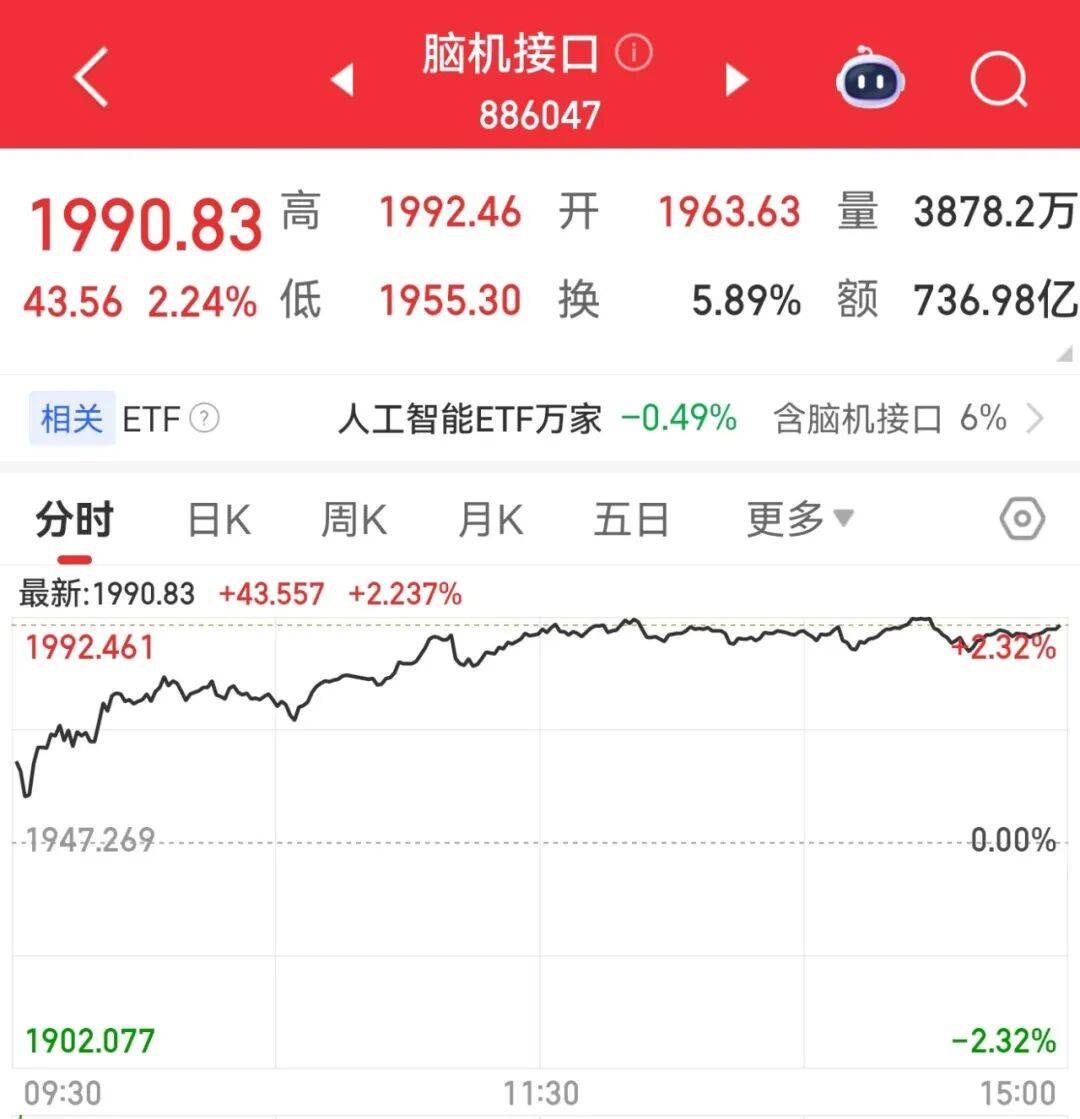
Group 1: Brain-Computer Interface Industry - The A-share brain-computer interface sector experienced a significant increase, closing up over 2% on January 23 [1] - Neuralink, founded by Elon Musk, plans to achieve large-scale production of brain-computer interface devices by 2026, with a highly automated surgical process [3] - Strong Brain Technology, one of the "Six Little Dragons" in Hangzhou, has submitted a confidential IPO application and recently completed approximately 2 billion yuan in financing, marking the second-largest financing event in the brain-computer interface field globally, after Neuralink [4] Group 2: Market Potential and Applications - The brain-computer interface technology has vast application prospects in various fields, including healthcare, consumer electronics, and military aerospace [5] - The technology is expected to transition from experimental stages to pilot applications, with significant industry value anticipated during the "14th Five-Year Plan" period [4] - The integration of brain-computer interfaces into high-end manufacturing and strategic industries is seen as a foundational technology supporting new industrialization [5] Group 3: Neuroplasticity and Cognitive Health - Joyce Shaffer, a respected expert in neuroplasticity and brain health, emphasizes that neuroplasticity is a lifelong ability, allowing for cognitive rejuvenation regardless of age [9][10] - The book "How to Unlock the Reverse-Aging Brain" provides a systematic approach to reducing brain degeneration across the lifespan, highlighting the importance of active intervention in neural networks [11] - The LANDS model introduced in the book integrates five scientifically validated areas—Love, Aerobics, Neurobics, Diet, and Sleep—into a comprehensive lifestyle system for brain health [11]

2025年国内发明专利有效量达532万件 人工智能专利有效量居全球前列
Zhong Guo Zheng Quan Bao· 2026-01-24 02:02
Core Viewpoint - The State Council Information Office held a press conference on January 23, 2025, to report on the progress of intellectual property work, highlighting that by the end of 2025, the effective number of domestic invention patents in China (excluding Hong Kong, Macau, and Taiwan) is expected to reach 5.32 million, with artificial intelligence patents ranking among the top globally [1] Group 1: Innovation Quality Improvement - In 2025, a total of 972,000 invention patents, 1.461 million utility model patents, and 666,000 design patents were granted, with a patent review cycle reduced to 15 months and a case closure accuracy rate improved to 95.6% [2] - The effective number of high-value invention patents reached 2.292 million, with a year-on-year growth rate 2.2 percentage points higher than the overall level [2] - The value-added of patent-intensive industries accounted for 13.38% of GDP in 2024, exceeding the expectations set in the "14th Five-Year Plan" for intellectual property [2][3] Group 2: Patent Quality and International Standing - The quality of patents is a crucial indicator of innovation levels, with China achieving a high-value invention patent ownership of 16 per 10,000 people, surpassing the "14th Five-Year Plan" target [3] - China ranked 10th in the World Intellectual Property Organization's "2025 Global Innovation Index Report," recognized as one of the fastest-growing countries in terms of high-quality development [3] Group 3: Strengthening Foreign Intellectual Property Protection - The National Intellectual Property Administration (NIPA) is enhancing foreign intellectual property protection, addressing issues such as information asymmetry and weak response capabilities among domestic enterprises [4] - By the end of 2025, NIPA established 99 overseas intellectual property dispute response guidance platforms across 30 provinces, providing over 4,800 guidance and consulting services, recovering losses of 2.75 billion yuan [4] - NIPA plans to further strengthen foreign intellectual property protection in 2025, improving coordination mechanisms and enhancing the guidance network for dispute response [5]
数读中国 一组数据看我国知识产权强国建设迈出坚实步伐
Ren Min Wang· 2026-01-24 01:35
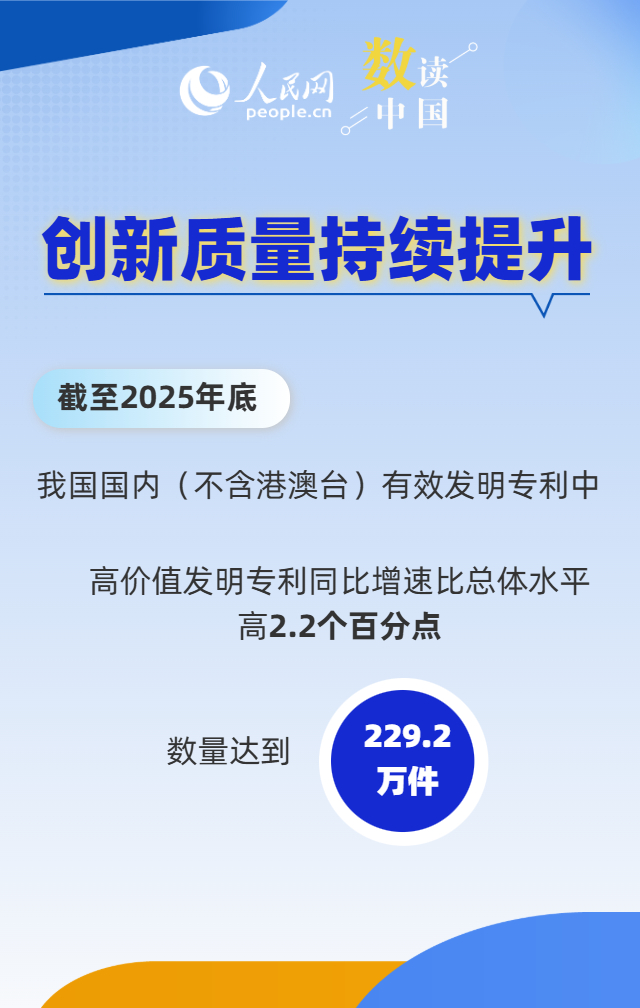
Group 1 - Innovation is the primary driving force for development, with intellectual property increasingly recognized as a strategic national resource and a core element of international competitiveness [1] - By the end of 2025, the growth rate of high-value invention patents in China is expected to exceed the overall level by 2.2 percentage points [3] - The number of effective invention patents in China is projected to reach 229.2 million [4] Group 2 - China ranks first globally in the effective number of artificial intelligence patents, with rapid growth in fields such as computer technology, medicine, information technology, and management methods [5] - Key core technology patents have been laid out in future industries like quantum technology, biomanufacturing, brain-computer interfaces, and sixth-generation communications, promoting high-level technological self-reliance [5] Group 3 - Key regions for innovation include the Yangtze River Delta with 173.4 million invention patents, the Beijing-Tianjin-Hebei region with 91.6 million, and Guangdong Province with 89.9 million, collectively accounting for about two-thirds of the national total [6] - The total number of effective registered trademarks is 28.058 million, representing over half of the national total [6] Group 4 - The Shenzhen-Hong Kong-Guangzhou cluster ranks first globally in the World Intellectual Property Organization's 2025 Global Top 100 Innovation Clusters ranking [8] - The Beijing cluster ranks fourth globally, while the Shanghai-Suzhou cluster ranks sixth [9]
【策略】A股牛市当前阶段形态特征六问六答——解密牛市系列之六(张宇生/郭磊)
光大证券研究· 2026-01-24 00:04
Core Viewpoint - The article analyzes the characteristics and patterns of bull markets in the A-share market, emphasizing the alternating phases of upward and consolidation segments, with a low proportion of long-term downward phases [4]. Group 1: Bull Market Patterns - A-share bull markets typically follow a pattern of alternating "upward segments and consolidation segments," with long-term downward phases being rare [4]. - In a comprehensive bull market, the structure consists of "3 consolidation segments and 4 upward segments," while a structural bull market has "2 consolidation segments and 3 upward segments" [4]. Group 2: Characteristics of Second Consolidation Segment - Historical differences between comprehensive and structural bull markets during the second consolidation segment include significant variations in pullback magnitude, duration, market style, and activity level [5]. - From September 2024 to the present, the Shanghai Composite Index has formed 2 complete upward segments and 2 consolidation segments, currently transitioning from the second consolidation segment to the early stage of the third consolidation segment [5]. Group 3: Confirming Breakthrough from Consolidation to Upward Segment - A bull market's transition from the second consolidation segment to the third upward segment requires dual validation from technical patterns and policy events [6]. - A successful technical breakout above the upper boundary of the second consolidation segment, along with favorable policy signals, is essential for confirming the transition [6]. Group 4: Current Bull Market Type - The current bull market aligns more closely with the characteristics of a structural bull market, as the second consolidation segment exhibits "small pullback magnitude and long duration," which is distinct from comprehensive bull markets [7]. - The market style during the second consolidation segment has shown a "stronger winners" trend, consistent with historical structural bull markets [7]. Group 5: Potential Breakthrough of the Second Consolidation Segment - The current bull market may have already broken through the second consolidation segment, entering the third upward segment, as indicated by the Shanghai Composite Index's effective breakout and the appearance of a bullish candlestick pattern [8]. - Following the breakout, the market has shown steady upward movement, suggesting sufficient buying power and sustainability of the trend [8]. Group 6: Future Market Development - The initial phase of the third upward segment may form a temporary high between 4200-4300 points, followed by a potential pullback that stabilizes at the upper boundary of the second consolidation segment [9]. - Historical patterns suggest that after breaking through the second consolidation segment, the initial high in the third upward segment typically sees a rise of about 5% from the upper boundary and approximately 14.5% from the lower boundary of the second consolidation segment [9].

新浪财经资讯AI速递:昨夜今晨财经热点一览 丨2026年1月24日
Xin Lang Cai Jing· 2026-01-23 23:31
Group 1 - US stock market showed mixed results with Nasdaq and S&P slightly up while Dow Jones declined, Intel's stock plummeted by 17% due to poor earnings guidance, while Nvidia and other chip stocks provided support [1] - The dollar index continued to weaken, and gold futures reached an all-time high, with silver breaking the $100 mark for the first time, driven by severe weather that caused US natural gas prices to surge by 70% in a week [1] - European countries hold approximately $3.6 trillion in US Treasury bonds, representing 40% of the overseas total, which could be used as leverage against the US amid tariff pressures, although coordinated selling may lead to significant losses [2][19] Group 2 - Japanese Prime Minister Fumio Kishida's tax cut promises have raised market concerns, leading to a massive sell-off of Japanese government bonds, causing long-term bond yields to soar to multi-year highs [3][20] - The US oil service giant SLB stated it could quickly expand operations in Venezuela if permitted, being the only international oil service company currently operating there, with competitors like Halliburton also looking to re-enter the market [4][21] - Canadian billionaire Eric Sprott has significantly profited from investing in the struggling Hycroft Mining Company, with a return on investment of 678%, capitalizing on the bull market for gold and silver [5][22] Group 3 - Silver prices have historically surpassed $100 per ounce, with a year-to-date increase of 40%, driven by strong industrial demand and ongoing structural supply shortages [6][23] - Economists have revised their expectations, indicating that the Federal Reserve may delay interest rate cuts until June, with inflation pressures and a robust labor market reducing the urgency for rate reductions [7][24] - Nomura's chief economist suggested gradually increasing farmers' pensions to 1,000 yuan per month, which could significantly improve rural elderly income expectations and stimulate consumption [8][25] Group 4 - The A-share market saw a surge in the photovoltaic sector, with major investment from well-known funds in commercial aerospace and semiconductor industries, indicating a strong institutional interest [10][26] - Musk's support for space-based solar power has led to a significant rally in photovoltaic stocks, with over 30 stocks hitting the daily limit up, although the industry still faces substantial technical and cost challenges [11][28] - China Merchants Bank has become the first bank to surpass 13 trillion yuan in total assets, indicating a potential turning point in its financial performance, while other banks also reached significant asset milestones [12][29]




人工智能专利有效量居全球前列
Zhong Guo Zheng Quan Bao· 2026-01-23 21:02
Core Viewpoint - The press conference held by the State Council Information Office highlighted the progress of intellectual property work in China, with a focus on the significant increase in the number of valid invention patents and the improvement in innovation quality by 2025 [1][2]. Group 1: Patent Statistics and Quality Improvement - By the end of 2025, the number of valid invention patents in China (excluding Hong Kong, Macau, and Taiwan) is expected to reach 5.32 million, with a per capita high-value invention patent ownership of 16 [1][3]. - In 2025, a total of 972,000 invention patents, 1.461 million utility model patents, and 666,000 design patents were authorized, with a patent review cycle reduced to 15 months and an accuracy rate of 95.6% [1][2]. - The added value of patent-intensive industries is projected to account for 13.38% of GDP, exceeding the targets set in the "14th Five-Year Plan" [1]. Group 2: High-Value Patent Growth - The number of high-value invention patents in China reached 2.292 million, with a year-on-year growth rate 2.2 percentage points higher than the overall level [2]. - Key areas such as information technology management methods, computer technology, and medical technology have seen significant growth in valid invention patents, with artificial intelligence patents ranking among the top globally [2]. Group 3: International Intellectual Property Protection - The National Intellectual Property Administration (NIPA) is enhancing foreign intellectual property protection as Chinese enterprises engage more in global trade, addressing issues like information asymmetry and weak response capabilities [3][4]. - The implementation of the "Regulations on Handling Foreign Intellectual Property Disputes" marks a new level of legal protection, with 99 overseas intellectual property dispute response guidance platforms established across 30 provinces [4]. - In 2025, NIPA provided over 4,800 guidance and consulting services related to cross-border e-commerce intellectual property disputes, recovering losses amounting to 2.75 billion yuan [4].
国家知识产权局:我国创新质量持续提升
Zheng Quan Ri Bao· 2026-01-23 16:07
Group 1 - The core viewpoint of the articles highlights the significant growth and strategic importance of China's patent landscape, with a focus on high-value invention patents and their contribution to economic growth [1][2] - By the end of 2025, the number of valid invention patents in China (excluding Hong Kong, Macau, and Taiwan) is expected to reach 5.32 million, with a per capita high-value invention patent ownership of 16 [1] - The number of high-value invention patents has increased to 2.292 million, with a year-on-year growth rate 2.2 percentage points higher than the overall level, indicating a continuous improvement in innovation quality [1] - The fastest growth in valid invention patents is observed in fields such as information technology management methods, computer technology, and medical technology, with artificial intelligence patents ranking among the top globally [1] - The number of patent transfer and licensing registrations is projected to reach 697,000 in 2025, reflecting a year-on-year increase of 13.7%, while the industrialization rate of enterprise invention patents has reached 54% [1] Group 2 - The added value of patent-intensive industries in China has surpassed 18 trillion yuan, with its GDP share increasing from 11.97% in 2020 to 13.38% in 2024, contributing steadily to economic growth [2] - Patent-intensive industries exhibit significant innovation-driven characteristics, with R&D investment intensity expected to exceed 2.6% in 2024, which is 2.4 times that of non-patent-intensive industries [2] - The number of invention patent authorizations per 10,000 employees in patent-intensive industries has reached 476 over the past five years, an increase of 66 compared to the previous period, which is ten times the national average [2] - The digital economy's role is increasingly prominent, with information and communication technology manufacturing and services contributing nearly 8 trillion yuan, accounting for over 40% of the overall value [2] - Emerging industries such as new equipment manufacturing, pharmaceuticals, and environmental protection are also steadily increasing in value, indicating a shift towards high-end, intelligent, and green development in China's industrial landscape [2]
康芝药业(300086.SZ):截止目前,公司没有与脑机接口类公司合作的项目
Ge Long Hui· 2026-01-23 15:50
Core Viewpoint - The company, Kangzhi Pharmaceutical (300086.SZ), has stated that it currently has no projects in collaboration with brain-computer interface companies [1] Group 1 - The company confirmed its lack of partnerships with brain-computer interface firms as of now [1]
