全面牛市

Search documents
和讯投顾张义明:美国非农数据爆了 会影响A股吗?
Sou Hu Cai Jing· 2026-02-13 06:35
Core Viewpoint - The recent U.S. non-farm employment data significantly exceeded expectations, impacting A-share investors and altering expectations for monetary policy adjustments in China [1] Group 1: U.S. Employment Data Impact - The U.S. non-farm employment data showed a substantial increase, with actual figures at 130,000 compared to the expected 60,000 to 70,000, indicating a robust job market [1] - This positive employment data suggests that the Federal Reserve may not need to lower interest rates, which affects global monetary policy expectations, including those in China [1] Group 2: Monetary Policy Expectations - The expectation for the Federal Reserve to cut rates has been pushed back to July 2026, which limits the likelihood of significant monetary easing in China in the first half of the year [1] - Major investment banks, including UBS and Citigroup, predict that China's interest rate cuts in 2026 will be around 20 basis points, indicating limited monetary policy support for a bull market [1] Group 3: Market Outlook - The current labor market improvement in the U.S. is attributed to a significant rise in healthcare-related employment, which may be an anomaly; the sustainability of this trend will be monitored through upcoming data [1] - The market is expected to remain in a volatile state in the first half of the year, with a focus on structural opportunities rather than a broad bull market, as the likelihood of a comprehensive bull market is low [1]
4100点的十字路口,如何做好投资布局?
雪球· 2026-01-30 13:00
Core Viewpoint - The article discusses the current market dynamics in China, highlighting a significant divergence between traditional economy stocks and emerging sectors like non-ferrous metals and commercial aerospace, indicating a transition from a "structural bull market" to a "broad bull market" as the Shanghai Composite Index surpasses 4000 points [3][4]. Group 1: Market Dynamics - The divergence in market performance reflects a "new-old momentum transition," with non-ferrous metals and commercial aerospace experiencing substantial growth driven by macroeconomic and industrial logic [3][4]. - Non-ferrous metals are benefiting from a multi-dimensional resonance, including global energy transition, AI development, geopolitical uncertainties, and supply constraints, leading to a strong demand cycle [3][4]. - The rise of commercial aerospace signifies the industrialization of "new productive forces," with increasing satellite internet deployment and significant demand for rocket manufacturing and satellite development [4]. Group 2: Traditional Economy - The weakness in traditional economy stocks indicates a market waiting for performance turning points and policy catalysts, particularly in key areas like real estate that impact the consumption chain [4][5]. - Despite current underperformance, traditional stocks are expected to recover as the market transitions to a broader bull phase, with historical trends suggesting that healthy bull markets typically involve rotation across multiple sectors [4][5]. Group 3: Investment Strategy - The core strategy for navigating the current market involves "focusing on prosperity, balanced allocation, and dynamic adjustment," emphasizing the importance of aligning with industry trends and maintaining core positions in strong sectors [5][6]. - Investors are advised to consider ETFs covering diverse non-ferrous metals and the entire commercial aerospace supply chain to mitigate risks and capitalize on sector growth [5][6]. - Attention should also be given to potential recovery signals in "mid-tier" and "traditional" stocks, particularly in consumer and financial sectors, as the market evolves [5][6]. Group 4: Market Outlook - The market is anticipated to exhibit an "N-shaped" trajectory in 2026, with potential highs in the first quarter followed by consolidation in the second and third quarters, before reaching new highs in the latter half of the year [6][7]. - Future excess returns are expected to stem from the industrialization of "new productive forces" and the cyclical recovery and value reassessment of the traditional economy, necessitating a balanced investment approach [7].


光大证券:A股牛市当前阶段形态特征六问六答
Xin Lang Cai Jing· 2026-01-25 06:31
Group 1 - The core pattern of A-share bull markets follows an alternating cycle of "upward phases and consolidation phases," with long-term downward phases being very rare [1][5] - Different types of bull markets exhibit variations in their phase combinations, with a comprehensive bull market consisting of "3 consolidation phases and 4 upward phases," while a structural bull market consists of "2 consolidation phases and 3 upward phases" [1][5] - Historical differences in the second consolidation phase between comprehensive and structural bull markets are evident in terms of retracement magnitude, duration, market style, and activity level [6] Group 2 - Confirmation of a bull market transition from the second consolidation phase to the third upward phase requires both technical and policy validation [2][6] - The current bull market aligns more closely with structural bull market characteristics, as the second consolidation phase has shown "small retracement magnitude and long duration," which is distinct from comprehensive bull markets [7] - The current bull market may have already transitioned into the third upward phase, supported by technical signals and positive macro policies [3][7] Group 3 - Based on historical patterns, the initial phase of the third upward segment may reach a temporary high between 4200-4300 points, followed by a potential retracement that stabilizes at the upper boundary of the second consolidation phase [4][8] - The upper boundary of the second consolidation phase serves as a critical support level, indicating strong capital support and psychological backing for the market [8] - Future monitoring should focus on the pressure release and capital support within the 4200-4300 point range, as well as the effectiveness of support at the upper boundary of the second consolidation phase [8]

【策略】A股牛市当前阶段形态特征六问六答——解密牛市系列之六(张宇生/郭磊)
光大证券研究· 2026-01-24 00:04
Core Viewpoint - The article analyzes the characteristics and patterns of bull markets in the A-share market, emphasizing the alternating phases of upward and consolidation segments, with a low proportion of long-term downward phases [4]. Group 1: Bull Market Patterns - A-share bull markets typically follow a pattern of alternating "upward segments and consolidation segments," with long-term downward phases being rare [4]. - In a comprehensive bull market, the structure consists of "3 consolidation segments and 4 upward segments," while a structural bull market has "2 consolidation segments and 3 upward segments" [4]. Group 2: Characteristics of Second Consolidation Segment - Historical differences between comprehensive and structural bull markets during the second consolidation segment include significant variations in pullback magnitude, duration, market style, and activity level [5]. - From September 2024 to the present, the Shanghai Composite Index has formed 2 complete upward segments and 2 consolidation segments, currently transitioning from the second consolidation segment to the early stage of the third consolidation segment [5]. Group 3: Confirming Breakthrough from Consolidation to Upward Segment - A bull market's transition from the second consolidation segment to the third upward segment requires dual validation from technical patterns and policy events [6]. - A successful technical breakout above the upper boundary of the second consolidation segment, along with favorable policy signals, is essential for confirming the transition [6]. Group 4: Current Bull Market Type - The current bull market aligns more closely with the characteristics of a structural bull market, as the second consolidation segment exhibits "small pullback magnitude and long duration," which is distinct from comprehensive bull markets [7]. - The market style during the second consolidation segment has shown a "stronger winners" trend, consistent with historical structural bull markets [7]. Group 5: Potential Breakthrough of the Second Consolidation Segment - The current bull market may have already broken through the second consolidation segment, entering the third upward segment, as indicated by the Shanghai Composite Index's effective breakout and the appearance of a bullish candlestick pattern [8]. - Following the breakout, the market has shown steady upward movement, suggesting sufficient buying power and sustainability of the trend [8]. Group 6: Future Market Development - The initial phase of the third upward segment may form a temporary high between 4200-4300 points, followed by a potential pullback that stabilizes at the upper boundary of the second consolidation segment [9]. - Historical patterns suggest that after breaking through the second consolidation segment, the initial high in the third upward segment typically sees a rise of about 5% from the upper boundary and approximately 14.5% from the lower boundary of the second consolidation segment [9].

解密牛市系列之六:A股牛市当前阶段形态特征六问六答
EBSCN· 2026-01-23 02:47
Group 1 - The core characteristic of the A-share bull market is the alternating pattern of "upward phases and consolidation phases," with long-term downward phases being very rare [1][12][23] - Historical bull markets show that comprehensive bull markets consist of "3 consolidation phases + 4 upward phases," while structural bull markets consist of "2 consolidation phases + 3 upward phases" [1][12][19] - The current market has formed 2 complete upward phases and 2 complete consolidation phases since September 2024, indicating a transition from the second consolidation phase to the third upward phase [1][21][22] Group 2 - The second consolidation phase of comprehensive bull markets typically features significant pullbacks and short durations, while structural bull markets exhibit smaller pullbacks and longer durations [23][24][27] - The maximum pullback during the second consolidation phase for structural bull markets is significantly lower than that of comprehensive bull markets, with maximum pullbacks of 7.2% and 6.8% compared to 11.3% and 9.1% for comprehensive bull markets [23][24][26] - The duration of the second consolidation phase in structural bull markets is much longer, averaging 8.9 months and 5.7 months, compared to approximately 1.8 months and 2.0 months for comprehensive bull markets [24][25][26] Group 3 - Confirmation of a transition from the second consolidation phase to the third upward phase requires both technical indicators and policy events to align [2][42] - Historical bull markets have shown that breakthroughs from consolidation phases are often supported by favorable policies or key events, which provide the necessary momentum for market transitions [43][44][45] - The current bull market has shown signs of breaking through the second consolidation phase, with the Shanghai Composite Index effectively surpassing the upper boundary of the consolidation phase and closing with a strong bullish signal on January 6, 2026 [3][77][79] Group 4 - The current bull market aligns more closely with the characteristics of a structural bull market, as evidenced by the small pullback and long duration of the second consolidation phase [62][63] - The market style during the second consolidation phase has maintained a "stronger remains strong" pattern, contrasting with the "high cut low" style seen in comprehensive bull markets [27][28][63] - The performance of the second upward phase in the current bull market also reflects structural bull market traits, with a duration of approximately 1.3 months and a price increase of 10.0%, which is significantly lower than the upward phases in comprehensive bull markets [62][75]
申万宏源傅静涛:市场正在为“全面牛”积蓄力量,关键窗口或在2026年下半年
Xin Lang Cai Jing· 2026-01-16 08:02
Core Viewpoint - The forum highlighted the "Two-Stage Bull Market" theory proposed by Fu Jingtao, indicating that the current market is experiencing a structural bull market primarily driven by technology and AI sectors, with a potential comprehensive bull market expected in the second half of 2026 after a phase of adjustment [3][8]. Group 1: Market Analysis - Fu Jingtao noted that the main divergence in the current market is regarding the rhythm and depth of the upcoming bull market [3][8]. - The market has been in a high-level oscillation phase since September 3, 2022, with the current spring rally seen as an extension of the high-level structural bull market [3][8]. - Historical patterns of the A-share market demonstrate a "two-stage" performance, with notable examples from 2013 to 2015 and 2016 to 2021, both of which included significant adjustment periods [3][8]. Group 2: Structural vs. Comprehensive Bull Market - Fu Jingtao explained the relationship between structural and comprehensive bull markets and industry trends, stating that structural bulls occur when industry trends are not yet mature, leading to low-value areas and subsequent adjustments [4][9]. - A comprehensive bull market is characterized by mature industry trends supported by various funding forces and optimistic market expectations, which can lead to inflated valuations and potential bubbles [4][9]. - Two key judgments were made: the major bull market trend has not yet ended, and after the spring rally, the market may enter a phase of quarterly adjustments to build momentum for the comprehensive bull market anticipated in the second half of 2026 [4][9].


申万宏源傅静涛:全面牛市需叠加三大因素
Xin Lang Cai Jing· 2026-01-15 09:05
Core Viewpoint - The A-share bull market is not over, but the subsequent development will exhibit a clear two-phase characteristic: "structural bull" and "comprehensive bull" [1][6]. Group 1: Conditions for Comprehensive Bull Market - Three overlapping factors are necessary for the initiation of a comprehensive bull market: cyclical improvement in fundamentals, reinforcement of technology industry trends, and a positive cycle of incremental resident funds [3][8]. - By the second half of 2026, conditions for a comprehensive bull market are expected to mature, with the potential for significant market opportunities [3][8]. Group 2: Earnings and Investment Focus - Company earnings improvement is more certain than overall economic improvement, indicating a focus on midstream manufacturing, which is expected to emerge from deflation first [3][8]. - The A-share market may witness effective marginal upward movement in overall profitability and achieve double-digit growth for the first time in five years [3][8]. Group 3: Market Dynamics and Fund Flow - The current market concerns regarding fund flow reflect that funds have not yet entered a true inflow phase, but once a bull market arrives, actively managed products will likely outperform [3][8]. - The next phase of the bull market may not be driven by fundamental earnings but rather by comprehensive valuation increases and a positive cycle of incremental funds [4][9].

时隔近4个月 A股成交额历史第6次突破3万亿
2 1 Shi Ji Jing Ji Bao Dao· 2026-01-09 07:56
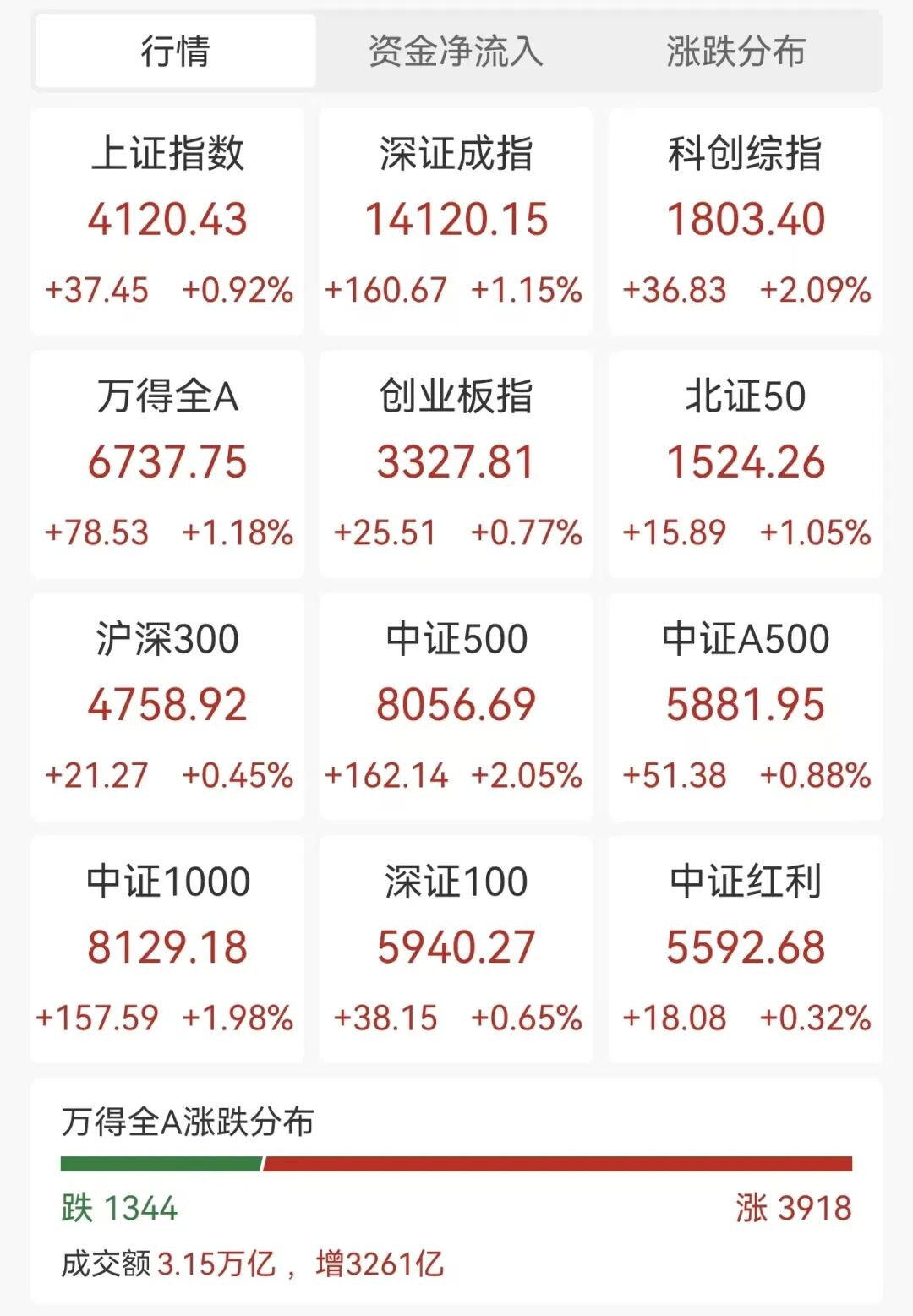
Group 1 - The A-share market has entered a strong bullish phase, with the Shanghai Composite Index rising 0.92% and surpassing the 4100-point mark for the first time in 10 years, achieving a 16-day consecutive increase [1] - The market's trading volume has significantly increased, with the A-share market's turnover exceeding 3 trillion yuan for the first time in nearly four months, indicating a surge in investor sentiment [2] - Economic expert Pan Helin suggests that the current rise in A-shares is driven by the appreciation of the RMB, leading to a global capital inflow, and that this bullish trend is within a reasonable range [2] Group 2 - Pan Helin notes that while the bull market may experience fluctuations, the overall stock market will remain strong until the global economic boom cycle ends, indicating a structural bull market [3] - Certain popular sectors are expected to continue reaching new highs, while less favored sectors may need to wait for market rotation opportunities [3]
时隔近4个月,A股成交额历史第6次突破3万亿
21世纪经济报道· 2026-01-09 07:18
Market Overview - The A-share market experienced a strong rally on January 9, with all three major indices rising. The Shanghai Composite Index increased by 0.92%, surpassing the 4100-point mark for the first time in 10 years, marking a 16-day consecutive rise [1] - The ChiNext Index rose by 0.77%, driven by surges in AI application themes, particularly in the film, short drama, and gaming sectors. Other leading sectors included commercial aerospace, humanoid robots, and small metal concepts, while the photovoltaic and large financial sectors weakened [1] Trading Volume and Investor Sentiment - Since the beginning of 2026, the market has maintained a trading volume exceeding 2.5 trillion yuan for four consecutive trading days, with today's half-day volume surpassing 2 trillion yuan, indicating a rapid increase in investor sentiment [3] - Historical data shows that such high trading volumes are rare in A-share history, with only six instances of daily trading volumes exceeding 3 trillion yuan. The most recent occurrence was on October 8, 2024, with a volume of 34,835.43 billion yuan [3][4] Market Dynamics and Economic Analysis - Economist Pan Helin stated that the current performance of the A-share market indicates a transition into a full bull market phase, driven by the appreciation of the yuan and the return of global capital. He noted that the upward trend in A-shares is still within a reasonable range compared to global markets [9] - Pan further analyzed that once trading volumes exceed 3 trillion yuan, market sentiment will likely push the market higher. This phase of growth may be less correlated with earnings and value, representing a typical characteristic of a bull market [9] Structural Characteristics of the Bull Market - Despite the bullish trend, Pan cautioned that fluctuations may occur during the bull market, with potential for short-term adjustments. However, the overall market is expected to remain strong until the end of the global economic prosperity cycle [10] - The current bull market is characterized as structural, with certain popular sectors likely to continue reaching new highs, while less popular sectors may need to wait for market rotation opportunities [10]

时隔近4个月,A股成交额历史第6次突破3万亿
2 1 Shi Ji Jing Ji Bao Dao· 2026-01-09 07:17
Market Performance - The A-share market experienced a strong rally, with all three major indices rising; the Shanghai Composite Index increased by 0.92%, surpassing the 4100-point mark for the first time in 10 years, marking a 16-day consecutive rise [1] - The ChiNext Index rose by 0.77%, while the overall trading volume exceeded 3 trillion yuan, a significant increase of 326.1 billion yuan from previous levels [2][3] Sector Performance - AI application themes surged, leading sectors included film, short dramas, and gaming, while commercial aerospace, humanoid robots, and small metal concept stocks also saw significant gains [1] - Conversely, the photovoltaic and large financial sectors showed weakness during this trading session [1] Trading Volume Insights - The trading volume of the A-share market has consistently remained above 2.5 trillion yuan for four consecutive trading days since the beginning of January 2026, indicating a rapid increase in investor sentiment [3] - Historical data shows that such high trading volumes are rare, with only six instances of daily trading volumes exceeding 3 trillion yuan in the past [3][4] Economic Analysis - Economist Pan Helin stated that the current performance indicates that the A-share market has entered a full bull market phase, driven by the appreciation of the yuan and the return of global capital [6] - The increase in trading volume beyond 3 trillion yuan is expected to further boost market sentiment, although it may lead to irrational exuberance typical of a bull market [6]