
人民币汇率

Search documents
人民币对美元中间价报7.0905 调贬33个基点
Zhong Guo Jing Ji Wang· 2025-11-20 01:34
中国人民银行授权中国外汇交易中心公布,2025年11月20日银行间外汇市场人民币汇率中间价为: 1美元对人民币7.0905元,1欧元对人民币8.1918元,100日元对人民币4.5207元,1港元对人民币0.91064 元,1英镑对人民币9.2742元,1澳大利亚元对人民币4.6080元,1新西兰元对人民币3.9893元,1新加坡 元对人民币5.4359元,1瑞士法郎对人民币8.8168元,1加拿大元对人民币5.0575元,人民币1元对1.1316 澳门元,人民币1元对0.58523马来西亚林吉特,人民币1元对11.3241俄罗斯卢布,人民币1元对2.4221南 非兰特,人民币1元对206.41韩元,人民币1元对0.51712阿联酋迪拉姆,人民币1元对0.52801沙特里亚 尔,人民币1元对46.6300匈牙利福林,人民币1元对0.51638波兰兹罗提,人民币1元对0.9116丹麦克朗, 人民币1元对1.3440瑞典克朗,人民币1元对1.4322挪威克朗,人民币1元对5.96149土耳其里拉,人民币1 元对2.5844墨西哥比索,人民币1元对4.5655泰铢。 中国经济网北京11月20日讯 今日,人民币对美元 ...
国泰海通|宏观:破“7”之旅——2026年人民币汇率展望
国泰海通证券研究· 2025-11-19 12:48
Core Insights - The article discusses the expected fluctuations of the RMB exchange rate in 2025 and 2026, highlighting the central bank's effective liquidity management that helps mitigate risks [1] Group 1: 2025 RMB Exchange Rate Outlook - The appreciation of the RMB in 2025 is driven by two main factors: cracks in USD credit and the Federal Reserve's easing measures. However, the appreciation expectation is not straightforward, with significant volatility observed [2] - In April 2025, trade frictions led to a depreciation expectation exceeding 7.5, while the onset of the Fed's rate cut cycle in September brought the appreciation expectation closer to 7.0. This reflects investor uncertainty in a still fragile internal economic environment [2] - A key factor supporting the RMB's appreciation is the reversal of foreign trade enterprises' willingness to settle in RMB. The weakening belief in a strong USD has led to a historic level of cross-border capital inflow, primarily driven by these enterprises [3] Group 2: Central Bank's Management and Policy - The central bank's management of exchange rate controls is described as "brilliant," effectively balancing the optimism of currency holders and the hesitance of currency exchangers. This includes lowering swap market premiums to manage foreign capital inflow and guiding domestic expectations through the central parity rate [4] - The central bank aims to align domestic and foreign pricing expectations, achieving a "three-price unification" where both domestic and foreign asset pricing converge towards the central bank's expectations [4] Group 3: 2026 RMB Exchange Rate Expectations - The article raises the question of whether global easing will continue into 2026, noting a significant "K-shaped" economic divergence in the U.S. This divergence affects high-net-worth individuals and new borrowers differently, impacting credit expansion and overall economic conditions [5] - The central bank's willingness to allow the RMB to break the 7.0 mark is questioned, with indications that it is managing the pace of appreciation through historical low swap premiums. The central bank's focus appears to be on fundamental factors rather than credit-driven factors [6] - The future decoupling of the RMB exchange rate from the USD index is anticipated, with both fundamental and policy support for the RMB to break the 7.0 level. However, the article emphasizes that fundamental changes will be the core variable supporting long-term RMB strength [6]


跨境资金净流入增多 10月银行结售汇顺差177亿美元
Zhong Guo Jing Ying Bao· 2025-11-19 07:18
Core Insights - The foreign exchange market in China remains stable despite fluctuations in the international financial market, with a reported surplus in bank settlement and sales of foreign exchange [1][2] Group 1: Bank Settlement and Sales Data - In October 2025, banks settled foreign exchange at USD 214.2 billion and sold USD 196.5 billion, resulting in a surplus of USD 17.7 billion, which shows a narrowing trend compared to previous months [1] - The foreign exchange income for clients was USD 623.1 billion, while foreign payments amounted to USD 571.9 billion in the same month [1] - The dollar index increased by 2.1% to 99.8 in October, indicating a general upward trend in the dollar's value [1] Group 2: Cross-Border Capital Flows - In September, there was a slight net outflow of cross-border funds due to holiday factors, but October saw an increase in net inflows, with an average monthly surplus of USD 24 billion over the two months [2] - High levels of net inflow from trade funds were maintained, while seasonal declines were noted in cross-border expenditures related to travel and dividends [2] - Future bank settlement and sales are expected to remain stable, influenced by both domestic economic fundamentals and international market conditions [2]
人民币汇率创年内新高 下一阶段怎么走?
Xin Hua Cai Jing· 2025-11-19 06:33
新华财经北京11月19日电(马萌伟)上周,人民币汇率在美元回落的影响下升至年内新高,人民币对美 元中间价保持升值不过速率有所回落。 具体数据显示,美元指数跌0.26%报99.28;在岸人民币兑美元累计涨218个基点报7.1007,离岸人民币 兑美元累计涨271个基点报7.0991,中间价累计调升11个基点报7.0825。 分析认为,在当前美元指数反弹有限和中间价稳步升值的环境下,人民币汇率仍将保持偏低波动,并对 美元有望维持偏强态势。接下来要重点关注美元走势和人民币对美元汇率中间价调控力度。 美元反弹有限人民币汇率创年内新高 在美国联邦政府上周结束停摆、包括非农报告在内的一系列数据发布前,交易员正加紧为美元波动性上 升做准备,美元指数上周自进入9月以来首次连续第二周收跌,人民币汇率在美元回落的影响下明显走 高。 14日,在岸人民币兑美元逼近7.09,最高升至7.0912,创一年来新高;离岸人民币兑美元一度升至 7.0900。 但值得注意的是,人民币中间价虽升破年内高点,不过速率较有所放缓。分析称,这或是由于人民币汇 率刷新年内高点,且临近年末,结汇资金集中出现等因素有关。与前几周相比,逆周期因子调节幅度趋 于 ...
2025年10月境外人民币市场综述
Sou Hu Cai Jing· 2025-11-19 03:16
Core Insights - The offshore (CNH) and onshore (CNY) RMB exchange rates appreciated in October, with the average daily price difference (absolute value of CNY-CNH) decreasing by 16 basis points to 51 basis points [1][3] - The CFETS RMB exchange rate index, referencing the BIS currency basket and SDR currency basket, increased by 0.87%, 1.19%, and 1.13% respectively compared to the end of the previous month [1][3] Offshore RMB Deposits - As of September 2025, offshore RMB deposits in Hong Kong increased by 3.5% to 1,001.77 billion yuan, while Taiwan's deposits decreased by 0.6% to 119.91 billion yuan [2] Offshore RMB Foreign Exchange Market - On October 31, the CNH/USD exchange rate closed at 7.1224, appreciating by 0.09%, while the CNY/USD exchange rate closed at 7.1135, appreciating by 0.07% [3] - The average daily price difference (absolute value of CNY-CNH) was 51 basis points, a decrease of 16 basis points from the previous month [3] Offshore RMB Bond Market - In October, 77 offshore RMB bonds were issued, a decrease of 44 bonds from the previous month, with a total issuance amount of 73.43 billion yuan, down 74.8% [5] Offshore RMB Money Market - By the end of October, the CNH HIBOR rates for overnight, 7-day, 3-month, and 1-year were 1.2421%, 1.4988%, 1.7085%, and 1.9183% respectively, with decreases of 57 basis points, 12 basis points, and 5 basis points [6] - The average interest rate spread (HIBOR-SHIBOR) for various tenors increased for overnight and 7-day periods, while remaining stable for 1-year [6] Dynamics of Foreign Institutions in Domestic Interbank Market - As of the end of October, the total number of foreign institutions participating in the domestic interbank foreign exchange market reached 239, an increase of 2 from the previous month [7] Trading Volume in Domestic Interbank Market - In October, the total trading volume of foreign institutions in the domestic interbank foreign exchange market was 27,746.55 billion yuan, a decrease of 16.1% [8] - The trading volume in the domestic interbank bond market totaled 9,411.06 billion yuan, a decrease of 2.5% [8]

11月19日人民币兑美元中间价下调16个基点
Sou Hu Cai Jing· 2025-11-19 02:15
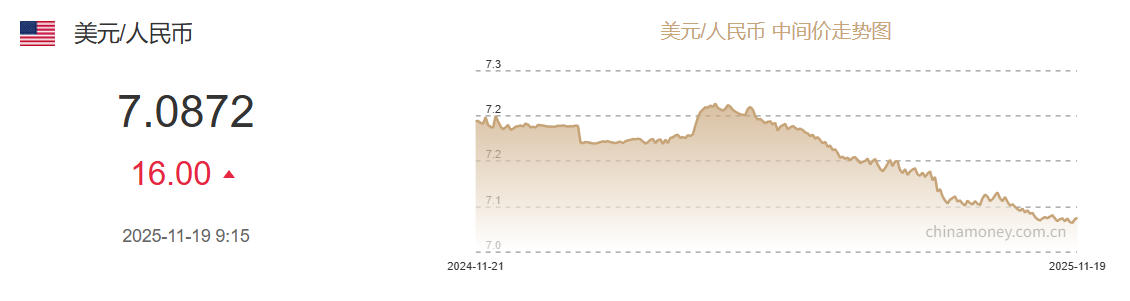
中国人民银行授权中国外汇交易中心公布,2025年11月19日银行间外汇市场人民币汇率中间价为:1美 元对人民币7.0872元,1欧元对人民币8.2164元,100日元对人民币4.5635元,1港元对人民币0.91023元, 1英镑对人民币9.3295元,1澳大利亚元对人民币4.6181元,1新西兰元对人民币4.0161元,1新加坡元对 人民币5.4513元,1瑞士法郎对人民币8.8685元,1加拿大元对人民币5.0743元,人民币1元对1.1322澳门 元,人民币1元对0.58585马来西亚林吉特,人民币1元对11.3983俄罗斯卢布,人民币1元对2.4229南非兰 特,人民币1元对205.87韩元,人民币1元对0.51753阿联酋迪拉姆,人民币1元对0.52842沙特里亚尔,人 民币1元对46.7230匈牙利福林,人民币1元对0.51584波兰兹罗提,人民币1元对0.9090丹麦克朗,人民币 1元对1.3348瑞典克朗,人民币1元对1.4246挪威克朗,人民币1元对5.96352土耳其里拉,人民币1元对 2.5858墨西哥比索,人民币1元对4.5589泰铢。 11月19日,人民币兑美元中间价下调16个基点, ...
11月19日人民币对美元中间价报7.0872元 下调16个基点
Zhong Guo Xin Wen Wang· 2025-11-19 01:48
11月19日人民币对美元中间价报7.0872元 下调16个基点 广告等商务合作,请点击这里 本文为转载内容,授权事宜请联系原著作权人 中新网11月19日电 据中国外汇交易中心网站消息,中国人民银行授权中国外汇交易中心公布,2025年11月19日银行间外汇市场人民币汇率中间价为:1美元 对人民币7.0872元,下调16个基点。 中新经纬版权所有,未经书面授权,任何单位及个人不得转载、摘编或以其它方式使用。 关注中新经纬微信公众号(微信搜索"中新经纬"或"jwview"),看更多精彩财经资讯。 图源:中国外汇交易中心网站截图 来源:中国新闻网 编辑:付健青 ...
人民币对美元中间价报7.0872 调贬16个基点
Zhong Guo Jing Ji Wang· 2025-11-19 01:38
中国经济网北京11月19日讯 今日,人民币对美元汇率中间价报7.0872,较前一交易日调贬16个基 点。 (责任编辑:魏京婷) 中国人民银行授权中国外汇交易中心公布,2025年11月19日银行间外汇市场人民币汇率中间价为: 1美元对人民币7.0872元,1欧元对人民币8.2164元,100日元对人民币4.5635元,1港元对人民币0.91023 元,1英镑对人民币9.3295元,1澳大利亚元对人民币4.6181元,1新西兰元对人民币4.0161元,1新加坡 元对人民币5.4513元,1瑞士法郎对人民币8.8685元,1加拿大元对人民币5.0743元,人民币1元对1.1322 澳门元,人民币1元对0.58585马来西亚林吉特,人民币1元对11.3983俄罗斯卢布,人民币1元对2.4229南 非兰特,人民币1元对205.87韩元,人民币1元对0.51753阿联酋迪拉姆,人民币1元对0.52842沙特里亚 尔,人民币1元对46.7230匈牙利福林,人民币1元对0.51584波兰兹罗提,人民币1元对0.9090丹麦克朗, 人民币1元对1.3348瑞典克朗,人民币1元对1.4246挪威克朗,人民币1元对5.96352土 ...
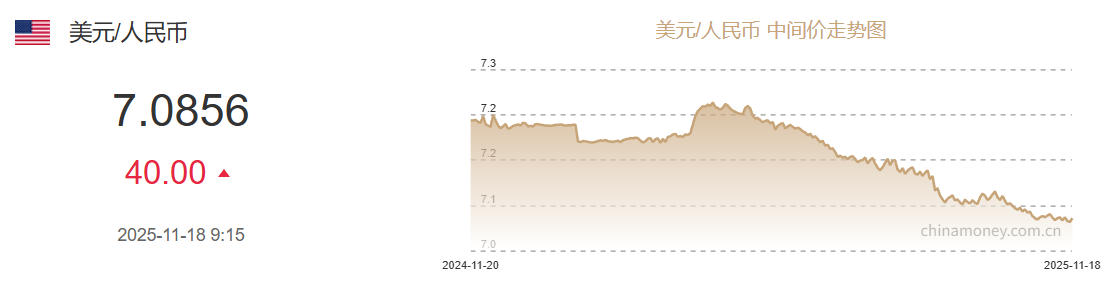
11月18日人民币对美元中间价报7.0856元 下调40个基点
Zhong Guo Xin Wen Wang· 2025-11-18 02:08
本文为转载内容,授权事宜请联系原著作权人 来源:中国新闻网 编辑:付健青 广告等商务合作,请点击这里 11月18日人民币对美元中间价报7.0856元 下调40个基点 中新网11月18日电 据中国外汇交易中心网站消息,中国人民银行授权中国外汇交易中心公布,2025年11月18日银行间外汇市场人民币汇率中间价为:1美元 对人民币7.0856元,下调40个基点。 图源:中国外汇交易中心网站截图 中新经纬版权所有,未经书面授权,任何单位及个人不得转载、摘编或以其它方式使用。 关注中新经纬微信公众号(微信搜索"中新经纬"或"jwview"),看更多精彩财经资讯。 ...
人民币市场汇价(11月18日)
Xin Hua Wang· 2025-11-18 02:01
【纠错】 【责任编辑:吴京泽】 11月18日人民币汇率中间价如下: 100美元 708.56人民币 100欧元 822.23人民币 100日元 4.5710人民币 100港元 91.145人民币 100英镑 933.48人民币 100澳元 460.89人民币 100新西兰元 401.63人民币 100新加坡元 544.49人民币 100瑞士法郎 891.29人民币 100加元 505.1人民币 100人民币113.06澳门元 100人民币58.428马来西亚林吉特 100人民币1143.33俄罗斯卢布 100人民币242.17南非兰特 100人民币20603韩元 100人民币51.749阿联酋迪拉姆 100人民币52.843沙特里亚尔 100人民币4675.52匈牙利福林 100人民币51.497波兰兹罗提 100人民币90.82丹麦克朗 100人民币133.54瑞典克朗 100人民币142.39挪威克朗 100人民币596.235土耳其里拉 100人民币259.95墨西哥比索 100人民币457.07泰铢 新华社北京11月18日电 中国外汇交易中心11月18日受权公布人民币对美元、欧元、日元、港元、 英镑、 ...