银行结售汇

Search documents
1月份银行结汇20048亿元 售汇14457亿元
Jin Rong Shi Bao· 2026-02-24 01:28
Group 1 - In January 2026, banks in China reported a settlement of 20,048 billion RMB and a sale of 14,457 billion RMB [1] - In USD terms, the bank settlements amounted to 2,863 billion USD, while the sales totaled 2,065 billion USD [1] - The foreign-related income for banks in January 2026 was 54,722 billion RMB, with outward payments of 48,974 billion RMB [1] Group 2 - The foreign-related income in USD for banks was 7,816 billion USD, and the outward payments were 6,995 billion USD [1]
1月结售汇顺差798亿美元 跨境资金保持净流入
Sou Hu Cai Jing· 2026-02-13 22:11
Core Viewpoint - The foreign exchange market in China remains active and stable, with a net inflow of cross-border funds, despite a decrease in the surplus of bank foreign exchange settlement and sales, as well as a decline in net inflows from non-bank sectors [1] Group 1: Foreign Exchange Market Performance - In January, banks settled foreign exchange of 286.3 billion USD and sold 206.5 billion USD, resulting in a settlement surplus of 79.8 billion USD [1] - The foreign exchange settlement and sales surplus from banks decreased by 20% compared to the previous month [1] - The increase in corporate receipts and settlements at the end of the year has slowed down as demand gradually releases [1] Group 2: Non-Bank Sector Cross-Border Transactions - In January, banks recorded foreign-related income of 781.6 billion USD and foreign payments of 699.5 billion USD, leading to a cross-border balance surplus of 82.1 billion USD [1] - Net inflows from goods trade decreased by 27% compared to the previous month, while net outflows from service trade increased by 23% [1] - Net inflows from securities investment remained stable [1] Group 3: Market Outlook - The international financial market has seen increased volatility and differentiation, yet China's foreign exchange market continues to operate steadily [1] - Overall, the foreign exchange market is characterized by active trading and stable expectations, with cross-border capital flows becoming more stable [1]
国家外汇局:1月银行结汇20048亿元人民币
Bei Jing Shang Bao· 2026-02-13 10:53
Core Viewpoint - The State Administration of Foreign Exchange (SAFE) reported data on bank foreign exchange settlement and sales for January 2026, indicating a stable operation of China's foreign exchange market despite increased volatility in international financial markets [1] Group 1: Bank Foreign Exchange Data - In January 2026, banks settled foreign exchange amounting to 20,048 billion RMB and sold 14,457 billion RMB, equivalent to 2,863 billion USD and 2,065 billion USD respectively [1] - The foreign exchange settlement surplus for banks decreased by 20% compared to the previous month [1] Group 2: Cross-Border Payment Data - In January 2026, banks recorded foreign income of 54,722 billion RMB and foreign payments of 48,974 billion RMB, translating to 7,816 billion USD and 6,995 billion USD respectively [1] - The net inflow of cross-border funds from non-bank sectors, including enterprises and individuals, fell by 28% compared to the previous month [1] Group 3: Market Trends and Observations - The SAFE spokesperson noted that the foreign exchange market remains active and expectations are stable, with cross-border capital flows becoming more stable [1] - A 27% decrease in net inflow of funds under the goods trade category was observed, while net outflow under the services trade category increased by 23% [1] - Securities investment net inflow remained stable, indicating resilience in this segment [1]
国家外汇管理局:2026年1月银行结汇20048亿元 售汇14457亿元人民币
智通财经网· 2026-02-13 08:47
Core Insights - The State Administration of Foreign Exchange (SAFE) released data on bank foreign exchange settlement and sales for January 2026, indicating significant foreign exchange activity in the banking sector [1] Group 1: Bank Foreign Exchange Data - In January 2026, banks settled foreign exchange amounting to 20,048 billion RMB and sold 14,457 billion RMB, which translates to 2,863 billion USD in settlements and 2,065 billion USD in sales [1] - The data reflects a robust foreign exchange market, with banks facilitating substantial transactions in both settlements and sales [1] Group 2: Customer Foreign Exchange Transactions - For January 2026, banks recorded foreign exchange income from customers at 54,722 billion RMB and foreign payments at 48,974 billion RMB, equivalent to 7,816 billion USD in income and 6,995 billion USD in payments [1] - This indicates a strong demand for foreign currency among customers, highlighting the active role of banks in international transactions [1]
央行上海总部:2025年上海涉外收支和银行结售汇规模再创新高
Zhong Guo Xin Wen Wang· 2026-01-29 09:14
Group 1 - The core viewpoint of the news is that Shanghai's foreign-related economy remained active in 2025, with record highs in foreign-related income and bank foreign exchange settlement and sales [1][2] - In 2025, Shanghai's total foreign-related income through banks reached $5.66 trillion, accounting for over 36% of the national total, with a year-on-year growth of 14.3% [1] - The total bank foreign exchange settlement and sales exceeded $1.15 trillion, representing over 23% of the national total, with a year-on-year increase of 10.7% [1] Group 2 - Shanghai's goods trade showed strong resilience, achieving a total trade income of over $1 trillion, with a year-on-year growth of 7.0%, surpassing the national growth rate by 2.6 percentage points [1] - The service trade income exceeded $250 billion, with a year-on-year growth of 2.2%, maintaining the top position in the country and accounting for nearly 30% of the national total [1] - Emerging productive service trade, supported by digital technology and knowledge-intensive factors, showed positive growth in both income and surplus [1] Group 3 - Direct investment in Shanghai remained stable, with foreign direct investment continuing to grow, resulting in a year-on-year increase of 5.8% in total foreign-related investment income [2] - The cross-border capital flow, primarily facilitated by Shanghai's international financial center, saw a significant increase in securities investment income, growing by over 19% year-on-year and accounting for over 60% of the national total [2] - The foreign exchange market in Shanghai maintained strong resilience, with bank settlement and sales volumes increasing by 21% and 4% year-on-year, respectively [2] Group 4 - The demand for enterprises to identify and manage exchange rate risks in cross-border trade and investment increased, with the signing scale of RMB foreign exchange derivative business growing by 9.6% year-on-year [2] - The foreign exchange hedging ratio reached nearly 38%, exceeding the national average by about 8 percentage points, indicating a leading position in the country [2]
2025年12月银行结汇22446亿元
Jin Rong Shi Bao· 2026-01-16 01:21
Core Insights - The State Administration of Foreign Exchange released data on bank foreign exchange settlement and sales for December 2025, indicating significant foreign exchange activity in the banking sector [1] Group 1: Bank Foreign Exchange Settlement and Sales - In December 2025, banks settled foreign exchange amounting to 22,446 billion RMB and sold 15,382 billion RMB [1] - For the entire year of 2025, banks cumulatively settled 185,227 billion RMB and sold 171,314 billion RMB [1] - In USD terms, December 2025 saw banks settle 3,180 billion USD and sell 2,179 billion USD, with cumulative settlements for the year reaching 25,949 billion USD and sales at 23,983 billion USD [1] Group 2: Bank Customer Foreign Exchange Income and Payments - In December 2025, banks recorded foreign exchange income from customers at 58,197 billion RMB and foreign payments at 50,186 billion RMB [1] - For the full year 2025, cumulative foreign exchange income from customers was 569,405 billion RMB, while cumulative foreign payments totaled 547,906 billion RMB [1] - In USD terms, December 2025's foreign exchange income from customers was 8,244 billion USD, with foreign payments at 7,109 billion USD; the annual totals were 79,725 billion USD for income and 76,704 billion USD for payments [1]
外汇局:2025年银行累计结汇185227亿元人民币,累计售汇171314亿元人民币
Bei Jing Shang Bao· 2026-01-15 09:14
Core Insights - The State Administration of Foreign Exchange (SAFE) reported significant foreign exchange statistics for December 2025, indicating a strong performance in both settlement and sales of foreign currency [1] Group 1: Bank Settlement and Sales - In December 2025, banks settled 22,446 billion RMB and sold 15,382 billion RMB [1] - For the entire year of 2025, banks cumulatively settled 185,227 billion RMB and sold 171,314 billion RMB [1] - In USD terms, banks settled 3,180 billion USD and sold 2,179 billion USD in December 2025 [1] Group 2: Foreign Exchange Income and Payments - In December 2025, banks recorded foreign income of 58,197 billion RMB and foreign payments of 50,186 billion RMB [1] - For the year 2025, cumulative foreign income reached 569,405 billion RMB, while cumulative foreign payments totaled 547,906 billion RMB [1] - In USD terms, foreign income in December 2025 was 8,244 billion USD, and foreign payments were 7,109 billion USD [1]
众口一词的 人民币升值“真相”
Sou Hu Cai Jing· 2026-01-11 16:35
Group 1 - Japan's current account surplus to GDP ratio is projected to reach 4.5% in 2024, increasing by 0.9 percentage points, and further rise to 5.1% in the first three quarters of 2025, exceeding the international warning line for two consecutive years [1] - The Chinese yuan (RMB) is expected to appreciate against the US dollar, with foreign investment banks suggesting that the RMB is structurally undervalued, predicting that RMB appreciation is the "highest conviction" trade for 2026 [1] - The RMB exchange rate has shown signs of appreciation since March 2025, with a cumulative surplus of $273.3 billion in bank foreign exchange settlements by November 2025, although there are concerns about the sustainability of this trend [2][3] Group 2 - The improvement in the foreign exchange situation is attributed more to a decrease in the motivation to purchase foreign currency rather than an increase in the willingness to settle foreign exchange [3] - The actual effective exchange rate (REER) of the RMB has depreciated by 16.7% since March 2022, indicating a potential undervaluation, but this does not guarantee an appreciation of the nominal exchange rate [5] - The RMB's REER has shown a weaker trend compared to other major currencies, with significant fluctuations in the exchange rate not necessarily correlating with the bank's foreign exchange settlement surplus [9][10] Group 3 - The trade balance indicates that while China has a strong goods trade surplus, it faces deficits in service trade and investment income, leading to a current account surplus to GDP ratio of 2.2% in 2024, which is below the international warning line [7][8] - The dynamics of the RMB's appreciation and its impact on asset prices are complex, with historical data showing that RMB appreciation does not always correlate with positive outcomes for Chinese assets [10][12] - The transition of China's private sector from net external debt to net external assets by 2025 may lead to net exchange losses for listed companies if the RMB appreciates significantly, affecting their profitability [11][12]
11月外汇市场分析报告:人民币汇率升值加快,但结汇潮仍缺乏数据支持
Bank of China Securities· 2026-01-04 11:37
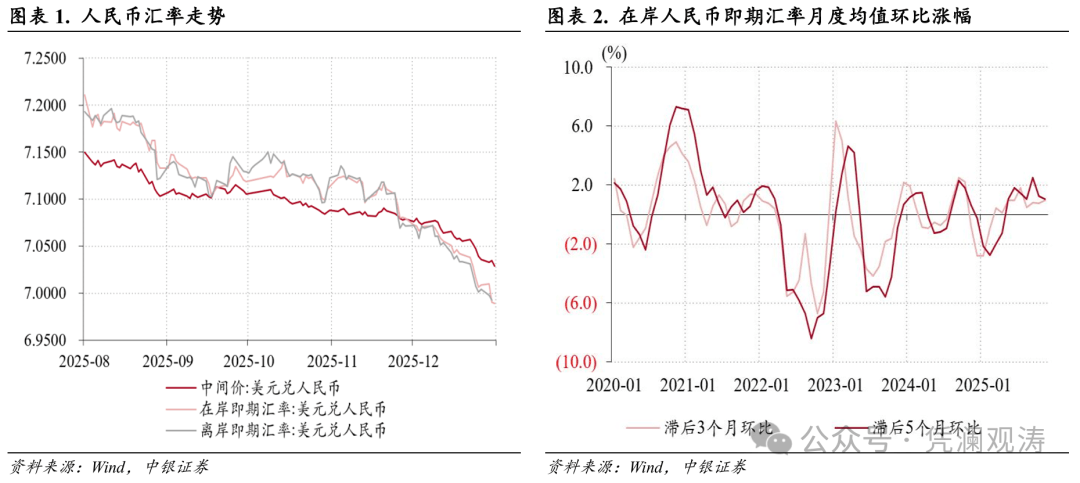
Report Industry Investment Rating - The report does not provide an industry investment rating [1][2] Core Viewpoints - In November 2025, the U.S. dollar index fluctuated and declined. The RMB exchange rate resumed the "three - price" unity, and the market did not accumulate strong exchange - rate appreciation expectations. The RMB led the rise among major non - U.S. currencies, driving the multilateral exchange - rate index to rebound [3]. - The cross - border capital inflow scale narrowed month - on - month. Goods trade and securities investment were the main contributors. The upward swap points of the U.S. dollar against the onshore RMB significantly compressed the foreign capital arbitrage space, and the balance of RMB bonds held by foreign investors decreased for the seventh consecutive month. Foreign investors remained cautious about the stock market but were more confident about its prospects [3]. - Bank settlement and sales of foreign exchange remained basically stable. The willingness of market entities to settle foreign exchange weakened, and the balance of domestic foreign - exchange deposits of financial institutions hit a record high. The recent acceleration of RMB appreciation may lead to exchange losses for domestic investors holding U.S. dollar deposits, inducing relevant entities to accelerate foreign - exchange settlement [3]. - A decline in the real effective exchange rate does not mean the undervaluation of the domestic currency. The weakening of China's real exchange rate is mainly due to strong domestic supply, weak demand, and low price trends. Restoring internal economic balance is the fundamental measure to prevent the intensification of external imbalances, and a significant appreciation of the RMB should not be used as a policy tool [3] Summary by Related Content 1. RMB Exchange Rate Performance - In November, the Fed's interest - rate cut expectations fluctuated greatly. The U.S. dollar index ended its rebound in the previous month, fluctuated between 99 and 100, and fell 0.3% to 99.4 for the whole month. The RMB exchange rate continued its catch - up appreciation. The central parity rate gradually appreciated, accumulating an appreciation of 91 basis points to 7.0789 against the U.S. dollar; the onshore spot exchange rate appreciated faster, accumulating an appreciation of 341 basis points to 7.0794 against the U.S. dollar, reaching a new high since mid - October 2024; the offshore exchange rate appreciated 511 basis points to 7.0713 compared with the end of the previous month. The RMB exchange rate resumed the "three - price" unity, indicating that market expectations remained basically stable [4]. - The average spot exchange rate with a 3 - month lag in November appreciated for the ninth consecutive month, with a gain of 0.9%, a new high in the past four months; the average spot exchange rate with a 5 - month lag appreciated for the seventh consecutive month, and the appreciation rate exceeded 1%, which might increase the negative impact on the financial situation of export enterprises. However, under the goal of exchange - rate stability, the change range of the spot exchange rate in the past three years has significantly narrowed, and the overall impact on the financial situation of export enterprises is limited. In the first 11 months of 2025, the scale of enterprises using foreign - exchange derivatives such as forwards, swaps, and options to manage exchange - rate risks reached 1.75 trillion U.S. dollars, the hedging ratio increased by 3.4 percentage points to 30.2% compared with the previous year, and the proportion of RMB settlement in goods trade was nearly 30%, both reaching record highs, which helped foreign - trade enterprises avoid exchange - rate risks [5]. - In November, the RMB led the rise among major non - U.S. currencies. The RMB multilateral exchange - rate index continued its overall upward trend since July, but the month - on - month increase narrowed. The CFETS RMB exchange - rate index, the RMB exchange - rate index referenced to the BIS currency basket, and the RMB exchange - rate index referenced to the SDR currency basket rose 0.3%, 0.6%, and 0.2% respectively, lower than the previous month's increases of 0.9%, 1.2%, and 1.1%. Affected by the rebound of the nominal effective exchange - rate index, the real effective exchange - rate index of the RMB released by the BIS rebounded for the fifth consecutive month, and the increase expanded to 0.8%, a new high in the past five months. The cumulative decline in the first 11 months narrowed from 5.8% in the first half of the year to 3.2% [6] 2. Cross - border Capital Flows - In November, the surplus of banks' foreign - exchange receipts and payments on behalf of customers continued from the previous month, but the surplus scale dropped sharply from 51.1 billion U.S. dollars in the previous month to 17.8 billion U.S. dollars, lower than the average level of 24 billion U.S. dollars in the previous two months. In terms of currency, the RMB's foreign - exchange receipts and payments changed from a surplus of 1.6 billion U.S. dollars in the previous month to a deficit of 29 billion U.S. dollars, contributing 91% of the month - on - month decline in the surplus of banks' foreign - exchange receipts and payments on behalf of customers. The surplus of foreign - currency foreign - exchange receipts and payments was basically stable, only falling 2.9 billion U.S. dollars month - on - month to 46.7 billion U.S. dollars [14]. - In terms of items, the surplus of foreign - exchange receipts and payments in goods trade decreased by 17.5 billion U.S. dollars month - on - month to 72.7 billion U.S. dollars, but it was still at a historical high and was the main channel for cross - border capital inflow; the foreign - exchange receipts and payments in securities investment had a deficit for the sixth consecutive month, and the deficit scale increased by 14.6 billion U.S. dollars month - on - month to 34.6 billion U.S. dollars. Goods trade and securities investment contributed 52% and 44% respectively to the month - on - month decline in the surplus of banks' foreign - exchange receipts and payments on behalf of customers [14]. - In November, in the goods - trade sector, the trade surplus in customs statistics increased by 21.6 billion U.S. dollars month - on - month to 111.7 billion U.S. dollars, the third - highest in history, and the gap with the comparable foreign - exchange receipts and payments surplus widened to + 38.1 billion U.S. dollars. However, from the perspective of the 12 - month moving average, since the second half of 2024, with the alleviation of the RMB depreciation pressure, the situation of "surplus but no corresponding income" in goods trade has generally improved [15]. - In November, in the securities - investment sector, the activity of cross - border capital increased. The scale of foreign - exchange receipts and payments of banks on behalf of customers increased by 33.8 billion and 48.3 billion U.S. dollars month - on - month to 232 billion and 266.6 billion U.S. dollars respectively, both at historical highs. However, the balance of RMB bonds held by foreign investors continued to decrease. At the end of November, the balance of domestic RMB bonds held by overseas institutions was 3.61 trillion yuan, having decreased for the seventh consecutive month, and decreased by 116.7 billion yuan compared with the end of the previous month, returning to the scale of over 100 billion yuan after three months. The main reason was that the recent upward swap points of the U.S. dollar against the onshore RMB significantly compressed the foreign - capital arbitrage space [20]. - According to IIF data, in November, foreign capital had a net outflow of 18.9 billion U.S. dollars from emerging - market stock markets, the second - largest net outflow this year after March. This was mainly because the stock - market funds of emerging markets other than China changed from a net inflow in the previous two months to a net outflow of 12.1 billion U.S. dollars, and foreign capital had a net outflow of 6.9 billion U.S. dollars from the Chinese stock market for the third consecutive month, indicating that foreign investors remained cautious about the Chinese stock market. However, in 2025, the Chinese stock market performed well. The MSCI China Index had a cumulative increase of nearly 22%, outperforming the overall performance of global stock markets. Recently, many international institutions, including Goldman Sachs, have raised their forecasts for China's economic growth rate, reflecting that foreign investors are more confident about China's economic prospects and RMB assets. Many foreign - funded institutions such as BlackRock said that more funds may flow into the Chinese market in the next year [20][21] 3. Bank Settlement and Sales of Foreign Exchange - In November, the on - and off - forward (including options) settlement and sales of foreign exchange by banks (hereinafter referred to as bank settlement and sales of foreign exchange) had a surplus for the ninth consecutive month. The surplus scale was 29.7 billion U.S. dollars, basically the same as the previous month, only increasing by 2.4 billion U.S. dollars, but far lower than the surplus of 73.4 billion U.S. dollars in September. Both spot transactions and derivatives transactions remained basically stable. The net settlement of foreign exchange in forwards and options increased by 4.5 billion U.S. dollars month - on - month, the deficit of banks' own settlement and sales of foreign exchange decreased by 3 billion U.S. dollars, and the surplus of banks' settlement and sales of foreign exchange on behalf of customers decreased by 5 billion U.S. dollars [28]. - In November, after excluding the forward performance amount, the settlement - rate of foreign exchange receipts and the purchase - rate of foreign exchange payments decreased by 2.1 and 1.8 percentage points respectively month - on - month. This shows that enterprises may avoid exchange - rate risks through natural hedging rather than settlement and sales of foreign exchange. In the context of the accelerating appreciation of the RMB exchange rate, the month - on - month decline of the settlement - rate of foreign exchange receipts was greater than that of the purchase - rate of foreign exchange payments, and the former dropped to 52.0%, the lowest since April, reflecting the normal operation of the exchange - rate leverage adjustment mechanism and indicating that market entities did not accumulate exchange - rate appreciation expectations [28]. - In the goods - trade sector, the settlement - rate of enterprise income increased by 1.4 percentage points month - on - month, and the purchase - rate of enterprise expenditures decreased by 1.1 percentage points. Therefore, the gap between the surplus of foreign - exchange receipts and payments in goods trade and the settlement and sales of foreign exchange narrowed from the historical high of 52.4 billion U.S. dollars in the previous month to 36.8 billion U.S. dollars. However, from the perspective of the 12 - month moving average, since the second half of 2024, even though the scale of goods exports has maintained rapid growth and the collection of export enterprises has accelerated, due to the continuous low settlement - rate of enterprises, the gap between the scale of goods - trade settlement of foreign exchange and foreign - exchange income has continued to expand, that is, the funds of enterprises waiting to be settled have increased. As of the end of November, the balance of domestic foreign - exchange deposits of financial institutions rose to 879.4 billion U.S. dollars, and the balance of domestic foreign - exchange deposits of non - financial enterprises was 561.8 billion U.S. dollars, both hitting record highs. With the recent acceleration of RMB appreciation, there is a need to be vigilant that the strengthening of appreciation expectations may induce market entities to accelerate foreign - exchange settlement and promote further appreciation of the RMB exchange rate [32] 4. Current Special Topic: A Decline in the Real Effective Exchange Rate Does Not Mean the Undervaluation of the Domestic Currency - In the first 11 months of 2025, the RMB real effective exchange - rate index decreased by 3.2% cumulatively, and the scale of China's goods - trade surplus exceeded 1 trillion U.S. dollars, which attracted international attention to China's exchange - rate policy. Many foreign - funded institutions believed that the RMB exchange rate was undervalued and called for a significant appreciation of the RMB [40]. - The decline of the RMB real effective exchange - rate index started in April 2022 and reached a new low of 86.2 in June 2025 since December 2011. The change in the real effective exchange rate can be decomposed into the change in the nominal effective exchange rate and the consumer price index. From April 2022 to November 2025, the RMB real effective exchange - rate index decreased by 16.7% cumulatively, while the RMB nominal effective exchange - rate index only decreased by 5.1%, indicating that China's lower inflation level than its trading partners was the main reason for the weakening of the RMB real exchange rate. In contrast, the decline of the Japanese yen's real effective exchange - rate index started in June 2020, and as of November 2025, it had decreased by 32.9% cumulatively, and the nominal effective exchange - rate index had decreased by 30.2% cumulatively, which was the main reason for the weakening of the real exchange rate [40]. - According to BIS data, the top five weighted currencies in the RMB effective exchange - rate index are the euro, the U.S. dollar, the Japanese yen, the South Korean won, and the New Taiwan dollar. The top five weighted currencies in the Japanese yen effective exchange - rate index are the RMB, the U.S. dollar, the euro, the South Korean won, and the New Taiwan dollar. In recent years, the RMB nominal effective exchange - rate index has remained stable because the bilateral exchange rates of the RMB against major currencies have both risen and fallen, while the significant decline of the Japanese yen nominal effective exchange - rate index is because the exchange rates of the Japanese yen against major currencies have all weakened significantly [41]. - Judging whether the exchange rate is overvalued or undervalued is relative to the equilibrium exchange rate, not simply referring to historical values. The weakening of the RMB real exchange rate is mainly due to strong domestic supply, weak demand, and low prices. Promoting stable economic growth and a reasonable recovery of prices and restoring internal economic balance are the fundamental measures to prevent the intensification of external imbalances. In the past, China's current - account surplus decreased after a series of policies, and the appreciation of the RMB exchange rate was more of a result of economic re - balancing rather than a tool. Currently, guiding the RMB to appreciate against the U.S. dollar to "reduce the surplus and promote balance" may intensify the contradiction between strong supply and weak demand in China and strengthen the downward pressure on prices [42]. - Recently, the IMF completed its Article IV consultation with China in 2025. The IMF Managing Director said that China's lower inflation rate than its trading partners led to a significant depreciation of the real exchange rate, and suggested that China implement more expansionary macroeconomic policies and necessary reforms, which would help promote the appreciation of the real exchange rate, but did not explicitly recommend that China take measures to push up the RMB exchange rate, hoping to see a market - based exchange rate reflecting the fundamentals. That is, the IMF did not pressure the RMB to appreciate but suggested solving economic imbalances from the inside out [43]. - The Central Economic Work Conference at the end of 2025 emphasized "maintaining the basic stability of the RMB exchange rate at a reasonable and balanced level" for the fourth consecutive year, which was the first time in history. Combining with the minutes of the fourth - quarter regular meeting of the Monetary Policy Committee, the specific statement on exchange - rate stability in the fourth - quarter regular meeting of 2025 changed, deleting some previous statements. This was mainly due to the overall easing of the RMB depreciation pressure in 2025 and the obvious improvement of the domestic and foreign - exchange market supply and demand situation. However, since there are still many uncertainties in the external environment, the fourth - quarter regular meeting reiterated "enhancing the resilience of the foreign - exchange market", "stabilizing market expectations", and "preventing exchange - rate overshooting risks", indicating that the exchange - rate policy goal in 2026 is still to prevent excessive appreciation or depreciation of the RMB exchange rate and provide a relatively stable monetary environment for domestic economic operations [44]
管涛:人民币汇率升值加快,但结汇潮仍缺乏数据支持|立方大家谈
Sou Hu Cai Jing· 2026-01-04 11:04
Core Viewpoint - The foreign exchange market in China showed signs of stability in November 2025, with the RMB appreciating against the USD, while market expectations remained stable despite fluctuations in the USD index and interest rate predictions from the Federal Reserve [1][2]. Exchange Rate Trends - In November, the USD index fell by 0.3% to 99.4, while the RMB appreciated, with the onshore spot rate rising by 341 basis points to 7.0794, marking a new high since mid-October 2024 [1] - The RMB's appreciation trend continued, with the average spot exchange rate increasing for the ninth consecutive month, up 0.9%, the highest in four months [2] - The RMB multilateral exchange rate index continued to rise, although the rate of increase slowed compared to previous months [3] Cross-Border Capital Flows - There was a significant decrease in the net inflow of cross-border capital, with the surplus from bank foreign exchange payments dropping from $51.1 billion to $17.8 billion [9] - The trade surplus in goods increased to $111.7 billion, the third highest on record, despite a widening gap with foreign exchange payment surpluses [9] - Foreign investment in RMB-denominated bonds continued to decline, with a reduction of 116.7 billion RMB, marking the seventh consecutive month of decrease [10] Market Participation and Sentiment - Foreign investors showed a cautious approach towards the Chinese stock market, with net outflows reaching $6.9 billion in November, indicating a lack of confidence [10][11] - Despite the cautious sentiment, international institutions have raised their economic growth forecasts for China, suggesting potential future inflows into the market [11] Currency Management and Corporate Behavior - Companies have increasingly utilized foreign exchange derivatives to manage currency risk, with the scale reaching $1.75 trillion, and the hedging ratio rising to 30.2%, a historical high [2] - The willingness of market participants to convert currencies remains weak, with foreign exchange deposits reaching a record high of $879.4 billion [19] Policy and Economic Outlook - The central economic work conference emphasized maintaining the RMB exchange rate at a reasonable and balanced level, reflecting a shift in policy focus towards stability [29] - The International Monetary Fund (IMF) suggested that China's low inflation relative to trading partners has led to a significant depreciation of the real exchange rate, recommending more expansive macroeconomic policies [28]