稳定币

Search documents
资金动向 | 北水净买入腾讯超7亿,净卖出阿里巴巴超5亿
Ge Long Hui· 2026-02-11 10:21
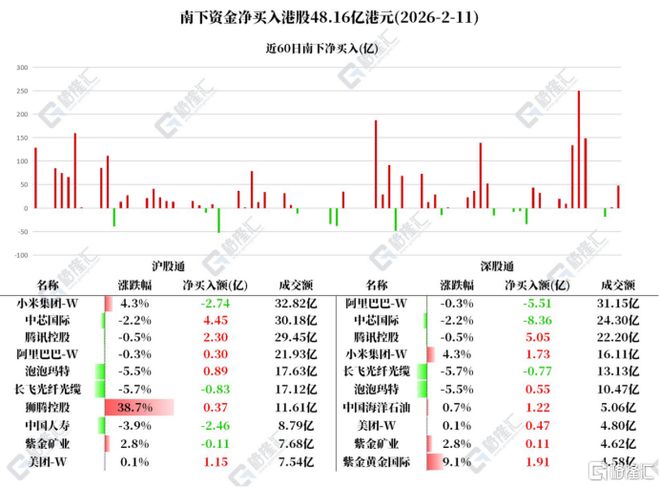
Group 1 - Southbound funds net bought Hong Kong stocks worth HKD 4.816 billion on February 11, with notable net purchases in Tencent Holdings (HKD 735 million), Zijin Mining International (HKD 191 million), Meituan-W (HKD 162 million), Pop Mart (HKD 144 million), and CNOOC (HKD 122 million) [1] - Significant net sales were observed in Alibaba-W (HKD 520 million), SMIC (HKD 390 million), China Life (HKD 246 million), Yangtze Optical Fibre and Cable (HKD 159 million), and Xiaomi Group-W (HKD 100 million) [1] Group 2 - Zijin Mining International is influenced by fluctuating gold prices, currently hovering above USD 5,050, with expectations of a slight increase in interest rate cuts following disappointing U.S. retail sales data for December 2025 [3] - Geopolitical tensions remain high, with the U.S. considering deploying an aircraft carrier strike group to the Middle East if negotiations with Iran fail, impacting oil price volatility [3] Group 3 - Meituan announced plans to invest approximately USD 717 million to acquire the Chinese "Dingdong Maicai" business from Dingdong Group, which is expected to create synergies with Meituan's existing operations and strengthen its market position in fresh food delivery [3] - The Hong Kong government is positioning the region as a global innovation center for Web3 and cryptocurrency, with the implementation of a licensing system for stablecoin issuers expected to attract new businesses [4] Group 4 - Xiaomi Group is facing increased cost pressures due to rising prices of DRAM and NAND, with speculation that the standard version of its upcoming smartphone may use the Snapdragon 8 Elite Gen6 or even the previous generation Snapdragon 8 Elite Gen5 [5]


港股收盘(02.11) | 恒指收涨0.31% 黄金等有色金属股走强 汽车股普遍上扬
智通财经网· 2026-02-11 08:52
Market Overview - The Hong Kong stock market indices collectively rose, with the Hang Seng Index increasing by 0.31% to close at 27,266.38 points and a total trading volume of HKD 217.218 billion [1] - The Hang Seng Tech Index rose by 0.9% to 5,499.99 points, indicating a positive sentiment in the technology sector [1] Economic Insights - Chief Economist Zhao Wenli from Jianyin International believes that the valuation repair of Hong Kong stocks is nearly complete, shifting the investment logic from "valuation repair" to "new productive forces" [1] - There is a consensus forming among emerging market funds favoring Chinese assets by 2026, although long-term capital from Europe and the U.S. requires substantial fundamental improvements for a return [1] Blue-Chip Performance - Xiaomi Group-W (01810) saw a significant increase of 4.27%, closing at HKD 37.1, contributing 44.59 points to the Hang Seng Index [2] - Other notable blue-chip performances include: - Techtronic Industries (00669) up 4.9%, contributing 13.18 points [2] - Link REIT (00823) up 3.83%, contributing 5.62 points [2] - China Life (02628) down 3.94%, detracting 16.82 points [2] - Shenzhou International (02313) down 2.22%, detracting 1.93 points [2] Sector Highlights - Large technology stocks showed mixed results, with Tencent down 0.54% and Alibaba down 0.25%, while Xiaomi surged over 4% [3] - Precious metals stocks performed strongly, with Zijin Mining International rising over 9% due to significant cuts in nickel mining quotas by Indonesia [3] - Cement and building materials stocks also saw gains, with China National Building Material rising over 11% [3] - Automotive stocks were active, with BYD Company rising over 3% [3] Stablecoin Developments - The Hong Kong government is set to issue stablecoin licenses next month, enhancing its position as a global center for Web3 and cryptocurrency innovation [5] - Stocks related to stablecoins saw significant gains, including Lianlian Digital (02598) up 8.99% and Linklogis Technology-W (09959) up 6.13% [4] MSCI Index Adjustments - MSCI announced its quarterly index adjustments, effective February 27, 2026, adding 37 stocks and removing 16, impacting several Hong Kong stocks positively [5] Company-Specific Updates - Lexin Outdoor (02720) surged by 53.35%, closing at HKD 38, recognized as the global leader in fishing equipment manufacturing [6] - Kintor Group (01888) rose by 11.52% due to increased demand for high-end copper-clad laminates driven by AI [7] - Television Broadcasts (00511) announced a positive earnings forecast, expecting over HKD 350 million in EBITDA for the fiscal year 2025 [8] - Yue Yuen Industrial (00551) reported a decline in net operating income by 12.5% year-on-year, leading to a drop of 7.13% in stock price [9] - Semiconductor company SMIC (00981) faced pressure post-earnings, with a slight decline of 2.17% amid cautious revenue guidance [10]

比特币暴跌59万人爆仓,中国8部门停虚拟币,坚决不跟美国疯
Sou Hu Cai Jing· 2026-02-10 19:12
Group 1 - Bitcoin experienced a dramatic decline, dropping over 10% in a single day to around $60,000, down from a peak of $126,000 in October, resulting in a market capitalization halving and significant losses for investors [1] - Over 590,000 investor accounts were forcibly liquidated within 24 hours, leading to a total loss of $2.705 billion, with Bitcoin-related liquidations accounting for more than half of this amount [1] - The largest single loss reported was $12.02 million, highlighting the severe impact of the market crash on individual investors [1] Group 2 - On February 6, Chinese regulatory authorities, including the People's Bank of China and the China Securities Regulatory Commission, issued a significant document declaring all virtual currency-related activities as illegal financial activities within China [3] - The notification explicitly prohibits any trading, promotion, or technical support related to virtual currencies, tightening regulatory measures to an unprecedented level [3][5] - Financial institutions are banned from providing account opening and fund transfer services for virtual currency activities, and internet companies are prohibited from offering platforms for such activities [3] Group 3 - The contrasting approaches between China and the U.S. regarding virtual currencies stem from fundamentally different perceptions and risk assessments of cryptocurrencies [4] - The U.S. is exploring a conditional integration of Bitcoin into the mainstream financial system, aiming to maintain control over pricing and regulatory frameworks, while China prioritizes risk prevention [4][5] - China's regulatory stance is driven by concerns over the speculative nature of virtual currencies, which are seen as tools for money laundering and financial fraud [5] Group 4 - The recent regulatory notification expands the scope of illegal financial activities to include the tokenization of real-world assets (RWA) and prohibits foreign entities from issuing stablecoins pegged to the Chinese yuan [7] - This measure aims to prevent the integration of traditional assets into the blockchain and to safeguard the legal status of the yuan against potential challenges from digital currencies [7] Group 5 - The volatility and high leverage characteristic of the cryptocurrency market have led to a rapid sell-off, exacerbated by macroeconomic factors such as rising interest rate expectations from the Federal Reserve [8] - The combination of these factors has created a precarious environment for investors, with the potential for cascading liquidations as prices decline [8] Group 6 - China's strict regulatory measures are viewed as protective, aimed at safeguarding the financial stability and security of its citizens, preventing the emergence of a high-risk speculative bubble [10] - The government's clear stance is to maintain control over its financial sovereignty and ensure that virtual currencies do not gain a foothold in the domestic market [10]
MoonPay 与 Deel 合作在 UK 和 EU 推出稳定币发薪服务
Xin Lang Cai Jing· 2026-02-10 19:01
(来源:吴说) MoonPay 表示已与薪资与人力资源平台 Deel 达成合作,基于其法币基础设施子公司 Iron,为英国和欧 盟约 4 万家企业提供稳定币发薪服务,员工可直接在个人钱包中接收款项;该服务将率先在 UK 与 EU 上线,并计划后续扩展至美国。(The Block) ...
全球数字资产: 市场回调 监管博弈
Sou Hu Cai Jing· 2026-02-10 16:40
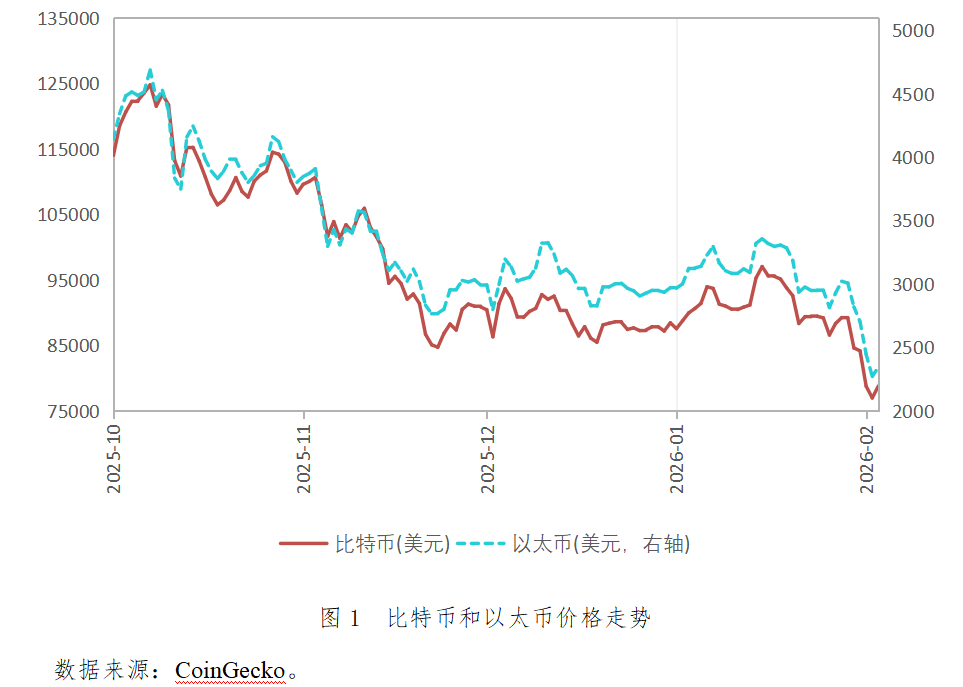
Group 1: Digital Asset Market Overview - The digital asset market experienced a significant downturn in Q4 2025, with a total market capitalization of approximately $2.93 trillion as of January 31, 2026, reflecting a decline of about 27.1% from the end of Q3 2025 [3][4] - Bitcoin's closing price was $84,100, down approximately 26.4%, while Ethereum fell to around $2,702, a decrease of about 35.9% [3][4] - The market adjustment was influenced by changes in liquidity expectations, delays in key regulatory legislation in the U.S., and a shift in market sentiment towards caution [3][4] Group 2: Stablecoin Market Dynamics - The stablecoin market showed a significant slowdown in growth, with a total market capitalization of $293.29 billion as of January 31, 2026, representing a mere 2.3% increase from the previous quarter [5] - The dominance of USD stablecoins remains strong, with USDT and USDC maintaining a duopoly, accounting for approximately 59.7% and 22.8% of the market, respectively [5] Group 3: Regulatory Developments - The U.S. regulatory landscape for digital assets is characterized by a dual focus on institutional integration and risk prevention, with the legislative process for the "CLARITY Act" stalled due to industry conflicts [2][8] - The People's Bank of China has initiated a new generation of the digital RMB system, marking a transition towards a more systematic development phase [2][13] - The U.S. Office of the Comptroller of the Currency (OCC) has granted temporary national bank charters to several stablecoin issuers, integrating them into the federal banking regulatory framework [7] Group 4: Real World Assets (RWA) Growth - The market capitalization of Real World Assets (RWA) grew by 41.1% from the end of Q3 2025 to approximately $23.7 billion as of January 31, 2026, with U.S. Treasury RWA accounting for 40% of this total [15][16] - Traditional financial institutions are actively promoting the tokenization of compliant products, indicating a shift towards integrating RWA into blockchain ecosystems [16] Group 5: Future Regulatory Scenarios - The ongoing negotiations surrounding the "CLARITY Act" may lead to three potential outcomes: a conservative version favoring banking interests, a middle-ground version facilitating compliance for crypto-native platforms, or a complete failure of the act, resulting in continued regulatory uncertainty [11][12] - The Chinese regulatory framework has clarified the definition and stance on RWA, emphasizing compliance and the need for regulatory approval for tokenization activities [17][18]
Fiserv(FI) - 2025 Q4 - Earnings Call Transcript
2026-02-10 14:00
Financial Data and Key Metrics Changes - Total company Q4 adjusted revenue was $4.9 billion, flat year-over-year, with adjusted operating income of $1.7 billion, resulting in an adjusted operating margin of 34.9% [20] - Full year total company adjusted revenue reached $19.8 billion, up 4%, with adjusted operating income of $7.4 billion, resulting in an adjusted operating margin of 37.4%, a decrease of 200 basis points [20] - Total company organic revenue was roughly flat, down approximately 40 basis points in Q4, resulting in annual organic revenue growth of 3.8% [20] Business Line Data and Key Metrics Changes - Merchant Solutions grew 6% organically for the year, while Financial Solutions grew 2% [21] - Q4 Merchant Solutions organic revenue growth was 1%, while adjusted revenue grew 2% [22] - Clover revenue grew 12% in Q4, with Clover volume growth of 6% on a reported basis and 9% excluding gateway conversion [23] - Financial Solutions saw both organic and adjusted revenue decline by 2% in Q4 [26] Market Data and Key Metrics Changes - Clover Capital grew 30% in 2025 in North America, with significant upside potential [10] - Internationally, the launch in Brazil was highly successful, with results tracking ahead of plan [10] - Canada experienced strong growth in 2025, expected to accelerate with a new strategic relationship with TD [10] Company Strategy and Development Direction - The company is focused on a client-first mindset, building a preeminent small business operating platform through Clover, and delivering operational excellence enabled by AI [5] - The One Fiserv plan is central to the company's strategy, integrating various business lines and enhancing client service [4] - The company is committed to disciplined capital allocation and evaluating businesses to align with its go-forward strategy [17] Management's Comments on Operating Environment and Future Outlook - Management expressed optimism about the multi-quarter path towards delivering strong, sustainable operating performance [3] - The company anticipates that headline results will remain below expectations for the first half of 2026 due to investments and a higher mix of non-recurring revenue [4] - Management is confident in the strategy and ability to execute, emphasizing the unique position in the financial ecosystem [18] Other Important Information - The company repurchased 3 million shares during the quarter for approximately $200 million and paid down over $1 billion in debt [28] - Project Elevate incurred $73 million of expenses related to the program in Q4, with ongoing one-time costs expected in 2026 [28] Q&A Session Summary Question: Confidence in business review and future numbers - Management feels confident about the progress made and believes the conclusions from the analysis are fully reflected in the Q4 results and 2026 guidance [35] Question: Digital payments pricing actions - Management noted no new developments in Q4 related to pricing actions, but expressed satisfaction with the sequential improvement in digital payments and network volumes [41] Question: Expenses related to One Fiserv - Management indicated that expenses related to One Fiserv are largely baked in, with no material ramp-up expected, and highlighted the focus on process efficiencies moving forward [46] Question: SMB performance expectations - Management expects slight growth in non-Clover SMB for next year, with Argentina no longer a growth factor [52] Question: Clover yield outlook - Management is optimistic about yield growth driven by value-added services and vertical expansions, with expectations for long-term revenue growth [56]

LMAX推出全新交易平台 打破加密货币与外汇之间的壁垒
Xin Lang Cai Jing· 2026-02-10 11:59
Core Insights - LMAX Group has launched the Omnia exchange, designed to allow users to seamlessly exchange foreign exchange, cryptocurrencies, stablecoins, and other digital assets on a single platform [1][3] - Omnia is positioned as a "unified multi-asset infrastructure layer," enabling users to trade any asset directly 24/7 without restrictions on transaction size or asset type, with settlement options through traditional payment channels or instant blockchain settlement [1][3] - LMAX's cryptocurrency business has been a major player in the institutional crypto trading space, with an institutional trading volume of $8.2 trillion last year [1][3] Company Developments - LMAX Digital focuses on cryptocurrency/foreign exchange trading pairs as an institutional crypto execution and custody platform, while Omnia aims to integrate foreign exchange, cryptocurrencies, stablecoins, and other digital assets into a single system [1][3] - CEO David Mercer stated that Omnia bridges the gap between traditional markets and digital asset markets [4] - The recent partnership with Ripple to integrate its stablecoin RLUSD reflects the growing role of stablecoins as a universal tool for institutions entering the market, beyond just the crypto-native space [4]
全球数字资产:市场回调,监管博弈
Di Yi Cai Jing· 2026-02-10 11:02
Market Overview - The digital asset market experienced a significant downturn in Q4 2025, with the total market capitalization dropping approximately 27.1% to $2.93 trillion by January 31, 2026 [1][3] - Bitcoin's closing price was $84,100, reflecting a decline of about 26.4%, while Ethereum fell to approximately $2,702, down 35.9% [1][3] - The contraction in the market was influenced by changes in liquidity expectations, delays in key regulatory legislation in the U.S., and a cautious shift in market sentiment [1][3] Stablecoin Market - The stablecoin market saw a slowdown in growth, with total market capitalization increasing only 2.3% to $293.29 billion by January 31, 2026 [1][5] - USDT and USDC continue to dominate the market, with USDT's market cap at approximately $184.8 billion, accounting for about 59.7% of the total [1][5] Regulatory Developments - Global regulatory frameworks are evolving to integrate digital assets while simultaneously addressing risk prevention [1][8] - The U.S. legislative process for the Digital Asset Market Structure Bill (CLARITY Act) has been stalled due to industry conflicts, highlighting the struggle for control over market infrastructure between new crypto entities and traditional financial capital [1][10] - The U.K. has proposed new regulations to align digital assets with traditional securities, indicating a move towards stricter compliance for crypto service providers [1][9] Real World Assets (RWA) - The market for Real World Assets (RWA) has seen a substantial increase, with a 41.1% growth to approximately $23.7 billion from Q3 2025 to January 31, 2026 [2][17] - U.S. Treasury securities represent the largest segment of RWA, accounting for 40% of the total [2][17] Digital Currency Developments in China - The People's Bank of China has initiated a new generation of the digital yuan, transitioning from digital cash to digital deposit currency, marking a significant development in its operational framework [1][15] - The new system emphasizes a dual-layer operational structure involving central banks and commercial institutions, enhancing the integration of digital currency into the existing financial system [1][15][16]
【首席观察】银发42号文的红线、锚点与双轨试验
Jing Ji Guan Cha Bao· 2026-02-10 06:28
Core Viewpoint - The regulatory landscape for Real World Asset (RWA) tokenization in China is undergoing significant changes, with the introduction of the "42 Document" marking a shift from merely preventing virtual currency speculation to a comprehensive regulatory framework for asset tokenization [3][4]. Regulatory Framework - The "42 Document" clearly defines RWA tokenization as the process of converting ownership and income rights of assets into tokens using cryptographic and distributed ledger technologies, thus bringing it under systematic regulatory oversight [3][4]. - Activities related to RWA tokenization within China are largely prohibited unless they are approved by relevant authorities, while foreign entities are also restricted from providing such services to domestic subjects [4][5]. Comparison with Hong Kong - In contrast to mainland China's restrictive approach, Hong Kong is actively promoting RWA tokenization, with government policies encouraging the tokenization of various assets, including government bonds and carbon credits [5][6]. - The regulatory environment in Hong Kong is designed to facilitate compliance and innovation, creating a dual-track system where mainland China focuses on maintaining financial security while Hong Kong serves as a testing ground for new financial products [5][6]. Market Dynamics - The global trend towards the tokenization of standardized financial assets, such as money market funds and bonds, is gaining traction, with significant examples like BlackRock's BUIDL fund and Franklin Templeton's BENJI fund leading the way [8][9]. - The regulatory framework in China, while restrictive, leaves room for the tokenization of standardized assets, which are seen as more compliant and less risky compared to non-standard assets like real estate [8]. Strategic Considerations - The regulatory environment is prompting a strategic differentiation between mainland China and Hong Kong, with the former focusing on strict compliance and the latter on creating a conducive ecosystem for innovation [9][10]. - The competition among currencies, particularly the rise of USDT and other stablecoins, highlights the need for the digital RMB to adapt and remain relevant in the evolving financial landscape [10][11]. Compliance and Risk Management - The "42 Document" emphasizes the importance of compliance, particularly regarding the issuance of tokens that could be perceived as currency or securities, and outlines the responsibilities of entities involved in RWA tokenization [11][12]. - Key risks include the potential for illegal cross-border activities and the necessity for clear asset ownership and disclosure practices to avoid regulatory pitfalls [12][13].

研究 | 破与立:中国虚拟货币监管的制度重构与法律前瞻
Sou Hu Cai Jing· 2026-02-10 02:22
Core Viewpoint - The issuance of Document No. 42 marks a significant shift in China's regulatory approach to virtual currencies, transitioning from fragmented responses to a systematic reconstruction of regulations, including the inclusion of stablecoins and RWA (Real World Asset tokenization) under regulatory oversight [2][3]. Regulatory Policy Evolution - The evolution of China's virtual currency regulation can be categorized into four distinct phases: 1. **2013**: Initial classification of Bitcoin as a "specific virtual commodity" with a cautious observation approach [4]. 2. **2017**: Introduction of the ICO ban and the requirement for existing ICO projects to arrange for refunds, marking a shift to strict limitations [5]. 3. **2021**: Comprehensive crackdown on all virtual currency-related activities, defining them as "illegal financial activities" [6]. 4. **2026**: Systematic reconstruction with Document No. 42, expanding regulatory scope to include stablecoins and RWA, and enhancing legal frameworks [7]. Innovations in Document No. 42 - Document No. 42 introduces three major innovations: 1. **Stablecoins**: Clearly defined and regulated, with restrictions on issuing stablecoins linked to the Renminbi without approval, emphasizing currency sovereignty [8][9]. 2. **RWA**: Introduced under a "principle of prohibition, with exceptions upon approval" framework, allowing for regulated activities under specific conditions [10]. 3. **Overseas Operations Control**: Extends regulatory oversight to the global activities of domestic entities, marking a shift from domestic to global regulatory logic [11]. Legal Responsibilities - The addition of a dedicated chapter on legal responsibilities in Document No. 42 establishes clear administrative and criminal liabilities for violations, addressing previous gaps in enforcement [12]. Legal Classification Dimensions - The legal classification of virtual currencies in China is complex, involving civil, administrative, criminal, and foreign exchange control dimensions: 1. **Civil Aspect**: The recognition of virtual currencies as property has evolved, but contract validity remains contentious [14][15]. 2. **Administrative Aspect**: Strengthened regulatory defenses against financial institutions and enhanced information control measures [16]. 3. **Criminal Aspect**: Expansion of criminal charges related to virtual currencies, including fraud and money laundering [17][18]. 4. **Foreign Exchange Control**: Concerns over the use of virtual currencies like USDT for circumventing foreign exchange regulations [19]. Judicial Practice Developments - Recent trends in judicial practice indicate a move towards nuanced rulings in virtual currency disputes, reflecting a shift from blanket prohibitions to more refined adjudications [20][21]. - The judicial system is exploring practical solutions for the disposal of seized virtual currencies, indicating a willingness to adapt within the regulatory framework [22]. International Comparison - China's regulatory approach contrasts with global paradigms, highlighting a unique stance characterized by comprehensive prohibitions while observing developments in regions like Hong Kong and Singapore [24][25]. - The regulatory landscape in Hong Kong, with its dual-track system, provides a potential model for balancing innovation and regulation in mainland China [26]. Future Trends - The implementation of supporting regulations for Document No. 42, the specific pathways for RWA registration, and the progression of dedicated virtual currency legislation are anticipated areas of focus [27].