能源结构转型

Search documents
上海电气再涨超5% 核聚变领域催化密集 机构看好公司新兴业务发展
Zhi Tong Cai Jing· 2026-01-08 03:08
Core Viewpoint - Shanghai Electric (601727)(02727) saw a stock increase of over 5%, currently at 4.58 HKD with a trading volume of 242 million HKD, driven by the upcoming 2026 Nuclear Fusion Energy Technology and Industry Conference in Hefei, Anhui [1] Group 1: Industry Developments - The 2026 Nuclear Fusion Energy Technology and Industry Conference will take place from January 16 to 17, 2026, focusing on promoting collaboration and innovation within the nuclear fusion industry [1] - Nuclear fusion energy has been included in national planning for future industries for the first time in 2025, and it is also a key focus in the national "14th Five-Year Plan" [1] Group 2: Company Performance and Prospects - Shanghai Electric has successfully delivered the world's first ITER project magnet cold test Dewar and is set to deliver key components for major national scientific infrastructure projects, including the CRAFT project and the compact fusion experimental device BEST [1] - The company is expected to leverage its leading position to enhance market share in traditional business areas while also exploring new growth opportunities in emerging sectors such as energy storage, hydrogen energy, and robotics, supported by its technological R&D advantages [1]

港股异动 | 上海电气(02727)再涨超5% 核聚变领域催化密集 机构看好公司新兴业务发展
智通财经网· 2026-01-08 03:03
Core Viewpoint - Shanghai Electric (02727) has seen a stock increase of over 5%, currently at 4.58 HKD, with a trading volume of 242 million HKD, driven by developments in the nuclear fusion sector [1] Group 1: Industry Developments - The 2026 Nuclear Fusion Energy Technology and Industry Conference will be held from January 16 to 17, 2026, in Hefei, Anhui, focusing on promoting collaboration and innovation within the nuclear fusion industry [1] - Nuclear fusion energy has been included in national planning for future industries for the first time in 2025, and it is also a key focus in the "14th Five-Year Plan" [1] Group 2: Company Positioning - Shanghai Electric has successfully delivered the world's first ITER project magnet cold test Dewar and is set to deliver key components for major national scientific infrastructure projects, including CRAFT and the compact fusion experimental device BEST [1] - The company is expected to leverage its leading position to enhance market share in traditional business areas while also exploring new growth opportunities in emerging sectors such as energy storage, hydrogen energy, and robotics, supported by its technological R&D advantages [1]
周红波在国网电科院(南瑞集团)调研
Nan Jing Ri Bao· 2026-01-07 02:46
Group 1 - The core message emphasizes the commitment of Nanjing to enhance service levels for enterprises and strengthen collaboration with State Grid Electric Power Research Institute (NARI Group) to improve national energy security and support the development of the smart grid industry [1][2] - NARI Group is recognized as a leading enterprise in Nanjing's smart grid industry, focusing on becoming a world-class high-tech leader in energy internet, with continuous improvements in innovation capabilities, industrial strength, and development momentum [1] - The city government expresses gratitude for the long-term support from State Grid Corporation and NARI Group in developing a 500 billion yuan smart grid industry cluster in Nanjing [2] Group 2 - The "14th Five-Year Plan" period is identified as a critical phase for comprehensive green transformation in economic and social development, with new requirements for the safety and security of the power system due to the implementation of carbon emission controls and accelerated energy structure transformation [2] - NARI Group is encouraged to leverage its core technological advantages to drive product upgrades and achieve more groundbreaking technological innovations, while also playing a leading role in empowering partners and promoting the collaborative development of upstream and downstream SMEs [2] - Nanjing aims to build a robust ecosystem for the smart grid industry, deepen the integration of production, education, research, and application, and facilitate cooperation in relevant fields to create a conducive environment for enterprise development [2]


年度榜单丨2025年中国储能电池出货量TOP20发布
起点锂电· 2026-01-06 11:04
Global Energy Storage Battery Shipment Analysis and Forecast - The report from Qidian Research Institute SPIR indicates that global energy storage battery shipments are projected to reach 358 GWh in 2024 and 637 GWh in 2025, representing a year-on-year growth of 77.93%. By 2030, shipments are expected to reach 2380 GWh. The main drivers for this growth include the transition in the global energy structure towards renewable energy sources like solar and wind, which increases the demand for energy storage batteries [2][3] - The demand for energy storage on the grid side is also expected to grow rapidly due to the increasing need for stability and flexibility in power systems, especially with the large-scale integration of renewable energy sources. Grid-side storage can effectively balance power supply and demand fluctuations, enhancing system stability [2] Market Concentration and Competitive Landscape - By 2025, the concentration ratio (CR6) of the energy storage cell industry is expected to reach around 50%, indicating a highly concentrated competitive landscape characterized by "one strong player and many strong challengers" along with emerging dark horses. CATL remains the leader, while companies like Chuangneng New Energy have rapidly entered the top five within four years [6] - Lithium iron phosphate (LFP) has become the dominant choice for energy storage cells, holding over 90% of the global market share. The ability to innovate in storage technology and control costs has become a significant competitive barrier for leading companies. The industry is anticipated to undergo a deep reshuffling period in the next two years, where technological innovation and scale advantages will be crucial for companies aiming to emerge as dark horses [8] Top 20 Energy Storage Battery Suppliers in China for 2025 - According to Qidian Research Institute SPIR, the top 20 energy storage cell suppliers in China for 2025 include CATL, EVE Energy, Chuangneng New Energy, Zhongchuang Innovation, Ruipu Lanjun, BYD, Guoxuan High-Tech, Penghui Energy, Rongjie Energy, Ganfeng Lithium, Zhongtian Energy, Xinwanda, Desay Battery, Haishida, Lishen Battery, Trina Storage, Kunyu Power, Nandu Power, Dufeng New Energy, and Xinneng An [9]






西北电网2025年跨区外送电量超4000亿千瓦时
Zhong Guo Neng Yuan Wang· 2026-01-05 08:19
Core Viewpoint - The Northwest Power Grid is set to achieve a cross-regional electricity delivery volume of 4,110 billion kilowatt-hours by 2025, marking a significant increase and establishing its position as the largest regional power grid in China [1][3]. Group 1: Electricity Delivery Volume - The cross-regional electricity delivery volume for 2025 is projected to exceed 4,000 billion kilowatt-hours for the first time, representing a 16.4% increase from 2024 and a 71% increase from the end of the 13th Five-Year Plan [1]. - The Northwest Power Grid will deliver 1,402.3 billion kilowatt-hours of renewable energy in 2025, a 38.5% increase from 2024, accounting for 34.1% of the total delivery volume [3]. Group 2: Regional Contributions - All provinces in the Northwest, including Shaanxi, Gansu, Qinghai, Ningxia, and Xinjiang, are expected to achieve record-high cross-regional electricity delivery volumes in 2025, contributing to the national energy structure transformation and supporting economic development in central and southwestern China [3][5]. - The Northwest Power Grid has established a robust electricity delivery framework through 14 cross-regional direct current channels, supplying power to 24 provinces and municipalities across North China, East China, Central China, and Southwest China [5]. Group 3: Strategic Initiatives - The Northwest Power Grid will leverage its role as a major electricity delivery hub to optimize resource allocation, with nearly half of the total electricity delivery volume from the State Grid system coming from this region in 2025 [7]. - The implementation of the "Shagehuang" large base market mechanism aims to enhance the high proportion of renewable energy delivery and ensure stable direct current transmission, thereby driving economic and social development in the five provinces [7].
2025年工业阀门行业词条报告
Tou Bao Yan Jiu Yuan· 2026-01-04 13:13
Investment Rating - The report rates the industrial valve industry as a growth sector with a positive outlook, projecting a market size increase from $14.586 billion in 2024 to $18.705 billion by 2029, reflecting a compound annual growth rate (CAGR) of 5.10% [3][59]. Core Insights - The industrial valve market is driven by the demand for ball valves and cast steel valves, with new power plants and smart city construction contributing to growth [3]. - The industry is characterized by a wide variety of valve types, significant cost influence from upstream materials, and a clear technological gradient, with high barriers in high-end sectors [8][10][11]. - The market is expected to expand due to factors such as new infrastructure, energy demand, accelerated domestic substitution of ball valves, and downstream industry upgrades [3]. Industry Definition - Industrial valves are essential components in industrial fluid control systems, used across various sectors including oil, chemicals, power, and aerospace [4]. - They can be categorized into different types based on their functions, including shut-off valves, check valves, safety valves, regulating valves, and diverter valves [4][5][6][7]. Industry Characteristics - The industry features a diverse range of products that can adapt to complex working conditions, with costs heavily influenced by upstream material prices [8][10]. - There is a notable technological gradient, with high-end valves requiring advanced materials and manufacturing techniques, creating significant barriers to entry [11]. Development History - The industrial valve industry has evolved through several phases, from its inception in the early 20th century to a period of rapid growth post-1979, leading to increased marketization and technological advancements [12][20]. Industry Scale - The market size of the industrial valve industry grew from $11.945 billion in 2019 to $14.586 billion in 2024, with a CAGR of 4.08% [59]. - The demand for ball valves is particularly strong, accounting for 24.50% of the market share in 2024, driven by their applications in oil and gas, food and beverage industries [61]. Industry Chain Analysis - The industrial valve industry chain includes upstream raw materials, midstream manufacturing, and downstream application sectors, with each segment influencing the overall market dynamics [22][49]. - Upstream material quality and processing techniques significantly impact valve manufacturing efficiency and cost [24][25][36][38]. Downstream Analysis - The oil and gas sector remains a traditional stronghold for valve applications, while emerging markets such as marine engineering are becoming increasingly important [54]. - The nuclear power sector is identified as a key area for technological advancement and competitive positioning among valve manufacturers [58].
元旦假期多地清洁能源齐发力 保供兼具暖意与绿意
Xin Hua She· 2026-01-03 04:21
Core Insights - The news highlights the effective utilization of clean energy during the New Year holiday across various regions in China, ensuring stable electricity supply and promoting green energy usage [1][2]. Group 1: Clean Energy Supply and Utilization - In Inner Mongolia, clean heating initiatives contributed to a supply of over 240,000 kilowatt-hours of clean energy on New Year's Day, benefiting 33,000 households [2]. - Hebei's Xiong'an High-speed Railway Station features over 17,000 solar panels, generating more than 30 million kilowatt-hours since its grid connection in 2020, ensuring reliable power for holiday travelers [1]. - Jilin's Baicheng has increased its clean energy capacity to over 16 million kilowatts with the commissioning of the Changfu Wind Farm, facilitating the transmission of clean electricity across regions [1][2]. Group 2: Infrastructure and Future Projects - Ningxia is advancing a 1 million-kilowatt wind power project, which is expected to enhance future energy supply capabilities [2]. - In Xinjiang, power employees completed inspections of 1,808 kilometers of high-voltage transmission lines, contributing to a total electricity export of 460 million kilowatt-hours on New Year's Day [2]. - Hebei aims to increase green electricity trading volume to over 43 billion kilowatt-hours by 2025, supporting various events and platforms [1].
雅砻江两座百万千瓦光伏电站同步投产发电 四川新能源装机容量突破3200万千瓦
Si Chuan Ri Bao· 2026-01-01 01:32
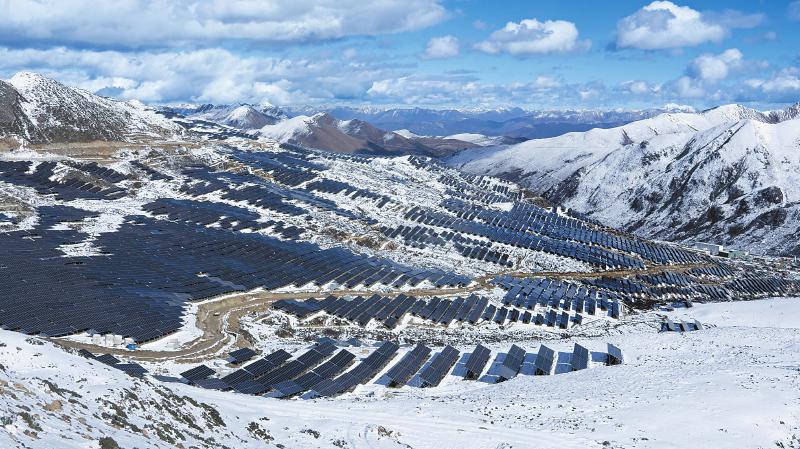
Core Insights - Sichuan province is making significant progress in building a clean energy stronghold, with a rapid increase in renewable energy capacity and a focus on solar and wind energy projects [3][4] Group 1: Renewable Energy Development - Sichuan has entered a high-speed development phase, adding approximately 10 million kilowatts of new renewable energy capacity [3] - By December 31, 2025, the total installed capacity of renewable energy in Sichuan is expected to exceed 32 million kilowatts, marking a fivefold increase since the beginning of the 14th Five-Year Plan [3] - The total installed power capacity in the province has surpassed 150 million kilowatts, equivalent to 6.7 Three Gorges power stations [4] Group 2: Key Projects - The newly commissioned solar power stations, Yalong River Suorong and Chaburang, each have a capacity of 1 million kilowatts, contributing approximately 3.9 billion kilowatt-hours of clean electricity annually [3] - The Suorong solar power station is part of the world's largest water-solar complementary project, combining 3 million kilowatts of hydropower and solar power [3] - The Chaburang solar power station is noted for being the largest high-altitude mountain solar project in China [3] Group 3: Future Projections - By 2030, the installed capacity of renewable energy in Sichuan is projected to reach 82 million kilowatts, accounting for over 45% of the total energy structure [4] - The annual electricity generation in Sichuan is expected to exceed 500 billion kilowatt-hours by 2025, sufficient to meet the annual electricity needs of approximately 200 million households [4] - The technical potential for wind and solar resources in Sichuan exceeds 758 million kilowatts, indicating substantial development potential [4]
四川新能源装机容量突破3200万千瓦
Zheng Quan Shi Bao Wang· 2026-01-01 00:33
Core Insights - By December 31, 2025, Sichuan's renewable energy installed capacity is expected to exceed 32 million kilowatts, marking a fivefold increase since the beginning of the 14th Five-Year Plan [1] - The total installed power capacity in Sichuan will surpass 150 million kilowatts, equivalent to 6.7 Three Gorges power stations, indicating significant progress in energy structure transformation [1] - The share of renewable energy in Sichuan's power generation is projected to rise to approximately 20%, while hydropower will account for about 60% and thermal power (including gas power) will also represent around 20% [1] Industry Developments - The simultaneous commissioning of the Yalong River Suorong and Chaburang photovoltaic power stations, each with a capacity of one million kilowatts, is a key milestone for Sichuan's clean energy development [1] - The annual electricity generation in Sichuan is anticipated to exceed 500 billion kilowatt-hours by 2025, which could meet the annual electricity needs of approximately 200 million households [1]
电力短缺背景下,如何布局电网设备?
市值风云· 2025-12-30 10:11
Core Viewpoint - The article discusses the growing investment opportunities in the power grid equipment sector, driven by the increasing demand for electricity and the need for infrastructure upgrades, particularly in the context of artificial intelligence and energy transition [4][5]. Investment Logic of Power Grid Equipment - Domestic investment in power grids remains robust, with projections indicating an average annual investment exceeding 700 billion yuan during the 14th Five-Year Plan period [7]. - Chinese leading companies are expanding internationally, capitalizing on the urgent need for grid upgrades in developed regions and the industrialization challenges in developing countries [8]. - The global energy transition and the explosion of computing power demand from AI data centers are driving increased demand for various power equipment, including transformers and energy storage systems [9]. ETF Performance and Comparison - Significant capital has flowed into power grid equipment ETFs, with the leading ETF (159326.SZ) seeing its fund size increase nearly sixfold over two months [11]. - The performance of different ETFs tracking power grid equipment indices has diverged significantly, with the ETF tracking the Hang Seng A-share Power Grid Equipment Index returning over 70% this year, compared to less than 40% for the ETF tracking the CSI Power Grid Equipment Theme Index [16][20]. - The disparity in performance is attributed to differences in portfolio concentration and industry purity, with the CSI index focusing more on traditional power grid equipment leaders, while the Hang Seng index includes a more diverse set of stocks [17][18]. Index Adjustments and Future Outlook - The Hang Seng Power Grid Equipment Index underwent significant adjustments to enhance focus, reducing the number of constituent stocks from 100 to 50 and removing companies related to upstream materials [23][25]. - The new index aims to better reflect the performance of core equipment manufacturing in the power grid sector, with a notable increase in the weight of power grid equipment [25][28]. - Despite the adjustments, both indices share a high degree of overlap, with 35 common constituent stocks, indicating a similar investment focus [25][27].