进出口贸易

Search documents
前8个月山西省进出口914.7亿元
Zhong Guo Xin Wen Wang· 2025-09-20 10:47
Core Insights - In the first eight months of the year, Shanxi Province's total import and export value reached 91.47 billion yuan [1] - In August alone, imports amounted to 5.69 billion yuan, reflecting a year-on-year growth of 8.5% [1] Import and Export Performance - A total of 1,962 enterprises engaged in import and export activities, marking an increase of 11.8% year-on-year, with a net addition of 207 companies [1] - Major export products included mobile phone parts valued at 3.89 billion yuan, lithium-ion batteries at 290 million yuan (a significant increase of 126.5% year-on-year), and agricultural products at 1.18 billion yuan [1] - The total import value of various metal ores reached 16.98 billion yuan [1] Commodity Trends - The import of bulk commodities, including metal ores and coal, totaled 22.05 billion yuan, showing a year-on-year increase of 8.5%, which contributed to a 3.8 percentage point increase in the province's overall import growth rate [1] - The share of bulk commodities in total imports rose by 4.6 percentage points compared to the same period last year, reaching 49.5% [1] Special Supervision Areas - The Taiyuan Wusu Comprehensive Bonded Zone achieved an import and export value of 4.742 billion yuan, reflecting a year-on-year growth of 46.2%, ranking 99th among 161 comprehensive bonded zones nationwide [1] - The Shanxi Fanglue Bonded Logistics Center reported an impressive 19.57 billion yuan in import and export value, with a staggering year-on-year growth of 776%, ranking 17th among 85 bonded logistics centers nationwide [1]
京津冀、长三角、大湾区“厮杀”升级!谁才是第一城市群?
Sou Hu Cai Jing· 2025-09-15 06:48
Core Viewpoint - The recent publication of the "Opinions on Promoting High-Quality Urban Development" emphasizes the support for world-class urban agglomerations in China, particularly the Beijing-Tianjin-Hebei, Yangtze River Delta, and Guangdong-Hong Kong-Macao Greater Bay Area, while also promoting the Chengdu-Chongqing economic circle and the central Yangtze River urban agglomeration as growth poles for high-quality development [1][12]. Economic Dimensions - In terms of GDP total for 2024, the ranking is as follows: Yangtze River Delta (33.16 trillion) > Greater Bay Area (14.84 trillion) > Beijing-Tianjin-Hebei (11.5 trillion) [4][5]. - China will have 27 cities with GDP exceeding 1 trillion, with the Yangtze River Delta contributing 9 cities, the Greater Bay Area 4 cities, and Beijing-Tianjin-Hebei 3 cities [4]. - The Yangtze River Delta has a higher number of cities and population compared to the other two urban clusters, but when considering per capita GDP, the ranking changes: Greater Bay Area (170,000) > Yangtze River Delta (139,000) > Beijing-Tianjin-Hebei (105,000) [4][5]. Innovation and Technology - Beijing-Tianjin-Hebei leads in R&D investment intensity at 4.27%, followed by Greater Bay Area at 3.54% and Yangtze River Delta at 3.33% [5]. - In the 2025 Global Innovation Index, the Shenzhen-Hong Kong-Guangzhou cluster ranks first, with Beijing fourth, and Shanghai-Suzhou sixth [6]. Trade and Port Activity - The three major urban clusters have significant port activities, with major ports like Shenzhen, Guangzhou, Shanghai, and Ningbo-Zhoushan facilitating substantial trade [7][8]. - In the first half of this year, the top 10 ports in China by container throughput included several from these urban clusters, with Shanghai and Ningbo-Zhoushan leading [9]. - Shenzhen has recently surpassed Shanghai to become the "foreign trade capital" of China, with notable export growth from Guangzhou in the Greater Bay Area and impressive trade performance from Jinhua in the Yangtze River Delta [11] [12]. Strategic Complementarity - The three urban clusters are not in competition but rather functionally complementary, each with unique strengths: Beijing-Tianjin-Hebei has political significance, Yangtze River Delta excels in comprehensive development, and the Greater Bay Area benefits from its open resources [12].

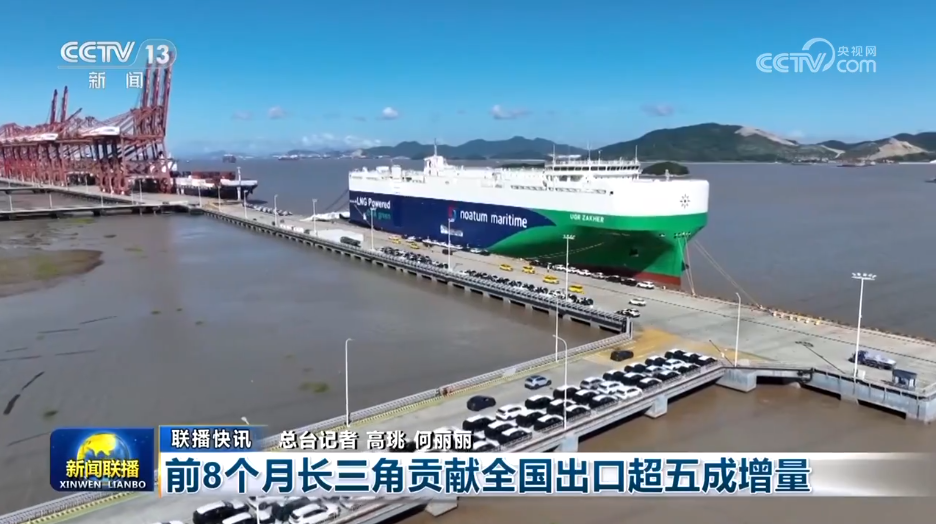
1亿吨、11.07万亿元……利好数据接连发布 多维度看中国发展“拔节向上”
Yang Shi Wang· 2025-09-15 03:25
Group 1: Real Estate Market - In August, the sales prices of new residential properties in first-tier cities decreased by 0.9% year-on-year, with the decline narrowing by 0.2 percentage points compared to the previous month [1] - Shanghai saw an increase of 5.9%, while Beijing, Guangzhou, and Shenzhen experienced declines of 3.5%, 4.3%, and 1.7% respectively [1] - Second and third-tier cities saw new residential property prices decrease by 2.4% and 3.7% year-on-year, with declines narrowing by 0.4 and 0.5 percentage points respectively [1] - The year-on-year decline in second-hand residential property prices in first-tier cities was 3.5%, with the decline expanding by 0.1 percentage points compared to the previous month [1] - Second and third-tier cities experienced year-on-year declines in second-hand residential property prices of 5.2% and 6.0%, with both declines narrowing by 0.4 percentage points [1] Group 2: Agricultural Sector - The cumulative wheat purchase in the country has exceeded 100 million tons, maintaining a high level compared to previous years [2][3] - Supported by the minimum purchase price policy, wheat prices remain stable, with a clear trend of higher quality fetching higher prices [3] Group 3: Trade and Investment - The Yangtze River Delta region's import and export scale reached 11.07 trillion yuan in the first eight months, a year-on-year increase of 5.5%, accounting for 37.4% of the national total [5] - Exports amounted to 7.08 trillion yuan, with a year-on-year growth of 9.2%, contributing 52.3% to the national export growth [5] - National railway fixed asset investment reached 504.1 billion yuan from January to August, reflecting a year-on-year increase of 5.6% [5][7] Group 4: Service Trade and Cultural Tourism - The 2025 China International Service Trade Fair concluded with over 900 achievements across various sectors including construction, information technology, and finance [8][10] - The 2025 China Cultural Tourism Industry Expo attracted 225,000 visitors, with cooperative transactions reaching 810 million yuan and project signings totaling 23.28 billion yuan [12]
前8月陕西进出口同比增长10.5%
Shan Xi Ri Bao· 2025-09-11 00:44
Summary of Key Points Core Viewpoint - The total import and export value of Shaanxi province reached 332.6 billion yuan from January to August, reflecting a year-on-year growth of 10.5%, which is 7 percentage points higher than the national average [1] Group 1: Trade Performance - Export value amounted to 230.4 billion yuan, with a year-on-year increase of 13.2% [1] - Import value was 102.16 billion yuan, showing a year-on-year growth of 4.8% [1] - The trade surplus during this period was 128.28 billion yuan [1] Group 2: Trade with Specific Regions - Trade with countries involved in the "Belt and Road" initiative reached 180.48 billion yuan, a year-on-year increase of 1.2%, accounting for 54.3% of the province's total trade [2] - Trade with RCEP countries totaled 125 billion yuan, representing 37.6% of the total [2] - Trade with ASEAN countries grew by 17.9% to 53.69 billion yuan [2] - Trade with Taiwan surged by 72.1% to 42.56 billion yuan [2] - Trade with the EU increased by 43.4% to 42.13 billion yuan [2] - Trade with Hong Kong rose by 15.2% to 19.23 billion yuan [2] - Trade with the United States reached 17.91 billion yuan [2] Group 3: Trade by Type - Processing trade saw a slight increase, with a total of 149.25 billion yuan, up 4.1%, making up 44.9% of the province's total trade [1] - General trade increased by 13.5% to 128.56 billion yuan [1] - Bonded logistics trade grew by 4.5% to 40.03 billion yuan [1] Group 4: Contribution of Enterprises - Foreign-invested enterprises reported a trade value of 192.43 billion yuan, a year-on-year increase of 17.2%, accounting for 57.9% of the total [2] - State-owned enterprises experienced a trade increase of 11.6%, totaling 22.78 billion yuan [2] Group 5: Product Categories - Exports of electromechanical products reached 197.65 billion yuan, up 14.5%, comprising 85.8% of total exports [2] - Key exports included integrated circuits at 85.52 billion yuan (up 14.6%), automobiles at 37.37 billion yuan (up 33.9%), and solar cells at 10.06 billion yuan [2] - Imports of electromechanical products totaled 70.63 billion yuan, a year-on-year increase of 7.9%, making up 69.1% of total imports [3] - Major imports included integrated circuits at 42.52 billion yuan and semiconductor manufacturing equipment at 6.31 billion yuan (up 226.9%) [3]
韩国9月1~10日出口同比增长3.8%,进口增长11.1%
Mei Ri Jing Ji Xin Wen· 2025-09-11 00:11
Group 1 - South Korea's exports from September 1 to 10 increased by 3.8% year-on-year [1] - Imports during the same period rose by 11.1% year-on-year [1]
苏州国手激光科技有限公司成立 注册资本100万人民币
Sou Hu Cai Jing· 2025-08-26 23:20
Group 1 - Suzhou Guoshou Laser Technology Co., Ltd. has been established with a registered capital of 1 million RMB [1] - The legal representative of the company is Hu Liangqiong [1] - The company's business scope includes technology services, equipment manufacturing, and sales of various electronic and mechanical products [1] Group 2 - The company is involved in the manufacturing of general and specialized equipment, including industrial robots and electronic components [1] - It also engages in technology transfer, consulting, and leasing of machinery and equipment [1] - The company is authorized to conduct import and export activities, as well as technology import and export [1]
深圳市泰陌进出口有限公司成立,注册资本500万人民币
Sou Hu Cai Jing· 2025-08-26 00:00
Company Overview - Shenzhen Taimo Import and Export Co., Ltd. has been established with a registered capital of 5 million RMB [1] - The legal representative of the company is Qi Miao, and it is wholly owned by Shanghai Taimo Electronic Technology Co., Ltd. [1] Business Scope - The company’s business scope includes technology services, development, consulting, and transfer, as well as sales of daily necessities, kitchenware, textiles, clothing accessories, toys, bags, sports equipment, medical devices, machinery, communication equipment, electronic products, and more [1] - It also engages in import and export activities, with no licensed business projects required [1] Company Structure - The company is classified as a limited liability company (sole proprietorship) [1] - The registered address is located in Nanshan District, Shenzhen [1]
今年1-6月吉进出口总额下降12.4%
Shang Wu Bu Wang Zhan· 2025-08-23 16:53
Core Insights - The total import and export volume of Kyrgyzstan decreased by 12.4% in the first half of 2025, amounting to $7 billion [1] Trade Breakdown - Trade volume between Kyrgyzstan and China reached $2.57 billion, showing a decline of 19.1% year-on-year [1] - Trade volume between Kyrgyzstan and Russia was $1.48 billion, reflecting a decrease of 12.8% [1] - Trade volume between Kyrgyzstan and Kazakhstan increased to $720 million, marking a growth of 13.8% [1]
今年1-7月吉经济增长11.5%
Shang Wu Bu Wang Zhan· 2025-08-23 16:53
Core Insights - The GDP of Kyrgyzstan grew by 11.5% year-on-year in the first seven months of 2025 [1] Economic Performance - Industrial sector growth was recorded at 11.3% [1] - The construction industry experienced significant growth of 37.8% [1] - Agricultural growth was modest at 2.3% [1] - Wholesale and retail trade saw an increase of 13.2% [1] Trade Data - The total import and export volume for the first half of the year was $7 billion, reflecting a year-on-year decline of 12.4% [1] - Exports decreased by 26.3% [1] - Imports fell by 9.4% [1]
有喜有忧!东莞镇街2025上半年经济“成绩单”陆续公布
Nan Fang Du Shi Bao· 2025-08-21 10:21
Core Insights - Dongguan's economy shows a mixed performance in the first half of 2025, with strong consumer markets and active foreign trade, but a slowdown in fixed asset investment [2][3][21] Economic Performance - Dongguan's GDP reached 606.78 billion yuan, growing by 4.8% year-on-year, which is 0.6 percentage points higher than the provincial average [3] - Among the 20 towns that reported, Dongkeng, Xiegang, and Gaobu had the highest GDP growth rates of 24.2%, 18.1%, and 8.1% respectively [3][4][6] Consumer Market - The total retail sales of social consumer goods in Dongguan amounted to 2,195.55 billion yuan, with a year-on-year increase of 3.4% [10] - Notably, the retail sales in Liubu and Dongcheng grew by 10.9% and 15.9% respectively, outperforming the city average [10][13] Foreign Trade - Dongguan's total import and export value reached 7,492.8 billion yuan, marking a year-on-year increase of 16.5%, ranking second in the province [17][19] - Noteworthy growth in foreign trade was observed in Tangxia and Xiegang, with increases of 184% and 2.8% respectively [19][20] Fixed Asset Investment - Fixed asset investment in Dongguan decreased by 10.9% year-on-year, although the decline was less severe than in the first quarter [21] - Some towns like Huangjiang and Tangxia experienced declines in fixed asset investment, while others like Dongcheng and Xiegang saw increases of 20.8% and 3.9% respectively [21][22][24]