GEO(生成式引擎优化)

Search documents
被爆炒个股澄清“不涉及”“无收入” GEO概念公司集体“拉警报”
Di Yi Cai Jing· 2026-01-13 13:52
1月13日,引力传媒(603598.SH)、人民网(603000.SH)、新华网(603888.SH)再度涨停。其中, 引力传媒在近7个交易日走出6个涨停板,人民网、新华网则在最近两个交易日连续涨停。此外,浙文互 联(600986.SH)、浙数文化(600633.SH)在盘中涨停后大幅跳水。 人民网、浙数文化均表示,目前不涉及GEO业务。其中,2026年1月5日至13日期间,人民网累计上涨 33.75%,股价短期涨幅较大。 GEO(生成式引擎优化)概念股大涨,多家上市公司紧急提示风险,纷纷表示"不涉及GEO业 务"或"GEO业务未形成收入"。 (文章来源:第一财经) 引力传媒、新华网、浙文互联则都表示GEO业务尚未形成收入。 其中,引力传媒(603598.SH)近期涨幅最大。自2025年12月30日至2026年1月13日期间,该公司股票 累计上涨97.54%。 浙文互联也是类似的情况,GEO业务尚未形成收入。但是自2026年1月5日以来,股价累计涨幅 43.99%。该公司的最新动态市盈率为132.13倍,根据申万行业分类,所属"传媒行业"市盈率为53.13倍。 该公司前三季度业绩处于下滑状态。2025年前三季 ...


被爆炒个股澄清“不涉及”“无收入”,GEO概念公司集体“拉警报”
Di Yi Cai Jing· 2026-01-13 13:51
浙文互联也是类似的情况,GEO业务尚未形成收入。但是自2026年1月5日以来,股价累计涨幅 43.99%。该公司的最新动态市盈率为132.13倍,根据申万行业分类,所属"传媒行业"市盈率为53.13倍。 引力传媒、新华网、浙文互联则都表示GEO业务尚未形成收入。 其中,引力传媒(603598.SH)近期涨幅最大。自2025年12月30日至2026年1月13日期间,该公司股票 累计上涨97.54%。 该公司的最新动态市盈率为311.50倍,最新市净率为40.53倍,显著高于行业平均水平。截至2026年1月 13日,引力传媒所处的L7租赁和商务服务业的最新静态市盈率为32.49倍,最新市净率为2.23倍。 面对飙涨的股价,引力传媒称,公司GEO事业部仍处于组建筹划阶段,GEO业务尚未形成成熟的商业 模式,其市场认可度及盈利模式均存在不确定性,该业务尚未形成相关收入。目前,公司主营业务仍为 广告代理服务。 同时,该公司提示称,业绩存在波动风险。2025年前三季度,引力传媒实现营业收入64.62亿元,实现 归属于上市公司股东的净利润2036.02万元,毛利率2.69%,较去年同期下降1.73个百分点,主要系行业 竞争 ...
GEO概念逆势暴涨,多家上市公司回应相关业务情况
2 1 Shi Ji Jing Ji Bao Dao· 2026-01-13 13:24
1月13日晚间,多家上市公司公开回应相关业务情况。 引力传媒(603598.SH)发布股票交易异常波动暨风险提示公告,公司关注到有媒体将公司列为GEO概念 股。目前,公司主营业务仍为广告代理服务。截至目前,公司GEO事业部仍处于组建筹划阶段。公司 GEO业务尚未形成成熟的商业模式,其市场认可度及盈利模式均存在不确定性,该业务尚未形成相关 收入。 浙文互联(600986.SH)发布风险提示公告,公司关注到有媒体将公司列为GEO概念股。截至本公告披露 之日,公司GEO业务尚未形成成熟的盈利模式,市场认可度及盈利性均存在不确定性,目前尚未形成 相关收入。 新华网(603888.SH)公告称,公司股票1月5日至1月13日收盘价累计涨幅38.5%,高于行业平均水平。公 司GEO业务未形成收入:近日,有媒体将公司列为GEO概念股。经自查,公司GEO业务尚未形成成熟 的盈利模式,市场认可度及盈利性均存在不确定性,目前尚未形成收入。 南方财经全媒体集团投资传媒记者 李昊 1月13日,GEO(生成式引擎优化)概念股逆市大涨。消息面上,马斯克近期发文称,将会在7天内开 源新的算法,包括所有用于决定向用户推荐哪些自然内容和广告帖子 ...


“新易中天”狂飙,“概念溢价”风险初显
2 1 Shi Ji Jing Ji Bao Dao· 2026-01-13 11:09
Core Viewpoint - The recent surge in A-share market, particularly the "New Yi Zhong Tian" combination, is driven by the emerging concept of "GEO" (Generative Engine Optimization), reflecting both genuine market demand and speculative capital activities [1][2]. Group 1: Market Dynamics - The "New Yi Zhong Tian" combination, consisting of Yidian Tianxia, Zhongwen Online, and Tianlong Group, has seen stock prices increase by over 47% within a few trading days [1][3]. - The GEO concept is gaining traction as a critical strategy for brands to enhance visibility and authority in AI-generated content, contrasting with traditional SEO methods [2][3]. - The global GEO service market is projected to grow from $1.2 billion to $3.5 billion by 2026, with a compound annual growth rate (CAGR) exceeding 140% [3]. Group 2: Company Profiles - Yidian Tianxia, as a Google primary agent, focuses on overseas marketing and is viewed as a potential player in the cross-border GEO field [4]. - Zhongwen Online provides compliant copyright data to large models, positioning itself as a core content provider in the GEO ecosystem [4]. - Tianlong Group leverages its internet marketing experience to develop AIGC engine-related businesses, which are interpreted as foundational capabilities for GEO applications [4]. Group 3: Investment Trends - The concentrated capital interest in the "New Yi Zhong Tian" combination has made it a leading sector player, with other AI marketing stocks also experiencing significant price increases [5]. - As of January 13, Tianlong Group's stock has risen by 82.26%, Yidian Tianxia by 72.86%, and Zhongwen Online by 47.37% [4]. Group 4: Financial Performance - Yidian Tianxia reported a revenue of 2.717 billion yuan, a year-on-year increase of 54.94%, with a net profit of 204 million yuan, up 4.41% [8]. - Tianlong Group's revenue for the first three quarters was 5.459 billion yuan, down 5.84%, but net profit increased by 129.06% to 111 million yuan [8]. - Zhongwen Online continued to report losses, with a revenue of 1.011 billion yuan, a 25.12% increase, but a net loss of 520 million yuan, widening by 176.64% [8]. Group 5: Market Sentiment and Risks - The current market sentiment reflects a "concept premium," with concerns about the disconnect between valuations and actual performance [6][8]. - Many companies, including Yidian Tianxia and Liao Shares, have issued risk warnings indicating that their GEO-related business models are still in the early stages and lack substantial revenue contributions [9].


从概念到变现:GEO优化策略打开商业化空间,低费率云计算ETF(159890)获资金逢跌加仓
Sou Hu Cai Jing· 2026-01-13 06:40
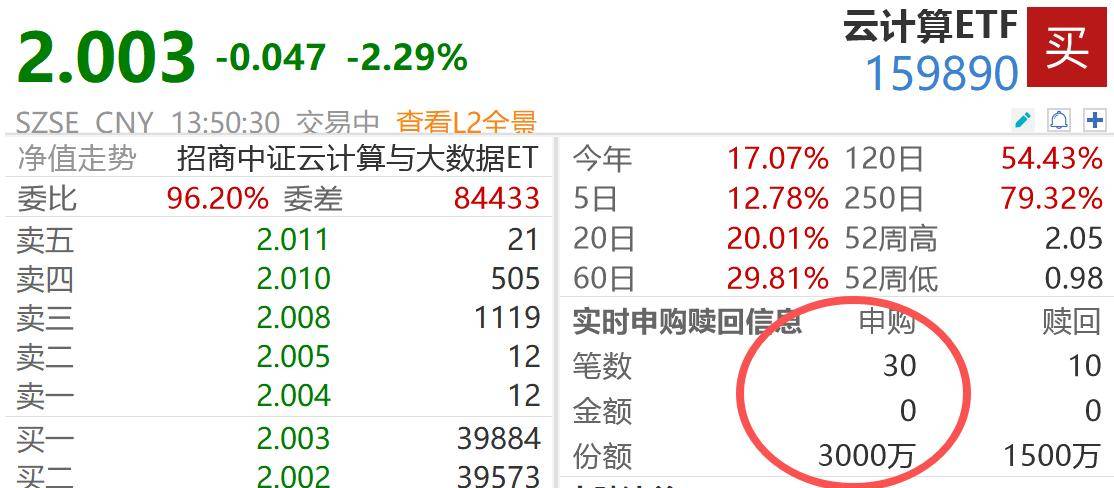
Group 1 - The technology industry is experiencing differentiation, with fluctuations in computing infrastructure and continued growth in AI applications driven by the "GEO" concept [1][3] - The low-fee cloud computing ETF (159890) saw active trading despite a decline, with a net inflow of 30 million during intraday trading [1][2] - Stocks within the ETF showed mixed performance, with notable gains from companies like Yitong Tianxia (up over 13%), Youfu Network (limit up), and Wanxing Technology (up over 10%) [1] Group 2 - The GEO (Generative Engine Optimization) concept is gaining traction, focusing on content optimization strategies for large models to enhance brand visibility in AI-generated responses [3] - Major industry players are expected to launch related products and strategies in the first half of 2026, which is anticipated to drive further interest in the GEO concept [3][4] - The successful IPOs of companies like Zhipu and MiniMax, which focus on general artificial intelligence models, are boosting confidence in the sector [3] Group 3 - 2026 is projected to be a pivotal year for AI applications, transitioning from technical validation to large-scale commercial promotion, with large models serving as key hubs for traffic and commercialization [4] - The cloud computing ETF (159890) tracks a comprehensive range of sectors including computer software, cloud services, and communication equipment, with a significant focus on AI applications [4]
GEO革命重构AI流量入口:传媒ETF华夏日净流入5.75亿
2 1 Shi Ji Jing Ji Bao Dao· 2026-01-13 05:33
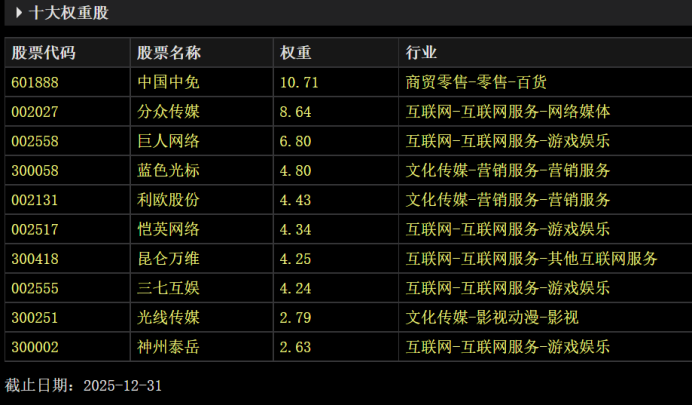
Core Viewpoint - A marketing revolution is underway, shifting from "keyword ranking" to "AI answer priority," significantly impacting the media sector, as evidenced by the surge in the Media ETF Huaxia (code: 516190) with a net inflow of 575 million yuan on January 12 [1][6]. Group 1: Market Dynamics - The announcement by Elon Musk to open-source the content recommendation algorithm of the X platform has marked the arrival of the Generative Engine Optimization (GEO) era [1]. - The A-share media sector experienced a wave of price surges, with companies like Liou Co. and Yidian Tianxia achieving consecutive price limits, and the Media ETF Huaxia rising over 8% after an 8.41% increase the previous week [1][6]. - The GEO revolution is expected to create a trillion-yuan market space, as investors recognize the potential of this shift [1]. Group 2: GEO Characteristics - Unlike traditional SEO, GEO emphasizes logical coherence, authoritative data, and emotional resonance in content [2]. - The demand from advertisers is transitioning from "ranking priority" (SEO) to "answer priority" (GEO), leading to innovations in marketing and media business models [2]. - The GEO market in China is projected to reach approximately 2.9 billion yuan by 2025 and 24 billion yuan by 2030, with the global market expected to exceed 100 billion dollars [2]. Group 3: Investment Opportunities - The Media ETF Huaxia (516190) is identified as a prime investment vehicle for the GEO revolution, as its constituent stocks align closely with GEO concepts [3]. - The ETF includes leading companies in online retail, advertising, film publishing, gaming, and digital media, with top holdings such as Focus Media, Giant Network, and BlueFocus [3][4]. - As of January 9, the ETF has achieved a year-to-date return of 13.15% and a one-year return of 52.38%, significantly outperforming the CSI 300 index [6]. Group 4: Long-term Outlook - The transition from traditional search to AI-driven dialogue signifies a fundamental change in how users access information, positioning GEO optimization as a critical area for corporate marketing [6][7]. - The Media ETF Huaxia is well-positioned for long-term investment due to the ongoing trends of traffic entry reshaping, conversion chain reconstruction, and concentrated event catalysts [7].



GEO概念股,大涨
Di Yi Cai Jing Zi Xun· 2026-01-13 05:31
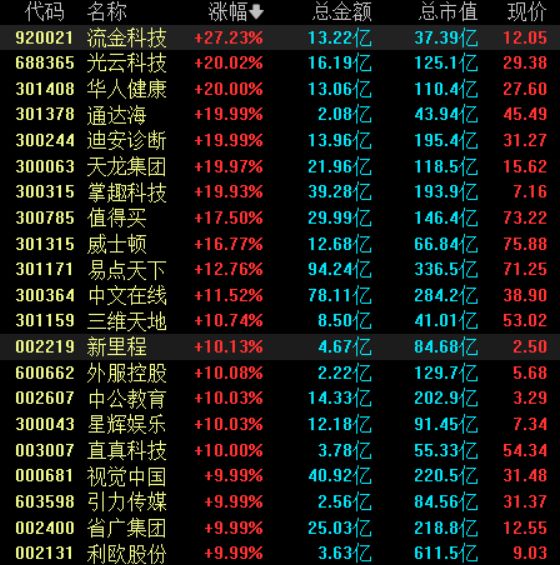
1月13日,AI应用板块表现活跃,AI应用细分概念——"GEO"(生成式引擎优化)再走强,被市场称为 新"易中天"组合的——易点天下、中文在线、天龙集团均大涨,易点天下一度三连板。 据媒体报道称,马斯克当地时间1月10日在社交媒体平台X发文称,将在一周内正式开源X平台最新的内 容推荐算法,覆盖"所有用于决定向用户推荐自然内容和广告内容的代码"。马斯克表示,"此过程将每 四周重复一次",同时附带开发者说明,标注算法和逻辑上的改动内容。 截至发稿,天龙集团20%涨停,易点天下、中文在线均涨超10%。浙文互联、引力传媒、利欧股份等涨 停。 编辑丨瑜见 | 代码 | 名称 | 米唱 | 息金额 | 息市值 | 现价 | | --- | --- | --- | --- | --- | --- | | 920021 流金科技 | | +27.23% | 13.22 Z | 37.39 Z | 12.05 | | e88382 | 光云科技 | +20.02% | 16.19 Z | 125.1 乙 | 29.38 | | 301 408 | 华人健康 | +20.00% | 13.06 Z | 110.4 Z | 27. ...
GEO概念继续爆发!AI应用有望接棒商业航天?传媒ETF(512980)盘中涨超4%冲击9连涨
Xin Lang Cai Jing· 2026-01-13 02:54
Group 1: AI Applications and Market Trends - The AI application sector continues to show strong momentum, with companies like Yiyuan Media achieving six consecutive trading limits in seven days, and others like Yidian Tianxia and Zhuoyi Information also experiencing three consecutive limits [1] - The AI comic industry is expected to see significant growth, with 46,931 new comic productions anticipated in 2025, marking a 1,150% increase in the second half of the year alone [1] - The market size for AI comics is projected to exceed 20 billion yuan by the end of 2025, driven by low production costs ranging from 50,000 to 150,000 yuan per episode, which is significantly lower than traditional short dramas [1] Group 2: Generative AI and Marketing Strategies - Generative AI is reshaping the internet traffic landscape, with marketing strategies shifting from traditional SEO to Generative Engine Optimization (GEO), where brand competition is now focused on "AI answer citation rights" [2] - The global GEO market is expected to grow from $11.2 billion in 2025 to $100.7 billion by 2030, while the Chinese market is projected to increase from $2.9 billion to $24 billion [2] - DeepSeek plans to release its next-generation flagship model V4 in February 2026, which has shown superior code generation capabilities in internal benchmarks compared to competitors [2] Group 3: ETF Performance and Market Insights - As of January 13, 2026, the CSI Media Index rose by 3.38%, with the Media ETF (512980) increasing by 2.96%, reaching a peak of over 4% during the trading session [3] - The Media ETF has seen a cumulative increase of 23.01% over the past week, leading its category, with a total fund inflow of 3.281 billion yuan over the last eight days [3] - The latest scale of the Media ETF reached 6.667 billion yuan, marking a new high since its inception, with the number of shares also hitting a one-year peak at 5.293 billion [3]
资金周报|传媒ETF(159805)实现7连涨,AI应用端进入密集催化期(1/5-1/9)
Sou Hu Cai Jing· 2026-01-13 02:35
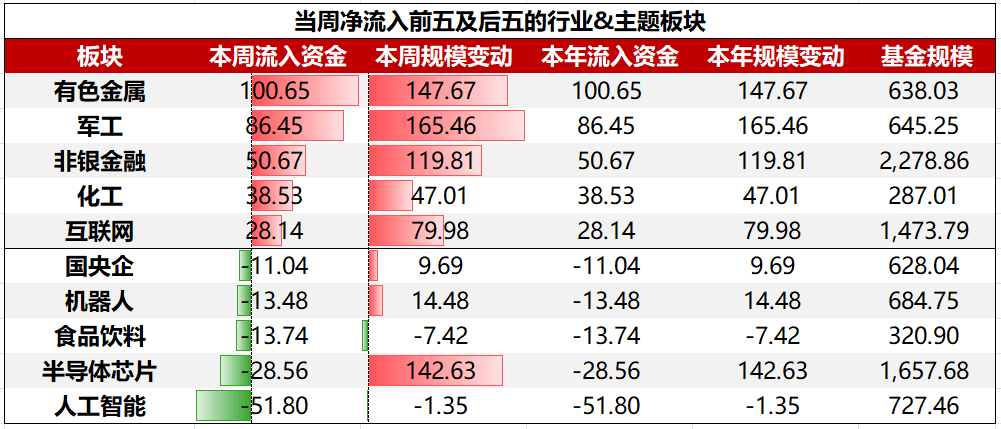
Market Overview - The total scale of equity ETFs in the market reached 52,595.73 billion yuan, with an increase of 2,430.91 billion yuan in total scale over the past week, and a net inflow of 201.06 billion yuan [1] - Industry and thematic sector ETFs saw a net inflow of 204.65 billion yuan, primarily driven by the non-ferrous metals sector, while broad-based and strategic sector ETFs experienced a net outflow of 148.43 billion yuan [2] Fund Positioning - In the broad-based and strategic sector ETFs, the top three sectors for net inflow were: CSI 500, CSI 300, and CSI 1000; the top three sectors for net outflow were: CSI A500, ChiNext 50, and Sci-Tech 50 [3] - For industry and thematic sector ETFs, the top five sectors for net inflow were: non-ferrous metals, military industry, non-bank financials, chemicals, and the internet; the top five sectors for net outflow were: artificial intelligence, semiconductor chips, food and beverage, robotics, and state-owned enterprises [3] Key Focus Areas - The Sci-Tech 100 ETF (588220) achieved a 14-day consecutive increase, with the technology sector overall rising, particularly in commercial aerospace and AI applications [5] - The fund saw a net inflow of 1,562.30 million yuan, with a total of 7.78 billion yuan net inflow over the past eight trading days [6] - The Media ETF (159805) experienced a 7-day consecutive increase, driven by the explosive growth in AI applications, with the GEO (Generative Engine Optimization) market projected to grow significantly [7][8] Sector Performance - The non-ferrous metals sector had a net inflow of 100.65 billion yuan, while the military industry and non-bank financials followed with inflows of 86.45 billion yuan and 50.67 billion yuan, respectively [4] - The artificial intelligence sector faced a net outflow of 51.80 billion yuan, indicating a shift in investor sentiment [4]
AI应用集体爆发,重仓基金单日大涨14%
券商中国· 2026-01-13 01:51
Core Viewpoint - The AI industry is experiencing a significant shift from hardware to software, marking the beginning of a new phase in 2026, where applications will dominate the market [1][6]. Group 1: Market Performance - On January 12, the AI application sector saw a substantial surge, with companies like Yidian Tianxia, Chinese Online, and Tianlong Group achieving a 20% limit-up, while the CSI Media Index and CSI Software Index rose over 9% [2]. - Several funds heavily invested in AI applications also reported significant gains, with the Western Li De Technology Innovation A fund increasing by 14.17% in a single day, driven by strong performances from its holdings [3]. Group 2: Catalysts for Growth - Key catalysts for the recent surge in AI applications include potential acquisitions by major overseas companies, such as the proposed acquisition of Manus, which exceeded market expectations and disrupted the narrative of software dominance by large firms [4]. - The emergence of new business models in the advertising sector, driven by AI, is also contributing to the positive sentiment in the market [4]. - The announcement by Elon Musk to open-source algorithms related to content and ad recommendations is seen as a pivotal moment for the commercialization of Generative Engine Optimization (GEO), which is expected to shift 25% of traditional search engine traffic to AI tools by 2026 [4]. Group 3: Future Outlook - Analysts predict that 2026 may be the year when AI applications take precedence, as the industry transitions from infrastructure development to application-focused growth [7][8]. - Investment opportunities are expected to arise in companies with strong data, ecosystem, and scenario barriers, as well as those with stable main businesses that have successfully implemented AI applications [7]. - The potential for AI to enhance business processes and customer experiences is highlighted, with specific focus on sectors like advertising, office software, and new product categories such as AI glasses and smart wearables [8].