
新型电力系统

Search documents
周大地:“十五五”新型电力系统重塑,新能源与储能迎新机遇
2 1 Shi Ji Jing Ji Bao Dao· 2025-09-11 11:49
Core Insights - The article discusses the achievements and future directions of China's energy transition during the "14th Five-Year Plan" and the upcoming "15th Five-Year Plan," emphasizing the importance of non-fossil energy development and carbon peak goals [1][5][6]. Energy Transition Achievements - During the "14th Five-Year Plan," China's non-fossil energy consumption target is expected to be exceeded, with the proportion of electricity in terminal energy consumption reaching around 30% [1]. - The installed capacity of renewable energy generation has increased from 40% to approximately 60% during this period [7]. - Energy consumption growth in the first four years of the "14th Five-Year Plan" reached 1.5 times the total increase during the "13th Five-Year Plan" [6]. Future Goals and Strategies - The "15th Five-Year Plan" aims to achieve carbon peak by 2030, with a focus on developing renewable energy and strictly limiting coal consumption [8][9]. - The energy structure transition's success depends on the competitiveness of new clean energy sources and the establishment of a low-carbon energy supply system [8][9]. - The expected annual electricity consumption for achieving carbon neutrality is projected to be between 17 trillion to 20 trillion kilowatt-hours, requiring significant increases in renewable energy capacity [10]. Market and Policy Framework - The article highlights the need for a collaborative effort between policy and market forces to optimize energy structure and ensure system stability [1][6]. - A dual control system for energy consumption and carbon emissions will be implemented, focusing on intensity control and total volume control [7]. Challenges in Energy System - The rapid growth of renewable energy poses challenges for grid stability and requires the construction of a new power system centered on high proportions of renewable energy [14][16]. - The current electricity market needs to balance the promotion of renewable energy consumption with the survival of traditional energy sources [15]. Storage and Technology Development - The development of large-scale chemical energy storage is crucial for stabilizing renewable energy supply and addressing grid operation challenges [17][18]. - The article emphasizes the importance of encouraging renewable energy companies to build their own storage facilities to improve energy output stability [17].

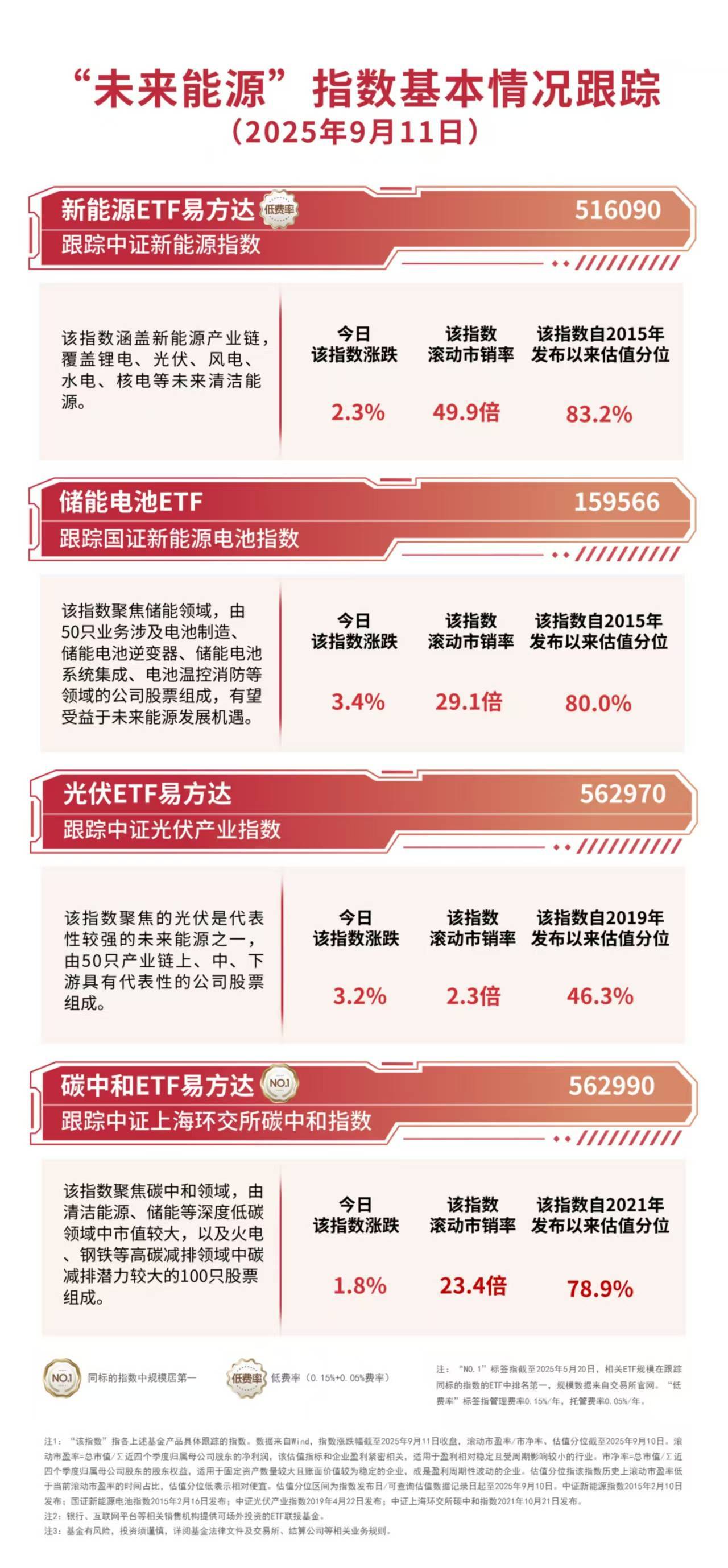
储能系统招标容量快速增长,相关产品受关注,储能电池ETF(159566)近一周“吸金”约7亿元
Sou Hu Cai Jing· 2025-09-11 11:43
| 今日 | 该指数 该指数自20 | | --- | --- | | 该指数涨跌 | 滚动市销率 发布以来估1 | | 3.2% | 2.3倍 46.39 | 截至收盘,国证新能源电池指数上涨3.4%,中证光伏产业指数上涨3.2%,中证新能源指数上涨2.3%,中证上海环交所碳中和指数上涨1.8%,储能电池ETF (159566)全天获1600万份净申购。截至昨日,该产品近一周持续获资金净流入,合计约7亿元。 国信证券表示,8月国内储能系统招标容量达到47.2GWh,实现同比和环比的快速增长。今年以来国内储能系统保持较高的订单需求,反映国内建设新型电 力系统对储能的高度需求,为未来两年国内储能市场平稳发展奠定基础。 每日经济新闻 ...
周大地:“十五五”新型电力系统重塑,新能源与储能迎新机遇
21世纪经济报道· 2025-09-11 10:52
Core Viewpoint - The article emphasizes the significant progress made in China's energy transition during the "14th Five-Year Plan" period, with a focus on achieving carbon peak targets in the upcoming "15th Five-Year Plan" through the development of renewable energy and strict limitations on coal consumption [1][4][5]. Group 1: Achievements in Energy Transition - During the "14th Five-Year Plan," China's non-fossil energy consumption target is expected to be exceeded, with the proportion of electricity in terminal energy consumption reaching around 30% [1]. - The installed capacity of renewable energy generation has increased from 40% to approximately 60% [5]. - By 2024, China's energy consumption increment has reached 1.5 times that of the previous five years, indicating robust energy supply capabilities [4]. Group 2: Future Directions for Energy Planning - The "15th Five-Year Plan" will continue to focus on the "dual carbon" goals, aiming for carbon emissions to peak before 2030 [6][7]. - The transition to a low-carbon energy structure will depend on the cost competitiveness of new clean energy sources [6]. - The article highlights the need for a systematic effort to accelerate the development of non-fossil energy and to strictly control coal consumption growth [7][9]. Group 3: Challenges in Energy System Transformation - The rapid growth of renewable energy generation presents challenges for grid stability and management, necessitating a shift towards a new power system that can accommodate high proportions of renewable energy [12][13]. - The current electricity market needs to balance the promotion of renewable energy consumption with the survival of traditional energy sources [14][15]. - The article discusses the importance of developing a multi-level energy storage system to enhance the stability and dispatchability of renewable energy [16][17]. Group 4: Technological and Structural Innovations - The article suggests that significant advancements in energy storage technology are essential for stabilizing renewable energy supply [16]. - It emphasizes the need for a collaborative approach among power generation, transmission, and consumption sectors to address the challenges posed by the integration of renewable energy [15]. - The future energy system should focus on decentralized energy solutions and the development of a competitive market for various energy sources [13][14].
我国光热发电加速商业化需降本增效
Zhong Guo Chan Ye Jing Ji Xin Xi Wang· 2025-09-11 00:37
Core Viewpoint - The solar thermal power generation industry in China is poised for significant growth, driven by policy support, technological advancements, and the need for cost reduction to achieve competitive pricing [1][2][3]. Policy Support - Solar thermal power is recognized as a clean and renewable energy technology, with China's installed capacity reaching 838.2 MW by the end of 2024, accounting for 10.6% of the global total [2]. - The Chinese government has implemented various policies to support the industry, including a benchmark grid price of 1.15 yuan per kWh established in 2016 and the promotion of demonstration projects [2][3]. - The Energy Law, effective January 1, 2025, emphasizes the active development of solar thermal power, providing a legal framework for its growth [3]. Technological Innovation - The industry has achieved significant technological breakthroughs, with a fully autonomous supply chain and key components being domestically produced [4]. - Innovations include advanced heat collection systems, high-temperature energy storage solutions, and large-scale solar thermal power plant designs [4][5]. - The rapid development of technology is expected to substantially lower generation costs, facilitating large-scale commercial applications [4]. Economic Viability - Despite the growth potential, the current levelized cost of electricity for solar thermal power remains high, estimated at 0.8-0.9 yuan per kWh [7]. - To enhance economic viability, the industry must leverage economies of scale and establish a "technology-standard-market" ecosystem [7]. - Recommendations include improving policy support mechanisms, integrating carbon market benefits, and prioritizing advanced large-capacity projects to avoid unhealthy competition [7][8]. Collaboration and Future Directions - Industry stakeholders, including companies, research institutions, and government bodies, are encouraged to collaborate to address key scientific and engineering challenges [8]. - Increased investment in research and development is essential for advancing high-capacity and intelligent solar thermal technologies [8].

银线连戈壁 绿能润雄关
Zhong Guo Neng Yuan Wang· 2025-09-10 16:14
Core Viewpoint - The company is actively enhancing its power grid infrastructure and promoting renewable energy development in Jiuquan, contributing to the region's economic growth and green transformation [1][2][5][6]. Group 1: Power Grid Development - The company is focused on building a robust and intelligent power grid to meet the increasing electricity demand and challenges of integrating renewable energy [2]. - Key projects include the construction of critical substations and the optimization of the grid structure, aiming for a reliability rate of 99.99% [2][3]. - The company has achieved a significant increase in distribution automation, with coverage reaching 89.6% and a 52% improvement in self-healing capabilities of the grid [3]. Group 2: Renewable Energy Integration - The Jiuquan photovoltaic industrial base has a total installed capacity of 2,004 megawatts, generating an annual output of 1.1 billion kilowatt-hours [5][6]. - The company is facilitating the integration of renewable energy projects by providing streamlined services and support for wind and solar power projects [5][6]. - The expected installed capacity of renewable energy is projected to exceed 2.4 million kilowatts by the end of 2025, with a 4.37% year-on-year increase in renewable energy generation anticipated for 2024 [6]. Group 3: Rural Electrification and Community Support - The company is promoting distributed photovoltaic systems in rural areas, with 164 households registered and a total capacity of 17.6 megawatts [8]. - Initiatives include the construction of power supply facilities to support rural revitalization projects, with an investment of 2.48 million yuan [8][9]. - The company is also conducting safety inspections and providing reliable electricity supply to enhance agricultural productivity and living conditions in rural areas [9][10].

专访周大地:“十五五”新型电力系统重塑 新能源与储能迎新机遇
2 1 Shi Ji Jing Ji Bao Dao· 2025-09-10 15:50
Core Insights - The "14th Five-Year Plan" has achieved significant progress in energy transition, with non-fossil energy consumption targets expected to be exceeded, and energy investments surpassing 1 trillion yuan annually [1][2][3] - The upcoming "15th Five-Year Plan" aims to further advance carbon peak goals, emphasizing the development of renewable energy and strict limitations on coal consumption [1][4][5] Energy Transition Achievements - During the "14th Five-Year Plan," the share of renewable energy generation capacity increased from 40% to approximately 60%, establishing a framework conducive to carbon peak and neutrality [3][4] - Energy consumption growth during the first four years of the "14th Five-Year Plan" reached 1.5 times the total increase during the "13th Five-Year Plan" [2][3] Future Energy Planning - The "15th Five-Year Plan" will continue to focus on the dual carbon goals, aiming for carbon emissions to peak before 2030, with a strong emphasis on developing competitive low-carbon energy supply systems [3][4][6] - The plan will also address the need for a transition from energy intensity control to a dual control system for carbon emissions [3][4] Renewable Energy Development - The anticipated electricity demand for achieving carbon neutrality is projected to require significant increases in renewable energy capacity, including 500 million kilowatts of hydropower and over 300 million kilowatts of nuclear power [6][7] - The transition to electric heating and cooking in residential areas is expected to gain momentum, with substantial potential for rooftop solar energy development [7][8] New Power System Construction - The construction of a new power system will focus on high proportions of renewable energy, necessitating advancements in energy storage and new power electronic technologies [9][10] - The current electricity market is evolving towards full competition, which will facilitate the integration of renewable energy sources while maintaining the viability of traditional energy sources [10][11] Energy Storage and Grid Challenges - The rapid growth of renewable energy capacity presents challenges for grid stability and management, necessitating innovative solutions for energy storage and distribution [8][9][13] - The development of large-scale chemical energy storage is crucial for stabilizing renewable energy supply and addressing operational challenges within the grid [13][14]
专访周大地:“十五五”新型电力系统重塑,新能源与储能迎新机遇
2 1 Shi Ji Jing Ji Bao Dao· 2025-09-10 09:17
(原标题:专访周大地:"十五五"新型电力系统重塑,新能源与储能迎新机遇) 21世纪经济报道记者雷椰 李德尚玉 实习生王怡茵 北京报道 距离"十四五"规划收官已不足半年。 日前,国务院新闻办举行"高质量完成'十四五'规划"系列主题新闻发布会,国家能源局介绍了"十四 五"时期能源高质量发展成就。"十四五"期间,我国非化石能源消费目标将超额完成,终端用能电能比 重已达30%左右,能源投资年破万亿元。 围绕"十四五"能源转型成果、"十五五"规划方向等热点话题,近日,国家气候变化专家委员会委员,国 家"十四五"规划专家委员会委员,中国能源研究会学术顾问、原副理事长,国家发展改革委能源研究所 原所长周大地接受21世纪经济报道记者专访。 周大地表示,"十四五"时期我国能源转型已取得系统性突破,为碳达峰奠定坚实基底。面对"十五五"实 现碳达峰目标的关键时期,出路是大力发展新能源,需严格限制煤炭消费并大力发展非化石能源,通过 风光核储等零碳电力发展全面替代化石能源增量。转型需政策与市场协同发力,构建以高比例可再生能 源为核心的新型电力系统,同时推动储能规模化应用,在条件成熟的终端用能推广电气化,确保能源结 构优化与系统安全稳定 ...
国家电网张智刚:10年来跨省跨区输电能力增长了2.3倍
Xin Lang Cai Jing· 2025-09-09 07:24
Core Viewpoint - The State Grid Corporation of China is accelerating the construction of a new power system and promoting the upgrade of the grid to an energy internet, in line with the government's energy security strategy focused on "four revolutions and one cooperation" [1] Group 1: Energy Strategy and Development - The State Grid is enhancing interconnection of the power grid and promoting a revolution in energy supply by increasing investment and advancing the construction of various levels of the grid [1] - Over the past decade, the cross-province and cross-region transmission capacity has increased by 2.3 times, exceeding 350 gigawatts [1] - The installed capacity of pumped storage in operation and under construction has grown by 1.6 times, surpassing 94 gigawatts [1] Group 2: Renewable Energy Growth - The installed capacity of wind and solar energy in the operational area has increased ninefold, reaching 1,355 gigawatts, accounting for nearly 50% of the total capacity [1] - Renewable energy has become the primary source of new installations and new power generation [1]
“塞上绿电”好风光——来自宁夏的调查
Jing Ji Ri Bao· 2025-09-08 01:34
Core Insights - Ningxia is recognized as China's first comprehensive demonstration zone for renewable energy, with a renewable energy installed capacity exceeding 50 million kilowatts, accounting for 62.6% of its total installed capacity, and solar power has become the primary energy source, surpassing coal power [1][3] Group 1: Renewable Energy Development - Ningxia has abundant solar and wind resources, with average annual utilization hours of approximately 1500 hours for solar and 2000 hours for wind [1] - The Ningdong Energy and Chemical Base features a 2 million kilowatt photovoltaic base that generates 3.7 billion kilowatt-hours annually, saving about 1.15 million tons of standard coal and reducing carbon emissions by approximately 3.15 million tons [2] - The region has established the first integrated wind-solar complementary project in the country and is accelerating the construction of green electricity parks [3] Group 2: Energy Transmission and Economic Impact - By 2024, Ningxia's renewable energy generation is projected to reach 61.3 billion kilowatt-hours, with 40.2 billion kilowatt-hours consumed locally and 21.1 billion kilowatt-hours transmitted externally [4] - The "Ningxia to Hunan" ultra-high voltage direct current transmission project is expected to deliver over 36 billion kilowatt-hours annually, with more than 50% from renewable sources [6] - In the first half of the year, Ningxia's external electricity transmission exceeded 46 billion kilowatt-hours, with renewable energy accounting for 13.01 billion kilowatt-hours, a year-on-year increase of 22.22% [7] Group 3: Technological Advancements and Infrastructure - Ningxia has built the first 750 kV double-ring backbone network in the country, enhancing the efficiency of its energy transmission [6] - The region's energy storage capacity has surpassed 600,000 kilowatts, ranking fourth nationally, which significantly improves renewable energy utilization [10] - The introduction of intelligent monitoring and maintenance equipment in substations has increased operational efficiency by four to five times, reducing operational time by over 50% [5] Group 4: Policy and Strategic Initiatives - Ningxia has implemented supportive policies to accelerate the construction of a new energy system, including a three-year action plan for green and low-carbon transformation [3] - The region aims to achieve a new installed capacity of 20.6 million kilowatts for wind and solar energy by 2025, along with 600,000 kilowatts of energy storage [8] - The establishment of the Ningxia Artificial Intelligence Medical Health Industry Park highlights the region's commitment to leveraging green electricity for economic development [12]
打造绿色发展“新名片”
Jing Ji Ri Bao· 2025-09-07 22:15
Core Viewpoint - The construction of a new power system is essential for achieving the "dual carbon" goals, ensuring energy security, and addressing the challenges of power transformation [1][2]. Group 1: Key Actions and Strategies - National authorities have deployed several key tasks, including actions for stable power system assurance, large-scale high-proportion renewable energy delivery, high-quality development of distribution networks, smart scheduling system construction, and enhancing the friendly performance of renewable energy systems [1]. - Local regions are actively piloting new technologies and models to build a new power system, creating new green development brands like "Green Power in the North" to support the development of new productive forces in the power sector [1]. Group 2: Market and Resource Integration - The construction of a new power system requires a unified national market to eliminate local protectionism and market segmentation, allowing for the free flow of goods and services across regions [1]. - Ningxia has established three major power delivery "arteries" to bundle and deliver "wind, solar, and thermal" energy to over ten provinces, achieving a leading level of channel utilization nationwide [1]. Group 3: Long-term Goals and Development - The construction of a new power system is a long-term, systematic project that focuses on clean, low-carbon, safe, abundant, economical, efficient, and coordinated supply and demand [2]. - The development of green electricity is a crucial measure for promoting green and low-carbon transformation, with a focus on coupling clean energy with characteristic advantageous industries to inject new momentum into industrial green development [2]. Group 4: Challenges and Solutions - There are existing shortcomings that need to be addressed, such as ensuring the integration and consumption of renewable energy, particularly in major projects like the national Shage Desert base [2]. - Effective scheduling based on renewable energy output and load forecasting is essential for promoting efficient utilization of renewable energy and achieving mutual benefits among generation, grid, and demand sides [2].