
6G

Search documents
6G技术与产业创新论坛在武汉举办 湖北企学研联合发起6G创新行动
Zhong Zheng Wang· 2025-10-15 08:23
Core Viewpoint - The "6G Unlimited: The Future is Here" forum held in Wuhan focuses on the development and innovation of 6G technology, aiming to position Hubei as a leader in the 6G industry [1][2] Group 1: Forum Overview - The forum was co-hosted by the Hubei Provincial Department of Science and Technology and China Information Communication Technologies Group, with participation from key industry players and academic institutions [1][2] - The event featured discussions on core 6G technologies, standards, applications, and the industrial ecosystem, culminating in the launch of the "6G Technology and Industry Innovation Action Initiative" for Hubei [1][3] Group 2: Government and Corporate Commitment - Hubei's Vice Governor emphasized the importance of 6G as a new engine for the digital economy and pledged to accelerate the province's 6G technology development and application [2] - China Information Communication Technologies Group's leadership committed to focusing on 6G technology breakthroughs and building a collaborative ecosystem to support Hubei's ambitions in the 6G sector [2][4] Group 3: Key Initiatives and Expert Contributions - The "6G Technology and Industry Innovation Action Initiative" aims to integrate resources across academia and industry, focusing on innovation, ecosystem development, talent cultivation, and sustainable practices [3] - Notable experts presented insights on 6G, including discussions on hyper-converged network architectures and the impact of AI on wireless communication systems [3][4]
研判2025!中国通感算控一体化行业产业链、市场规模及重点企业分析:行业技术取得突破,中国市场规模稳步增长[图]
Chan Ye Xin Xi Wang· 2025-10-15 01:28
Core Insights - The integrated sensing, communication, computing, and control (ISCCC) technology has seen significant development in China, with the market size projected to reach approximately 15.79 billion yuan in 2024, reflecting a year-on-year growth of 10.57% [1][7] - A major breakthrough in this field was achieved in 2023 when China Mobile Research Institute and ZTE completed the industry's first low-frequency ISCCC technology verification, demonstrating multi-target trajectory perception in complex mobile environments with a detection range exceeding 1.4 kilometers and sub-meter level accuracy [1][7] Industry Overview - ISCCC is a collaborative system that deeply integrates communication, sensing, computing, and control functions, enabling the fusion of communication and sensing capabilities through shared resources and joint design [2] - The technology supports smart cities, intelligent transportation, and industrial IoT by creating a closed-loop interaction between the physical and digital worlds [2] Industry Development History - The development of the ISCCC industry in China from 2021 to 2025 follows a path of "technology foundation - scenario verification - ecosystem construction," with significant milestones including the establishment of the ISCCC task force in July 2021 and various technological breakthroughs in subsequent years [3] - By 2025, the industry is expected to transition from technology verification to ecosystem collaboration and large-scale commercialization [3] Industry Value Chain - The upstream of the ISCCC industry includes core hardware such as base station RF and antennas, chips, and satellite communication equipment, while the midstream consists of system integrators and solution providers [4] - Downstream applications are primarily in smart cities, intelligent transportation, low-altitude economy, and smart manufacturing [4] Market Size - The ISCCC market in China is projected to reach approximately 15.79 billion yuan in 2024, with a year-on-year growth of 10.57% [7] - The successful verification of low-frequency ISCCC technology in 2023 has laid a solid foundation for future commercialization [7] Key Companies' Performance - The competitive landscape of the ISCCC industry is characterized by leading companies like Huawei, ZTE, and China Mobile, which leverage their technological advantages to dominate the market [8] - ZTE has made significant advancements in ISCCC technology, achieving notable results in various application scenarios and completing over 80 low-altitude ISCCC pilot projects across multiple provinces [10] - China Mobile has played a pivotal role in network architecture upgrades and has deployed ISCCC traffic perception systems during the Hangzhou Asian Games [9] Industry Development Trends - The ISCCC industry is expected to leverage 6G technology for accelerated development, creating a closed-loop system that integrates communication, sensing, and computing [11] - Low-altitude economy and smart city applications are anticipated to be core areas for ISCCC technology, enhancing logistics and urban management efficiency [13] - The industry is moving towards a collaborative ecosystem involving hardware, software, protocols, and applications, supported by government policies and standardization efforts [14]






Ericsson(ERIC) - 2025 Q3 - Earnings Call Transcript
2025-10-14 08:00
Financial Data and Key Metrics Changes - Organic sales declined by 2% year over year, with reported sales decreasing by 9% due to a negative currency effect of SEK 4.2 billion [5][13] - Gross margin reached 48.1%, while EBITDA margin improved to 14.7%, reflecting operational excellence and cost reduction initiatives [5][16] - Adjusted EBITDA increased to SEK 8.2 billion, up by SEK 0.4 billion, despite a negative currency impact of SEK 1.2 billion [16] Business Line Data and Key Metrics Changes - In Networks, sales decreased by 11% year over year to SEK 35.4 billion, with an organic sales decline of 5% [16] - Cloud and Software and Services saw a 3% increase in sales year over year to SEK 15.3 billion, with organic growth of 9% [17] - Enterprise sales decreased by 20%, impacted by divestments and currency, with organic sales down by 7% [18] Market Data and Key Metrics Changes - Sales in the Americas declined by 8% year over year, while Europe, Middle East, and Africa grew by 3%, driven by strong performance in Africa [11][12] - Northeast Asia reported a 10% increase in sales, attributed to higher network investments in Japan [12] - Southeast Asia, Oceania, and India saw a 1% increase in sales year over year, with India showing quarter-over-quarter growth [11] Company Strategy and Development Direction - The company is focusing on capturing a larger share of the value created by connectivity, with strategic agreements in key markets like Japan and the UK [8][9] - Continued investment in technology innovation, particularly in AI and programmable networks, is seen as essential for future growth [4][22] - The company aims to create new monetization opportunities through network APIs and fixed wireless access [10][23] Management's Comments on Operating Environment and Future Outlook - Management expressed optimism about the growing demand for advanced mobile connectivity driven by AI applications [3][4] - The company is preparing for a flat market in the near term while maintaining a focus on cost management and operational efficiency [6][24] - Future investments in networks are expected to be driven by the adoption of AI applications and devices [23] Other Important Information - The company ended the quarter with a strong cash position, allowing for potential increased shareholder returns through dividends or share buybacks [6] - The board is expected to propose options for shareholder returns in time for the AGM [6] Q&A Session Summary Question: Sustainable margins and regional mix impact - Management highlighted structural improvements in supply chain and service delivery that have reduced geographic mix dependency, leading to consistent gross margins [26][27][30] Question: Edge AI as a driver for network investments - Management noted that while most AI investments have been in data centers, there is a growing demand for edge computing, which is expected to increase in the coming years [32][34] Question: Cloud and Software and Services growth and 5G core implications - Management confirmed strong growth in Cloud and Software and Services, with expectations for continued development in 5G core deployments [37][41] Question: Recurring cash flow explanation - Management explained that recurring cash flow is a result of improved cost structures and a shift towards more stable revenue models [44][48] Question: Increased uncertainty in growth guidance - Management indicated that while they expect seasonal growth, there is ongoing uncertainty primarily related to tariffs and market conditions [51][52] Question: R&D spending and competitive positioning - Management reassured that despite cuts in R&D spending, they are prioritizing investments to maintain competitive technology leadership [67][71] Question: North American market and spectrum demand - Management noted that increased spectrum availability typically drives overall market CapEx, benefiting equipment demand [62][64] Question: Update on Germany's market situation - Management acknowledged slow progress in swapping out Chinese vendors, with no significant developments reported [91]

通宇通讯:公司已在“星-地-端”全面布局
Zheng Quan Ri Bao Wang· 2025-10-14 07:47
Core Viewpoint - The company has established a comprehensive layout in the "satellite-ground-terminal" ecosystem, with products including satellite antennas, ground stations, ground terminals, phased array antennas, millimeter-wave antennas, and integrated networking technology, benefiting from national 6G and satellite constellation construction policies, indicating long-term growth potential [1] Group 1 - The company has entered the low Earth orbit satellite supply chain and secured overseas orders [1] - The company has invested in Blue Arrow Hongqing (Honghu Satellite Constellation) and established new companies and industrial funds to enhance satellite-ground collaboration capabilities [1] - The aim is to improve the full industry chain layout from satellite design to terminal, thereby enhancing market competitiveness [1]

通宇通讯(002792.SZ):产品进入低轨卫星供应链并获海外订单
Ge Long Hui· 2025-10-14 07:23
Core Viewpoint - Tongyu Communication (002792.SZ) has positioned itself in the satellite communication sector, focusing on satellite antennas, ground terminals, and integrated networking technology, benefiting from national policies on 6G and satellite constellation development [1] Group 1: Business Development - The company has entered the low Earth orbit satellite supply chain and secured overseas orders, indicating a strong market presence and demand for its products [1] - The establishment of a partnership with Blue Arrow Hongqing (Honghu Constellation) and the creation of an industrial fund aim to enhance the synergy between satellite and ground operations, thereby improving the overall competitiveness in the market [1] Group 2: Growth Potential - The business is expected to have long-term growth potential due to supportive national policies regarding 6G and satellite constellation construction [1] - The comprehensive layout from satellite design to terminal production positions the company favorably within the entire industry chain, enhancing its market competitiveness [1]
通宇通讯:公司已布局星载天线、地面终端及融合组网技术,产品进入低轨卫星供应链并获海外订单
Mei Ri Jing Ji Xin Wen· 2025-10-14 04:06
Group 1 - The company has invested in satellite internet-related businesses, indicating a strategic move to enhance its existing satellite operations and strengthen the industry chain collaboration [2] - The company has laid out plans for satellite communication, including onboard antennas, ground terminals, and integrated networking technology, which have entered the low Earth orbit satellite supply chain and secured overseas orders [2] - The business benefits from national policies on 6G and satellite constellation construction, suggesting long-term growth potential [2] Group 2 - The company has a stake in Blue Arrow Hongqing (Honghu Satellite Constellation) and has established an industrial fund to enhance the synergy between satellite and ground operations [2] - The aim is to complete the full industry chain layout from satellite design to terminal, thereby improving market competitiveness [2]
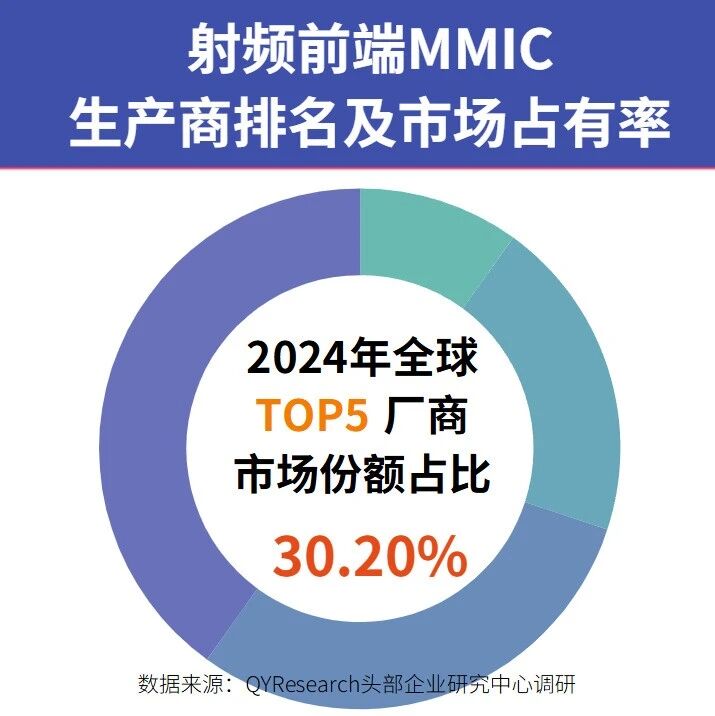
射频前端MMIC行业洞察:2024年TOP5 企业占据全球30.20%的市场份额
QYResearch· 2025-10-14 02:16
Core Viewpoint - The RF front-end MMIC market is experiencing significant growth driven by advancements in wireless communication technologies such as 5G, satellite communication, radar, and the Internet of Things (IoT) [1][2]. Market Overview - RF front-end MMICs are critical components in modern wireless communication systems, integrating multiple functions like amplification, filtering, and switching into compact semiconductor devices, thus reducing system size and power consumption [1]. - The market is becoming a focal point for technological advancements and strategic investments, supporting the performance and scalability of next-generation connectivity solutions [1]. Current Development Status - The development of RF front-end MMIC technology is steadily improving, with increasing diversification in materials, architectures, and applications [2]. - GaAs-based MMICs remain widely used due to their stable high-frequency performance, while GaN technology is rapidly gaining traction in demanding environments like radar and defense [2]. - SiGe technology is also evolving as a cost-effective solution, particularly in mass markets such as consumer electronics and communications [2]. Future Trends - Advanced semiconductor materials will significantly influence the future development of the RF front-end MMIC market, with GaN being highlighted for its high power density and efficiency at high frequencies [3]. - The global deployment of 5G networks and ongoing research into 6G technology are increasing the demand for RF front-end solutions capable of handling higher bandwidth and faster data transmission [3]. - Miniaturization and system integration are key trends, with a focus on integrating multiple RF front-end functions into compact MMIC modules to enhance reliability and reduce power consumption [3]. Thermal Management and Packaging Innovations - Thermal management is becoming a critical factor affecting the performance and lifespan of RF front-end MMICs, especially in high-power and high-frequency applications [4]. - Future designs will emphasize advanced packaging methods and thermal management technologies to address reliability challenges [4]. SWOT Analysis Strengths - The RF front-end MMIC market thrives due to its essential role in enhancing the high-frequency performance of advanced communication systems, radar, and satellite applications [5]. - The availability of mature semiconductor technologies like GaAs and SiGe, along with the growing adoption of GaN technology, provides a range of solutions balancing efficiency, power consumption, and cost [5]. Weaknesses - The industry faces challenges such as complex production processes and high costs, particularly in the GaN device sector, where manufacturing processes are still evolving [6]. - Thermal management issues at high power densities remain a technical bottleneck, and reliance on specialized foundries and advanced packaging technologies increases supply chain risks [6]. Opportunities - The development of 5G and future 6G networks, along with the growing demand for high-frequency and millimeter-wave solutions, presents significant growth potential for the industry [7]. - Expanding applications in aerospace, defense, and satellite communications further broaden market opportunities [7]. Threats - Global supply chain disruptions and geopolitical uncertainties pose risks to raw material procurement and semiconductor manufacturing [8]. - Intense competition between existing companies and new entrants may lead to increased price competition, compressing profit margins [8]. - Rapid technological changes, such as emerging alternative architectures or disruptive wireless technologies, could challenge the long-term dominance of existing millimeter-wave integrated circuit solutions [8]. Market Size and Forecast - According to QYResearch, the global RF front-end MMIC market is projected to reach approximately $14.13 billion by 2031, with a compound annual growth rate (CAGR) of 8.31% in the coming years [11]. - GaN currently dominates the product type segment, holding about 33.94% of the market share, while IT and telecommunications represent the largest downstream market, accounting for approximately 30.34% of the demand [15][16].
中国“星链”狂飙
Xin Lang Cai Jing· 2025-10-14 01:36
Core Insights - China's satellite communication industry is rapidly evolving, with Shanghai Yuanxin, known as the Chinese version of Starlink, initiating a new financing round of 5-6 billion RMB, with a pre-investment valuation exceeding 40 billion RMB [2] - The company aims to launch a total of 15,000 satellites by 2030, with a current goal of 108 satellites by the end of this year and 324 by mid-next year [2][5] - The global satellite communication market is becoming increasingly competitive, with strict regulations on satellite frequency and orbital resource allocation [3] Financing and Investment - Shanghai Yuanxin completed a record 6.7 billion RMB in Series A financing in February 2024, marking the largest single round of funding in China's satellite industry to date [2] - The company is currently seeking additional funding to support its ambitious satellite launch plans [2] Market Dynamics - The satellite communication sector is experiencing a shift as global investments in 5G decline, prompting companies to pivot towards satellite communication and 6G technologies [5] - The average cost of manufacturing a satellite is approximately 15 million RMB, indicating a substantial market potential of nearly 1 trillion RMB driven by major satellite constellations [5] Competitive Landscape - SpaceX's Starlink has a significant lead, having launched 8,926 satellites by August 2025, with plans to reach 12,000 by the end of this year [3] - Chinese companies, including China Star Network and Shanghai Yuanxin, are ramping up their satellite launches, with recent reports of multiple launches within a short timeframe [3] Supply Chain and Technological Development - The supply chain for satellite manufacturing and launching is becoming increasingly active, with companies like Tianbing Technology and Beijing Xinghe Power completing significant financing rounds to enhance their capabilities [7] - Companies are developing technologies for direct satellite communication with mobile devices and vehicles, indicating a focus on innovative applications in the satellite communication space [6] Future Prospects - The satellite communication market is projected to grow significantly, with estimates suggesting that 3 billion people globally remain unconnected, presenting a vast opportunity for satellite solutions [8] - Shanghai Yuanxin plans to expand its services to various countries, potentially securing orders worth 5 billion RMB once a sufficient number of satellites are operational [8]

The 4 industries Jamie Dimon says JPMorgan will invest billions in to preserve US dominance
Yahoo Finance· 2025-10-13 23:33
Core Insights - JPMorgan is launching a $1.5 trillion initiative to invest in critical US industries over the next decade, addressing reliance on unreliable sources for essential minerals and manufacturing [1][6] - The initiative will include $10 billion of the bank's own capital [1] Industry Focus - The initiative will target four main industries: Defense and Aerospace, Frontier Technologies, Energy Technology, and Supply Chain and Advanced Manufacturing [2][6] Defense and Aerospace - Key projects include Command & Control Tech, Unmanned Systems, Munitions, Missiles & Hypersonics, and Space Launch [7] - Relevant ETF: iShares Dow Jones US Aerospace & Defense ETF (Ticker: ITA) with top holdings in General Electric (21%), RTX Corporation (14.8%), and Boeing (8%) [11] Frontier Technologies - Focus areas include Cybersecurity, Quantum Computing, Artificial Intelligence, and Edge Computing [7] - Relevant ETF: Roundhill Generative AI & Technology ETF (Ticker: CHAT) with top holdings in Nvidia (8%), Alphabet (5.3%), and Oracle (4.2%) [11] Energy Technology - Investment will cover Nuclear Energy, Grid Resilience, Distributed Energy, and Battery Storage [7] - Relevant ETFs: VanEck Uranium & Nuclear ETF (Ticker: NLR), iShares Energy Storage & Materials ETF (Ticker: IBAT), and Invesco Solar ETF (Ticker: TAN) with top holdings in Constellation Energy (7.9%), Bloom Energy (8.8%), and Nextracker (11%) [11][13] Supply Chain and Advanced Manufacturing - Focus on Advanced Bulk Materials, Critical Minerals Mining & Processing, and Autonomous Mobile Robots [12]

菲利华拟定增募资不超过3亿元,进一步提升公司石英电子纱产能
Zheng Quan Shi Bao Wang· 2025-10-13 15:08
Core Viewpoint - The company plans to raise up to 300 million yuan through a simplified procedure for issuing shares, with all proceeds allocated to the construction of the first phase of its quartz electronic yarn intelligent manufacturing project [1] Group 1: Company Overview - The company has been developing quartz electronic cloth since 2017, creating various high-end ultra-thin fabrics and successfully producing high-performance electronic-grade glass fiber products, making it one of the few domestic manufacturers capable of providing such products [1] - The company possesses vertical integration capabilities across the entire quartz electronic cloth industry chain, from quartz sand to quartz electronic yarn and quartz electronic cloth [1] Group 2: Market Demand and Growth - The global electronic circuit industry is rapidly developing, and the company's current production capacity is insufficient to meet market demand [1] - Quartz electronic cloth, made from quartz electronic yarn, is preferred for high-frequency and high-speed copper-clad laminates (CCL) due to its low dielectric constant, low dielectric loss, excellent high-temperature resistance, and low thermal expansion coefficient [1] - The demand for low dielectric constant electronic cloth is increasing, particularly in high-end applications such as AI servers, data center switches, and 5G/6G base station RF modules [2] Group 3: Industry Trends - The AI server market is projected to grow from $125.1 billion in 2024 to $158.7 billion in 2025, reaching $222.7 billion by 2028, driving demand for quartz electronic cloth [2] - The Ethernet switch market is expected to see significant growth, with a 32.3% year-on-year increase in Q1 2025, and data center Ethernet switch revenue growing by 54.7% [3] - The deployment of 6G technology is anticipated to increase terminal connections by over 30 times by 2040, further expanding the market for quartz electronic cloth [3] Group 4: Project Significance - The fundraising project aims to enhance the company's production capacity for quartz electronic yarn, leveraging its integrated advantages in quartz fiber manufacturing [3] - The project will ensure a stable supply of high-performance raw materials for the production of quartz electronic cloth, meeting the emerging demands of AI servers and 5G communications [3] - The project is significant for promoting the localization of high-end electronic cloth materials and stabilizing the supply chain for downstream industries such as 5G/6G and consumer electronics [3]
