AI医疗

Search documents
创业慧康(300451):业绩短期承压 千万级订单同比增长
Xin Lang Cai Jing· 2025-08-28 06:47
Core Viewpoint - The company reported a significant decline in revenue and a shift to net loss in the first half of 2025, primarily due to project delays and the early-stage delivery cycle of new products, particularly Hi-HIS [1][2]. Financial Performance - The company achieved a revenue of 577 million yuan in H1 2025, a year-on-year decrease of 20.65% [1]. - The net profit attributable to shareholders was -81 million yuan, compared to a profit of 27 million yuan in the same period last year [1]. - In Q2 2025, revenue was 286 million yuan, down 18.48% year-on-year, with a net profit of -65 million yuan, reversing from a profit of 15 million yuan in Q2 2024 [1]. Cost and Margin Analysis - The gross margin for H1 2025 was 51.45%, a decrease of 2.76 percentage points year-on-year [2]. - The sales, management, and R&D expense ratios were 7.47%, 18.96%, and 25.96%, respectively, with year-on-year changes of -1.06, +3.5, and +6.95 percentage points [2]. - R&D investment reached 215 million yuan, accounting for 37.32% of revenue, an increase of 14.62 percentage points year-on-year [2]. Product Development and Innovation - The company upgraded its product from HuiKang Cloud 1.0 to 3.0, transitioning from basic cloud services to an intelligent ecosystem [2]. - AI technology has been integrated into products, with significant results from the pilot launch of the AI Patient Tracking System (APTS) [2]. - The company is actively expanding its business boundaries in the fields of medical internet and smart health insurance, with a 3% year-on-year increase in new smart health insurance projects [2]. Strategic Partnerships and Collaborations - The company established a joint laboratory with Zhejiang University to develop AI medical products, focusing on the "启真" medical model and APTS, which has been implemented in dozens of hospitals [4]. - The collaboration aims to create a closed-loop system of production, learning, research, and application, covering various medical scenarios [4]. Future Outlook and Valuation - The company maintains its revenue forecast for 2025-2027 at 1.607 billion, 1.821 billion, and 2.071 billion yuan, respectively [5]. - A target price of 7.26 yuan is set, based on a 7.0 times price-to-sales ratio for 2025, reflecting the early-stage promotion of the Hi-HIS product [5].

国金证券:AI医疗商业化加速落地 有望助力行业提质增效
智通财经网· 2025-08-28 02:19
Core Insights - The investment value in AI healthcare will focus on companies that integrate advanced technologies with specific clinical scenarios and can quantify product value in terms of improving diagnostic efficiency, optimizing patient outcomes, and reducing healthcare costs [1] Industry Development - The AI healthcare industry in China is transitioning through three stages: informatization (before 2014), internetization (2014-2020), and smartization (2021-present), driven by technological iterations that deepen the integration of AI and healthcare [1] - The market size of AI healthcare has expanded from 2.7 billion yuan in 2019 to 10.7 billion yuan in 2023, with its share of the AI industry increasing from 6.4% to 8.6%, and is expected to reach 97.6 billion yuan by 2028, accounting for 15.4% of the AI industry [1] - AI applications in healthcare must go through four progressive stages: demand validation, model development, performance testing, and commercialization exploration, with significant differences in maturity across various fields [1] Pain Points and Technological Innovation - The healthcare industry faces challenges such as an aging population, resource misallocation, and increasing pressure on medical insurance funds, which drive the need for technological innovation [2] - The complexity of diseases and inefficiencies in hospital operations further restrict the quality of healthcare services, highlighting the value of AI technology in addressing these issues [2] - Breakthroughs in large model technology have increased market acceptance of medical AI, with applications in clinical decision support systems (CDSS) enhancing diagnostic accuracy and efficiency [2] Case Study: IBM Watson - IBM Watson serves as an early application case in AI healthcare, demonstrating the clinical demand for AI tools despite facing challenges in technology and commercialization [3] - Initial successes included building a product matrix through natural language processing and machine learning, but limitations arose from system closure, insufficient data training, and complex clinical adaptation [3] - The commercial model struggled due to high costs and unclear quantification of clinical value, underscoring the need for companies with technological barriers, application capabilities, and clear commercialization paths in the domestic AI healthcare sector [3]

国金证券:AI医疗已进入商业化加速期
Zheng Quan Shi Bao Wang· 2025-08-28 00:24
Core Viewpoint - The investment value in AI-assisted diagnostics will focus on companies that can deeply integrate advanced technologies with specific clinical scenarios and clearly quantify their product value [1] Group 1: Market Trends - AI healthcare has entered a phase of accelerated commercialization, indicating a shift towards practical applications and market readiness [1] - Companies with technological barriers, application capabilities, and clear commercialization paths are expected to achieve rapid scale expansion and significant improvements in profitability [1] Group 2: Investment Focus - Future investments will prioritize firms that leverage large model capabilities and data assets to enhance diagnostic efficiency, optimize patient outcomes, and reduce healthcare costs [1]
国金证券:双重驱动AI医疗行业发展 持续看好兼具技术壁垒、落地应用能力以及明确商业化路径的公司
Zhi Tong Cai Jing· 2025-08-27 23:43
Core Insights - The investment value in AI healthcare will focus on companies that can deeply integrate advanced technologies with specific clinical scenarios and clearly quantify their product value [1][2][4] - The AI healthcare industry in China is transitioning through three stages: informatization (before 2014), internetization (2014-2020), and smartization (2021-present), driven by technological iterations [2][3] - The market size of AI healthcare has expanded from 2.7 billion yuan in 2019 to 10.7 billion yuan in 2023, with projections to reach 97.6 billion yuan by 2028, indicating a growing penetration rate [2][3] Industry Development - The demand for AI in healthcare is driven by the aging population and the increasing need for medical services, alongside the concentration of quality medical resources in top hospitals [3] - The challenges in the healthcare sector include high complexity of diseases, misdiagnosis risks, and inefficient hospital operations, which AI technologies can help address [3] - AI technologies, particularly breakthroughs in large model capabilities, are enhancing the acceptance of AI in healthcare and improving diagnostic accuracy and efficiency [3][4] Market Dynamics - The application maturity of AI Clinical Decision Support Systems (CDSS) is high, with significant market potential due to strong data integration capabilities and high technical adaptability [2][3] - The early exploration of IBM Watson in AI healthcare serves as a case study, highlighting the clinical demand for AI tools despite its eventual commercial challenges [4]
全球科技大厂争相布局AI医疗,投资机会几何
2025-08-27 15:19
Summary of Key Points from Conference Call Industry Overview - The conference call discusses the rapid development of AI in the healthcare sector, highlighting significant investments and advancements by major global tech companies in AI medical applications [1][8]. Core Insights and Arguments - **GPT-5's Role**: GPT-5 enhances decision-making for C-end users during medical consultations by providing detailed analyses of risks and benefits, improving accuracy and reducing patient rates [2][4]. - **Microsoft's Dragon CO-pilots**: This tool significantly boosts B-end clinical documentation efficiency, processing 13 million patient interactions in Q2 2025, a sevenfold increase year-over-year, saving 5-10 minutes per consultation [3][6]. - **Google's Med-PaLM**: This model has passed the US medical licensing exam and is used for medical knowledge retrieval and clinical documentation, improving efficiency and reducing burnout among healthcare professionals [4][5]. - **Multi-modal Models**: Google and DeepMind's GENINA model integrates various clinical data types, enhancing diagnostic accuracy and medical training effectiveness [5][9]. - **Palantir's Solutions**: AI-driven systems developed for HCA improve nurse scheduling and task allocation, optimizing workflow and ensuring accurate information transfer [6][12]. - **Tempus AI's Business Model**: Tempus AI leverages data from its operations to enhance service offerings, ensuring data reliability and sustainable growth in the AI healthcare sector [7][9]. - **Domestic AI Healthcare Growth**: The domestic AI healthcare industry is thriving, supported by policies that encourage AI technology integration in medical applications, with nearly 100 large models expected by the end of 2024 [8][9]. Additional Important Insights - **Challenges in AI Development**: The healthcare sector faces challenges such as data compliance, high-quality data acquisition, and the risk of inaccurate diagnostic results, necessitating a focus on improving multi-modal capabilities [12][13]. - **Future Prospects**: Despite current challenges, advancements in technology and regulatory frameworks are expected to enhance AI's role in electronic health records, diagnostic support, and drug development, accelerating its integration into the healthcare industry [13][14].
经营性现金流首次转正!智云健康(9955.HK)AI赋能P2M转型初显成效
Ge Long Hui· 2025-08-27 13:52
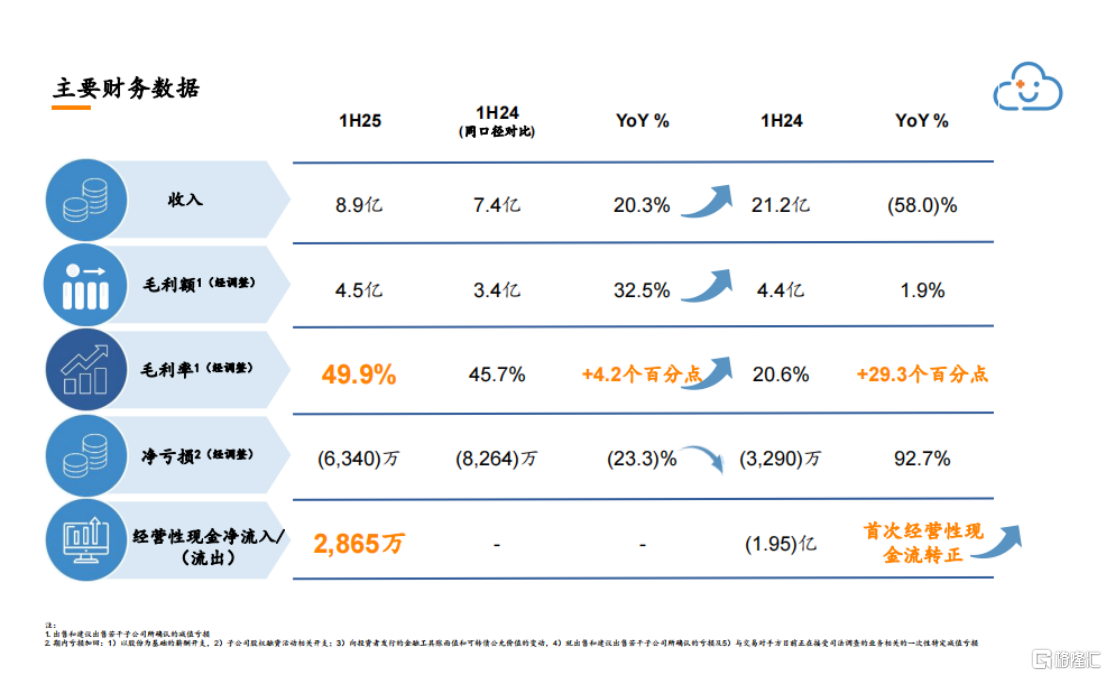
Core Viewpoint - The AI healthcare sector is gaining significant market attention, surpassing the previously popular innovative drug sector, driven by institutional fund reallocations towards AI medical stocks as they show potential for growth and recovery [1][2]. Financial Performance - Zhiyun Health reported a substantial improvement in profitability in its mid-2025 financial report, with a revenue of 889 million yuan, reflecting a year-on-year increase of 20.3% when adjusted for comparable periods [5][6]. - The adjusted gross margin reached 49.9%, up 4.2 percentage points year-on-year, indicating a significant enhancement in the company's core business profitability [5][6]. - The company achieved its first positive operating cash flow of 28.65 million yuan, marking a shift towards a positive operational cycle [8]. Strategic Transformation - Zhiyun Health's strategic shift towards AI-enabled high-value sectors is showing results, with a focus on subscription solutions and P2M (Patient to Industry) solutions, which now account for 77.5% of gross profit [6][9]. - The company has successfully implemented a dual-architecture strategy centered on "AI SaaS + P2M," enhancing operational efficiency across various healthcare scenarios [9][12]. Market Position and Growth Potential - The company has established a strong presence in both hospital and pharmacy sectors, with its SaaS solutions covering 2,774 hospitals and nearly 27,000 pharmacies, translating to significant service volume and market leadership [12][13]. - The P2M solution revenue reached 260 million yuan, a year-on-year increase of 142.1%, driven by the growth of proprietary products and strategic partnerships with pharmaceutical companies [13][25]. Industry Trends and Policy Support - The AI healthcare sector is experiencing a favorable policy environment, with recent government initiatives promoting the integration of AI in healthcare, which aligns with Zhiyun Health's strategic focus [21][22]. - The demand for AI in clinical settings is increasing, with nearly half of doctors in primary and secondary hospitals having used AI clinical decision support systems, indicating a shift towards AI as a necessary tool in healthcare [23][25]. Long-term Vision - Zhiyun Health aims to leverage its accumulated healthcare data for monetization, creating a comprehensive ecosystem that connects all stakeholders in the healthcare process, thus enhancing its long-term growth potential [25][26].

政策红利引爆医疗AI革命:一脉阳光(02522)领航AI迈入“基座大模型”2.0时代
智通财经网· 2025-08-27 01:07
Group 1 - The Chinese AI healthcare sector is experiencing a "dual wave of policy and technology" this summer, with the State Council's recent release of the "Opinions on Deepening the Implementation of 'Artificial Intelligence +'" which elevates AI in healthcare to a national strategic level [1] - The goal set by the Opinions is to achieve an AI-assisted diagnosis coverage rate of over 70% in grassroots medical institutions by 2027, marking a significant step towards the large-scale and standardized application of AI technology in healthcare [1] Group 2 - Under the influence of favorable policies, industry technological breakthroughs are reaching critical milestones, exemplified by the announcement from Yilai Sunshine (02522), which plans to launch the world's first AI-assisted diagnostic product for chest CT scans based on a medical imaging foundation model by October 2025 [2] - This product signifies a transition from the 1.0 era of AI in medical imaging, which relied on "single disease small models," to the 2.0 era driven by "foundation large models," filling a gap in the global medical imaging AI field [2] Group 3 - Yilai Sunshine's strategy includes deep collaborations with partners like Huawei and iFlytek in areas such as grassroots healthcare and AI diagnostics, aiming to promote the industrialization of medical AI [3] - The company is evolving from a traditional imaging service provider to an AI medical platform with capabilities across "data—algorithm—scene," leveraging its data advantages and breakthroughs in foundation models to enhance R&D efficiency and reduce costs [3] Group 4 - From an investment perspective, Yilai Sunshine's first-mover advantage is rapidly converting into commercial value, with expectations of AI products being included in the medical insurance payment system, opening up market opportunities across B-end (medical institutions), G-end (government public health projects), and C-end (health management) [4] - The company is positioned at a golden intersection of "technological breakthroughs—policy support—market expansion," with the anticipated launch of AI products in October 2025 likely to lead to significant growth in both performance and valuation [4]
旗下AI医生日接诊400万人次,港股百亿龙头近一月涨幅翻倍
Xuan Gu Bao· 2025-08-26 23:35
Group 1 - Ping An Good Doctor's stock surged by 6.99% on August 26, with its price doubling in the past month [1] - The company reported a "7+N+1" AI medical product system, achieving an AI-assisted consultation accuracy rate of approximately 98% and a complex disease MDT treatment plan accuracy rate of nearly 80% [1] - AI-assisted daily consultations can handle up to 4 million cases, and the average service cost for family doctors has decreased by about 52% year-on-year [1] Group 2 - The application of AI in healthcare is driven by population aging and a shortage of healthcare professionals, helping to alleviate the supply-demand imbalance in medical resources [2] - AI technology enhances the efficiency of the healthcare system, reduces the workload of medical staff, and accelerates drug and vaccine development [2] - Companies involved in AI+ healthcare include Jiahe Meikang, Weining Health, Kaile Co., Run Da Medical, Guo Xin Health, and Jiuyuan Yinhai [2] Group 3 - The AI healthcare market in China is projected to reach 115.7 billion yuan by 2025 and 159.8 billion yuan by 2028, with a compound annual growth rate of 10.5% from 2022 to 2028 [1]
中国平安上半年归母营运利润为777.32亿元 同比增长 3.7% 每股派0.95元
Zhi Tong Cai Jing· 2025-08-26 10:25
Core Viewpoint - China Ping An (601318) reported a solid performance in the first half of 2025, with significant growth in various business segments, particularly in life and health insurance, showcasing its innovative service models and strong customer retention strategies [1][4][5]. Financial Performance - The company achieved operating revenue of 546.469 billion yuan, with operating profit attributable to shareholders at 77.732 billion yuan, a year-on-year increase of 3.7% [1]. - Net profit attributable to shareholders reached 68.047 billion yuan, with basic earnings per share at 3.87 yuan and an interim cash dividend of 0.95 yuan per share [1]. Service Model Innovation - Ping An introduced the "Tian Ping An" insurance and service solution, which includes home-based elderly care services, combining pension benefits with a three-in-one service model of "smart housekeeper, life housekeeper, and doctor housekeeper" [2]. - The company upgraded its global emergency rescue service, covering 233 countries and regions, with the ability to dispatch medical aircraft within 48 hours for urgent medical needs [2]. Customer Management and Retention - As of June 2025, the company had nearly 247 million individual customers, a 4.6% increase from June 2024, with an average of 2.94 contracts per customer [3]. - The retention rate for long-term customers (5 years and above) was 73.8%, and the overall customer retention rate stood at 94.6% [3]. Business Segment Performance - The new business value for life and health insurance reached 22.335 billion yuan, a significant increase of 39.8% year-on-year, with high policy continuation rates [4]. - Property insurance premium income was 171.857 billion yuan, up 7.1%, with a comprehensive cost ratio of 95.2%, showing improvement [5]. Healthcare and Elderly Care Strategy - The company integrated its insurance and healthcare services, with nearly 63% of its individual customers enjoying benefits from its healthcare and elderly care ecosystem [6]. - Health insurance premium income was close to 87 billion yuan, with medical insurance premium income exceeding 41 billion yuan, reflecting a 3.3% year-on-year growth [6]. AI and Technology Integration - Ping An has developed a leading AI capability, utilizing a vast database of 30 trillion bytes of data, enhancing service efficiency and customer experience [8]. - The company reported 8.18 billion calls to its AI models in the first half of 2025, with over 650 application scenarios [8][9].

AI 医疗板块8月26日跌0.01%,贝瑞基因领跌,主力资金净流出7.07亿元
Sou Hu Cai Jing· 2025-08-26 09:20
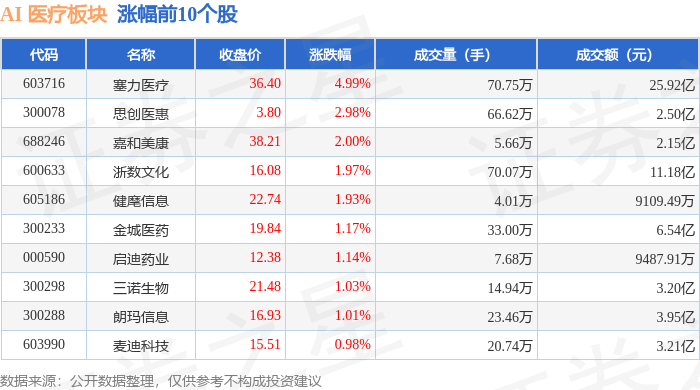
Market Overview - On August 26, the AI medical sector experienced a slight decline of 0.01%, with Bei Rui Gene leading the losses [1] - The Shanghai Composite Index closed at 3868.38, down 0.39%, while the Shenzhen Component Index closed at 12473.17, up 0.26% [1] Stock Performance - Notable gainers in the AI medical sector included: - Saily Medical (603716) with a closing price of 36.40, up 4.99% and a trading volume of 707,500 shares, totaling 2.592 billion yuan [1] - Sichuang Medical (300078) closed at 3.80, up 2.98% with a trading volume of 666,200 shares, totaling 250 million yuan [1] - Jiahe Meikang (688246) closed at 38.21, up 2.00% with a trading volume of 56,600 shares, totaling 215 million yuan [1] - Major decliners included: - Bei Rui Gene (000710) closed at 15.94, down 4.03% with a trading volume of 609,700 shares, totaling 977 million yuan [2] - Yao Shi Technology (300725) closed at 45.18, down 3.91% with a trading volume of 165,300 shares, totaling 756 million yuan [2] - Anbiping (688393) closed at 31.66, down 3.21% with a trading volume of 40,200 shares, totaling 129 million yuan [2] Capital Flow - The AI medical sector saw a net outflow of 707 million yuan from institutional investors, while retail investors experienced a net inflow of 697 million yuan [2] - The table of capital flow indicates that: - Wei Ning Health (300253) had a net inflow of 75.39 million yuan from institutional investors [3] - Zhejiang Data Culture (600633) had a net inflow of 67.70 million yuan from institutional investors [3] - Huada Gene (300676) had a net inflow of 23.14 million yuan from institutional investors [3]