上市公司易主

Search documents
廉价的易主,埋了多少雷?
财联社· 2025-12-29 14:12
Core Viewpoint - The article discusses the surge in A-share listed companies undergoing ownership changes, highlighting the low barriers to entry for acquiring control through mechanisms like voting rights delegation and abandonment, which can lead to significant risks and governance issues [1][2][4]. Group 1: Ownership Change Trends - Over 300 listed companies have changed ownership this year, with a notable increase in cases involving voting rights delegation, which has more than doubled compared to the previous year [2]. - The lowest price for acquiring control of a listed company this year was under 100 million yuan, exemplified by cases like Bangjie Co., which saw a 5.14% stake sold for approximately 96.56 million yuan [4][5]. - Approximately 80 cases of ownership changes involving voting rights delegation have been recorded, with nearly 30 companies experiencing "control inversion," where the new controlling party holds a lower percentage of shares than the voting rights they control [2][5]. Group 2: Regulatory Environment - The regulatory stance is shifting, with new rules set to take effect on January 5, 2024, prohibiting shareholders from delegating voting rights to others, aiming to close loopholes that allow evasion of shareholder obligations [2][5]. - The upcoming regulations are expected to address the misuse of voting rights delegation, which has been a common practice in recent ownership changes [2][5]. Group 3: Risks of Control Inversion - Control inversion poses multiple risks, as new controlling parties often lack the necessary financial or operational strength to support the companies, leading to deteriorating business conditions and governance issues [2][4]. - Historical data indicates that companies with control inversion frequently experience rapid declines in stock prices following speculative trading [2][4]. Group 4: Legal and Governance Issues - The legal framework surrounding voting rights delegation is contentious, with arguments suggesting that such practices effectively amount to voting rights transfer, which is not compliant with existing laws [9][10]. - The separation of voting rights and financial rights can lead to agency costs, where decisions made by the new controlling party may not align with the overall interests of the company, potentially resulting in disputes among shareholders [11][12]. Group 5: Market Manipulation Concerns - There is a significant concern regarding market manipulation, as approximately 40% of ownership change cases involving voting rights delegation have shown abnormal stock price increases prior to announcements [17][20]. - The use of leverage in ownership changes, including both equity and debt financing, raises questions about the sustainability of such transactions and the potential for inflated stock valuations [21][22]. Group 6: Historical Context and Future Outlook - Previous ownership change waves have led to numerous companies facing severe financial distress or even delisting, highlighting the risks associated with low-cost ownership changes [22][23]. - The ongoing regulatory reforms aim to stabilize the market and improve corporate governance, suggesting a shift towards more sustainable ownership practices in the future [24][25].


侃股:易主利于上市公司价值再发现
Bei Jing Shang Bao· 2025-12-11 12:27
Group 1 - The core viewpoint is that the change of control in listed companies, such as Rhein Biotech (002166), reflects a process of survival of the fittest, where new potential owners can rejuvenate the company and enhance its value [1][3] - The process of control change provides an opportunity for companies facing operational difficulties, such as poor management or strategic errors, to potentially avoid market elimination and risk of delisting [1][3] - New controlling shareholders, especially industry leaders, can inject vitality into the company by leveraging their resources, experience, and strategic vision, thus promoting transformation and upgrading [1][2] Group 2 - Industry leaders can significantly enhance the value of a listed company through their strong advantages in technology, brand, and distribution channels, leading to improved production efficiency and cost reduction [1][2] - The involvement of industrial capital supports the restructuring of a company's value by formulating reasonable development strategies based on industry trends and needs, facilitating supply chain integration and enhancing market control [2] - Private equity funds also play a crucial role by employing flexible investment strategies and professional teams to uncover undervalued assets and potential companies, thereby enhancing the company's market value through capital operations and reforms [2]
陈运拿下华锋股份意欲何为
Bei Jing Shang Bao· 2025-11-24 15:52
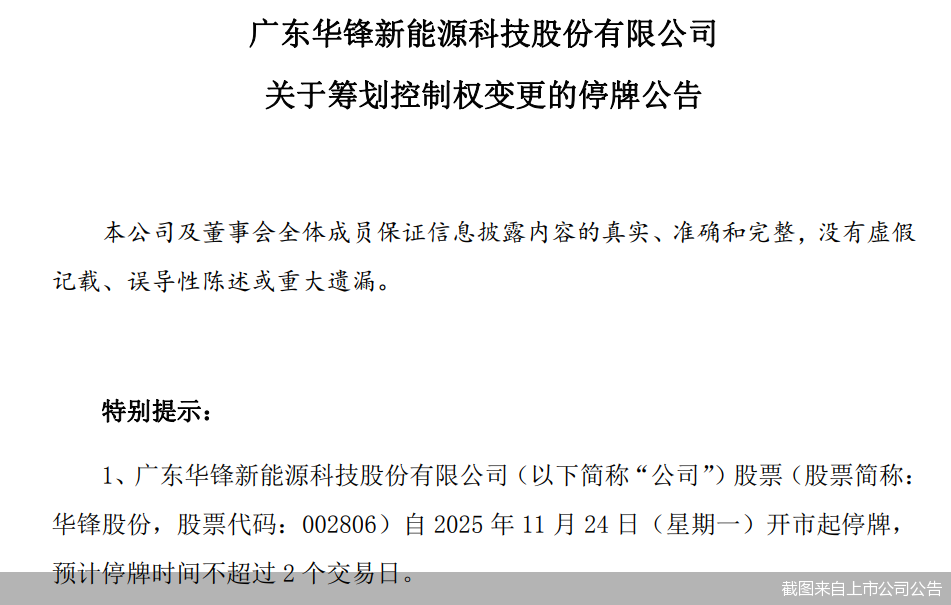
Core Viewpoint - The controlling shareholder and chairman of Huafeng Co., Tan Guoying, has decided to relinquish control of the company after over 20 years, with Chen Yun set to acquire control, amid Huafeng's declining financial performance [1][2]. Group 1: Ownership Change - On November 22, Tan Guoying signed a share transfer intention agreement with Chen Yun, who plans to acquire Tan's shares either in a lump sum or in installments, along with voting rights [2][3]. - As of the announcement date, Tan Guoying holds approximately 42.8 million shares, representing 20.14% of Huafeng's total share capital [3]. Group 2: Financial Performance - Huafeng's financial performance has been poor, with net profits showing consecutive losses from 2022 to 2024, and the company reported a net loss of approximately 9.93 million in the first three quarters of this year [5]. - Revenue figures for Huafeng from 2022 to 2024 are approximately 658 million, 719 million, and 1.031 billion respectively, with corresponding net profits of -9.61 million, -324 million, and 85.48 million [5]. Group 3: Business Background of Chen Yun - Chen Yun is not a newcomer to the capital market, having co-founded two listed companies, Helitai and Sanlipu, and currently controls Shengbaolai Optoelectronics Technology Co., which focuses on various optical products [3][4]. - Shengbaolai, founded in 2010, has a registered capital of 64 million and is involved in the production and sales of automotive films, optical films, and other related products [4]. Group 4: Market Reactions and Future Considerations - The market is concerned about whether Huafeng's business will shift towards the polarizer sector, given Chen Yun's background, which differs from Huafeng's current focus on electric control and drive systems for new energy vehicles [6]. - Prior to the suspension of trading, Huafeng's stock price fell by 4.13% to 13.22 yuan per share, with a total market capitalization of approximately 2.809 billion [7].

陈运出手!欲拿下华锋股份,意欲何为
Bei Jing Shang Bao· 2025-11-24 11:43
Core Viewpoint - The controlling shareholder and chairman of Huafeng Co., Ltd. (002806), Tan Guoying, has decided to relinquish control of the company after over 20 years, with Chen Yun set to acquire control. This change comes amid Huafeng's poor financial performance, with consecutive losses projected from 2022 to 2024 [1][7]. Group 1: Ownership Change - On November 24, Huafeng announced that it received a notification from Tan Guoying regarding the signing of a share transfer intention agreement with Chen Yun on November 22 [4]. - Chen Yun or a third party controlled by him intends to acquire Tan Guoying's shares either in a lump sum or in installments, along with voting rights, to gain control of the company [4][5]. - As of the announcement date, Tan Guoying held approximately 42.8 million shares, accounting for 20.14% of the total share capital of Huafeng [5]. Group 2: Chen Yun's Background - Chen Yun is not a stranger to the capital market, having co-founded two listed companies, Helitai and Sanlipu, and has significant experience in the industry [6]. - His main asset is Shengbaolai Optoelectronics Technology Co., Ltd., which he founded and currently leads, focusing on various optical film products [6]. - Chen Yun's previous companies have been involved in sectors such as consumer electronics and smart home solutions, indicating a diverse background [6]. Group 3: Financial Performance - Huafeng has shown significant financial volatility, with projected net losses from 2022 to 2024, including a net profit of approximately -96.06 million yuan in 2022 and -324 million yuan in 2023 [7]. - In the first three quarters of 2025, Huafeng reported revenue of approximately 862 million yuan, an 18.75% year-on-year increase, but a net loss of about -9.93 million yuan, indicating a shift to losses [8]. - The company attributed revenue growth primarily to its electric vehicle business, which saw a 60% increase, while declining sales prices and lower gross margins contributed to the net profit decrease [8]. Group 4: Market Reaction - Prior to the suspension of trading, Huafeng's stock price fell by 4.13% to 13.22 yuan per share, with a total market capitalization of approximately 2.809 billion yuan [9].
毛毯龙头真爱美家筹划易主
Bei Jing Shang Bao· 2025-11-05 16:19
Core Viewpoint - Zheng Qizhong, the controlling shareholder of Zhenai Meijia, plans to transfer control of the company after nearly five years since its IPO, leading to a suspension of trading starting November 5 [1][2]. Group 1: Company Control and Management - Zhenai Meijia's controlling shareholder, Zhenai Group, is in discussions to transfer control, which may result in a change of the actual controller [2][3]. - Zheng Qizhong has been the chairman of Zhenai Meijia since its establishment in 2010 and has held various leadership roles in Zhenai Group since 2003 [2][3]. - The potential change in control is seen as a strategic move to bring in a new shareholder with better foresight and resource integration capabilities [2][3]. Group 2: Financial Performance - Zhenai Meijia has experienced a decline in net profit for two consecutive years, with revenues of approximately 979 million, 953 million, and 879 million yuan from 2022 to 2024, and corresponding net profits of about 155 million, 106 million, and 75.8 million yuan [3]. - However, in the first three quarters of this year, the company reported a revenue of 724 million yuan, a year-on-year increase of 16.16%, and a net profit of approximately 230 million yuan, a significant year-on-year increase of 310.28% [3]. - The company’s major products include blankets, carpets, and bedding, with a focus on home textile development and sales [2][3]. Group 3: Related Companies - Zheng Qizhong is also the actual controller of Huading Co., which he acquired in 2022, further diversifying his business interests [5][6]. - Huading Co. has faced its own challenges, with a revenue drop of 40.57% and a net profit decline of 42.11% in the first three quarters of 2025 [6]. - The financial struggles of Huading Co. are attributed to cyclical fluctuations in the nylon industry, affecting raw material costs and sales prices [6].
真爱美家筹划易主,郑期中资本版图将缺失一角
Bei Jing Shang Bao· 2025-11-05 11:28
Core Viewpoint - Zheng Qizhong intends to relinquish control of Zhenai Meijia after nearly five years since its IPO, with the company announcing a suspension of trading due to the planned transfer of control [1][3]. Group 1: Control Change Announcement - Zhenai Meijia announced on November 4 that its controlling shareholder, Zhenai Group, is planning to transfer control, leading to a suspension of trading starting November 5 [3]. - The company indicated that the control transfer is still under negotiation and carries significant uncertainty [3]. Group 2: Financial Performance - Zhenai Meijia's net profit has declined for two consecutive years in 2023 and 2024, with projected revenues of approximately 979 million, 953 million, and 879 million yuan for 2022, 2023, and 2024 respectively, and corresponding net profits of about 155 million, 106 million, and 75.8 million yuan [4]. - However, in the first three quarters of this year, the company reported a revenue of 724 million yuan, a year-on-year increase of 16.16%, and a net profit of approximately 230 million yuan, a significant year-on-year increase of 310.28% [4]. Group 3: Related Shareholder Actions - In July, a significant shareholder, Yiwu Boxin Investment, planned to reduce its stake in Zhenai Meijia by up to 4.32 million shares, representing no more than 3% of the total share capital, but did not execute this plan by the deadline [5]. Group 4: Background on Zheng Qizhong - Zheng Qizhong, born in 1964, has been the chairman of Zhenai Meijia since its establishment and has also been involved with another listed company, Huading Co., which he controls after acquiring its shares in 2022 [4][7]. Group 5: Huading Co. Performance - Huading Co. has also faced declining performance, with revenues of approximately 3.562 billion yuan in the first three quarters of 2025, a year-on-year decrease of 40.57%, and a net profit of about 188 million yuan, down 42.11% [9]. - The decline in Huading's performance is attributed to cyclical fluctuations in the nylon industry, affecting both procurement and sales prices [9].


侃股:易主是上市公司优化的重要途径
Bei Jing Shang Bao· 2025-10-26 11:24
Core Viewpoint - Recent changes in ownership among A-share listed companies indicate a significant trend where new controlling shareholders can enhance investment value through fresh management ideas and quality asset injection [1][2]. Group 1: Impact of Ownership Change - Ownership change provides a potential rebirth for listed companies, allowing stronger and more resourceful buyers to inject new vitality and drive a resurgence [1]. - New controlling shareholders often bring innovative management philosophies and quality assets, improving the asset quality and overall value of the listed companies [1][2]. - State-owned enterprises (SOEs) as buyers offer substantial financial strength, policy support, and social resources, which can stabilize funding and enhance market presence for the acquired companies [2]. Group 2: Advantages of Different Buyers - Industrial capital, with its deep industry knowledge, can provide precise strategic positioning and effective business expansion for listed companies [1][2]. - Individual buyers with rich business experience can introduce innovative thinking and flexible decision-making, potentially uncovering hidden value within the companies [2]. - Investors generally view ownership changes positively, anticipating a series of beneficial transformations that could lead to new profit growth points for the companies [2]. Group 3: Market Reactions and Expectations - Ownership changes are seen as crucial opportunities for stock price recovery, providing new development prospects and vitality for companies [2]. - However, not all ownership changes meet market expectations; if new shareholders fail to take effective actions, the investment value of the company may not improve [3].
澳洋健康拟5.93亿易主张家港国资 沈学如五年脱手两A股公司将套现14亿
Chang Jiang Shang Bao· 2025-09-16 23:20
Core Viewpoint - The article discusses the planned exit of Shen Xue Ru from the control of A-share listed company Aoyang Health, with a transfer of 20% of shares to a state-owned entity, marking a significant change in the company's ownership structure [1][2]. Group 1: Ownership Change - Aoyang Health's controlling shareholder, Aoyang Group, plans to transfer 20% of its shares to Zhangjiagang Yuesheng Technology Partnership for approximately 593 million yuan, resulting in Yuesheng Technology becoming the new controlling shareholder [1][4]. - Following the transaction, the actual controller of Aoyang Health will shift from Shen Xue Ru to the Zhangjiagang Economic and Technological Development Zone Management Committee [1][4]. Group 2: Financial Performance - Aoyang Health reported a revenue of 903 million yuan in the first half of 2025, a year-on-year decrease of 12.49%, and a net profit of 31.56 million yuan, down 15.46% [2][10]. - As of June 30, 2025, Aoyang Health's total assets amounted to 1.968 billion yuan, with a high debt ratio of 92.58% [2][11]. Group 3: Historical Context - This marks Shen Xue Ru's second exit from an A-share listed company, following the sale of Aoyang Shunchang (now known as "Weilan Lithium") in 2020 [2][5]. - Aoyang Health has undergone a transformation from a chemical fiber business to a focus on the health industry since 2015, but has faced challenges due to losses in its traditional business [9][10]. Group 4: Performance Commitments - Aoyang Group and Shen Xue Ru have made performance commitments for Aoyang Health, ensuring that net profits will not be less than 30 million yuan annually from 2025 to 2027 [11]. - If these targets are not met, Aoyang Group and Shen Xue Ru will compensate Yuesheng Technology with 60 million yuan [11].

筹划仅一周 永和智控三度易主告败
Bei Jing Shang Bao· 2025-08-13 16:33
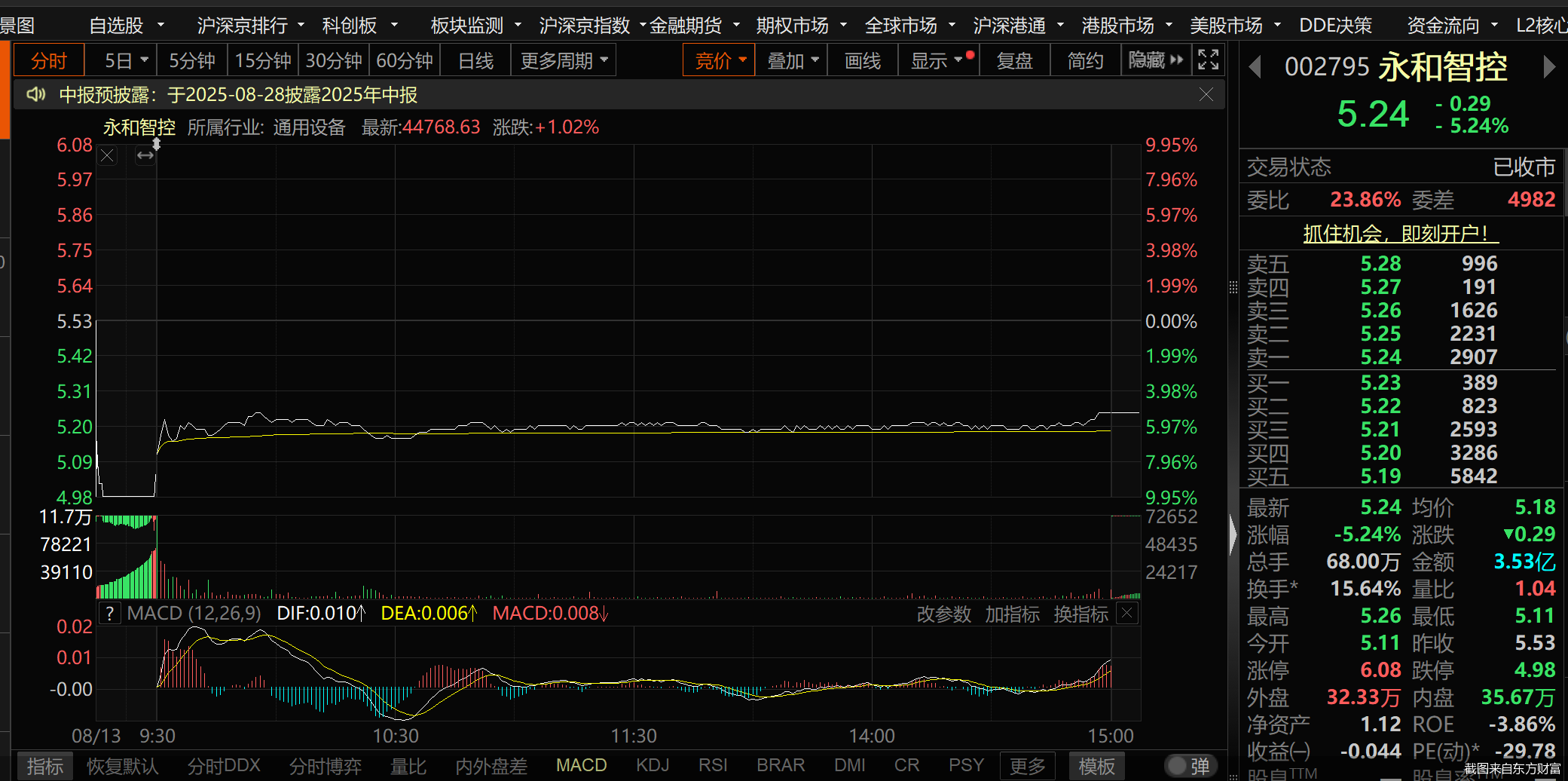
Core Viewpoint - The control change of Yonghe Intelligent Control (002795) has been terminated due to the acquirer's failure to pay the initial share transfer payment, leading to a significant drop in the company's stock price [1][2]. Group 1: Control Change Termination - Yonghe Intelligent Control's stock price fell over 7% during intraday trading on August 13, ultimately closing down 5.24% at 5.24 yuan per share, with a total market capitalization of approximately 2.336 billion yuan [1]. - The termination of the control change was announced on August 12, stating that the acquirer, Hangzhou Runfeng, failed to pay the initial transfer payment of approximately 20.0015 million yuan by the agreed deadline [2]. - This marks the third failed attempt by the actual controller, Cao Delin, to change control since he took over in 2019, with previous attempts in 2022 and 2023 also failing [3]. Group 2: Financial Performance - Yonghe Intelligent Control has reported continuous net losses for three consecutive years, with net profits of approximately -26.1867 million yuan in 2022, -155.6 million yuan in 2023, and -297 million yuan in 2024 [3]. - The company’s revenue for the years 2022 to 2024 was approximately 990 million yuan, 948 million yuan, and 823 million yuan, respectively [3]. - The company expects a net loss of between 56 million yuan and 30 million yuan for the first half of 2025, indicating a reduction in losses compared to the same period last year, but still not achieving profitability [4]. Group 3: Business Operations - Yonghe Intelligent Control operates primarily in the production and management of household water heating valves and fittings, while also focusing on the emerging industry of precise radiation treatment for tumors [3]. - The decline in net profit is attributed to reduced revenue from the valve and fitting business, decreased product gross margins, and high depreciation and labor costs [4]. - The company aims to establish a stable and high-quality industrial development model, focusing on its core business areas to achieve profitability in the future [4].

永和智控三度易主告败,曹德莅退出难
Bei Jing Shang Bao· 2025-08-13 11:01
Core Viewpoint - The control change of Yonghe Intelligent Control (002795) has been terminated due to the acquirer's failure to pay the initial share transfer payment, leading to a significant drop in the company's stock price [1][3]. Group 1: Control Change Termination - On August 12, Yonghe Intelligent Control announced the termination of the control change due to the acquirer's failure to pay approximately 20.01 million yuan for the initial share transfer [3][4]. - The proposed transfer involved selling 8% of the company's shares at a price of 8.9736 yuan per share, totaling around 320 million yuan [3][4]. - This marks the third failed attempt by the actual controller, Cao De Li, to change control since he took over in 2019 [4]. Group 2: Stock Price Reaction - Following the announcement, Yonghe Intelligent Control's stock opened down 7.59% and closed at 5.24 yuan per share, with a total market capitalization of approximately 2.336 billion yuan [3][4]. - The stock price decline reflects investor concerns regarding the company's future prospects after the failed control change [4]. Group 3: Financial Performance - Yonghe Intelligent Control has reported net losses for three consecutive years, with net profits of approximately -26.19 million yuan in 2022, -156 million yuan in 2023, and -297 million yuan in 2024 [6][7]. - The company’s revenue has also declined, with figures of approximately 990 million yuan in 2022, 948 million yuan in 2023, and 823 million yuan in 2024 [7]. - The company expects a net loss of between -56 million yuan and -30 million yuan for the first half of 2025, indicating ongoing financial challenges [7][8]. Group 4: Business Strategy - Yonghe Intelligent Control aims to establish a dual business model focusing on "water heating valve and fitting business" and "precision radiation treatment for tumors" to achieve sustainable and high-quality development [8].