
床上用品

Search documents
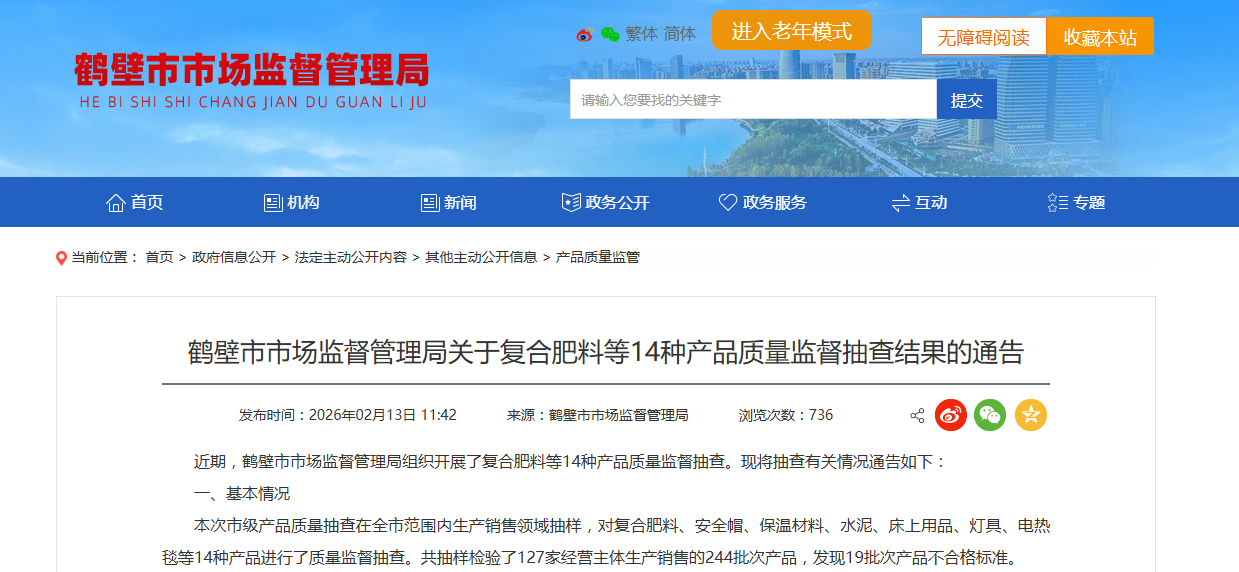
河南省 鹤壁市市场监督管理局发布复合肥料等14种产品质量监督抽查结果
Zhong Guo Zhi Liang Xin Wen Wang· 2026-02-24 08:03
Core Viewpoint - The quality supervision inspection conducted by the Hebi Market Supervision Administration revealed that out of 244 batches of 14 types of products, 19 batches were found to be non-compliant with standards, highlighting concerns regarding product quality in the region [1][2]. Group 1: Inspection Results - A total of 127 business entities were sampled, and 225 batches of products met the required standards, including safety helmets, cement, and electric bicycle batteries [1]. - The non-compliant products included composite fertilizers, insulation materials, and bedding products, indicating specific areas of quality concern [1]. Group 2: Regulatory Actions - The Hebi Market Supervision Administration has mandated local market regulatory departments to take strict legal actions against the identified issues, ensuring compliance with relevant laws and regulations [2]. Group 3: Consumer Guidance - Consumers are advised to purchase products from reputable and licensed physical stores or well-known e-commerce platforms to avoid substandard products [3]. - It is recommended that consumers check for complete product labeling, including manufacturer information and safety certifications, before making a purchase [4]. - Retaining purchase receipts is crucial for consumers to report any quality issues to market regulatory authorities [4].

《毛巾帝国》出圈背后,对话洁丽雅总裁石晶:流量是工具,不是解药 | 财之道
Xin Lang Cai Jing· 2026-02-09 08:38
Core Viewpoint - The company, Jieliya, is undergoing a transformation to rejuvenate its brand and appeal to younger consumers through innovative marketing strategies, including content marketing and product diversification, rather than relying on traditional celebrity endorsements [2][20]. Group 1: Brand Rejuvenation Strategy - Jieliya's president, Shi Jing, emphasizes the need for brand visibility and consumer awareness, stating that exposure is essential for survival in a competitive market [21][22]. - The company has faced challenges such as brand aging and channel rigidity, prompting a strategic shift towards a younger demographic [22][23]. - The success of the micro-drama "Towel Empire" has significantly contributed to the brand's visibility and youthfulness, marking a new direction for Jieliya [23][25]. Group 2: Marketing Philosophy - Shi Jing maintains a rational approach to current marketing trends, avoiding blind investments in popular strategies like influencer marketing, and focusing instead on initiatives that align with the brand's strategic goals [21][22]. - The company aims to create a brand that embodies a Chinese lifestyle, leveraging Xinjiang cotton and cultural elements as core components of its identity [30]. Group 3: Long-term Vision and Investment - Jieliya's long-term goal is to establish itself as a century-old brand, with a focus on product quality and supply chain efficiency, which requires substantial capital investment [27][29]. - The company is willing to accept short-term losses for strategic investments that are expected to yield future value, indicating a commitment to long-term growth over immediate financial returns [29][30]. Group 4: Generational Transition and Leadership - The leadership transition at Jieliya involves balancing traditional business practices with modern innovations, ensuring that decisions are suitable for the current market environment [32][34]. - Shi Jing advocates for a "middle way" approach in decision-making, emphasizing the importance of adaptability and continuous improvement in the company's strategies [33][34].

平价家具零售商Bob‘s Discount Furniture(BOBS.US)纽交所IPO以下限17美元定价,募资3.31亿美元今夜挂牌
Zhi Tong Cai Jing· 2026-02-05 07:48
Group 1 - Bob's Discount Furniture has priced its IPO at $17 per share, issuing 19.45 million shares, raising approximately $331 million, with a market capitalization of $1.3 billion [1] - The IPO is underwritten by major investment banks including JPMorgan, Morgan Stanley, and UBS, and is expected to debut on the New York Stock Exchange on February 5, 2026, under the ticker symbol BOBS [1] - The net proceeds from the IPO will primarily be used to repay approximately $350 million in term loan debt, which originated from a dividend recapitalization in October 2025 [1] Group 2 - As of September 28, 2025, Bob's Discount Furniture operates 206 showrooms across 26 states in the U.S., with a fiscal year 2025 revenue of $2.32 billion [2] - The company aims to double its store count to over 500 by 2035, supported by its "value pricing" model and omnichannel sales strategy [2] - In fiscal year 2024, 61% of the company's revenue came from the New England, New York, and Mid-Atlantic regions, with an average order value of approximately $1,400 [2] - Bob's Discount Furniture has 2.9 million active users, and 73% of showroom customers engaged in cross-channel interactions in fiscal year 2025 [2]
2025家用纺织品行业简析报告
MCR嘉世咨询· 2026-01-26 01:45
Investment Rating - The report indicates that the home textile industry is currently in a mature phase with a low market concentration, as evidenced by a CR5 of only 3.7% in 2024, suggesting potential for growth in market share among leading brands [30]. Core Insights - The market size of China's home textile industry is projected to reach 327.9 billion yuan in 2024, with bedding products accounting for approximately 72% of the market share [4][33]. - The industry is transitioning from a traditional channel-driven model to a dual-driven model focusing on products and brands, with profit sources shifting from scale effects to technological added value and brand premiums [4][20]. - The emergence of the sleep economy and technological innovation is driving new growth, with consumer decision-making shifting from aesthetic to experiential factors [4][39]. - Government policies, including "old-for-new" exchange and subsidies, are stimulating demand, particularly in online channels, with subsidies typically set at 15% of the sales price and a maximum of 2,000 yuan per product [18][19]. Summary by Sections Industry Definition - Home textiles encompass a consumer-oriented industry centered around textile products for living environments, including bedding, bath textiles, and living room textiles, with bedding being the core segment [5][8]. Market Structure - The home textile market is primarily composed of bedding (72%), living room textiles (14%), and bath textiles (9%) [7]. Industry History - The development of the home textile industry can be divided into three phases: 1. Growth driven by real estate and weddings (before 2015) 2. Market adjustment driven by daily replacements (2015-2024) 3. New growth driven by the sleep economy and technological innovation (2025 onwards) [11][13][15][17]. Policies - Recent government initiatives, including consumption subsidies and "old-for-new" policies, have significantly stimulated demand, especially in online channels [18]. Business Model - The core business logic of the home textile industry involves R&D and supply chain integration to produce textile products that meet consumer needs, transitioning from traditional channel-driven to a dual focus on product and brand [20]. Industry Chain Analysis - The industry chain includes upstream raw material supply, midstream product design and manufacturing, and downstream sales channels, with midstream being the core value-creating segment [23]. Upstream Analysis - Raw material prices are volatile, significantly impacting production costs, with materials accounting for over 80% of total costs for companies like Fuanna [26][27]. Downstream Analysis - The home textile industry is expected to maintain a stable growth rate of approximately 1.5% from 2025 to 2029, with online sales channels accounting for 34.4% of the market [33][36]. Future Prospects - The report highlights opportunities in health-functional textiles, the aging population market, and the benefits of cross-border e-commerce, which can enhance market reach [44][45][46].
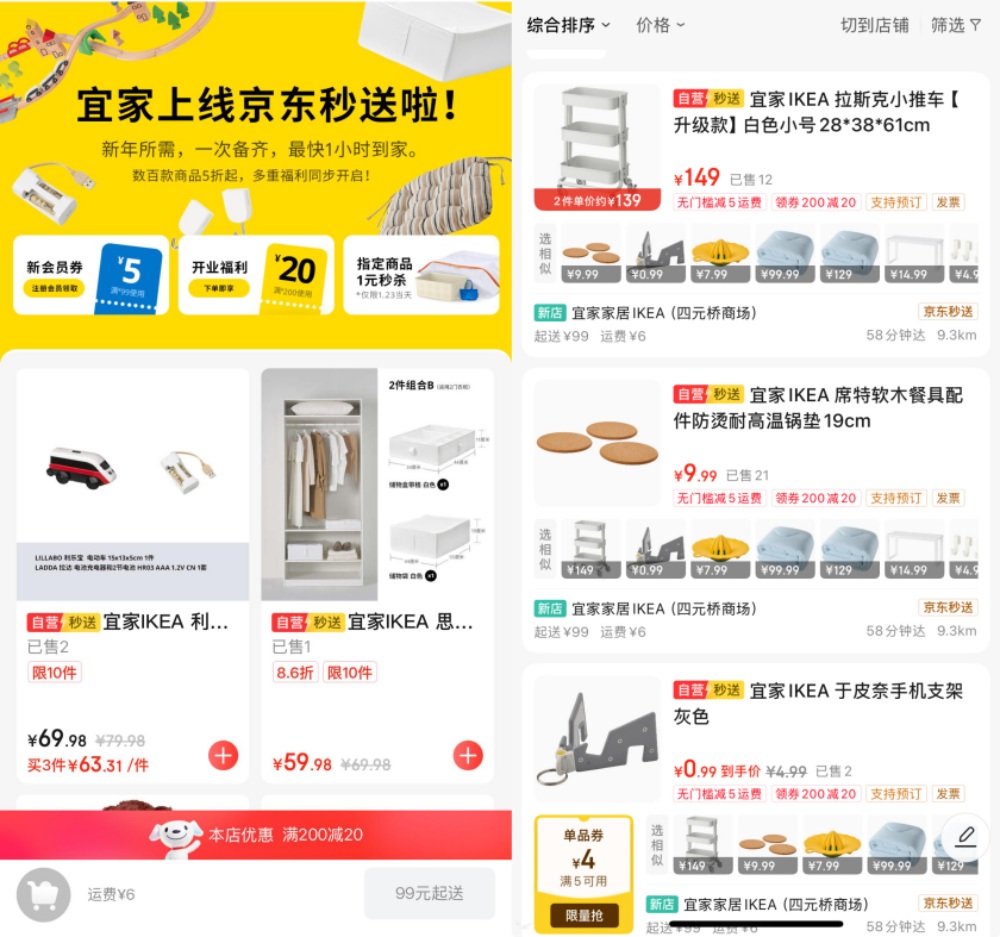
宜家首次支持即时零售:上线京东秒送,限时4公里内满99免运费
Xin Lang Cai Jing· 2026-01-23 04:26
Core Insights - IKEA has launched an instant retail service on JD.com, marking its entry into the instant retail sector, covering 9 cities and 13 stores in China [1][4] - The service offers a range of lightweight home products, with promotional activities to attract customers [1][3] Group 1: Instant Retail Launch - IKEA's instant retail service is available in cities including Beijing, Guangzhou, and Shenzhen, allowing consumers to order through the JD app [1] - The service features promotional offers such as 1 yuan flash sales and discounts for new customers [1][3] - The operating hours for the instant retail stores are from 10:00 to 20:00, shorter than traditional store hours [3] Group 2: Product Offering and Pricing - The product range includes storage items, tableware, kitchenware, bedding, lighting, and furniture, focusing on lighter items [3][4] - A specific example includes a drawer cabinet priced at 349 yuan, which can be purchased for 335.5 yuan after discounts and fees [3] Group 3: Market Context and Strategy - IKEA is facing a store closure trend in China, with plans to close 7 stores by February 2026 [5] - The company aims to shift from expansion to focused growth, planning to open over ten small stores in key markets like Beijing and Shenzhen [5] - IKEA's sales in China for FY2024 are projected to be approximately 11.15 billion yuan, a decline of nearly 1 billion yuan from the previous fiscal year [5]

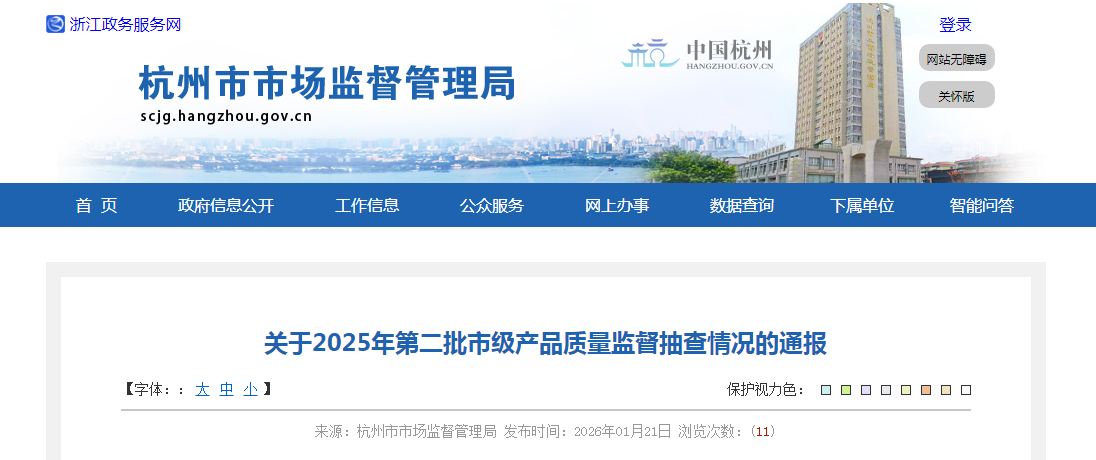
杭州市市场监督管理局通报2025年第二批市级产品质量监督抽查情况
Zhong Guo Zhi Liang Xin Wen Wang· 2026-01-22 06:42
Summary of Key Points Core Viewpoint - The product quality supervision work in Hangzhou for 2025 focuses on ensuring product safety and health for the public, with an emphasis on strengthening quality supervision and inspection efforts [2]. Group 1: Inspection Overview - The second batch of product quality supervision inspections includes 91 types of products such as electric bicycles, bedding, refrigerators, children's furniture, and more [2]. - A total of 1,455 batches were inspected, with 1,338 passing and 117 failing the quality standards [2]. - In the production sector, 209 batches were inspected, resulting in 8 failures, while in the circulation sector, 1,246 batches were inspected with 109 failures [2]. Group 2: Refusal to Inspect - No companies were found to have refused inspection during this year's quality supervision checks [2].
提升纤维制品质量监管效能
Jing Ji Ri Bao· 2026-01-14 03:04
Core Viewpoint - The recent revisions to the "Quality Supervision and Management Measures for Fiber Products" and the "General Technical Requirements for Filling Fiber Products" aim to enhance the quality and safety of fiber products in response to increasing consumer demands and the evolving market landscape [1][2]. Group 1: Regulatory Framework - The new regulations will take effect on July 1, 2026, focusing on key products such as infant fiber products, school uniforms, underwear, and filling fiber products [2]. - The regulations emphasize strict management of raw materials, particularly prohibiting the use of recycled fibers in infant and intimate apparel to eliminate safety risks [2]. - A rigorous inspection system will be implemented for school uniforms, ensuring that products are tested and approved before delivery [2]. Group 2: Quality Control Measures - The regulatory body will adopt a "zero tolerance" approach towards violations, establishing a closed-loop supervision system that includes prevention, management, risk control, and punishment for illegal activities [3]. - Enhanced quality monitoring and stricter standards will be enforced, with severe penalties for companies that violate regulations, especially those using banned materials [3]. - Companies found guilty of serious violations will be listed on a "serious violation and dishonesty list," leading to cross-departmental punitive measures [3]. Group 3: Lifecycle and Sustainability - The revised standards for filling fiber products will set clear technical guidelines and usage norms, promoting the recycling and high-value utilization of waste textiles [4]. - Products made from recycled materials must clearly indicate the use of such materials, fostering a transparent and trustworthy market environment [4]. - The rapid growth of e-commerce and new fiber materials presents challenges for quality supervision, prompting the need for integrated monitoring mechanisms across online and offline channels [4].
市场监管总局修订出台《纤维制品质量监督管理办法》
Zheng Quan Ri Bao Wang· 2026-01-13 11:09
Core Viewpoint - The National Market Supervision Administration emphasizes the importance of quality safety regulation in the fiber products industry to promote high-quality development of the circular economy [1][2] Group 1: Industry Overview - Fiber products are essential consumer goods in daily life, including textiles, clothing, bedding, and curtains, directly impacting public health and interests [1] - There is heightened social concern regarding the quality of products for children and adolescents, such as infant clothing and school uniforms [1] Group 2: Regulatory Developments - The National Market Supervision Administration has revised the "Quality Supervision and Management Measures for Fiber Products" and the mandatory national standard GB18383-2025, effective from July 1, 2026 [2] - The revised measures aim to establish a comprehensive and precise modern quality safety regulatory system for fiber products [2] Group 3: Key Focus Areas - The revised regulations focus on three main areas: comprehensive coverage for effective regulation, strict control at the source with traceability for safety assurance, and innovative regulation with rigid accountability for collaborative oversight [2]
什么是“监管棉”
Xin Lang Cai Jing· 2026-01-06 23:41
Group 1 - The core concept of "supervised cotton" is introduced, which is a type of cotton that is regulated by the state and must be stored in designated warehouses and undergo comprehensive inspections [3] - Supervised cotton provides benefits to cotton farmers by ensuring accurate subsidies and protecting them from exploitation [3] - For enterprises, supervised cotton allows for a single inspection to be valid throughout the supply chain, reducing logistics and time costs [3] Group 2 - The market benefits from supervised cotton as it helps eliminate counterfeit products, ensuring fairer transactions [3] - Supervised cotton also lowers credit risks for banks, facilitating easier financing for companies [3] - The application of supervised cotton is widespread, being used in everyday cotton clothing, bedding products, industrial textiles, and medical gauze [3]

今年前三季度韩国零售额四年来首次回升
Shang Wu Bu Wang Zhan· 2025-12-19 08:03
Group 1 - The core viewpoint of the article is that South Korea's retail sales have shown a positive trend for the first time in four years, with a cumulative growth rate of 1.9% in the first three quarters of this year [1] - The constant retail index, which reflects the actual retail level, recorded a cumulative growth rate of 0.4% in the third quarter, indicating an improvement compared to the weak performance in 2023 and 2024, although it remains below the pre-pandemic level of 2% [1] - The recovery in retail sales is largely attributed to strong sales of passenger cars, which showed the highest growth rates among 15 categories, with nominal and constant indices increasing by 12.9% and 14% respectively [1] Group 2 - In the third quarter, the growth rates for passenger cars reached 16% in both nominal and constant indices [1] - Other categories that experienced growth include pharmaceuticals at 9% and heating equipment at 6.4%, while categories such as home appliances (-6.3%), other semi-durable goods (-4.1%), and cosmetics (-3.8%) saw declines [1]