跨界整合

Search documents
这家公司连续六年亏损!口腔医疗“内卷”加剧,跨界整合遭遇“成长烦恼”
Hua Xia Shi Bao· 2026-02-15 10:12
Core Viewpoint - Haocen Medical Technology Co., Ltd. is expected to report a significant decline in revenue and increased losses for the fiscal year 2025, primarily due to intensified competition in the dental medical services sector and asset impairment provisions [2][4]. Financial Performance - The projected revenue for 2025 is between 650 million to 750 million yuan, representing a year-on-year decline of approximately 13% to 25% from 862 million yuan in the previous year [2][3]. - The net profit attributable to shareholders is expected to be a loss of 70 million to 140 million yuan, compared to a loss of 37.69 million yuan in the same period last year [2][3]. - The net profit after excluding non-recurring gains and losses is projected to be a loss of 65 million to 130 million yuan, compared to a loss of 23.88 million yuan in the previous year [2][3]. Reasons for Losses - The company attributes its performance decline to two main factors: pressure on the dental medical services business and asset impairment provisions [4]. - The dental medical services sector is facing increased competition, leading to higher customer acquisition costs and a significant drop in average transaction prices, which has severely impacted profitability [4]. - The company has conducted impairment tests on relevant assets, resulting in provisions for goodwill impairment and long-term equity investment impairment, which have negatively affected current profits [4]. Acquisition and Goodwill - The goodwill primarily stems from the acquisition of Guangdong Delun Medical Group, which was a strategic move to enter the dental medical services sector [5][6]. - The acquisition, completed in November 2021 for a total consideration of 246 million yuan for a 51% stake, aimed to create a dual business model of "dental medical services + industrial manufacturing" [5][6]. - However, Delun Medical has failed to meet its performance commitments for two consecutive years, triggering compensation obligations for the company [7]. Debt and Legal Issues - The company is facing significant debt risks, with a total debt amounting to approximately 181 million yuan, including principal and interest from a bank loan initiated in 2020 [14]. - Legal actions have been initiated by creditors, including a lawsuit to reverse the transfer of a controlling stake in Delun Medical, which has led to the freezing of key assets [15][16]. - The company has proposed various debt restructuring options to address its financial challenges [16]. Control Change - In November 2025, the company announced a significant change in control, moving away from the "Zhongzhi system" due to unresolved obligations, resulting in a lack of actual control [16]. - This change has raised concerns about strategic stability and decision-making efficiency, as the company now operates without a clear controlling entity [17].


棒杰股份预亏9-12亿 光伏业务导致“披星戴帽”危机 体检龙头尝试跨界“接盘”
Xin Lang Cai Jing· 2026-02-03 09:13
Group 1 - The core point of the news is that Bangjie Co., Ltd. is facing significant financial difficulties, with an expected net loss of 900 million to 1.2 billion yuan for 2025, which is a further deterioration from a loss of 672 million yuan in 2024 [1] - The company anticipates a negative net asset position of 900 million to 600 million yuan by the end of 2025, a sharp decline from a positive net asset of 299 million yuan at the end of 2024, potentially leading to a delisting risk warning [1] - The substantial losses are primarily attributed to the debt crisis and production halt of its core photovoltaic subsidiary, Yangzhou Bangjie, which continues to incur fixed costs despite the shutdown [1] Group 2 - To address the crisis, Bangjie Co., Ltd. is actively promoting the restructuring of its subsidiaries, with Meinian Health announcing its intention to participate in the pre-restructuring process and potentially become the controlling shareholder post-restructuring [2] - Meinian Health's financial performance is also under pressure, with a revenue of 6.925 billion yuan for the first three quarters of 2025, a decrease of 3.01% year-on-year, and a net profit of 52 million yuan, significantly lower than the 282 million yuan for the entire previous year [2] - There are uncertainties regarding Meinian Health's ability to leverage Bangjie Co., Ltd.'s resources effectively due to its lack of experience in the photovoltaic sector, which may pose challenges in the integration process [2]

跨界竞争,中国科技行业的一种新绝招
3 6 Ke· 2025-11-26 11:34
Core Insights - The recent price cuts by DJI and the subsequent reactions from competitors like影石 indicate a shift in the Chinese tech landscape, where companies are increasingly venturing into each other's domains rather than focusing solely on their core businesses [1][3] - This trend of cross-industry expansion is not new in China, but it has evolved from vertical integration to more horizontal breakthroughs, as companies seek new growth avenues amid intense competition [5][9] - The rise of AI, modular hardware, and cloud services has lowered the barriers for companies to enter new markets, prompting a wave of cross-industry initiatives [5][9] Industry Dynamics - Companies like影石, 追觅, and 极米 are now testing new waters, with影石 launching its影翎A1 drone, which emphasizes user experience over technical superiority [6][9] - OPPO's entry into the handheld imaging device market by 2026 is a strategic move leveraging its extensive experience in smartphone imaging technology [6][9] - The cross-industry movement is seen as a necessary response to the saturation of traditional markets, pushing companies to innovate and find new revenue streams [5][9] Cross-Industry Integration - Successful cross-industry ventures are characterized by the ability to transfer core technologies across different fields, creating synergies rather than merely competing for market share [19][20] - Companies like 追觅 and 安克 exemplify this approach, utilizing their core technologies in various applications, thus enhancing their resilience against market fluctuations [15][16] - The concept of "dynamic boundaries and modular alliances" is emerging in the Chinese manufacturing landscape, where companies collaborate and compete simultaneously, fostering innovation [25][26] Conclusion - Cross-industry integration is viewed as a strategic necessity for Chinese companies to thrive in a rapidly evolving market, emphasizing the importance of leveraging existing technologies for new applications [23][25] - The future of Chinese manufacturing may not replicate the model of American tech giants but will likely focus on collaborative innovation among multiple smaller players [25][26]

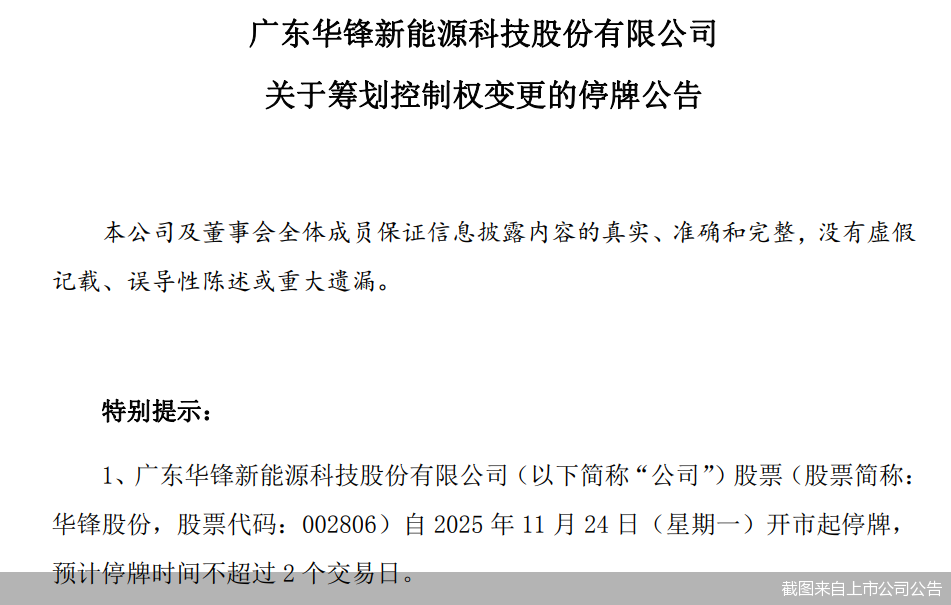
陈运拿下华锋股份意欲何为
Bei Jing Shang Bao· 2025-11-24 15:52
Core Viewpoint - The controlling shareholder and chairman of Huafeng Co., Tan Guoying, has decided to relinquish control of the company after over 20 years, with Chen Yun set to acquire control, amid Huafeng's declining financial performance [1][2]. Group 1: Ownership Change - On November 22, Tan Guoying signed a share transfer intention agreement with Chen Yun, who plans to acquire Tan's shares either in a lump sum or in installments, along with voting rights [2][3]. - As of the announcement date, Tan Guoying holds approximately 42.8 million shares, representing 20.14% of Huafeng's total share capital [3]. Group 2: Financial Performance - Huafeng's financial performance has been poor, with net profits showing consecutive losses from 2022 to 2024, and the company reported a net loss of approximately 9.93 million in the first three quarters of this year [5]. - Revenue figures for Huafeng from 2022 to 2024 are approximately 658 million, 719 million, and 1.031 billion respectively, with corresponding net profits of -9.61 million, -324 million, and 85.48 million [5]. Group 3: Business Background of Chen Yun - Chen Yun is not a newcomer to the capital market, having co-founded two listed companies, Helitai and Sanlipu, and currently controls Shengbaolai Optoelectronics Technology Co., which focuses on various optical products [3][4]. - Shengbaolai, founded in 2010, has a registered capital of 64 million and is involved in the production and sales of automotive films, optical films, and other related products [4]. Group 4: Market Reactions and Future Considerations - The market is concerned about whether Huafeng's business will shift towards the polarizer sector, given Chen Yun's background, which differs from Huafeng's current focus on electric control and drive systems for new energy vehicles [6]. - Prior to the suspension of trading, Huafeng's stock price fell by 4.13% to 13.22 yuan per share, with a total market capitalization of approximately 2.809 billion [7].

陈运出手!欲拿下华锋股份,意欲何为
Bei Jing Shang Bao· 2025-11-24 11:43
Core Viewpoint - The controlling shareholder and chairman of Huafeng Co., Ltd. (002806), Tan Guoying, has decided to relinquish control of the company after over 20 years, with Chen Yun set to acquire control. This change comes amid Huafeng's poor financial performance, with consecutive losses projected from 2022 to 2024 [1][7]. Group 1: Ownership Change - On November 24, Huafeng announced that it received a notification from Tan Guoying regarding the signing of a share transfer intention agreement with Chen Yun on November 22 [4]. - Chen Yun or a third party controlled by him intends to acquire Tan Guoying's shares either in a lump sum or in installments, along with voting rights, to gain control of the company [4][5]. - As of the announcement date, Tan Guoying held approximately 42.8 million shares, accounting for 20.14% of the total share capital of Huafeng [5]. Group 2: Chen Yun's Background - Chen Yun is not a stranger to the capital market, having co-founded two listed companies, Helitai and Sanlipu, and has significant experience in the industry [6]. - His main asset is Shengbaolai Optoelectronics Technology Co., Ltd., which he founded and currently leads, focusing on various optical film products [6]. - Chen Yun's previous companies have been involved in sectors such as consumer electronics and smart home solutions, indicating a diverse background [6]. Group 3: Financial Performance - Huafeng has shown significant financial volatility, with projected net losses from 2022 to 2024, including a net profit of approximately -96.06 million yuan in 2022 and -324 million yuan in 2023 [7]. - In the first three quarters of 2025, Huafeng reported revenue of approximately 862 million yuan, an 18.75% year-on-year increase, but a net loss of about -9.93 million yuan, indicating a shift to losses [8]. - The company attributed revenue growth primarily to its electric vehicle business, which saw a 60% increase, while declining sales prices and lower gross margins contributed to the net profit decrease [8]. Group 4: Market Reaction - Prior to the suspension of trading, Huafeng's stock price fell by 4.13% to 13.22 yuan per share, with a total market capitalization of approximately 2.809 billion yuan [9].
人工智能时代:跨界整合胜一技之长,马云式“杂家”如何引领未来?
Sou Hu Cai Jing· 2025-09-10 11:57
Group 1 - The role of fathers in family education significantly influences children's character development and value formation, but societal progress often stems from the younger generation's breakthroughs and innovations against traditional experiences [1] - The traditional educational model emphasizing a single skill may no longer serve as a protective moat for personal development in the age of knowledge explosion and AI advancements [3][5] - The emergence of AI challenges the traditional professional division of labor, shifting human core competitiveness towards knowledge integration and cross-disciplinary innovation [3][5] Group 2 - The concept of "everyone is a manager" suggests a fundamental change in work modes in the AI era, where individuals need to coordinate resources and systems rather than compete with machines on execution efficiency [3] - Knowledge networks exhibit non-linear characteristics, requiring individuals to cultivate both deep expertise in their fields and the ability to transcend cognitive boundaries [5][7] - The evolution of cognitive abilities emphasizes the integration of philosophical reasoning and artistic creativity, necessitating a shift from linear thinking to establishing non-linear knowledge connections [7] Group 3 - The need for a dynamic balance between maintaining core professional advantages and continuously expanding cognitive boundaries is crucial in the face of rapid technological changes [5][7] - The transformation in cognitive evaluation systems is moving away from mere performance assessments towards comprehensive evaluations of knowledge transfer capabilities, system thinking levels, and innovation potential [7] - The educational approach of fathers should evolve from focusing solely on professional depth to fostering open-mindedness, aiding children in building cognitive frameworks suitable for future societal demands [7]
业内直击并购重组核心话题!审核效率、估值倒挂、跨界整合难度......
证券时报· 2025-05-21 00:13
Group 1 - The core discussion at the 2025 Global Investor Conference focused on the progress of the M&A market, including topics such as valuation discrepancies, investor expectations, and challenges in deal design and cross-industry integration [1][2] - The Shenzhen Stock Exchange has implemented measures to enhance the efficiency of M&A reviews, with a reported average time reduction of 20% for major asset restructurings from 2022 to 2024 [2][3] - The number of disclosed restructuring projects has approached 800, with significant growth in major asset restructurings, which increased by over 200% year-on-year [2][3] Group 2 - The current M&A market is characterized by a notable gap between valuations in M&A transactions and IPO valuations, which poses challenges for both buyers and sellers [4][5] - The average static P/E ratio for major asset purchases by listed companies from 2022 to 2024 is reported to be between 13x and 16x, significantly lower than IPO valuations [5][6] - The semiconductor industry has seen a shift in seller sentiment, with sellers becoming more willing to accept lower valuations due to changing market conditions and regulatory clarity [6][7] Group 3 - Cross-industry mergers are facing challenges, including the complexity of integrating unrelated businesses and the difficulty in reaching consensus on key terms [7][8] - Regulatory support for cross-industry mergers is conditional, requiring that the acquiring company is of good quality and that the target company has strong competitive advantages in its niche market [8]

业内直击并购重组核心话题!审核效率、估值倒挂、跨界整合难度......
券商中国· 2025-05-20 15:00
Group 1: M&A Market Trends - The current M&A market is experiencing significant activity, with nearly 800 disclosed restructuring projects, and major asset restructurings exceeding 90, representing a year-on-year increase of over 200% [2] - The Shenzhen Stock Exchange is enhancing review efficiency, aiming to reduce the average time for major asset restructurings by 20% from 2022 to 2024 [2][3] - Many small and medium-sized enterprises are seeking acquisitions by listed companies due to pressures from slow IPO reviews and limited financing options [2] Group 2: Valuation Challenges - There is a notable discrepancy between M&A valuations and IPO valuations, with the average static P/E ratio for major asset purchases between 13x and 16x, significantly lower than IPO valuations [5] - The market is witnessing a phenomenon of price inversion, where sellers are becoming more willing to accept lower valuations, with some indicating a willingness to accept a 50% reduction [6][5] - Regulatory bodies are increasingly recognizing the need for valuation flexibility to facilitate reasonable transaction pricing between parties [6] Group 3: Cross-Industry M&A Challenges - Cross-industry mergers face significant challenges, including complex integration processes and differing corporate cultures, which can lead to high failure risks [7] - Successful cross-industry acquisitions require a strong competitive position for the target company and a willingness from the acquiring company to adapt and integrate new capabilities [8] - Regulatory support for cross-industry mergers is conditional, emphasizing the need for quality in both the acquiring and target companies [8]