
中期借贷便利(MLF)

Search documents
央行逆回购操作加量护盘
第一财经· 2026-03-30 09:42
Core Viewpoint - The People's Bank of China (PBOC) has increased its open market operations significantly at the end of March, injecting liquidity to ensure a stable funding environment as the quarter ends [3][4]. Group 1: Market Operations - On March 30, the PBOC conducted a 7-day reverse repurchase operation of 2,695 billion yuan, resulting in a net injection of 2,615 billion yuan for the day [5][6]. - From March 26 onwards, the PBOC's net injection scale has been at the billion level, with significant operations on March 26 and 27, injecting 2,110 billion yuan and 1,257 billion yuan respectively [6][8]. - The increase in short-term reverse repos aligns with seasonal patterns, as the PBOC aims to stabilize the market during critical periods [6][8]. Group 2: Liquidity Trends - Despite pressures from tax payments and government bond issuances, the funding environment has remained stable, with overnight rates fluctuating around 1.39% and 7-day rates around 1.50% [9][10]. - The PBOC's operations have effectively alleviated concerns about excessive liquidity, with a focus on maintaining market rates around policy levels [8][12]. Group 3: Future Outlook - Looking ahead to April, the funding environment is expected to remain relatively loose, supported by fiscal spending and limited government bond supply [10][11]. - However, potential disturbances include increased tax payments and the peak of government bond issuances, which could impact liquidity [10][12]. - Analysts suggest that the PBOC may continue to implement measures to manage liquidity effectively, with a possibility of reducing the scale of injections in response to market conditions [12].


关注能源、有色上游分化
Hua Tai Qi Huo· 2026-03-25 05:27
Report Summary 1. Report Industry Investment Rating No information provided in the content. 2. Core View of the Report The report focuses on the differentiation in the upstream sectors of energy and non - ferrous metals, and provides an overview of mid - view events and the industry situation [1][2]. 3. Summary by Related Catalogs Mid - view Event Overview - **Production Industry**: By the end of 2025, over 100,000 high - quality data sets were built in China. By March 2026, the daily average Token call volume exceeded 140 trillion, a more than 1000 - fold increase from the beginning of 2024 and a 40% increase from the end of 2025 [1]. - **Service Industry**: The Medium - term Lending Facility (MLF) has been increased and renewed for 13 consecutive months. On March 25, 2026, a 500 - billion - yuan MLF operation with a 1 - year term will be carried out. Chengdu and Wuhan have introduced housing - related policies, including increasing the maximum loan amount and soliciting opinions on the implementation rules for off - site personal housing loans [1]. Industry Overview - **Upstream**: Copper, aluminum, and nickel prices in the non - ferrous sector, natural rubber prices in the agricultural sector, and crude oil prices in the energy sector have declined, while natural gas prices in the energy sector have risen [2]. - **Midstream**: The PX operating rate in the chemical sector has declined, the PTA operating rate has increased, power plant coal consumption in the energy sector has decreased, and the operating rate of pig products in the agricultural sector has increased [3]. - **Downstream**: The sales of commercial housing in first - and second - tier cities have seasonally declined, and the number of domestic and international flights is at a high level compared to the same period [3].
节后资金面扰动可控,机构预计三月流动性延续宽松
Sou Hu Cai Jing· 2026-02-28 00:49
Core Viewpoint - After the Spring Festival holiday, the market's liquidity is under close scrutiny, with expectations for a balanced and slightly loose liquidity environment in March due to the gradual dissipation of holiday-related disturbances and cash returning to the banking system [1][4]. Group 1: Market Conditions - The first week after the holiday faces significant pressure with over 2.2 trillion yuan in reverse repos and 300 billion yuan in MLF maturing, compounded by tax payments and government bond repayments [2][3]. - Despite the pressures, the overall liquidity remained stable before the holiday, with the R001 average around 1.4%, marking a low point for the year [2][3]. Group 2: Policy Actions - The central bank has indicated a clear intention to counteract liquidity pressures through measures such as MLF operations, with a planned 600 billion yuan MLF operation on February 25 to maintain ample liquidity in the banking system [3][4]. - The central bank's actions have resulted in a net injection of 300 billion yuan through MLF in February, continuing a trend of increasing MLF operations for 12 consecutive months [3]. Group 3: Future Outlook - Multiple institutions predict that liquidity will continue to be balanced and slightly loose in March, supported by seasonal cash inflows and a reduction in tax-related disturbances [4][5]. - Historical data shows that the 7-day funding rate typically declines significantly after the Spring Festival, with an average drop of about 24 basis points observed since 2021 [4].
节后资金面扰动可控机构预计三月流动性延续宽松
Shang Hai Zheng Quan Bao· 2026-02-27 19:04
Core Viewpoint - The liquidity environment in March is expected to remain stable and relatively loose, despite short-term disturbances following the Spring Festival holiday [1][4]. Group 1: Market Conditions Post-Festival - After the Spring Festival, the market is facing multiple pressures, including over 2.2 trillion yuan in reverse repos and 300 billion yuan in MLF maturing [2][3]. - The People's Bank of China (PBOC) has been actively conducting reverse repos and MLF operations to mitigate the impact of these maturities, maintaining a stable liquidity environment [3][5]. - The average R001 rate remained around 1.4%, indicating a low level of funding costs in the lead-up to the holiday [2]. Group 2: Future Liquidity Outlook - Analysts predict that as the disturbances from the holiday fade, the liquidity situation will naturally improve, with a continued loose stance expected in March [4][5]. - Historical data shows that after the Spring Festival, the liquidity typically rebounds, with cash withdrawn by residents returning to the banking system [4]. - The issuance pace of government bonds is expected to slow down, further supporting a balanced and loose liquidity state in March [5].
利率呈“短涨长稳”态势
Qi Huo Ri Bao· 2026-02-25 07:37
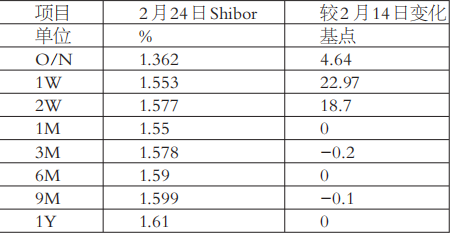
Group 1 - The core viewpoint of the article indicates that the money market interest rates are experiencing a "short-term rise and long-term stability" trend following the holiday period, driven by increased funding demand as businesses resume normal operations and the expiration of a large amount of reverse repos [1][3]. Group 2 - As of February 24, the Shanghai Interbank Offered Rate (Shibor) for overnight, 1-week, and 2-week periods reported at 1.362%, 1.553%, and 1.577% respectively, showing increases of 4.64, 22.97, and 18.7 basis points compared to February 14 [2]. - The 1-month, 6-month, and 1-year Shibor rates remained unchanged at 1.55%, 1.59%, and 1.61% respectively, while the 3-month and 9-month rates decreased slightly by 0.2 and 0.1 basis points [2]. Group 3 - A total of 852.4 billion yuan in reverse repos expired during the Spring Festival holiday, with an additional 800 billion yuan in 14-day reverse repos set to expire this week, indicating significant pressure for capital recovery in the market [3]. - The central bank conducted a reverse repo operation of 526 billion yuan on the first trading day after the holiday, and with 300 billion yuan in Medium-term Lending Facility (MLF) maturing this week, it is expected that the central bank will likely conduct an excess rollover to alleviate short-term funding tightness [3].
20260225申万期货品种策略日报-双焦(JM&J)-20260225
Shen Yin Wan Guo Qi Huo· 2026-02-25 02:34
Report Summary 1. Report Industry Investment Rating - No relevant information provided. 2. Core View - The main contracts of coking coal and coke showed a fluctuating trend in the night session yesterday. The total position of coking coal increased slightly month - on - month. Affected by the Spring Festival holiday, the output of clean coal from mines decreased slightly month - on - month, the import volume of Mongolian coal decreased from the high level but remained at the highest level in the same period. The supply pressure of coking coal has been relieved. The increase in molten iron output on the demand side was not obvious, and the output of downstream coke remained basically the same month - on - month, lacking obvious incremental demand. After the festival, with the resumption of work and production, there is an expectation of an increase in molten iron output, which will drive the improvement of the rigid demand for coking coal and coke and strongly support coal prices. In the future, attention should be paid to the trend of molten iron output, mine operation, and import - related policy trends [2]. 3. Summary by Relevant Catalogs Price and Volume Data of Coking Coal and Coke Futures Contracts - **Price Changes**: For coking coal, the previous day's closing prices of the 9 - month, 1 - month, and 5 - month contracts were 1365.5, 1101.5, and 1184.5 respectively, with changes of - 10.5, - 19.5, and - 17.0 compared to the day before, and price change rates of - 0.76%, - 1.74%, and - 1.41% respectively. For coke, the previous day's closing prices of the 9 - month, 1 - month, and 5 - month contracts were 1800.0, 1634.5, and 1706.5 respectively, with changes of - 40.0, - 47.5, and - 44.5 compared to the day before, and price change rates of - 2.17%, - 2.82%, and - 2.54% respectively [2]. - **Trading Volume and Open Interest**: The trading volumes of coking coal contracts for 9 - month, 1 - month, and 5 - month were 2201, 592026, and 39587 respectively, and the open interests were 9972, 468538, and 87519 respectively, with increases of 702, 56059, and 1720 respectively. The trading volumes of coke contracts for 9 - month, 1 - month, and 5 - month were 611, 19187, and 1014 respectively, and the open interests were 808, 39187, and 2307 respectively, with increases of 82, 3937, and 368 respectively [2]. - **Spread Data**: For coking coal, the current spreads of 1 - month minus 5 - month, 5 - month minus 9 - month, and 9 - month minus 1 - month were 240, - 79.5, and - 160.5 respectively, with changes of 306, 2.5, and - 308.5 respectively. For coke, the current spreads of 1 - month minus 5 - month, 5 - month minus 9 - month, and 9 - month minus 1 - month were 160.5, - 77.5, and - 83 respectively, with changes of 429.5, 2, and - 431.5 respectively [2]. Spot Price Data - The spot prices of Mongolian No. 5 primary coking coal (port self - pick - up price), low - sulfur primary coking coal (Linfen ex - factory price), low - sulfur primary coking coal (Taiyuan rail - side price), Tangshan Grade I coke (ex - factory price), Jinzhong quasi - Grade I coke (ex - factory price), and Rizhao Port quasi - Grade I coke (warehouse - out price) were 1227, 1570, 1391, 1852, 1330, and 1470 respectively, with no changes [2]. Macro - related Information - On February 24, the People's Bank of China announced that the one - year and five - year loan prime rates (LPR) remained unchanged at 3% and 3.5% respectively, for the ninth consecutive month. In addition, the central bank planned to conduct a 600 - billion - yuan MLF operation on February 25 with a term of 1 year, using the method of fixed - quantity, interest - rate tender, and multiple - price winning bids [2].
2月MLF续作加量3000亿,短期内降准的可能性较小
Sou Hu Cai Jing· 2026-02-24 12:34
Core Viewpoint - The People's Bank of China (PBOC) announced a 600 billion MLF operation to maintain liquidity in the banking system, indicating a continued supportive monetary policy stance amid potential tightening pressures [1][2]. Group 1: MLF Operations - On February 25, 2026, the PBOC will conduct a 600 billion MLF operation with a one-year term, marking the 12th consecutive month of increased MLF issuance [1]. - The MLF rollover in February is 300 billion, which is less than the previous month's 700 billion, indicating a smaller increase in liquidity [1]. Group 2: Liquidity and Economic Stability - The net liquidity injection in February reached 900 billion, continuing a trend of net injections for 10 months, although slightly lower than the previous month's 1 trillion [1]. - The increase in MLF and other liquidity measures aims to support major projects and stabilize macroeconomic operations, especially with the early issuance of local government bonds [1][2]. Group 3: Monetary Policy Implications - The significant increase in mid-term liquidity injections suggests a reduced likelihood of a reserve requirement ratio (RRR) cut in the short term, indicating a period of observation following the introduction of structural policies in January [2]. - The PBOC's actions are intended to counter potential liquidity tightening effects while ensuring stable funding for government bond issuance and maintaining credit support from banks [2].
央行宣布,6000亿元!
Zhong Guo Ji Jin Bao· 2026-02-24 12:25
Core Viewpoint - The People's Bank of China (PBOC) will conduct a 600 billion MLF operation to maintain liquidity in the banking system, marking the 12th consecutive month of increased MLF issuance [1][2]. Group 1: MLF Operations - On February 25, 2026, the PBOC will conduct a 600 billion yuan MLF operation with a one-year term, following the maturity of 300 billion yuan MLF in February, resulting in a net increase of 300 billion yuan [1]. - The total net liquidity injection for February, including 600 billion yuan from reverse repos, will reach 900 billion yuan, continuing a trend of high net liquidity injection for 10 consecutive months [1]. Group 2: Economic Analysis - Dong Ximiao, Chief Economist at Zhongan, indicates that February is a month with concentrated bank credit issuance, reflecting strong market demand for liquidity, exacerbated by the Spring Festival holiday and tax payment delays [1]. - Wang Qing, Chief Macro Analyst at Dongfang Jincheng, suggests that the PBOC's actions to increase MLF issuance signal a supportive monetary policy stance, reducing the likelihood of a rate cut in the short term [2]. - Continuous MLF and reverse repo operations by the PBOC are aimed at maintaining market liquidity and ensuring stable financial market operations at the year's end [2].
本周热点前瞻2026-02-24
Guo Tai Jun An Qi Huo· 2026-02-24 01:19
Report Summary 1. Report Industry Investment Rating No information provided. 2. Core Viewpoints - Trump's new import tariff increase and policy uncertainty boost the demand for precious metals as a hedge, which is conducive to the rise of precious metal futures prices [5][7] - If the US consumer confidence index in February is lower than the previous value, it will suppress the rise of non - ferrous metals, crude oil and related futures prices, but help the rise of precious metal futures prices [8] - If the initial jobless claims in the US for the week ending February 21 are slightly higher than the previous value, it will suppress the rise of commodity futures prices except for precious metals, but help the rise of precious metal futures prices [15] 3. Summary by Directory This Week's Key Focus - On February 24, 2026, the People's Bank of China will announce the LPR, with the 1 - year LPR expected to be 3.00% and the 5 - year - plus LPR expected to be 3.50%, both unchanged from the previous values [2][3] - Trump signed an executive order to impose a 10% ad - valorem import tariff on imported goods into the US starting from February 24, for 150 days, and later planned to raise it to 15% [2][5] - On February 25, the People's Bank of China will renew the MLF, with 300 billion yuan of MLF maturing on that day [10] - On February 27, the US Bureau of Labor Statistics will announce the US January PPI [2][16] - On February 28, the National Bureau of Statistics will announce the 2025 National Economic and Social Development Statistical Bulletin [2][19] This Week's Hotspot Preview February 24 - The People's Bank of China will announce the February LPR, with expected values unchanged from the previous ones [3] - The National Bureau of Statistics will announce the prices of important production materials in the circulation field in mid - February [4] - Trump's new import tariff increase and subsequent plan to raise it to 15% will increase the demand for precious metals as a hedge [5][7] - The US Conference Board will announce the February consumer confidence index, with an expected value of 83, lower than the previous value of 84.5 [8] - Trump will deliver the State of the Union address [9] February 25 - The People's Bank of China will renew the MLF, and the specific operation amount will be determined according to market demand [10] - The German Statistics Office will announce the revised GDP of the fourth quarter of 2025, with expected quarter - on - quarter and year - on - year growth rates [11] - The EU Statistics Office will announce the final value of the eurozone's January CPI, with expected year - on - year rates [12] - The EIA will announce the change in US EIA crude oil inventories for the week ending February 20. A continued decline will help the rise of crude oil and related commodity futures [13] February 26 - The EU Statistics Office will announce the eurozone's February economic and industrial景气指数, with expected values [14] - The US Department of Labor will announce the initial jobless claims for the week ending February 21, with an expected value of 216,000, higher than the previous value [15] February 27 - The US Bureau of Labor Statistics will announce the US January PPI, with expected year - on - year and month - on - month rates [16] - The Chicago branch of the Institute for Supply Management will announce the US February Chicago PMI, with an expected value of 52.5, lower than the previous value [18] February 28 - The National Bureau of Statistics will announce the 2025 National Economic and Social Development Statistical Bulletin, and attention should be paid to its impact on relevant futures prices [19] March 1 - OPEC+ eight oil - producing countries will hold a monthly meeting on oil - production policies, and the decision on whether to resume production increase from April will affect crude oil and related futures prices [20]
央行开展万亿元买断式逆回购 连续多月加量续作
Sou Hu Cai Jing· 2026-02-13 03:07
Group 1 - The central bank conducted a 1 trillion yuan reverse repurchase operation with a six-month term to maintain liquidity in the banking system, marking a continuation of its supportive monetary policy stance [1] - In February, the central bank increased the scale of the six-month reverse repurchase operation by 200 billion yuan compared to the previous month, indicating a proactive approach to ensure sufficient liquidity [1] - The central bank has been consistently increasing the scale of reverse repurchase operations for six consecutive months, reflecting a commitment to support economic recovery and stabilize the financial market [1] Group 2 - The central bank is expected to utilize both reverse repurchase and medium-term lending facility (MLF) tools to inject liquidity into the market, maintaining an "appropriately loose" monetary policy in 2026 [2] - The increase in net reverse repurchase operations in February suggests a reduced likelihood of a reserve requirement ratio cut in the near term, as the monetary policy enters an observation phase following structural policy measures introduced in January [2]