
主权信用风险溢价

Search documents
央行连续14个月增持黄金,背后信号很大
2 1 Shi Ji Jing Ji Bao Dao· 2026-01-07 11:27
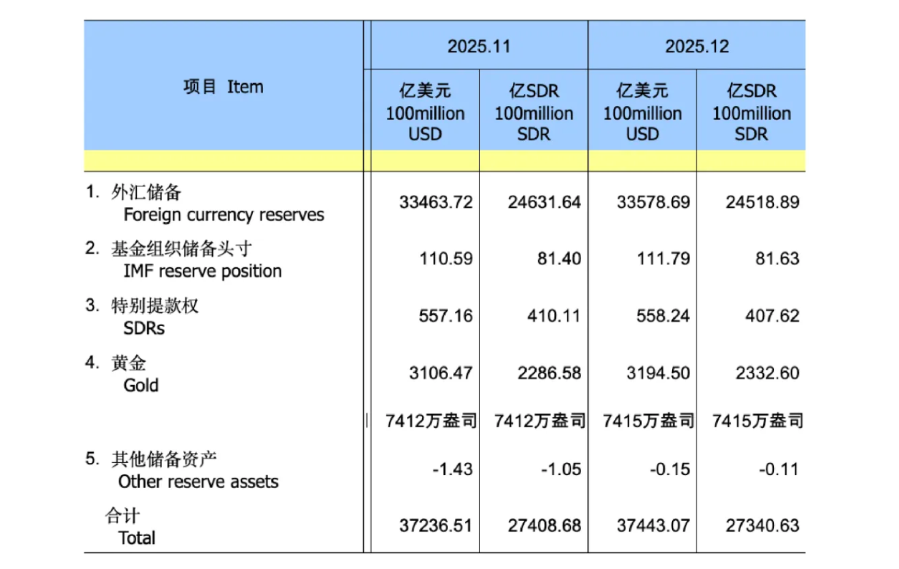
Group 1 - The central bank has increased its gold reserves to 74.15 million ounces as of December 2025, marking a continuous increase for 14 months since November 2024 [1][2] - The increase in gold holdings is attributed to changes in the global political and economic landscape, leading to a potential long-term rise in international gold prices [1][3] - The World Gold Council forecasts a 15% to 30% increase in gold prices in 2026, driven by investment demand, particularly through gold ETFs, despite weak demand from jewelry and technology sectors [3][8] Group 2 - In 2025, gold prices surged from $1,826 per ounce to around $4,460, with a peak of $4,550, resulting in a more than 60% increase, the highest annual gain in 46 years [3][6] - Analysts predict that the structural bull market for gold remains solid, with potential price fluctuations due to technical factors, but long-term value is expected to rise amid global economic uncertainties [6][7] - Major investment banks, including Bank of America and Goldman Sachs, project gold prices to reach between $4,900 and $5,000 per ounce in 2026, emphasizing the importance of gold as a hedge in investment portfolios [7][8]

央行连续14个月增持黄金,背后信号很大
21世纪经济报道· 2026-01-07 11:15
Core Viewpoint - The central theme of the articles revolves around the continuous increase in gold reserves by central banks, particularly in China, and the optimistic outlook for gold prices in 2026, driven by various macroeconomic factors and investment demand [1][4][10]. Group 1: Central Bank Gold Reserves - As of December 2025, the central bank holds 74.15 million ounces of gold, an increase of 30,000 ounces from the previous month, marking 14 consecutive months of gold accumulation since November 2024 [1][2]. - The increase in gold reserves is attributed to changes in the global political and economic landscape, leading to a decreased necessity to pause gold purchases for cost control and an increased necessity for optimizing international reserve structures [1] Group 2: Gold Price Trends - The World Gold Council reports that gold prices have shown remarkable performance in 2025, with expectations of a further increase of 15% to 30% in 2026 [4]. - Gold prices opened at $1,826 per ounce in 2023 and have surged to around $4,460 per ounce, with a peak of $4,550 per ounce, reflecting a more than 60% increase over the past year, the largest annual gain in 46 years [4][10]. - Analysts predict that despite potential short-term corrections, the structural bull market for gold remains solid, supported by ongoing fiscal expansion and strategic gold accumulation by central banks [9][11]. Group 3: Investment Demand and Market Dynamics - Investment demand, particularly through gold ETFs, is expected to play a crucial role in driving gold prices, offsetting weaker demand from jewelry and technology sectors [4]. - The report indicates that a 14% increase in investment demand could push gold prices to $5,000 per ounce, while a 55% increase could potentially reach $8,000 per ounce [10]. - The current market environment, characterized by high debt levels and policy uncertainty, continues to favor gold as a hedge, with recommendations for investors to increase their gold allocation in portfolios [10][11].
速看!央行连续14个月增持黄金
2 1 Shi Ji Jing Ji Bao Dao· 2026-01-07 10:20
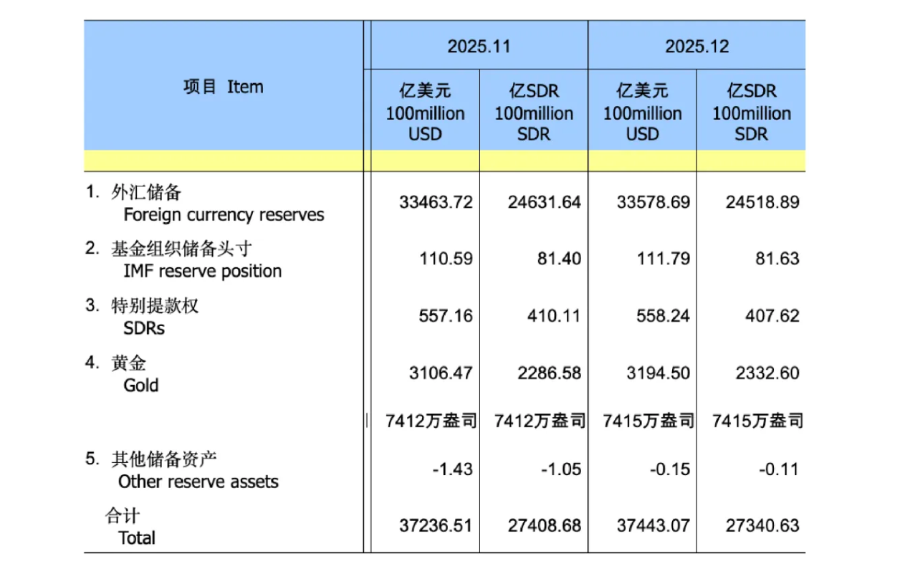
Core Viewpoint - The central theme of the news is the continuous increase in gold reserves by the central bank, driven by changing global political and economic conditions, suggesting a long-term bullish outlook for gold prices [1][4]. Group 1: Central Bank Gold Reserves - As of December 2025, the central bank holds 74.15 million ounces of gold, an increase of 30,000 ounces from the previous month, marking 14 consecutive months of gold accumulation since November 2024 [1][2]. - The total value of gold reserves increased from approximately 3106.47 billion USD in November 2025 to 3194.50 billion USD in December 2025 [2]. Group 2: Gold Price Trends - Gold prices have surged from 1826 USD/ounce at the beginning of 2023 to around 4460 USD/ounce, with a peak of 4549.52 USD/ounce, reflecting a more than 60% increase over the past year [4][8]. - The World Gold Council forecasts a potential further increase in gold prices by 15% to 30% in 2026, driven by investment demand, particularly through gold ETFs [4]. Group 3: Market Analysis and Predictions - Analysts from Guojin Securities indicate that despite a potential slowdown in central bank gold purchases in 2025, speculative funds are expected to drive gold prices higher, with a structural bull market foundation remaining solid into 2026 [6][7]. - International banks, including Bank of America and Societe Generale, predict that gold prices could reach between 4900 USD and 5000 USD per ounce by the end of 2026, emphasizing the importance of gold as a hedge in investment portfolios [8][9].
黄金市场的地位演变与战略机遇
An Liang Qi Huo· 2026-01-07 01:51
Group 1: Report Industry Investment Rating - Not provided in the content Group 2: Core Views of the Report - In 2025, the gold market witnessed a historic rally due to multiple structural factors, with international gold prices hitting record highs and cumulative gains exceeding 70%. The driving logic shifted from the traditional "real - interest - rate negative correlation" to the dual drivers of "sovereign credit risk premium" and "global monetary system fragmentation" [2]. - In 2026, the structural bull market for gold remains solid. Despite short - term callback pressure, the long - term allocation value of gold is prominent. Gold prices are likely to remain high and volatile, with higher volatility than in 2025. Opportunities for professional investors lie in cross - market arbitrage and volatility trading [3]. - The gold market's pricing paradigm is undergoing a profound transformation, from being dominated by real interest rates to being driven by fiscal sustainability, dollar - credit premium, and global monetary system reconstruction [61]. Group 3: Summary by Relevant Catalog 1. 2025 Gold Market Panorama Review International Market Performance - The international gold price in 2025 went through three stages: "expectation correction, main - uptrend acceleration, and high - level consolidation". The core driving force shifted from traditional interest - rate games to the re - evaluation of the global credit system and strategic asset allocation [5]. - In Q1, gold played the role of a "stabilizer" in the portfolio. Despite geopolitical risks, strong US economic data led to doubts about the Fed's rate - cut timing and amplitude, causing gold price fluctuations. Gold prices rose nearly 25% in the first half of 2025 [6]. - From late April to Q3, the driving logic switched. The Fed's dovish signals and rate cuts, explosive growth in investment demand (global gold investment demand in Q3 reached 537 tons, a 47% year - on - year increase), and deepening geopolitical and credit concerns drove the main uptrend [7]. - In Q4, gold price volatility increased. Profit - taking, short - term liquidity changes, central - bank gold purchases, new market forces, and the FOMO sentiment in the precious - metal sector all contributed to the high - level fluctuations [8][9]. Domestic Market Performance - The domestic gold market in 2025 showed a pattern of "new price highs, hot investment but cold consumption, and a more in - depth market". Domestic gold prices were highly synchronized with international prices [10][11]. - In terms of structured demand, high gold prices led to a significant difference between investment and consumption demand. Gold jewelry consumption declined, while investment in gold bars, coins, and ETFs showed different trends [13][14]. - Market activity increased significantly in 2025. The trading volume of the domestic gold spot and futures markets soared, and the internationalization of the domestic gold market advanced. The Shanghai Gold Exchange launched an international - board contract in Hong Kong [16]. - The RMB exchange rate in 2025 provided a buffer for domestic gold prices. Exchange - rate fluctuations affected the performance of RMB - denominated gold and created differences between domestic and international gold price trends [17]. - The spread between domestic and international gold prices fluctuated in 2025, providing arbitrage opportunities but also increasing risks. The spread was driven by short - term supply - demand imbalances, exchange - rate expectations, capital flows, market sentiment, and policy events [20][21]. - In 2025, a new gold - tax policy was implemented, which had a profound impact on the Chinese gold market. It differentiated the VAT treatment of investment and non - investment gold, guiding the market towards a more standardized and transparent stage [23][25][26]. 2. 2025 Core Driving Factor Analysis Macro Level - The Fed's "preventative cuts" in 2025 led to a "rate - logic failure" phenomenon, indicating a fundamental shift in the core driving logic of gold prices [29]. - The market's focus shifted from interest - rate levels to the deteriorating US fiscal sustainability, leading to a "credit - anchor migration" and a change in the gold - price driving logic from "against high interest rates" to "against credit dilution" [31]. Risk Premium Level - Geopolitical events in 2025 had a complex impact on gold prices. While single events might have a short - term and pulsed impact, they also raised the gold - pricing center as a long - term "background noise" and a structural call option [34][37]. - In 2025, the gold - silver ratio decreased significantly, and the gold - copper ratio reached a historical high. These changes reflected complex macro - narratives and market - structure changes, such as inflation expectations and differences in the driving logic of different commodities [39][42]. Structural Supply - Demand Level - Global central banks became important buyers in the gold market in 2025. Their gold - buying behavior was strategic, and the future potential for central - bank gold allocation in China is large [44]. - In 2025, there was a large - scale cross - ocean flow of physical gold between the New York (COMEX) and London (LME) markets. This flow was driven by arbitrage and policy - risk avoidance. It affected the inventory distribution, liquidity structure, and price - discovery mechanism of the gold market [47][48][55]. 3. 2026 Outlook Key Time Nodes and Event Deduction in 2026 - In Q1 2026, the US debt - ceiling negotiation may cause short - term market volatility and trigger a re - evaluation of the dollar's credit. The outcome of the negotiation will affect the gold - price trend [57]. - In Q2 2026, the Fed's mid - term inflation assessment will determine the market's trading narrative. Different inflation scenarios will have different impacts on gold prices [57]. - In Q3 2026, the BRICS summit may promote the internationalization of the gold monetary role. Positive signals from the summit will provide long - term support for gold prices [59]. - In Q4 2026, the US mid - term elections will affect future fiscal policies. Different policy expectations will have different impacts on gold prices [59]. Short - Term Volatility Risks - Uncertainty in the Fed's policy pace may suppress gold prices in the short term if inflation is反复 [63]. - Crowded trading structures and changes in market sentiment may lead to a 10% - 15% technical correction in gold prices [63][64]. 4. Investment Strategy Recommendations - For most investors, it is recommended to establish a core position with physical gold or gold - related financial products through a regular - investment approach to achieve long - term asset allocation [65]. - For professional and qualified investors, futures contracts can be used as tactical tools for enhanced strategies, risk management, and capturing structural opportunities such as cross - period and cross - market arbitrage [65][66].